



Click covers for info. Copyright (C) Rudy Rucker 2021.

Archive for the ‘Rudy’s Blog’ Category

Italy 3. Florence.

Monday, November 25th, 2019

Continuing my Italy posts here. #1 was Pisa, #2 was mostly Lucca (plus an intro to The Matrix), this #3 is Florence, and there’s a #4 of Genoa.

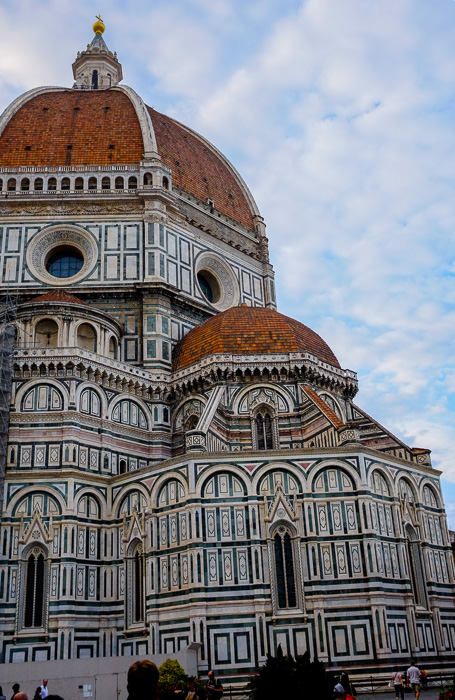
The Duomo, the cathedral at the heart of Florence, made of multi-colored stone, like a huge confection, massive yet weightless, like a thought made solid. After doing the outside, the builders were perhaps worn out, and the inside is very simple, almost stark.

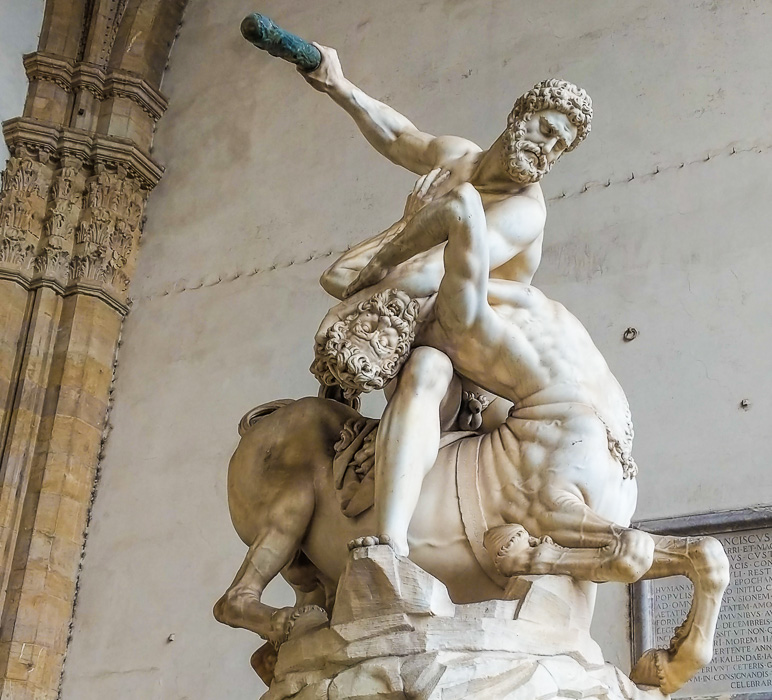
There’s a plaza in Florence near the Medici Palazzo, with an outdoor array of large marble statues. I’m always amazed how fleshy the marble becomes, how doughy. Here’s Hercules beating the living shit out of a centaur. They say the Florentines and Medici were fairly warlike.

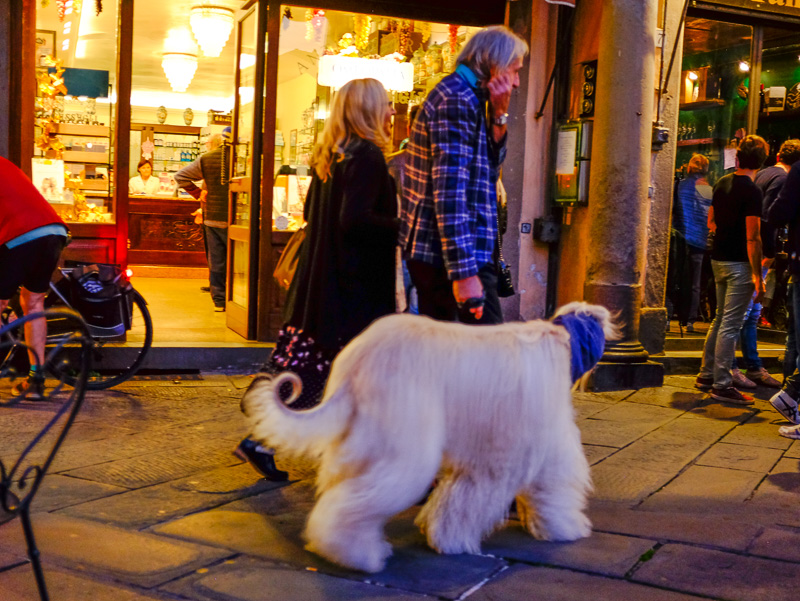
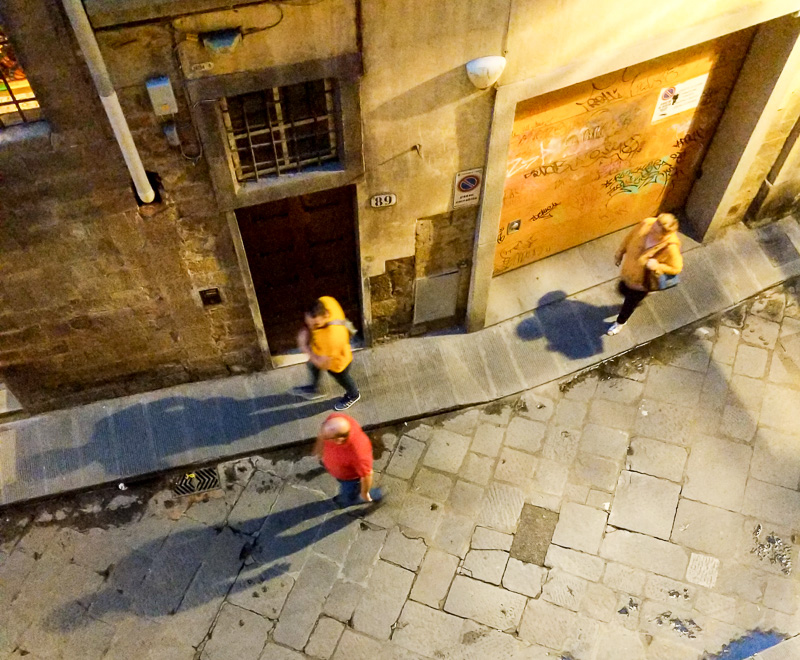
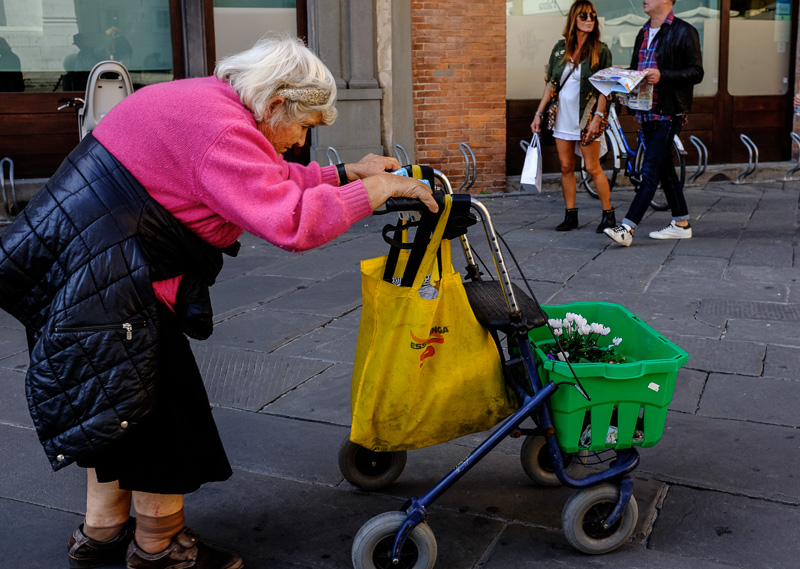
In the evening everyone goes out and walks up and down the streets. This shot is actually in Lucca. I love this old couple with their Afghan hound.

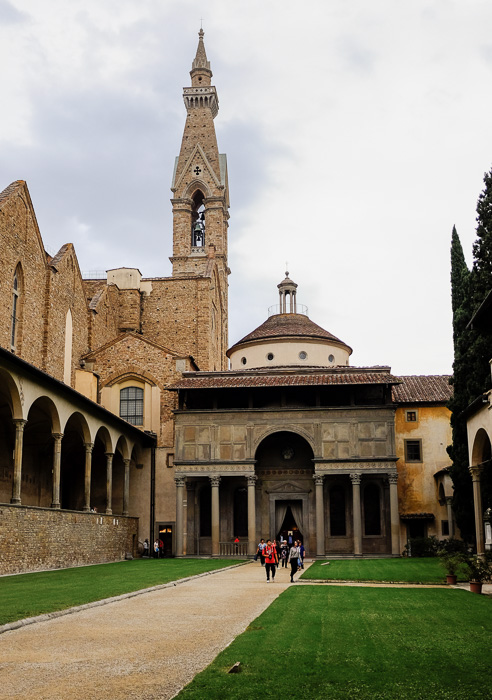
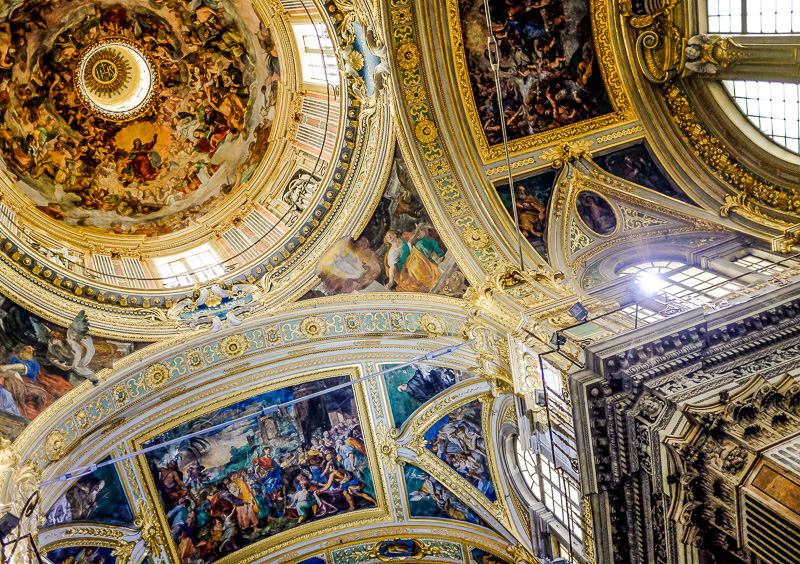
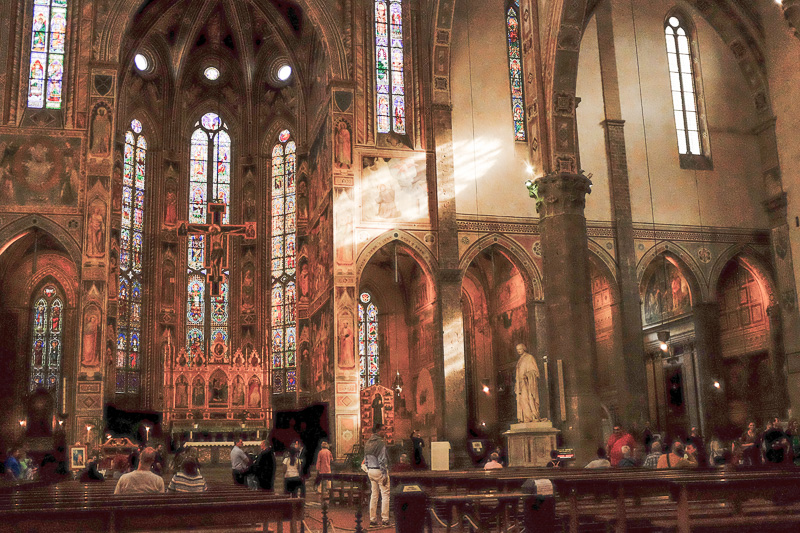
Wonderful light in the Florentine Basilica di Santa Croce. Seems like in the Middle Ages and the Renaissance, the churches were, like, the big art-form, the museums, the gathering places, the meditation halls, the houses of worship.

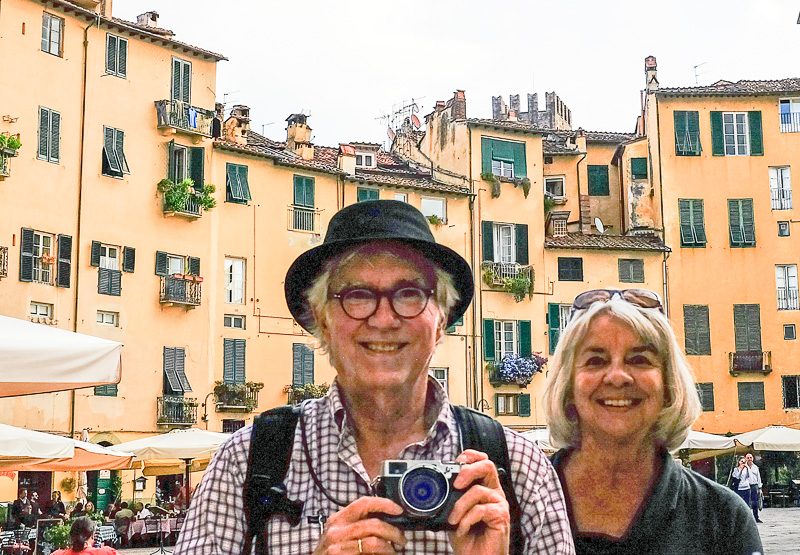
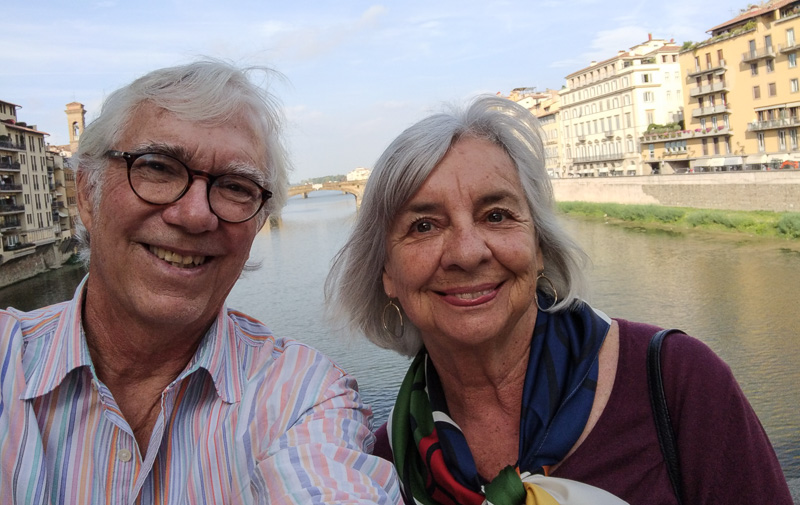
Sylvia and me on the Ponte Vecchio, the Old Bridge. It has shops on it, classy jewelry stores, not T-shirt stands.

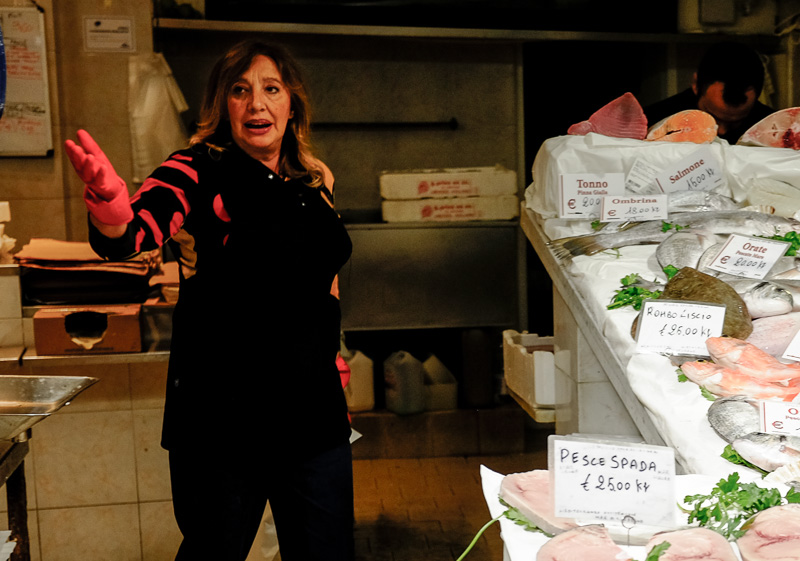
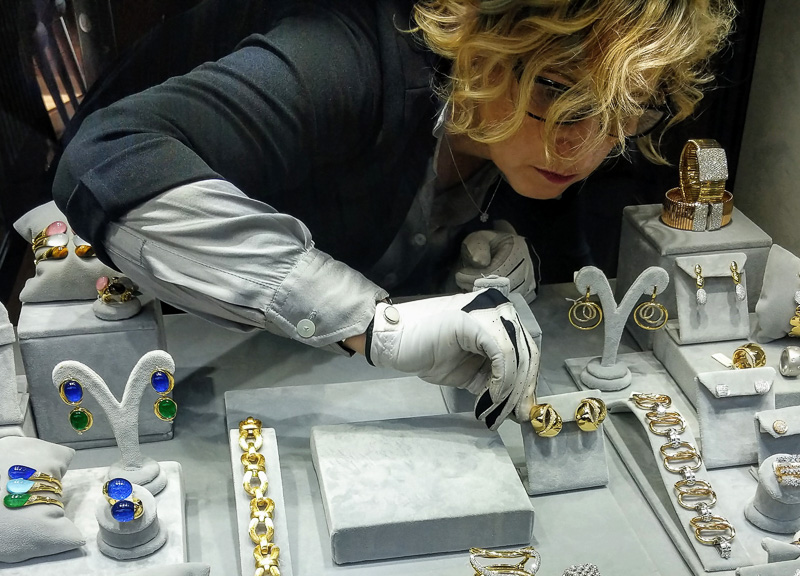
Love this woman arranging one of the Ponte Vecchio windows, with her leather gloves matching the window’s decor.

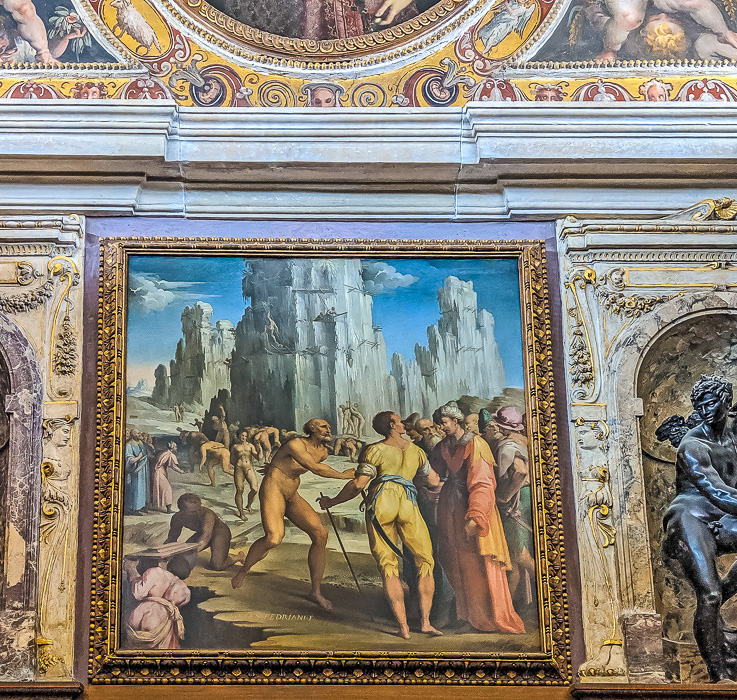
In the Palazzo Medici, they have a small side room that was a miniature personal art gallery for one of the Dukes. The Studiola of Francesco I. No widows, the size of a narrow bedroom, the walls and calling divided up into panels with a different painting on every panel, done by a variety of Renaissance painters from around Florence. In the original installation, each panel on the walls was in fact a cabinet door, generally with some treasure or curiosity stashed in the cabinet, and the object was often connected to the nature of the painting on the cabinet door. Francesco would hang out in there; it was right off his bedroom. Like sitting down with your lap top. You go in there and browse and ponder.

The image shown here is of Diamond Mines.

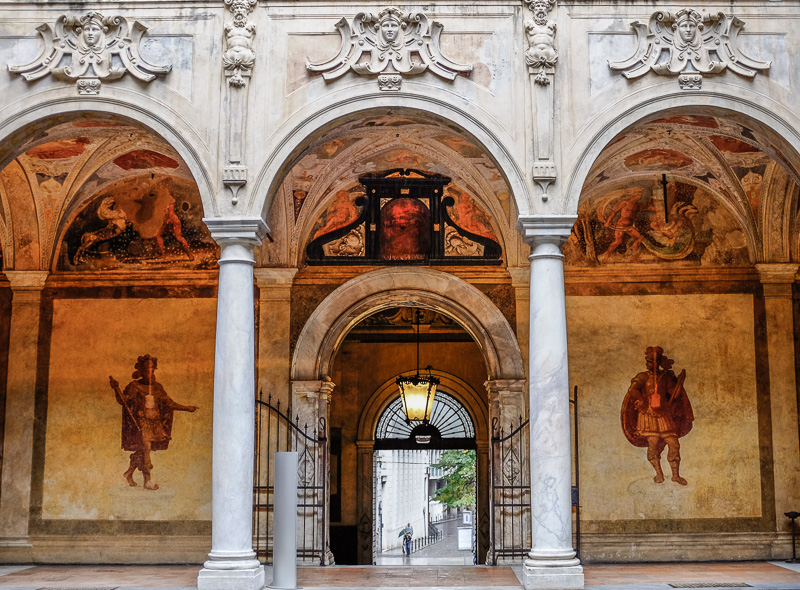
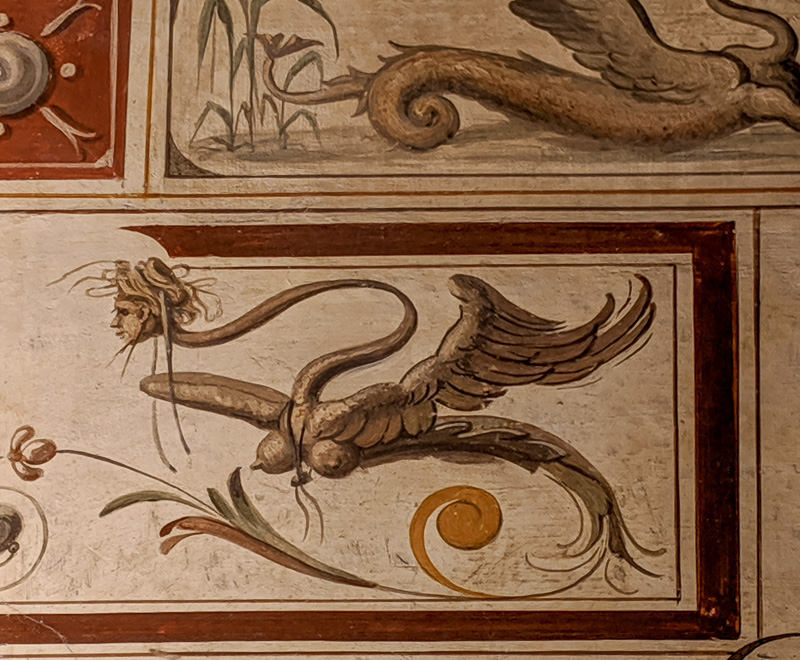
Wall decoration in that Palazzo Medici, it’s a huge square building by the sculpture plaza, like I said. This is a harpy, from the Odyssey, I think. Love the graceful curves of the lines.

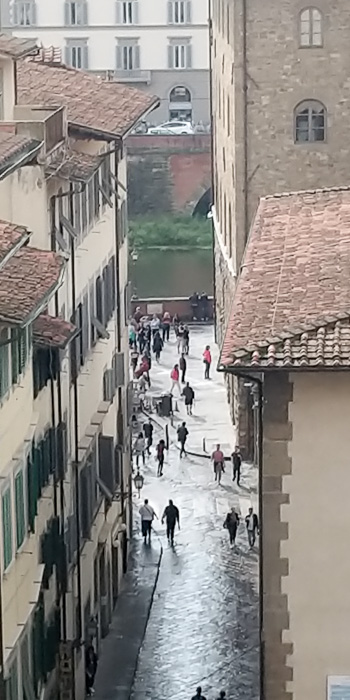
View out the Palazzo window, a bit of rain, the tourists. Not too many of us in October, but still plenty. We didn’t even try to go to the Uffizi Gallery, the main art museum, where Venus on the Half-Shell lives.

They have this cut of meat called Florentine beef or steak. Bruce Sterling ate one while we were with him, it weighed maybe a pound or a pound and a half. I got to gnaw the bone (kind of symoblic of our careers) …tenderest beef ever. The deal is that they age the beef for a month in a cooler, on display in the restaurant or on the street, and as the weeks go by, the big old chunks of beef migrate downward from the top shelf, level by level, and when they’re at the bottom, and kind of black on the outside, then they’re ready.

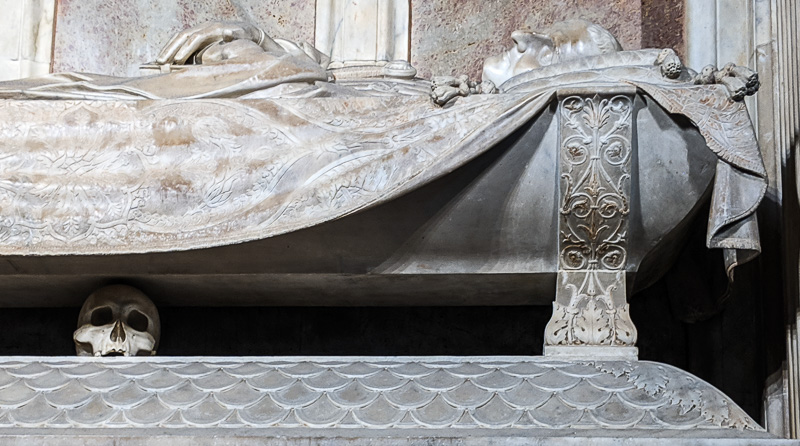
I loved these mausoleums where the person is in a stone bathtub and there’s an eternal stone mourner.

Went to a wonderful little medieval monastery that was decorated by Fra Angelico. About fifty monk cubicles with a mural in each of them. So insane, being in a bare room week after week with a painting of the crucifixion or some such. It struck me more heavily than ever what an insane religion Christianity is. Certainly the moral teachings are most admirable but…living in a cell with no company other than a painting of guy being tortured to death on a cross. Odd. This one here is an extra painting by Fra Angelico, not a mural, a monk saying Shhhh.

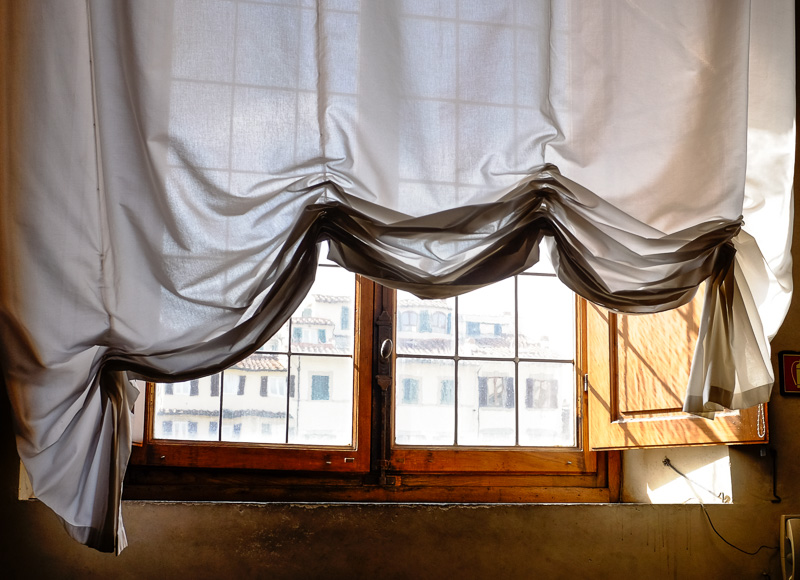
We hit the Galileo Science Museum, kind of interesting, with old mechanical science instruments. Hot in there with our unfolding climate change. Sat by the window for awhile, taking in the breeze off the Arno, enjoying the swaggy sags of the curtains. Note that in Europe they tend to have windows in public places that…open.

Science on parade!

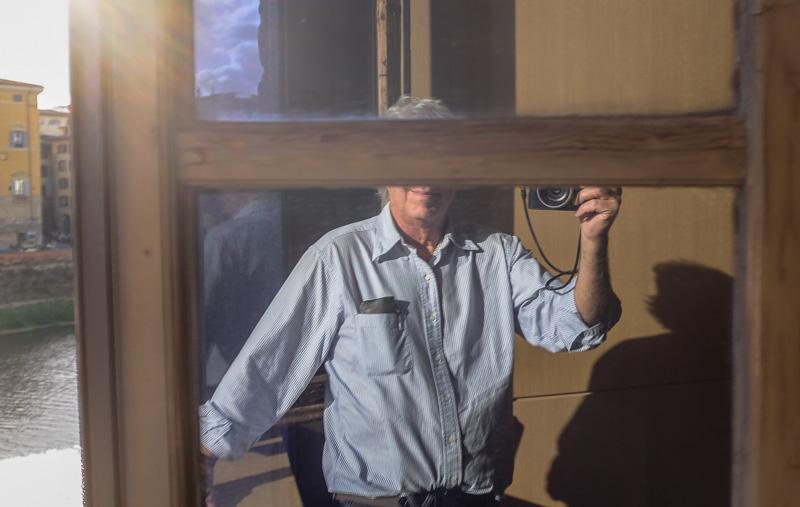
Portrait of the artist as a blank.

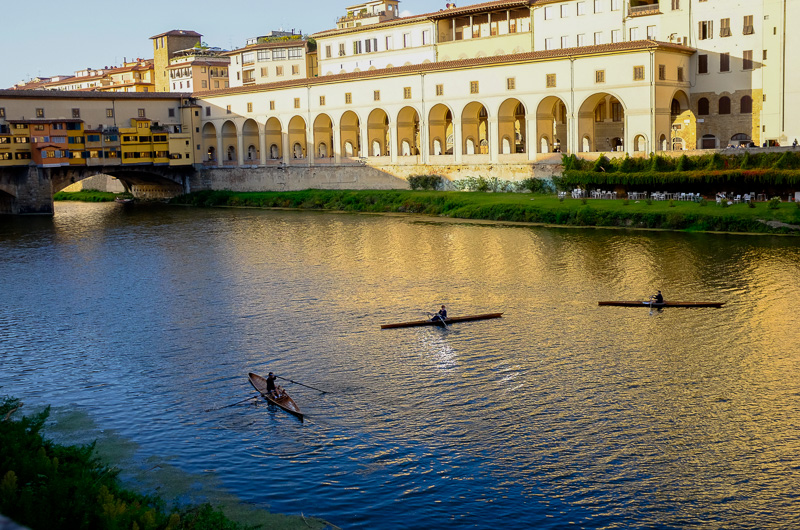
Scullers by the Ponte Vecchio. Lovely skies, soft clouds, wonderful old buildings reflected, pink and yellow.

Detail of the weirdest of Fran Angelico’s monk-chamber murals. This is the Scorning of Christ before the Crucifixion, with the Roman guards spitting on Him and striking Him. In His sensorium, only the hands or heads of the guards are present. Cool phenomenological shorthand.
t

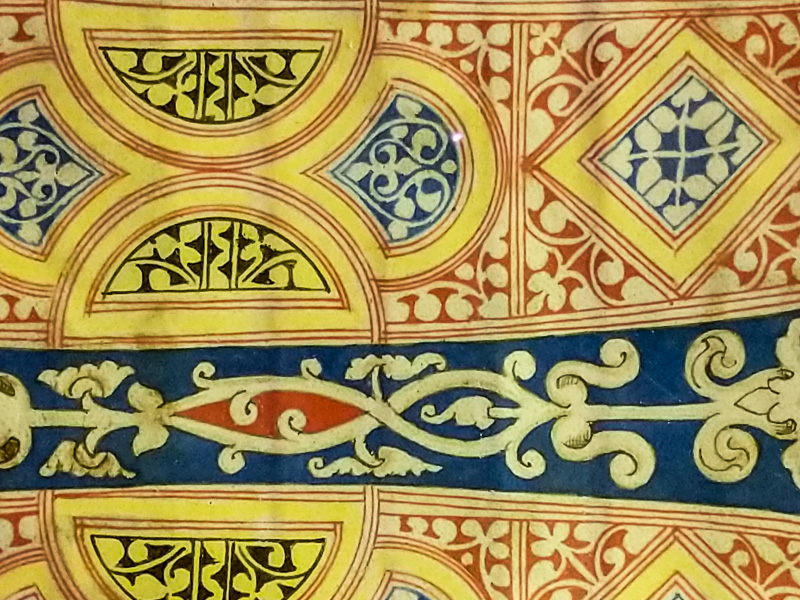
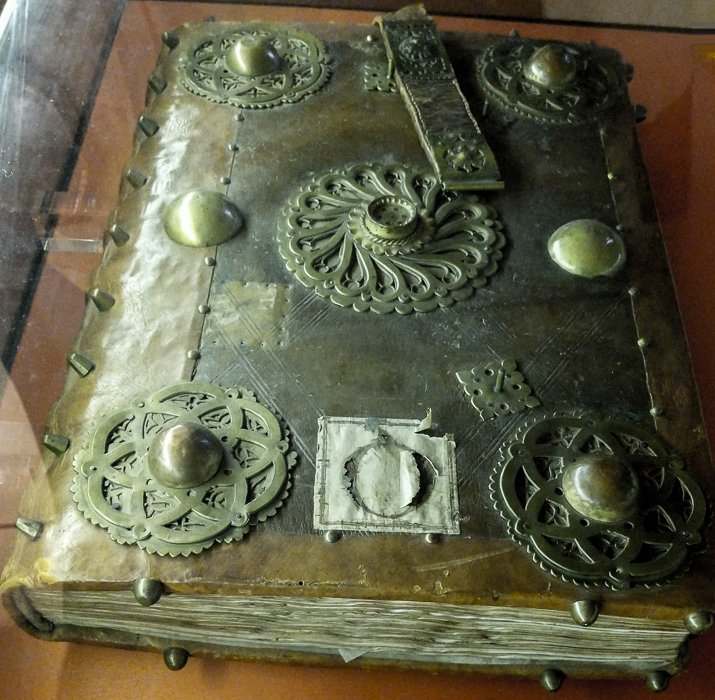
The monastery had some medieval books with those great hand-done “illuminations” of the pages. Love this one, the protractor-like shapes. the wiggly efflorescenses.

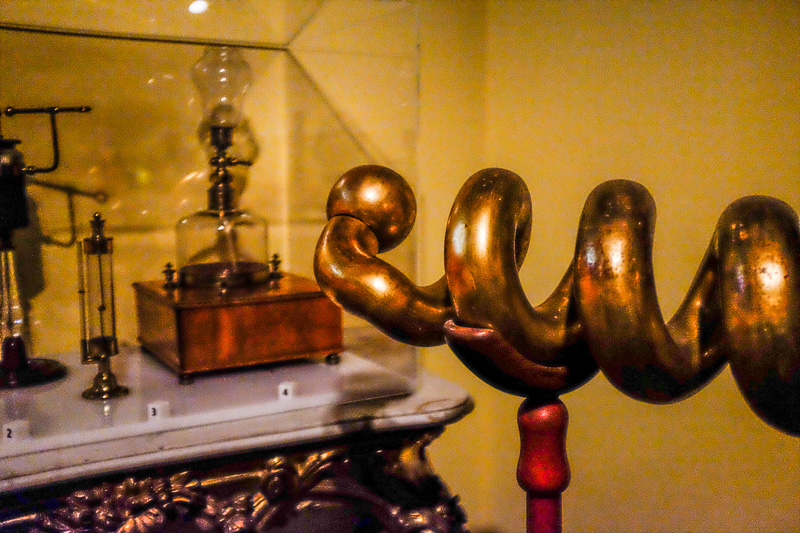
A sundial pocket watch in the Galileo Museum. The deal with a sundial is that it’s only accurate if you hold it in the right orientation vis-a-vis the direction of North. So you build a compass into it as well. Kind of like pushing your outmoded tech beyond practicality. It’s how chips are going to look to us in fifty years, when quantum computation, biocomputation, and the chaotic computations of matter have changed the game. Cf. my tome The Lifebox, the Seashell, and the Soul.

Copy of my book shown above in original binding.

We hated to leave Firenze! And our cozy room at Hotel Silla with the alley view on the quiet side of the Arno. Love those little streets, and the human ehcoes of voices.

Italy 2. “Intro to The Matrix.” Photos of Lucca.

Saturday, November 23rd, 2019

This is a little intro talk I gave before a showing of The Matrix  at the Pisa Internet Festival, October 11, 2019. I’ve illustrated this blog post with photos mostly taken in Lucca, a very nice town near Pisa. I’ll have 4 Italy posts in all.  #1 is Pisa,  this is #2 Lucca, #3 is Florence, and there’s a #4 of Genoa.


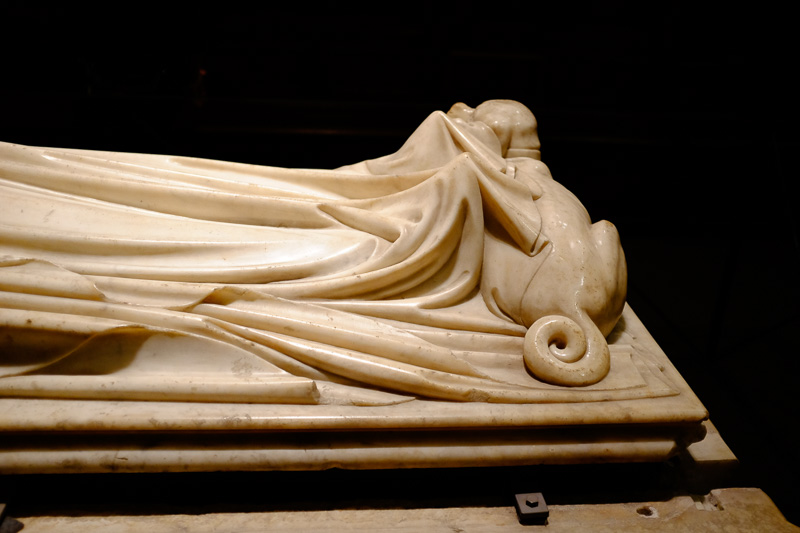
[Marble dog footrest for eternity.  Love how smooth the stone is.  Saw this in Lucca.]

Rudy to the audience in the theater about to see The Matrix:

It’s exciting to be in Pisa, the home of the 12th century mathematician Fibonacci, and of their 21st century Internet Festival.


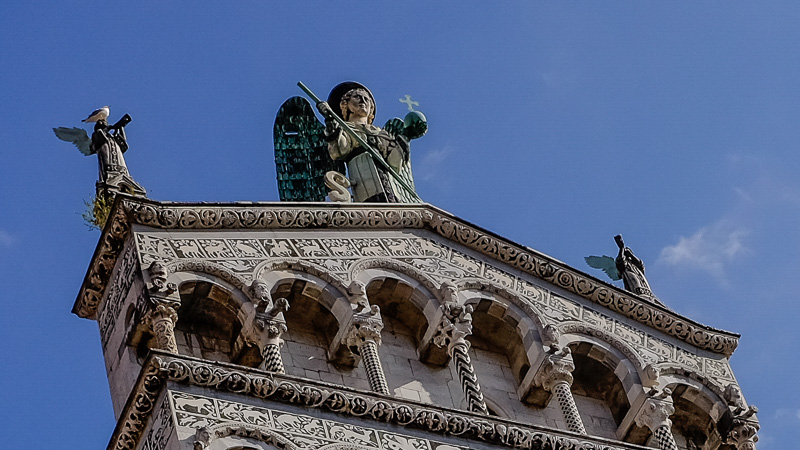
[The Archangel Michael in Lucca.  “He knows if you’ve been good or bad!”]

I’m a cyberpunk science fiction writer and a professor of computer science. In the 1990s I worked in a lab at Autodesk programming and designing early VR demos. Much of my novel The Hacker and the Ants is set in VR.

This morning I tried out the Apollo 11 virtual reality experience on display at the Pisa Internet Festival. I maneuvered myself so I was standing inside the hollow shell of Neil Armstrong’s body, guiding the Lunar Module towards a landing in the Sea of Tranquility.

It was viscerally engaging—we don’t actually require all that many cues to feel like something is real. But, as often happens with VR, it was a little lacking on details. The lunar surface was simply an unchanging 2D photo that got fuzzier as we approached it. Neil’s skin was smooth, like a mannequin’s. The dials on the control panel were static.

And by the end I had a bit of VR nausea, a condition induced by the mismatch between the fake and the real.


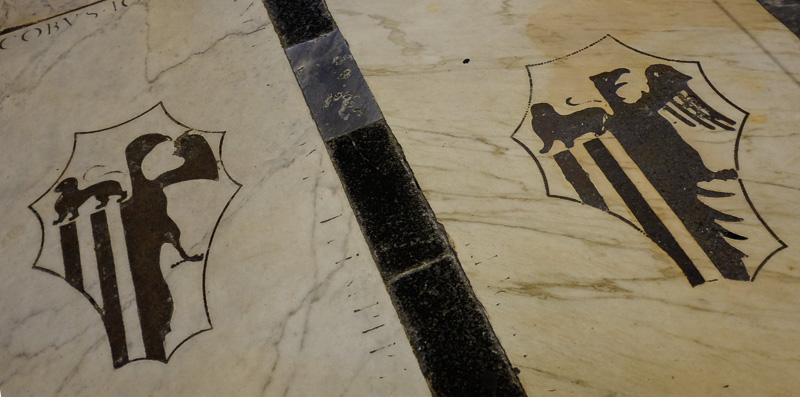
[They couldn’t cut and paste. so each time the the coat of arms was a little different.  I like that.]

I’m here tonight to give a brief introduction to the classic VR move, The Matrix. I like the movie—it has good characters, and the CG effects are great. But I’ve always been a bit dissatisfied with the ideas underlying the movie. Maybe I’m just jealous that Hollywood still hasn’t filmed any of my twenty SF novels. But I do want to mention three of problems I have with The Matrix.


[The main “square” of Lucca is a big ellipse.]

(1) The movie’s premise is that there could be a computer-generated reality that’s indistinguishable from our own. For whatever reason, many people today believe this , and some go far as to propose that the seemingly real world around us is itself a simulation.


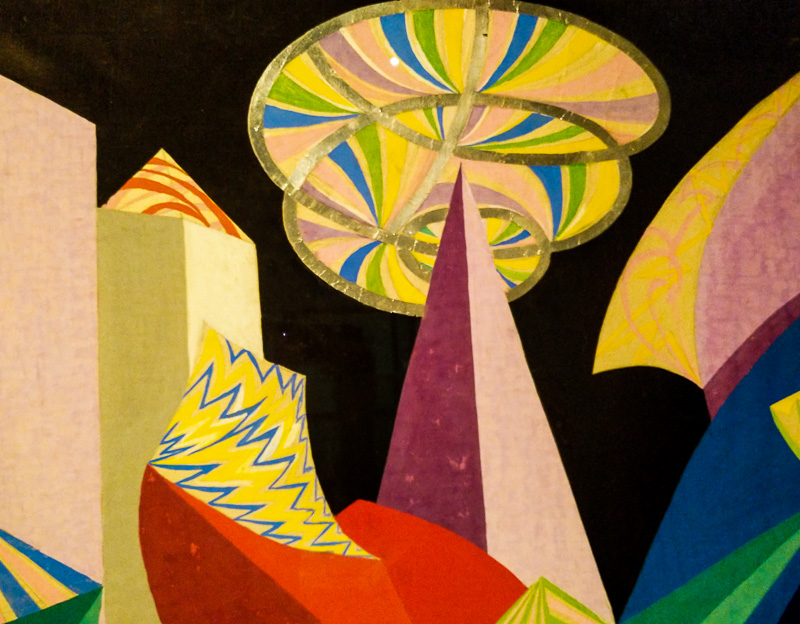
[Futurist painting of fireworks by, I think, Balla.]

Why would people want to think this? Perhaps it’s a Stockholm syndrome, and by this I mean a condition where prisoners of war begin to love and even worship their captors. Computers and the internet bully and parasitize us on every side. We’re obsessively addicted to our smart phones, with the social, the photos, the search, the music, the maps—tiny cornucopias, alluring sirens of the info sea. Hopeless and powerless in our cyberprison, we surrener and accept the computers as our lords—and go so far as to think the Supreme Being who creates our world is itself a digital program.


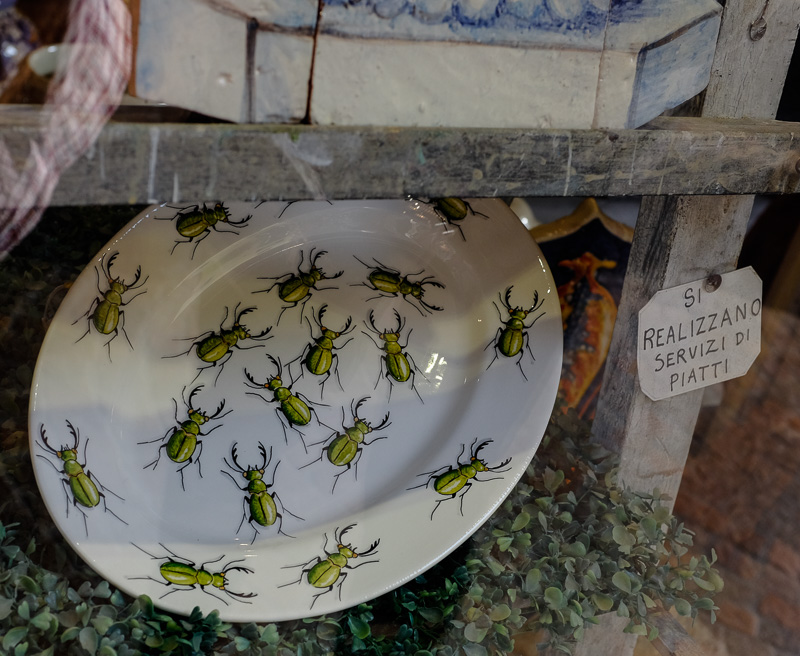
[I wish we had this beetle platter that we saw in Lucca.]

As a nature-lover and as a computer scientist, I know this idea is false. It’s phenomenologically clear that our reality is immensely richer than any possible simulation. You notice the deep fabric of reality whenever you take the trouble to leave your screens and go outdoors and observe, say, fluttering leaves, clouds in the sky, breaking waves, rain drops in puddles, people’s faces, the folds in clothing, the motions of crowds, the sounds of mingled voices in a piazza. Or pick up a dead stick in the garden, and peel off some bark, and observe the tiny creatures living there, and consider the fact that still tinier creature live within the guts of these mites. Look at the cracks in the wood, and the bits of fungus. God has a very big budget.


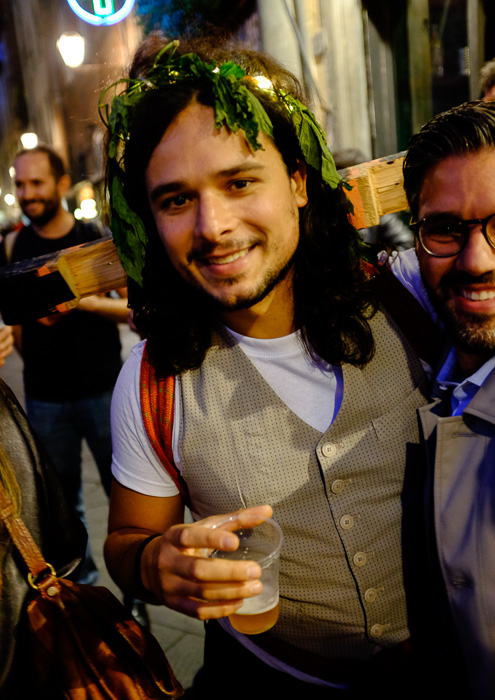
[This guy was celebrating with his friends outside a bar on a pedestrian street in Lucca. You can’t quite see in the photo, but he had a wooden cricifix strapped to his back.  I asked him, “Are you getting married tomorrow?” His answer: “No! Today is my 33rd birthday.” And Jesus was 33 when he went on the cross.]

Another thing regarding the physical world is that natural processes don’t repeat themselves. You never step into the same river twice. The modern notion of chaos expresses this by saying that, although the world unfolds according to natural laws, physical processes are inherently unpredictable. This means there is no shortcut formula to predict what a wave will look like, or precisely how many times a quaking leaf will wobble in the next five minutes.


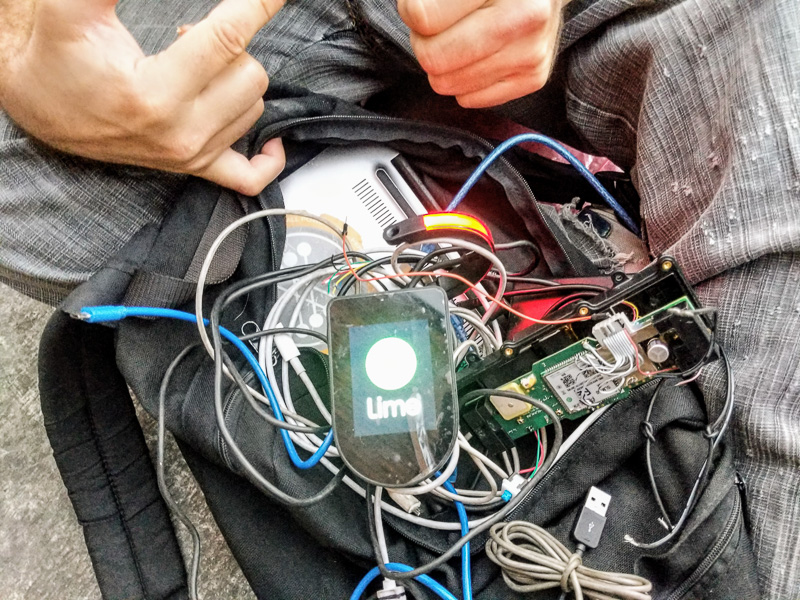
[In San Francisco, a young hacker friend of mine took apart a rental scooter so he could pwn it and use it for free.  While disconnected, the scooter’s chip was screaming, “I can’t feel my wheels!  I can’t feel my wheels!” ]

And understand that what I’m saying is not just an opinion—it’s a very nearly a theorem proved in theoretical computer science. I discussed this over a decade ago in my blog post, “Fundamental Limits to Virtual Reality.” The point, is that no cheesy, dipshit computer chip is going to crank out a precise emulation of our world. Not even if the cheesy, dipshit chip is the size of the solar system. Strict mathematical logic shows, in fact, that the only physical system that can emulate our universe is—our universe itself.


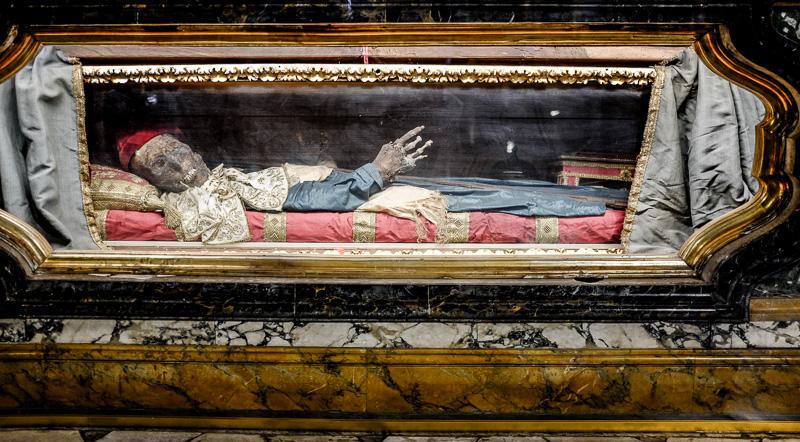
[Unbelievably gnarly mummified Saint in Michael’s Church in Lucca. He was called The Armenian.]

A lawn of grass blades is, if you will, a physical computer that emulates a lawn of grass blades. Using quantum computation, if you will, and running at the maximum possible speed, and with an octillion atoms in play. That’s what it takes.


[Talk about recycling!  Spread over five centuries…]

Okay, okay, I don’t want to be a bring-down, I don’t want to harsh your vibe. But I said I have three bones to pick with The Matrix.  Here’s the second and third…both are small points, but they bother me.

(2) Why would they be using human beings as, in effect, flashlight batteries to provide electricity? Like, how efficient is that? You’re keeping a guy alive, in a bidet in an underground stadium, you’re keeping him warm, and feeding him intravenously, and you think he’ll output more electricity than it takes to keep him alive? Please.


[Pisa concert hall.  The part you can’t see is that an accordianist and violinist weres warming up inside, lovely tunes floating out.]

(3) In Matrix 2, they finally meet the chief programmer of the matrix and he’s—a fastidious, white-bearded guy in a cream-colored suit. Have you ever met any computer people? Like programmers and hackers? They wear T-shirts, they’re slobs, and they don’t speak with upper-class British accents.

They’re cyberpunks! Give us our due.


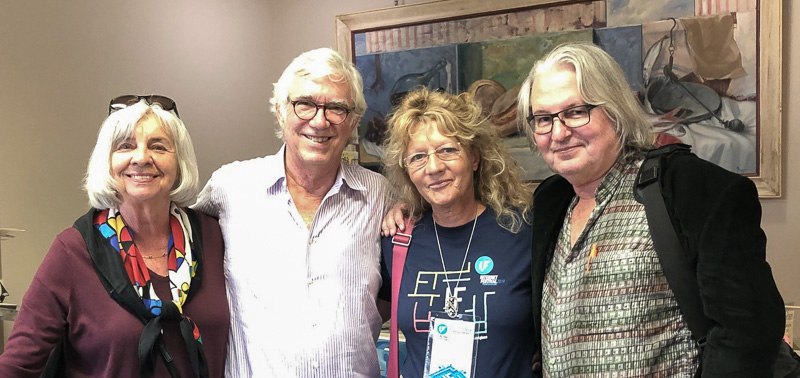
[Sylvia and I with Bruce Sterling and Jasmina Tesanovic at the Futurist art show in Pisa.]

But enough of all that. Enjoy The Matrix!

[After I delivered my intro, I stayed in the theater for awhile, and watched the start of the movie, dubbed into Italian, and it was really great, even better than I remembered, and it made me want to see the whole Matrix again.  And never mind that it’s “wrong.”   But then I left the theater to go to a club with Sylvia and Fabio and Roberto and Brolli and our other new Italian friends, and that was even better, even more cyberpunk. Nightlife with intellectuals at the Internet Festival in Pisa, Italy.]

Italy 1. Pisa.

Tuesday, November 19th, 2019

Sylvia and I were in Italy for two weeks. I’m going to do four posts about it.  This is #1 Pisa. I’ll also have #2 for Lucca, #3 Florence, and a #4 of Genoa.

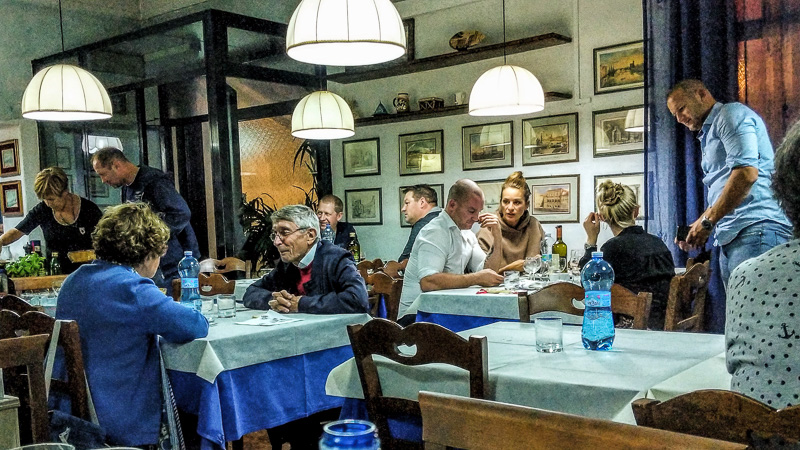
We were guests at the Internet Festival 2019 which organized a bunch of talks, displays, and demos. Eating is one of the many good things about being in Italy. This was a place called Schiaccianoci which means “nutcracker,” don’t ask me why. It was a seafood restaurant, just amazing, full of local types. Fabio Gadducci took us there. He’s friends with the owner. He didn’t really order in detail; the owner just brought us a long series of good plates.

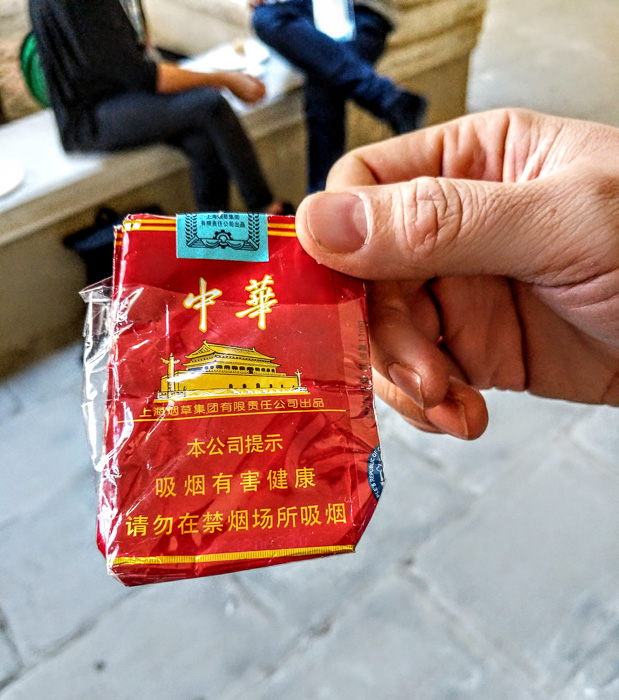
Who’s Fabio? Our contact a the con, a great guy. I think this cigarette were from Ukraine or something. Just tobacco! But people smoke odd brands in Europe. Fabio is a professor at the University of Pisa, involved with computer science, software engineering, and the history of computation. Also very much a boulevardier, a charming man about town, with friends everywhere.

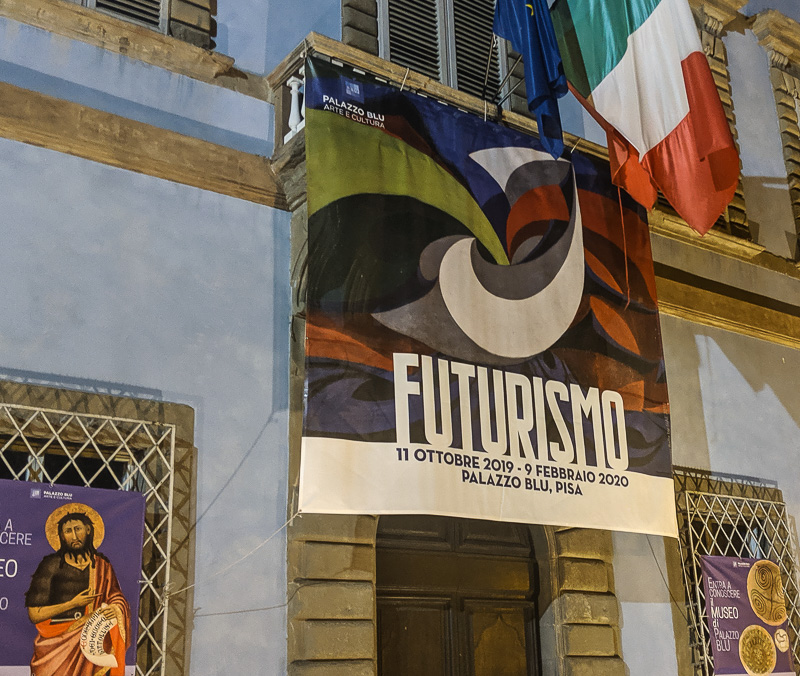
Fabio pointed out that there was a show of Futurist art in town. Sylvia and I actually pushed our way in there for the opening night party…I told the guy at the door I was a famous American science fiction writer…and he said to come back in half an hour and he’d let us in.

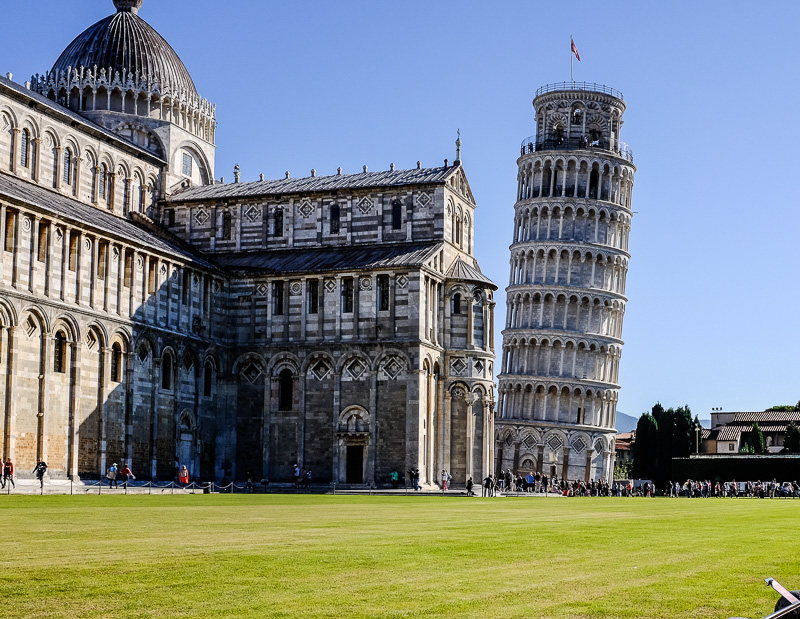
Naturally we checked out the Tower of Pisa. They actually worked for centuries, off and on, at stabilizing it. Ut was very cool, of course but the crowd of tourists at this spot was kind of brutal. And everyone but everyone was posing with their hands up so the photo would look like they were propping up the tower.

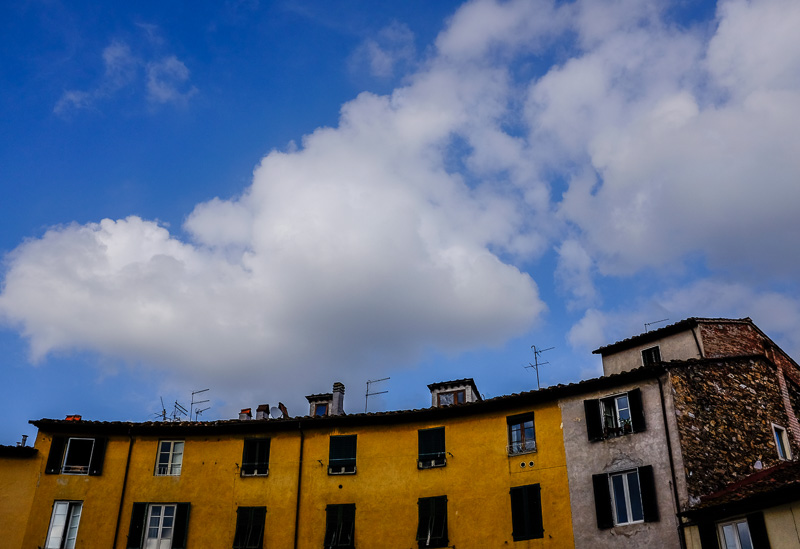
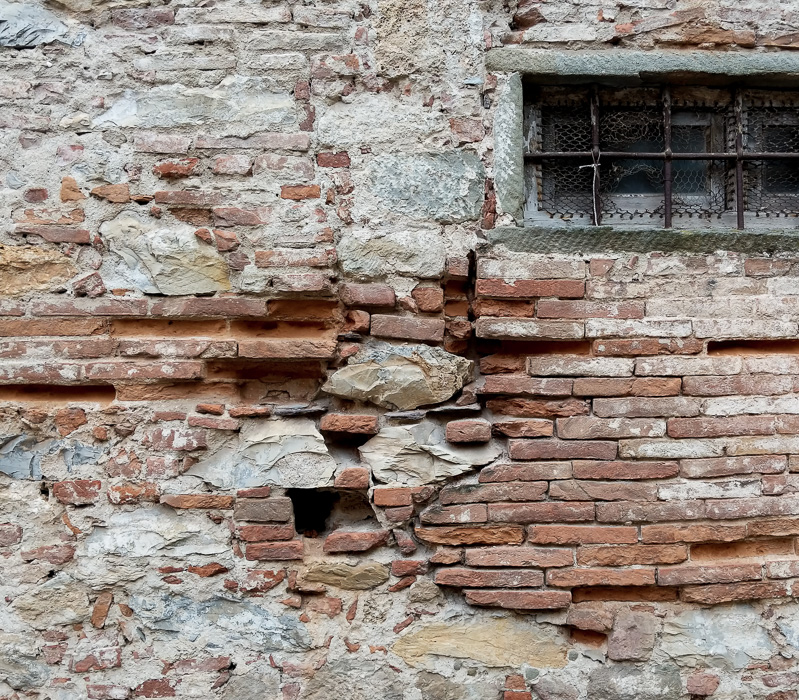
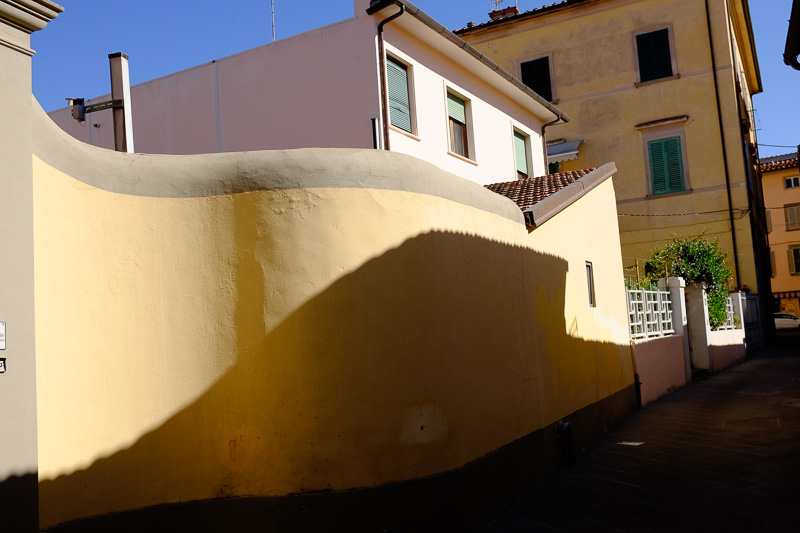
Mostly we were walking more or less randomly around Pisa. A lot of walls in Italy are yellow, or peach, or apricot, or brick red, or pink. Mediterranean. I like the curve of the shadow here.

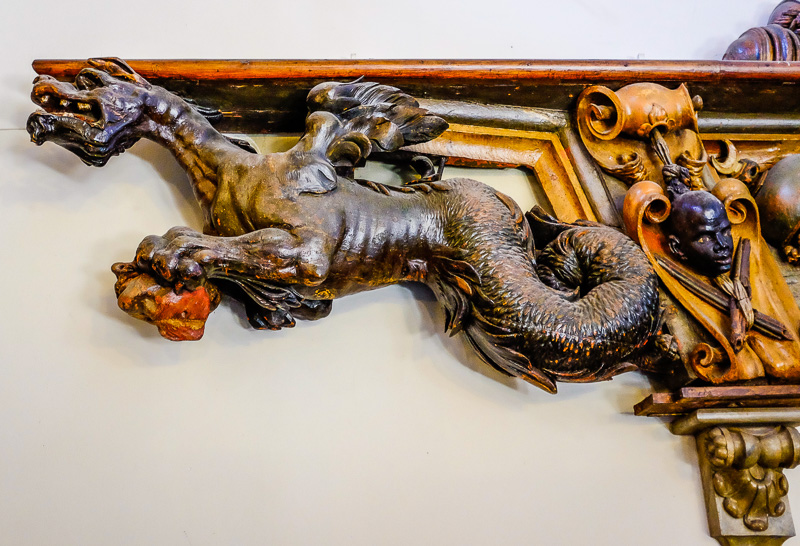
One of the churches we went into had this cool old bowsprit from a ship. I think maybe it was a model of the original, but an old model.

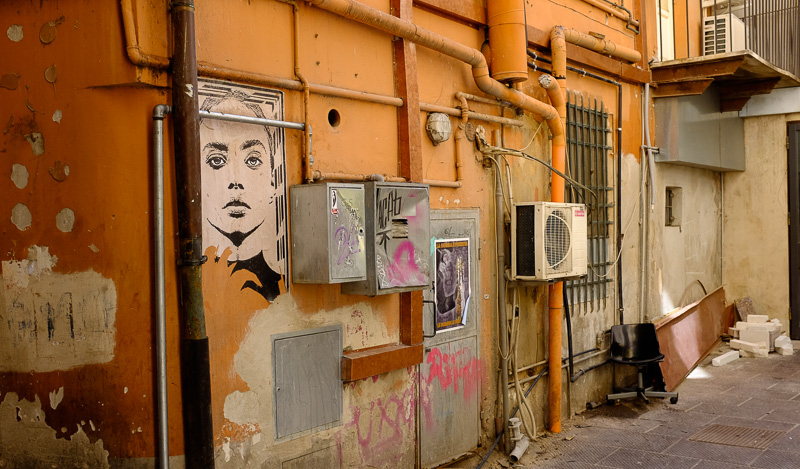
Plenty of art graffiti around, stenciled on. Tiny streets and alleys. I like this spot, the 3D jitter.

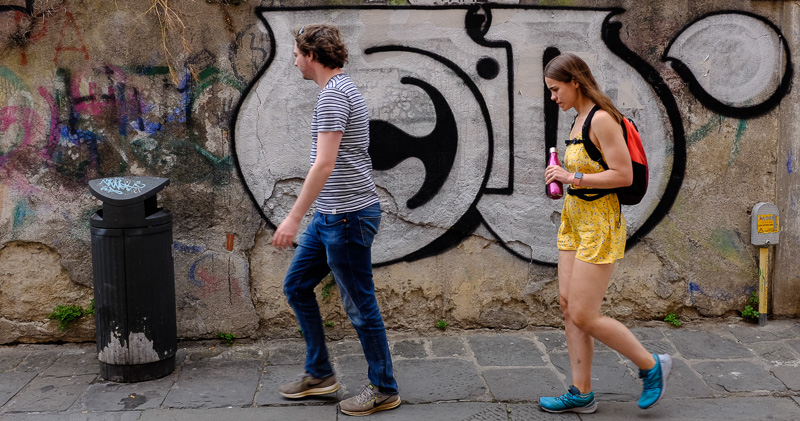
Lots of this one fat graffiti logo too, all over town. I never could figure out what it said.

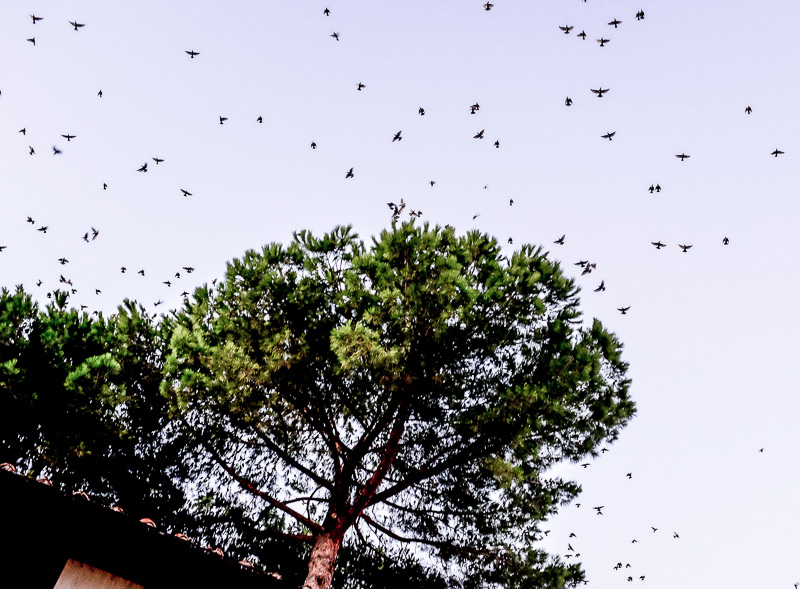
Fabio arranged it so the organizers gave us free lodging in what I guess was a university dorm. At night a huge, I mean humongous flock of birds would swirl around and around, settling down into a few big pine trees. I asked one of the locals about it. They said a bird flock is called a stormo, and that this particular kind of bird here is also called a stormo. Once they were in their tree, settled down, they kept cheeping and squawking for a long time. A wonderful multifarious sound.

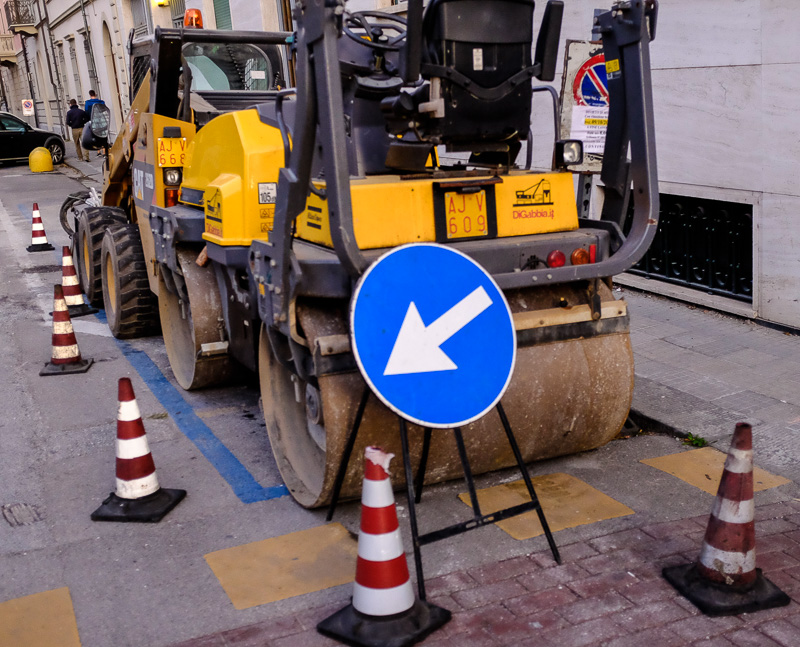
Design in everything; the Italians are masters of design. This think t looks like a conscious animal. Resting. “Tomorrow I work. Or maybe the day after that.” It’s amplified with the presence of sign that looks like a cursor symbol. Once we get our 3D augmented reality effectors in place you’ll be able to click on the steam roller and lift it up into the air.

Our dorm was by the River Arno, which runs from Florence, through Pisa, and into the Mediterranean west of Italy. Scullers here, in the sunset. The tower was a guard post for a gate into the city, back when. If the guys in the tower didn’t like the looks an new arrival, they’d throw rocks down onto them.

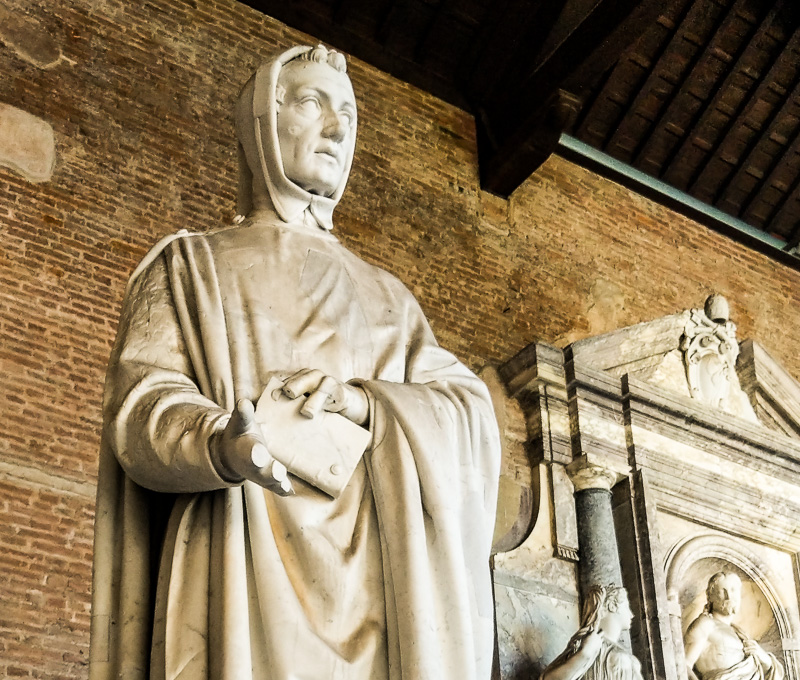
Here’s Leonardo of Pisa, more commonly known as Fibonacci. On the street, he’s best known for the Fibonacci series of numbers. Each Fibonacci number is the sum of the two before. You start with 1 and 1. You add them and get 2. And so on. So the Fibonacci series is, like, 1, 1, 2, 3, 5, 8, 13, 21, 34, 55, 89, 144, 233, 377, 610. 987, and wheenk on. They’re based on a story about raising pairs of rabbits and counting how many you have.

The silly story is in Fibonacci’s classic Liber Abaci of the year 1202. The most important math book of the Middle Ages. It taught Europeans how to use zeroes, Arabic numerals, and positional notation. Which gave arithmetic an exponential speed-up. Relative to those times, it was practically like getting computers.

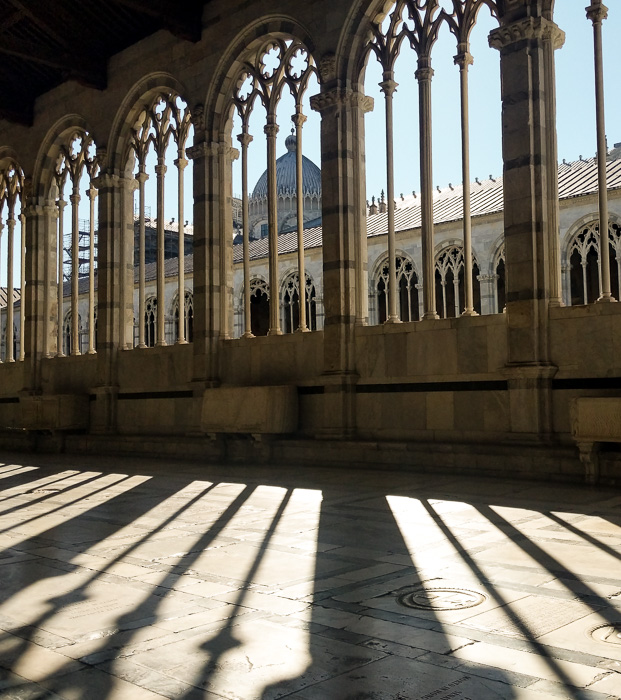
Fibonacci’s statue is in this really beautiful arcade near the Leaning Tower, it’s called the Camposanto, like Holy Field, it’s sort of a graveyard. They mixed in some soil from the Holy Land.

They had a chamber with a bunch of saints’ relics, like piece chunks of bone. This chunk is from St. Costanza. So gnarly.

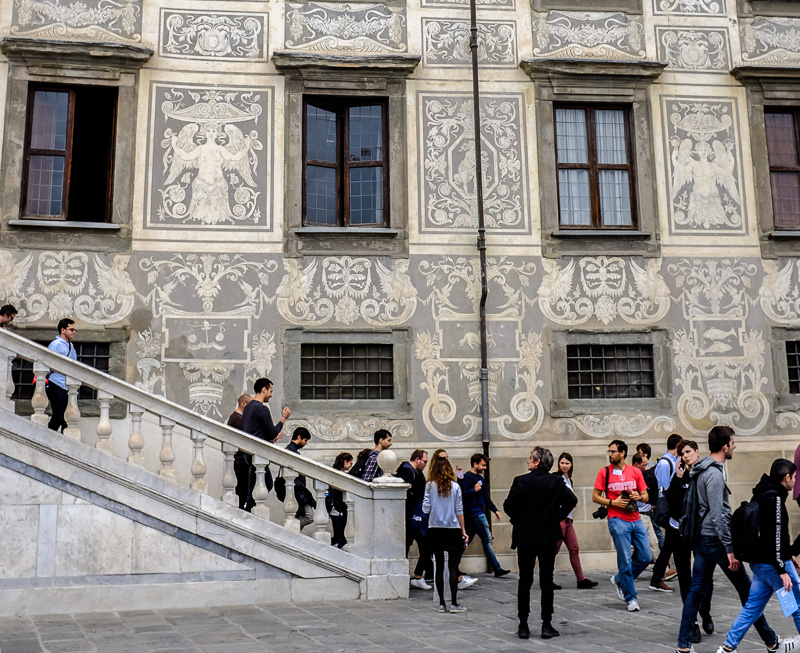
Dig the beautiful Art Noveau stenciling on this building. I think those might be Uni Pi students coming out.

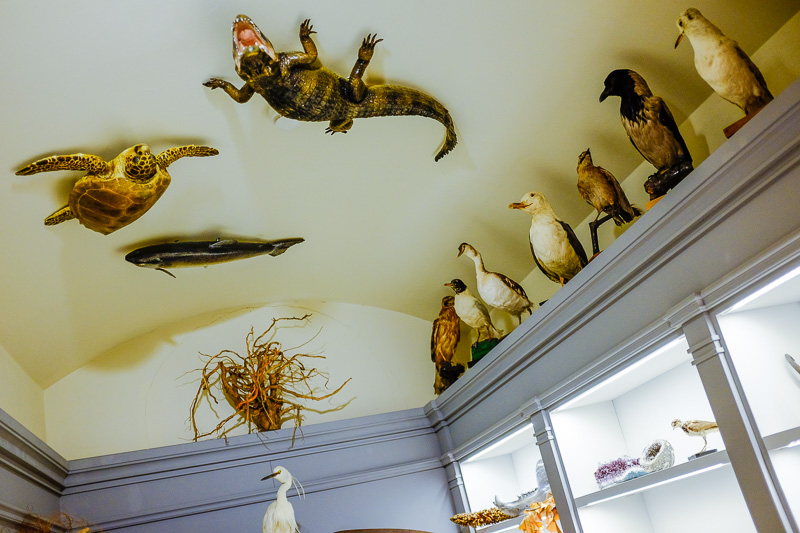
Rooting for sights, Sylvia and I ended up in the Pisa Botanical garden, and within it was a little museum, and in the second floor of the museum, we assiduous seekers found some very cool stuffed animals. It was a small room, so they mounted a few of the on the ceiling to good effect.

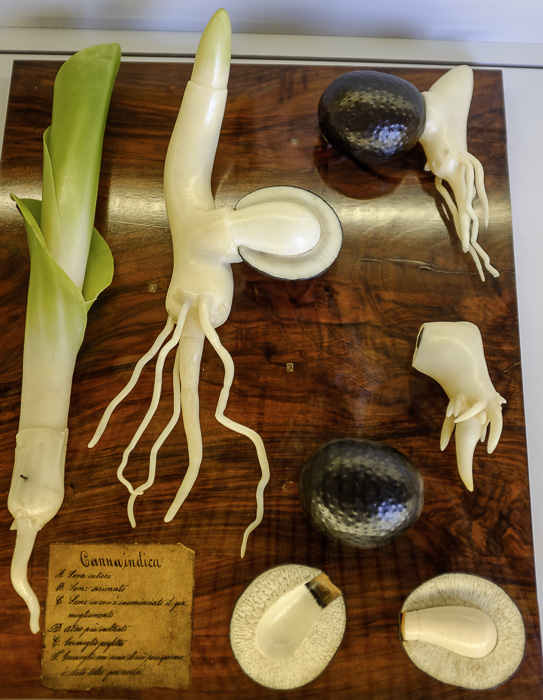
And there was something even better in the next room: big models made of colored wax. A very cool sculpture medium. This one shows the sprouting of a leek in extensive detail. I looked at it for a really long time.

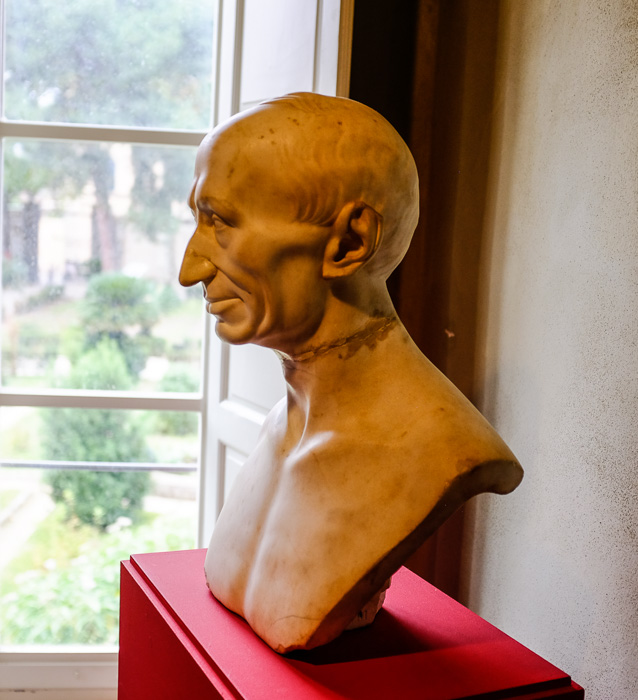
This here is the old time University of Pisa prof who made those models; and the little museum in the Bot Garden is named after him. He’s marble, not wax.

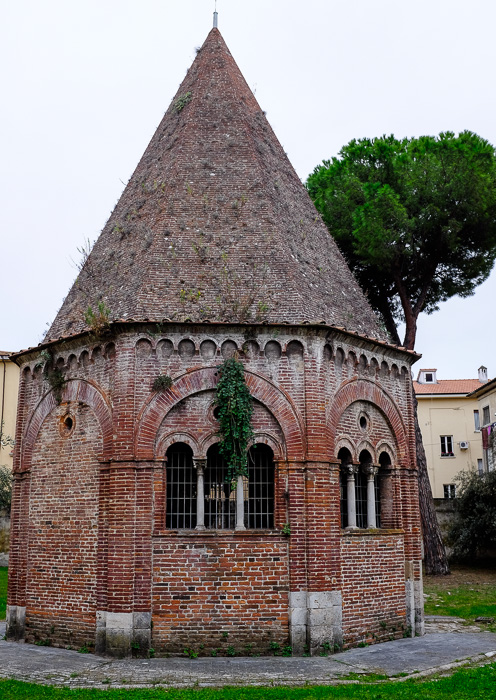
We had a large church near our dorm; it always seemed to be closed, though we should have checked on Sunday morning. Behind it was this very Hieronymus Bosch type building with a pointed roof. A lot of stormo birds came here in the evening. The building is, I think, what they call a baptistery…for some reason baptism rated a whole separate building.

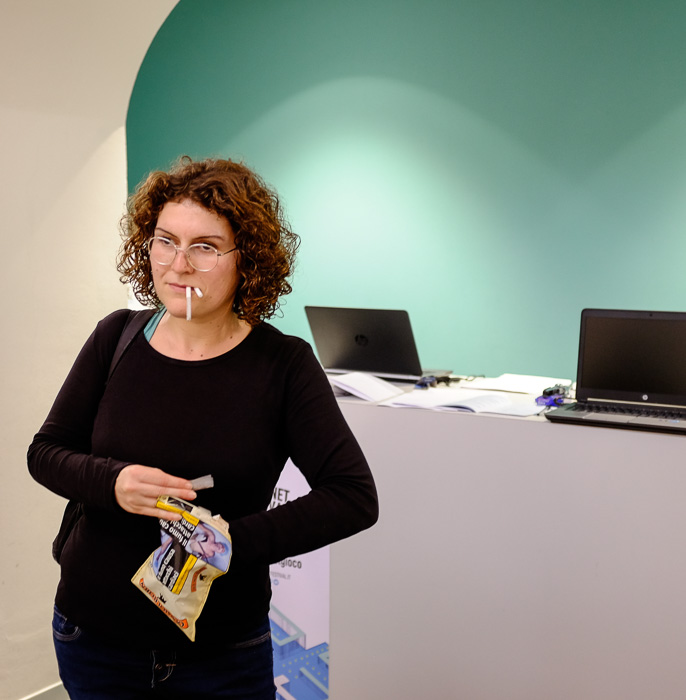
This is Laura, a pleasant computer scientist working, I think, at the Uni Pi, she was at the con and I talked to her a few times. Don’t know what she’s doing with the cigarettes, but I grabbed her photo. (I’ll find her last name later.)

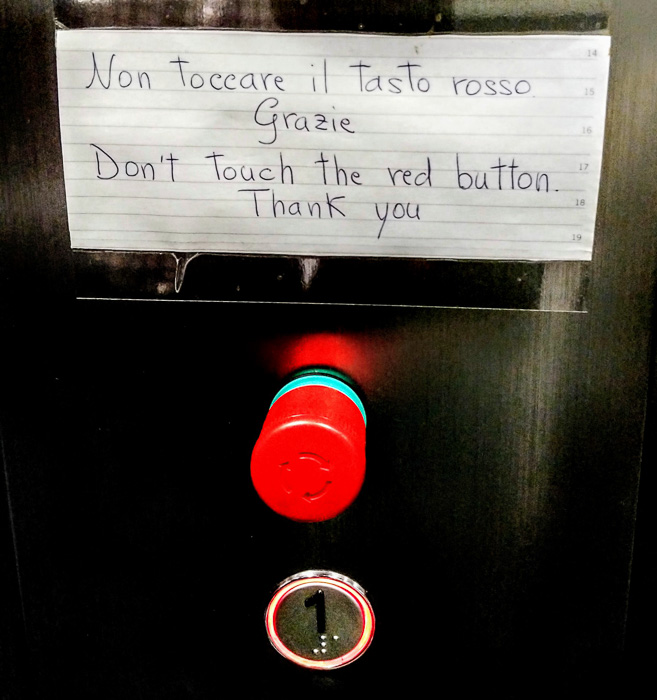
This was in the elevator at the botany museum. The opening shot for an SF adventure, right?

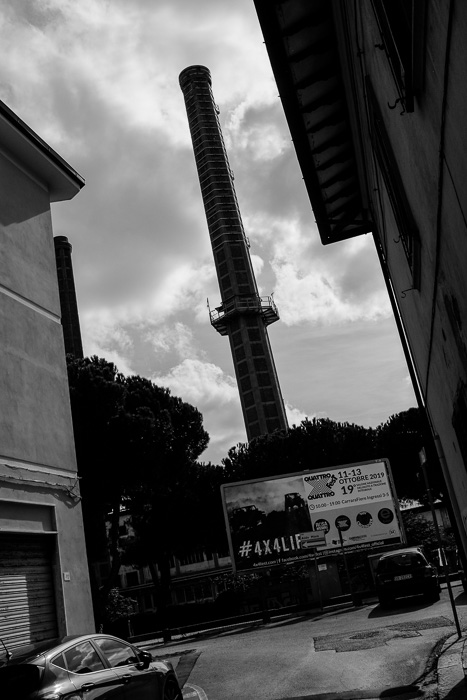
One day I was at loose ends, and wanted to find place to have lunch, and looked at Google maps, which led me to hell and gone, ending at a spot that seemed to unsavory, so I kept walking, in a more working-class neighborhood now, near a factory, flipped into the black-and-white world of Neorealist cinema.

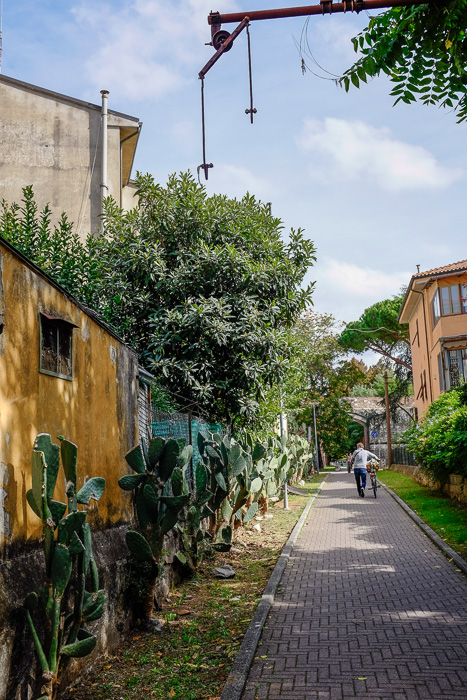
It’s so nice to get off the beaten track. Everything is interesting, everything is different, sanctioned sights don’t matter. I liked this dangling thing up there—remnant of the Inquisition? Something to do with horses? And dig the prickly-pear hedge. Like in California.

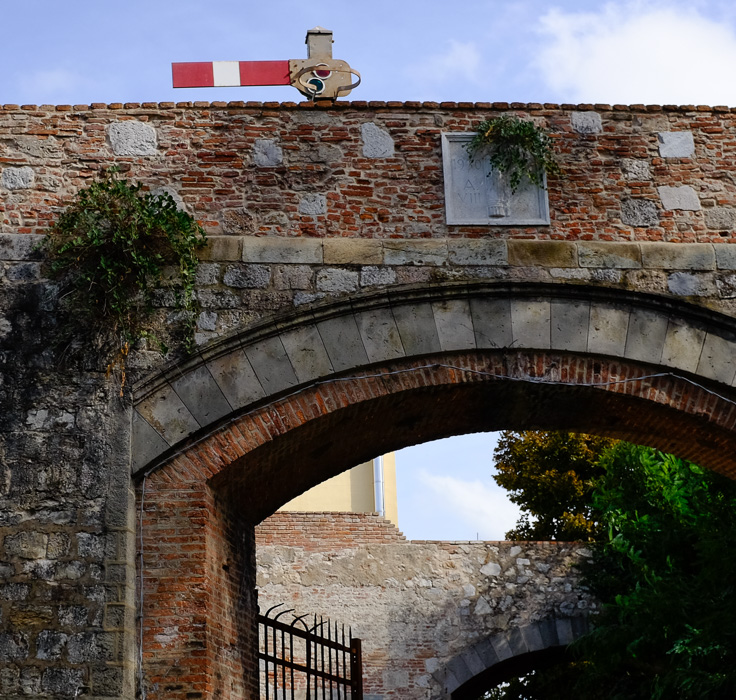
Another gift from the muse of strolling. The red and white bar is nice addition, also the toothy fence. This is a chunk of the old city wall.

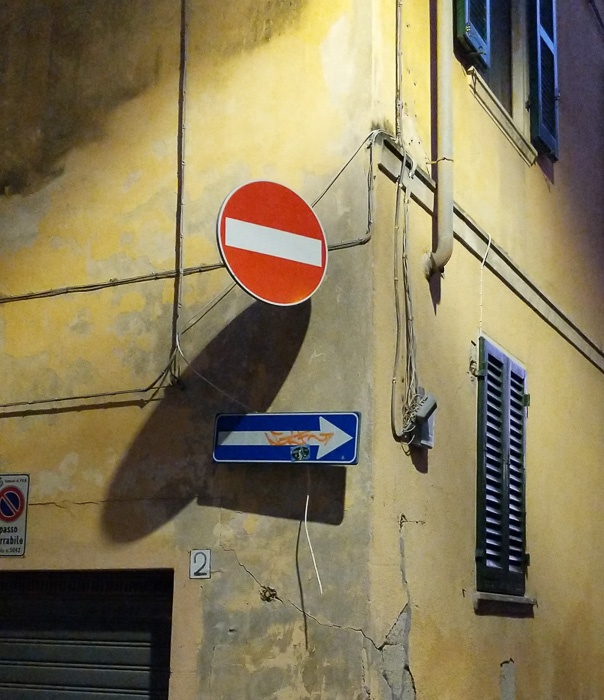
I know it’s cheap to photograph signage, but sometimes, well, you gotta. Especially when it’s night.

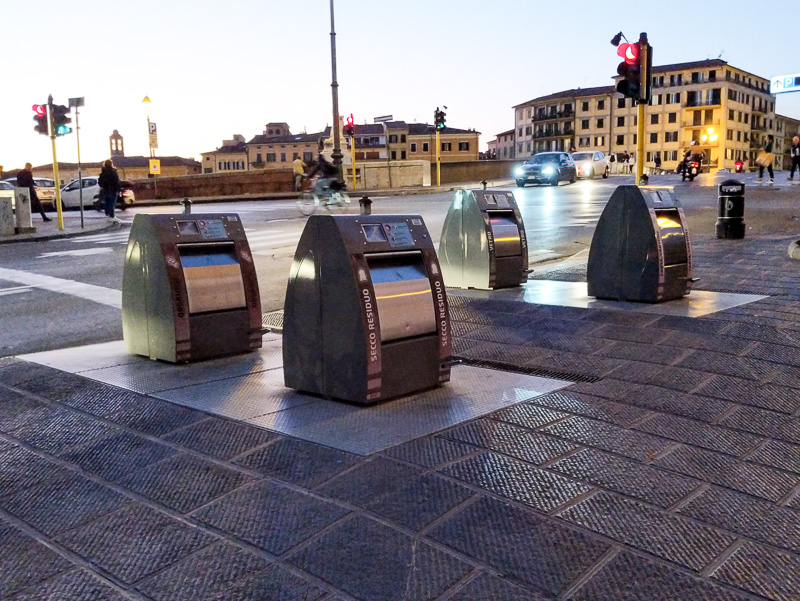
More on the genius of Italian design. These shapes are trash bins. The genius part is that each of those visible metal pimples is attached to a subterranean bin the size of the cargo hold on a truck, with the bin’s long side going down into the ground, and the pimple on top. In the morning an insanely ultra-designed huge garbage truck with a crane on top lifts each trash pimple high into the air—with its hidden trash bins now visible, dangling—and squeek a door on the bottom of bin hinges open, and the trash falls into the truck.

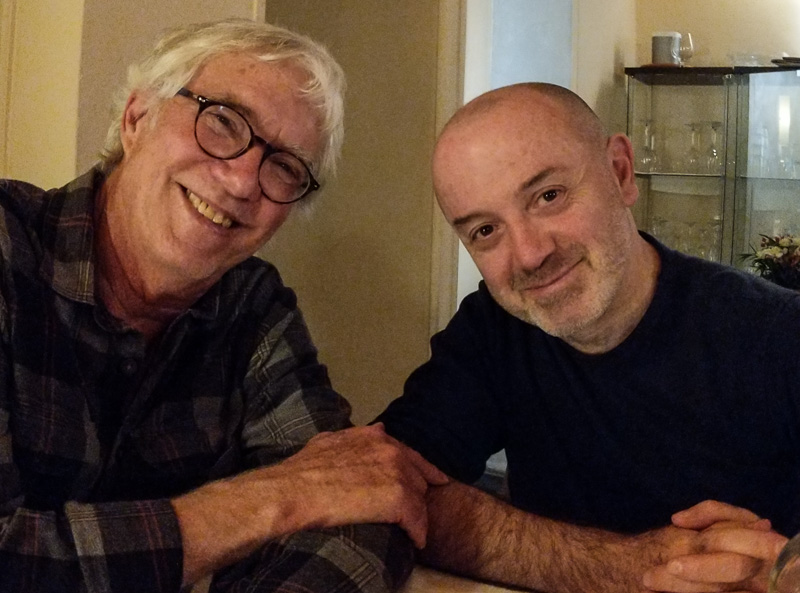
This is my very dear friend Daniele Brolli, who translates my SF books into Italian. He’s William Gibson’s translator as well. Brolli is a great translator because he’s an author himself. I try and see Brolli whenever I’m in Italy; he’s one of the kindest and most intelligent people I know.

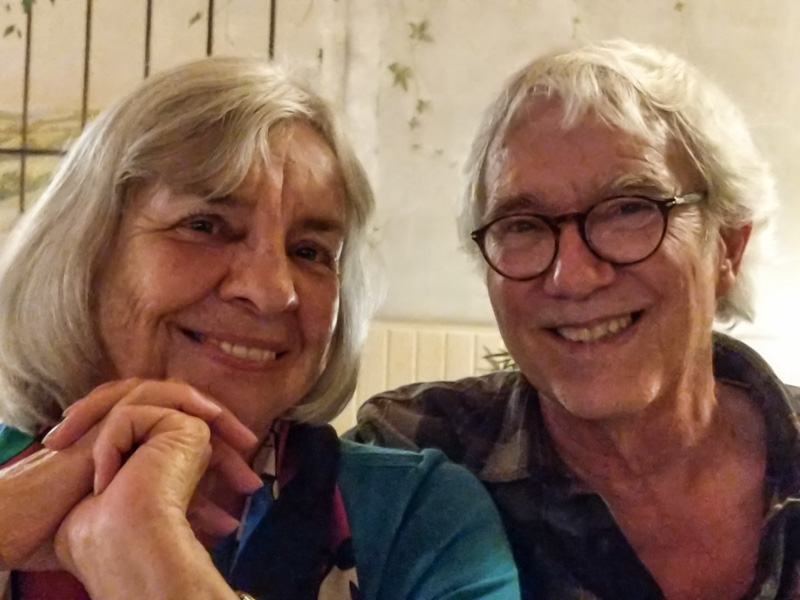
With Sylvia at that restaurant with Brolli.

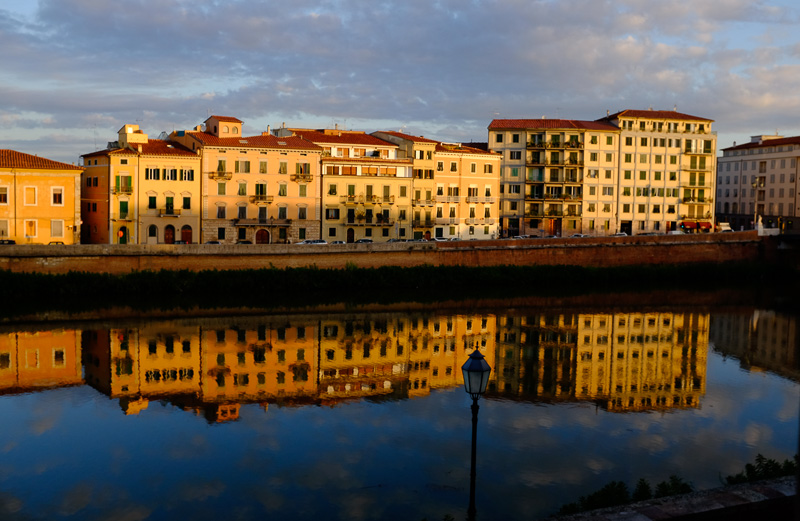
The Arno in the morning. I’ve love seeing buildings reflected in rivers!

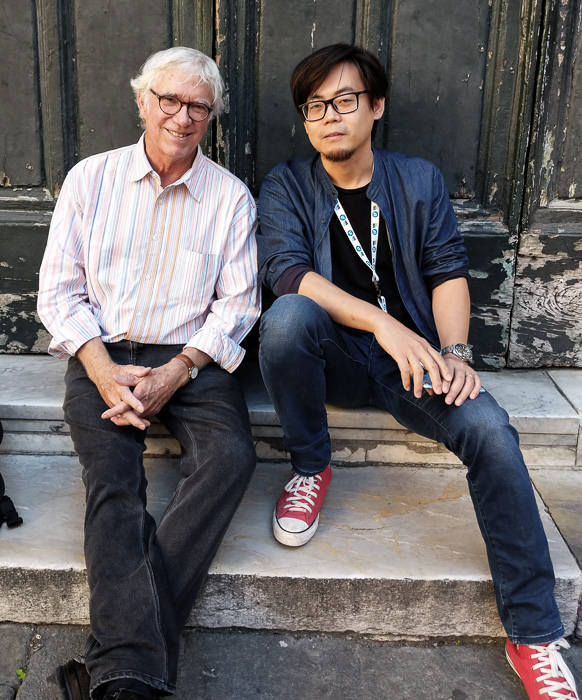
And here’s Ran Zhang, a cool Chinese SF writer. He says he’s not a cyberpunk…he’s in a different category, but what that is I don’t exactly know.

It was fun hanging out with Ran. He gave me a Chinese cigarette to smoke. Our peace pipe.

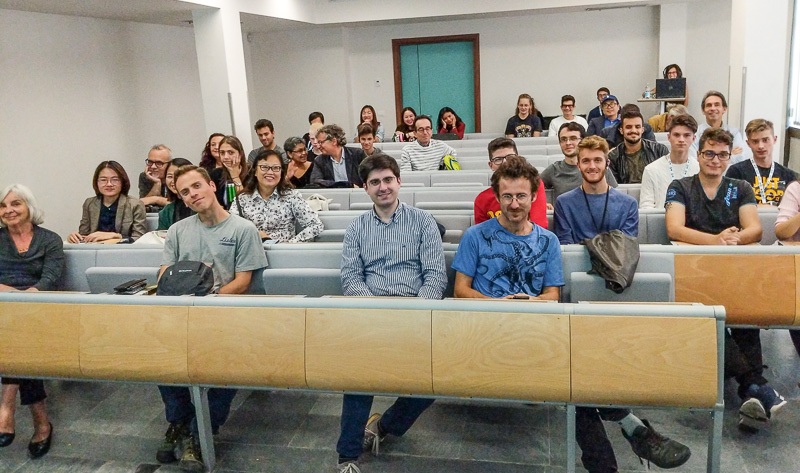
These were the people at the talk I gave, it was called “Lifebox, Telepathy, and Immortality,” and rather than using PowerPoint, I put the text and slides of the talk online as a blog post.  It went over well, and in the process of giving the talk and answering questions I got some new ideas. . Daniele Brolli introduced me, and Ran Zhang talked too.

Bruce Sterling showed up, which was great. I love that guy. We’ve published a book’s worth of stories together, Transreal Cyberpunk. It was a pleasure to hear his talk…he was going on about various kinds of colorful cybercriminals, which was funny as the speaker just before him had been laying out an idealistic fantasy about how “everyone willl soon agree on basic rules of how to use the internet.” As if!

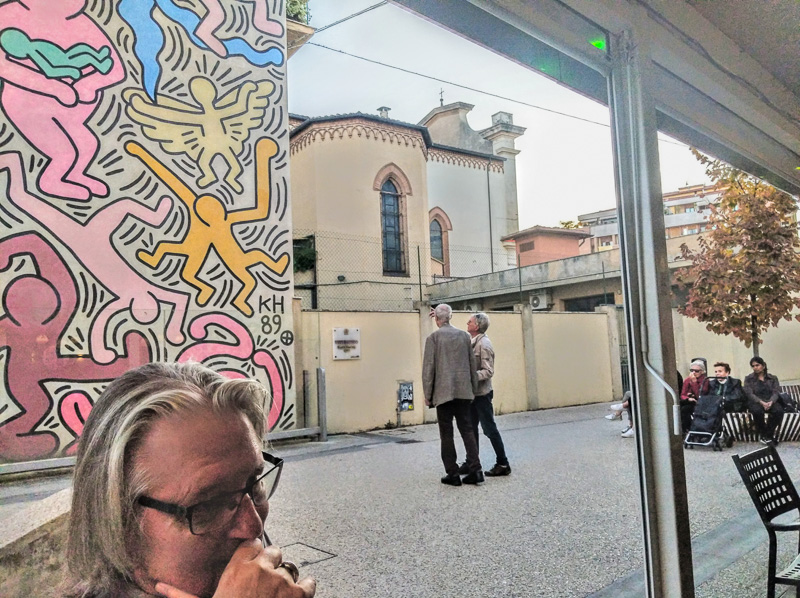
We took this photo in a bistro near the Pisa train station, we were waiting for a seafood restaurant to open. Kind of a Di Chirico feel to this setting here, and of course we’ve got a Keith Haring mural in the background. Bruce is an allegorical figure of some kind, but I’m not sure what the allegory is.

We might be working on a new story together…something peripherally involving Fibonacci.

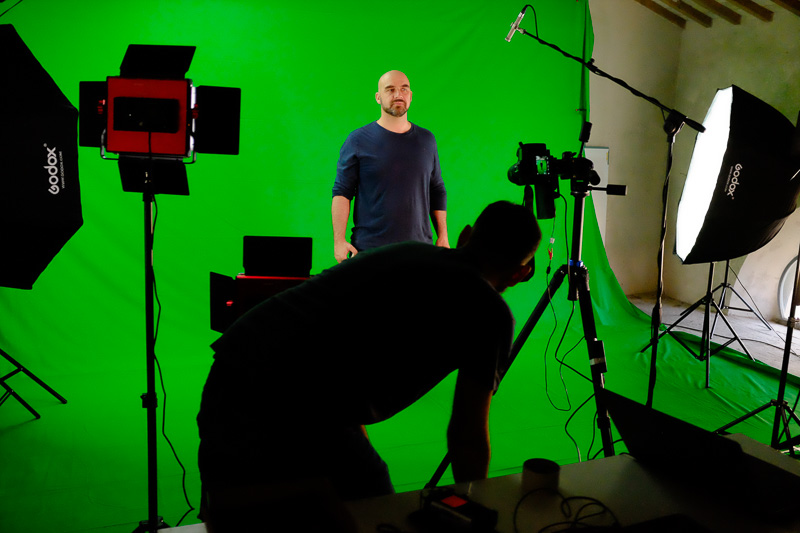
My last day in Pisa, Roberto Malfagia and some of his cool VR guys from Florence made a 3D film of me. The group is called La Jetee, you can see an example of their work here. Being recorded by them I felt like the next stage of the Rudy lifebox bot. That’s not me standing there, that guy is for getting the focus right. The guy in silhouette is nice photographer Manuel.

I told about an SF scenario I’d been thinking about. For immorality, we’ll take advantage of natural computation, in particular we store a person’s lifebox-ghost as a pattern in the octillion interwingled atoms of a stone. Let’s say it’s a gravestone. Your soul is in there.

And whenever you aren’t embodied as a juicy ghost in a living organism, your soul in the stone is waiting for some person or, better, some animal to chance past. And you can do a surgical, cyberknife-type, tight-beam narrowcast of your code into the brain (and the muscles!) of an animal.

And then you live in the animal for awhile as a juicy ghost. A crow. He circles up into the air, a rising gyre. In explaining this, I made a theatrical, swirling, upward gesture with my hand, with a Tim-Leary-type pitchman’s smile on my face, faking ecstasy for the camera.

Arrivederci, Pisa! And grazie.

Two Dimensional Time and Annalee Newitz’s 2nd Novel

Wednesday, October 23rd, 2019

This is a fairly long blog post. In my usual fashion, I’ll break up the text blocks with photos. Some of today’s images are from a recent trip to Italy. They have (at least superficially) no connection with the text. But never forget the Surrealist principle that everything illuminates everything!

“Nine Dragons” acrylic on canvas, October, 2019, 40” x 30”. Click for a larger version of the painting.

Like a Book Review

I recently read Annalee Newitz’s second novel, The Future of Another Timeline. It’s great. I was beguiled by the prose, fond of the characters, absorbed by the action, and intrigued by Newitz’s notions about time editing.

Men get harsh treatment in this book’s pages. Monstrous male villains from the future are trying to enslave women throughout all of history. The loss of voting rights and the denial of abortion rights aren’t enough for these goons. They’d like to see women who lack hands and who maybe don’t even have heads. Newitz’s heroines have max impact against these GOPpy creeps.

Meanwhile (if that word makes sense in a time travel novel) the younger versions of our characters are hanging out in the 1990s. I like their conversations. “We talked for a while about the stupidity of Disney World, and how it was like wanting to take a vacation inside a plastic replica of a vacation.” [Sorry, Cory!] And there’s a nice evocation of them at a rock concert, as seen by one of their future selves:

What really jolted me was the way people occupied themselves as they waited for the music to start. Nobody was texting or taking selfies. And without phones, people didn’t know what to do with their eyes. I didn’t either.

As well as going to rock shows, the younger characters are butchering sex-offenders in scenes of full-on horror gore. Not for the squeamish, but sick-funny in a Grand Guignol way. And, hey, they’re only killing men, so really it’s okay. No worse than squashing bugs.

To remove any lingering moral ambiguity, one of the women gives up serial killing—after a talking-to from her time-travelling future self. Newitz springs a fresh take on this normally mandatory time-travel-novel cliché.

I was wondering whether I’d ever see [my future self] Tess again. Would I grow up into her, and have to come back in time to visit myself? From what I’d learned in our unit on time travel, that was fake movie pseudoscience. It was more like her visit had reshuffled the timeline, generating a new history and future in its wake. Only Tess would remember the timeline that existed before her edit.

Regarding being a killer or not, at the very end of the novel this character realizes she was meant to be one all along.

Maybe that was why I belonged in the first century B.C.E. In Nabataean, there was a word for what I did best. There was actually a job that combined my skills as an academic and a murderer.
“I think I’d like to be an assassin.”
Hugayr smiled. “Great! We’ve really been needing one.”

The savage settling of scores is refreshing in these fraught times, and the book is a punk feminist anthem. We’ve seen enough bromantic sword-fighting, macho, jaw-jutting oink-fests, for sure. And the time travel scenes are enchanting.

Rain swarmed around us, full of fat hot drops and freezing bullets of hail, and we held each other in the void that meant history was still mutable. I concentrated on my friends, and how their breathing felt next to mine. We seemed to spin slowly, like a drifting asteroid or a diatom in the ocean’s water column.

The novel also features a thread of warm historical-fiction interplay involving women’s suffrage, family planning, belly dancing, and goddess worshipping. Things can be quite cozy when men aren’t around. And Newitz is wonderful at sketching scenes. Here’s old Chicago.

Wednesday night was humid. Sunset spread like a rash over the water, and the reek of rotting pig guts in the river mingled with smoke from roasting nuts.

Read The Future of Another Timeline! It’s cosmic, nasty, thoughtful fun.

Timeline Edits

My main goal today is to ponder the SF machinery in Newitz’s epic. The novel is about editing our timeline. That’s a geeky, techie concept I can wrap my monkey mind around. I realize that others have analyzed time travel, but rather than summarizing past efforts, I’ll wing this essay on my own.

This said, I’ll mention that a good recent survey is Damien Broderic, The Time Machine Hypothesis. And the Encyclopedia of Science Ficion, has many, many links.

I’ve thought about time travel a lot over the years. And this month a time travel story by Marc Laidlaw and me is appearing in Asimov’s: “Surfers at the End of Time.”

The idea behind timeline-editing is to change your past so your present is more like you want it to be. That is, people hop to past times, do things there, and hop back to the era where they started. When competing groups are editing the timeline you get what’s known as a “change war” or a “time war.” The Future of Another Timeline is about an ongoing time war.

But let’s back up for a second. As is known to all SF readers, timeline editing leads to odd situations. Suppose I’m sick of the corrupt and evil Premier Treadle. I hop back seventy years and drown him as a lad. Then I hop back to our present day. No more Treadle. Hooray!

But wait. Assuming my memories remain intact, I’ll notice that the present which I return to is not the same as the present I started from. It used to have Treadle, and now it doesn’t. How can one and the same present have two different forms?

The paradox gets particularly intense if you go back in time and depressively kill your own self as a child. If you then hop back your starting time, you’re in a world where you yourself have been dead for decades. So how can you even exist?

A separate issue is the fact that when we’re doing timeline-editing, or doing any kind of time travel at all, we get into different dimensions or levels or directions of time. That is, if I talk about the former, unedited version of my present as being in my personal “past,” that means that my life’s individual timeline is distinct from the world’s overall timeline.

Getting all lit-crit on your ass, the actions of time travelers are narrated as a (harrumph) diegesis, that as in a POV stream of experience that includes its own arrow of time. The individual’s diegetic time can be distinct from the world’s time. This is a large and stinky elephant in the living room, and it’s not often discussed.

So I’ll get back to elephant in a minute, but let’s say a bit more about the paradox issue first.

Option 1: Paradoxes Don’t Happen

One option is just to insist that the paradoxes don’t happen. You go back in time planning to kill young Treadle but, for whatever reason, you somehow don’t manage to. Or you go back and kill your earlier self, and maybe it seems like you’re successful, but guess what, your earlier self does not in fact really die, they have a miraculous recovery, accompanied by complete amnesia about nearly being killed, so there’s not paradox.

This move appears in a number of Golden Age time-travel stories.

And it’s the route that Marc Laidlaw and I recently took in our story “Surfers at the End of Time”, as I describe it in my on it post on it. I once had a chance to discuss time travel with the god-like logician Kurt Gödel, and he said, “Why not suppose that the world always arranges itself so that these paradoxes do not occur. If something is logically impossible, then it doesn’t happen. A priori logic is very powerful.”

Option 2: Multiple Timelines

The standard boilerplate time-travel-novel move is to say that, when you hop back in time, you don’t enter the the past of your own original timeline, which we’ll call timeline A. You go to the past of a parallel timeline B. And the changes you make in the past of B will be in effect in the present-day era of B, but not in the present-day era of A. You will have made timeline B into a better world than timeline B by deleting the foul Treadle. Or maybe you’ve made B into a sadder, duller timeline be deleting your fabulous and scintillating self.

Fine.

A variation on the theme of parallel timelines is to talk about branching timelines. Recently Bill Gibson integrated this move very smoothly into his wonderful novel The Peripheral, which I discussed on my blog. If you go to this page, also check out San Jose physicist Ken Wharton’s incisive comment at the end of the post.

The branching timeline idea is that I hop to the past of my timeline A and make a change (or, in Gibson’s case, make a change by opening a transtemporal communication channel to the past). And then (in which timestream is the diegetic “then” situated? ) timeline A splits off a branch or pokes out a stub that we can call timeline B. Your intervention occurs in the forked-off timeline B, but not in timeline A.

In either case, a new question arises.

When you hop forward from the past of B to the present day, what happens? Do you end up in crappy old A or in the nice new B? If you return to the present of timeline A, then you’re back in a world still addled with the vile Treadle, so your excursion has accomplished nothing in terms of improving your own life. And nobody in A will even have noticed that you were gone. You maybe disappeared for maybe a split second while you were doing your time excursion. Unsatisfying. What do you really care if some invisible timeline (or timeline-branch) B is okay, if your still in crappy timeline A?

It’s more customary to suppose that you hop from the past of B to the present of B. This feels right if you suppose that your intervention in fact produced the branch timeline B. If you hatched B, then maybe you ought to be staying in it.

On the other hand, if we’re using the Peripheral set-up, in which you don’t physically travel to the past, but you only send some signals to the past, then you yourself never really leave timeline A, so you will still be in timeline A, and the changes will be off in timeline B, which you can’t see.

[I can’t resist a joke here. Gibson says the trans-temporal communication links are made via a certain “server”—but nobody knows where it is. Might it be in…the Ukraine? Might this server have been operative in the emergence of that hideous election-gone-wrong stub that we’ve been suffering in since November, 2016?]

There are a few issues with hopping from the present of timeline A to the past of timeline B.

First of all, when you hop from the present of timeline A to the past of B, and then stay in in B, you disappear permanently from the present of A, never to be seen again in timeline A.

Second of all, if you hop from the present of A to the past of B and then to the present of B, it seems likely there will be a version of you already in the present era of timeline B there. A You-B. Do you move in with You-B? Have sex with them? Kill them? For nearly all possible versions, see the unforgettable and sexually louche time-travel extravaganza, The Man Who Folded Himself by David Gerrold.

If you want to avoid dealing with You-B, you might suppose there is in fact no You-B at all in timeline B. Maybe whenever you enter a new timeline B, it’s automatically lacking a You-B version of you. Would be handy. Like the omniscient transtemporal mulitiversal Great Spirit of the timelines has removed any copy of you from any timeline you are going to jump to. Somehow this makes me think of cleaning shrimp, and getting that dark shit-filled veins out of the shrimps’ backs. Your copies’ timelines being the shit veins, you understand.

Against Multiple Timelines

I’ve harped on this before, but basically I don’t like parallel worlds solutions to time travel. I think they’re wasteful, and I think they undermine one’s interest in the timelines involved. If all kinds of timelines are possible, then why should I care about any particular one of them? If everything happens, then nothing matters.

Even worse than multiple timelines is full multiverse worlds in which every possible world is just as real as ours. This is complete bullshit. An utter abandonment of common sense. Our world is rich and beautifully crafted, and not some random piece of crap.

I feel there really is some kind of underlying Logos. A secret of life. A white light. A cosmic aha. A glow. A magic mantra. Maybe there are a few alternate worlds, I’m okay with that. But not a buzzing gnat swarm of them.

The Newitz Option: Two Dimensional Time

Newitz takes an approach to the time paradoxes that’s kind of strange. She allows time travel and timeline editing. But she insists that there’s only one timeline. No parallel timelines, no branching timelines. Just our one timeline: “Our only timeline, whose natural stability emerged from perpetual revision.”

So, somehow, when you travel back in time, you alter the timeline..for everyone. But you yourself remember how it was before the change. This might be viewed as hopping to a different timestream, but Newitz doesn’t want that. She wants to have just one timestream. But the timestream is changing.

Geologists [Newitz’s word for students of time travel] agreed that the timeline was constantly in flux. Travelers exposed to edits returned with memories of lost histories, previous versions of the timeline they had witnessed.

Change means passage of time. So if the timestream is changing, that means there’s a second dimension of time which is, as it were, perpendicular to our normal direction of time. Let’s use the word meta-time for the second direction of time. As meta-time elapses, our entire universe of space time evolves. Like a twitching mollusc. At least this is how I see it, although Newitz has a slightly different image of what’s going on.

In a way, there are many timelines. But only one exists in our universe. The others are possibilities. Every time we change history, it’s as if we pull a segment from one of those other timelines into our own. The more we edit, the more our timeline becomes a patchwork. That’s why travelers remember so many different timelines. Each of us recalls the timeline before we made our changes. Every traveler has a slightly different patchwork in our memories.

When one philosopher want to harsh on another one, they’ll say the the other one’s views are “incoherent.” Is the idea of pulling in segments from other possible timelines incoherent? I wouldn’t go that far.

But if you don’t want the alternate timelines to be real, I think it’s better to stress that you’re editing our one timeline over the passage of meta-time. And that those other possible future timelines are imaginary.

Restating this, some of the other timelines are versions of our timeline that date back to early moments of meta-time. One of the timelines is our timeline as of this moment in meta-time. And the many, many other timelines are imaginary possible timelines that we might reach with the passage of meta-time. But we will in fact evolve into only a limited number of those options.

The time machines in the book are geological sites called Machines. Nobody knows where they came from. Newitz says, “the Machines are like… threads. They sew swatches together into a single quilt.”

This image is, again, close to being incoherent. I’d prefer to say that the Machines are like timestream-editing tools. The other timelines are not “out there.” As I understand it, in the context of The Future of Another Timeline, , the women characters and the evil men from the future are using the Machines to alter the timeline.

To me that’s not so much like quilting as it’s like having several people editing one and the same Photoshop image at once. Or, more to the point, like several people editing the same document at once. The document being the Great Book of Life, the Akahasic record of all time.

I used this image in my novel Mathematicians in Love, where I had a divine jellyfish fully re-editing our entire timestream once a week—where of course the week was elapsing in meta-time.

This said, the quilting image is also apt, if you think in terms of appliqué. The time travellers are editing spots of history as if inserting new fabric. And always remember that, as they do this, meta-time is passing, and the whole timestream is writing like a Santa Cruz banana slug.

Maybe the most confusing thing about the Newitz universe is that she insists that after you go back in time and make a timeline edit, you yourself will still remember how the world was before you changed it—even though nobody else in the world will remember the old world. You the timeline editor are unique. I’d like to see a nice coherent theory of how this works, and maybe, in the future of another timeline, I’ll work it out.

For now, let’s just say that, when you’re time-editing, you’re moving “sideways” in meta-time, and you’re in some way immune to the overall alteration of the timeline.

The main plot hook in the novel is kind of cool. If all the [time] Machines were destroyed, then the people in the timeline would be unable to make any further timeline edits. And the goal of those dastardly male turds from the future is in fact to edit the world into a really crappy anti-woman state—and simultaneously to destroy all the Machines so that everyone is stuck inside that one crappy world for the rest of time and for the rest of meta-time. Dead end.

We’re living in a timeline where the [time] Machines are being damaged. Soon, we could be in one where the Machines don’t work at all.

Eeek. And why does this feel so very much like the current political horror-show of our United States?

Thank you, Annalee for your call to arms! See you further down the winding road of meta-time.


Rudy's Blog is powered by WordPress