


Click covers for info. Copyright (C) Rudy Rucker 2021.


Archive for the ‘Rudy’s Blog’ Category

Painting Workshop

Wednesday, July 11th, 2007

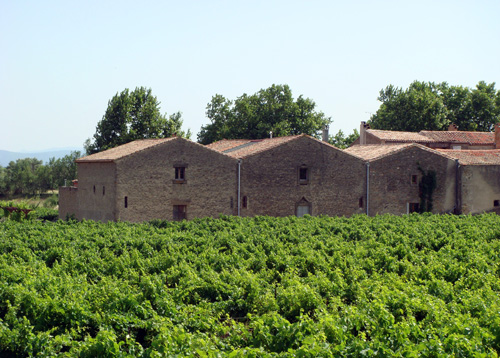
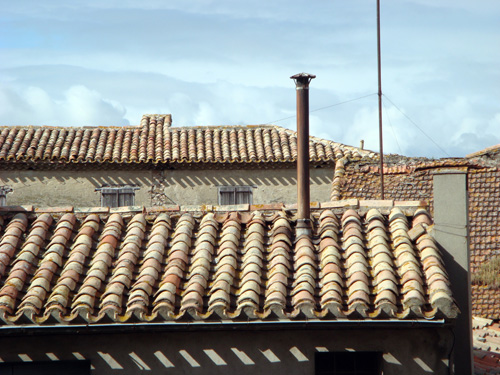
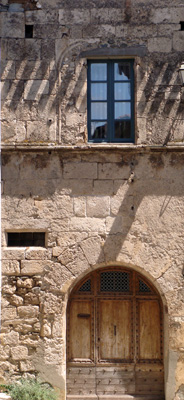
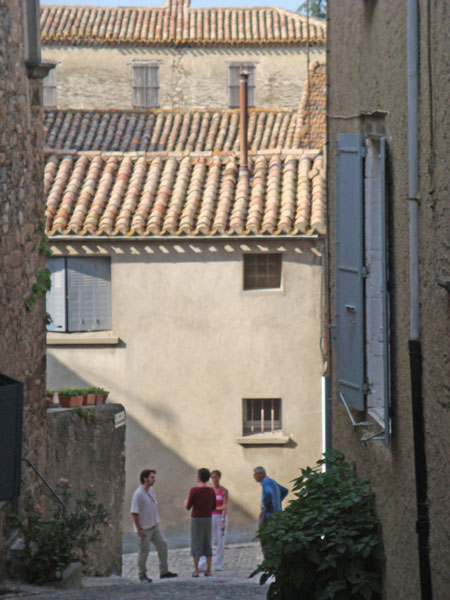
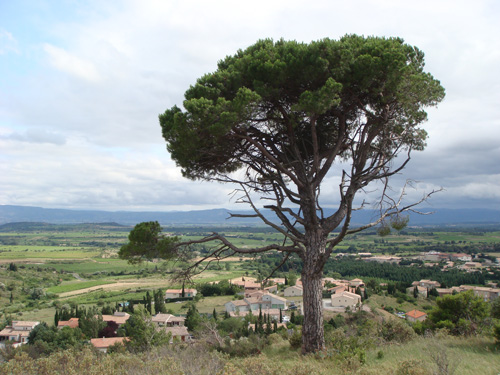
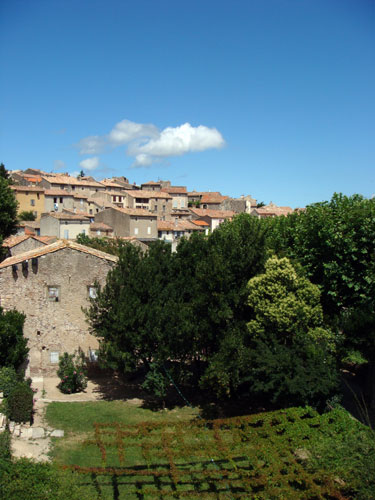
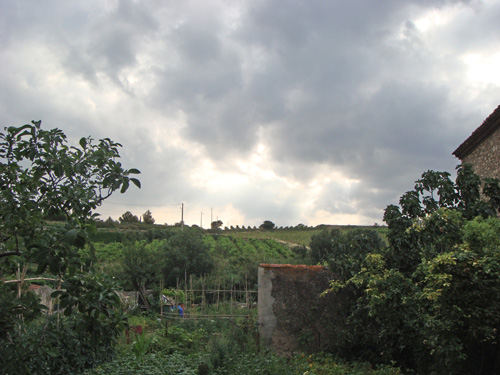
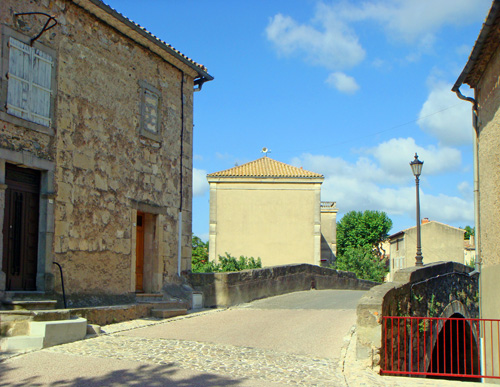
It’s so beautiful here in the south of France. Exquisite. Rocky and scrubby. The cypresses. The vineyards. Villages of piled yellow stones with red tile roofs. The real locals, like a guy who is the watchman at the marble quarry, they talk French so it sounds like Spanish. Languedoc.

It’s been very windy the whole time, like the wind in Big Sur, it gets on your nerves. A steady fitful wind is, by its very essence, “in your face.”

I’m fully off line here, which is great. I’m hardly even keeping journal notes. Just letting the experiences mount up and flow by. I like the flow of time here. Shifting sand. All the others have jet-lag, which makes time even more vague. The one kind of writing I’m doing is chipping away at the novel.

But really it’s about painting these days. I wake up at night and think about what I’ll paint the next day.

I’ve finished four paintings now, working six or more hours a day for eight days in the studio, which is a big old building in a field by a river, it’s a former saw mill for blocks of the local red marble from the Caunes quarry, “Le Carrière du Roi.” Only four more days to go here, I’ll miss this life.

Glen gave me really good practical advice about the pictures. He never talks about the content, just about the composition. Tricks to push things forward, or to avoid “triple points” (where too many lines come together).

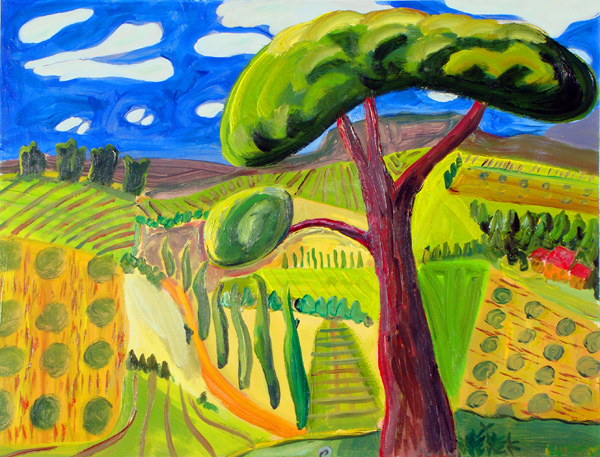
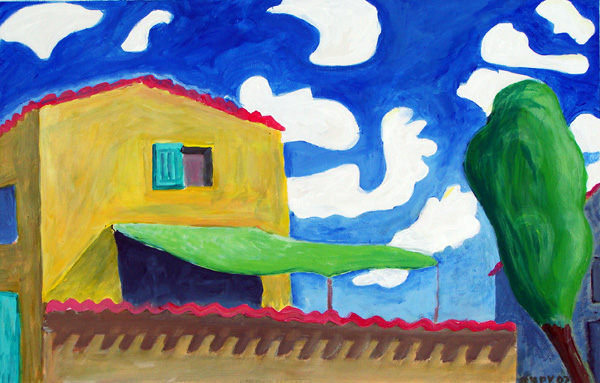
I did a very nice final landscape, South of France. I was working on it at night in the studio and then I went outside and it was still a little bit light even though it was 10 p.m. and I had my brush in my hand and I was reaching out towards the trees and clouds and the house, moving my brush in the air, “painting” the things in place.

It was in the Wayne Thiebaud multiperspective style, a view of the vineyards with a piñon pine in the foreground. Glen like it, he said it was a very personal take on Thiebaud, a fantasy landscape, with a lot of rhythm. I suggested putting in a UFO, but got no encouragement on this front! I’m happy to be doing a straight landscape. I never thought I could do that. Glen’s brought me to a new level.

Riding my bike home after finishing my painting, Hylozoic¸ I was enthralled by the alternating shutters and doors in they yellow stone houses by the road. And on the porch, the wind feels like a paintbrush, a sweep of color.

In the tub this morning, rubbing my back with a washcloth, it felt like I was painting on blue-white paint. Imagine everything becoming color and gesture.

It’s all about painting these days. I wake up at night and think about what I’ll paint the next day. I wake up sore from the painting. Today I did yoga and I was seeing my muscle pains as colors. Not intellectually imagining this, but viscerally feeling washes of color in my brain. My forever-sore muscle along the right side of my spine oozed a pale cobalt blue as I squeezed it out. The sharp pain in my right shoulder a triangle of orange (made of vermillion and cadmium yellow). My legs a mixture of Mars black and cadmium red. The pain in my lower back is an acid green produced by mixing cobalt blue with cadmium yellow and white. Veins of thalo green creeping in.


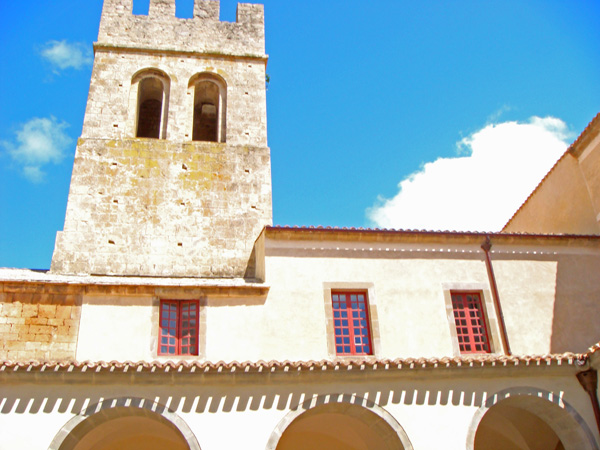
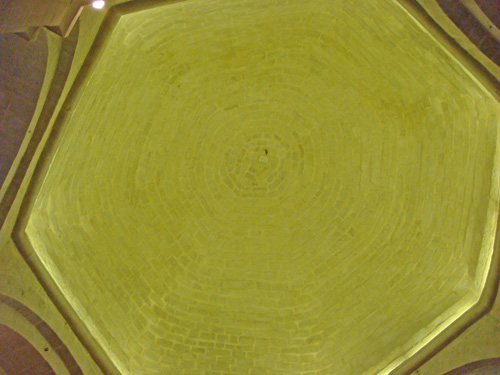
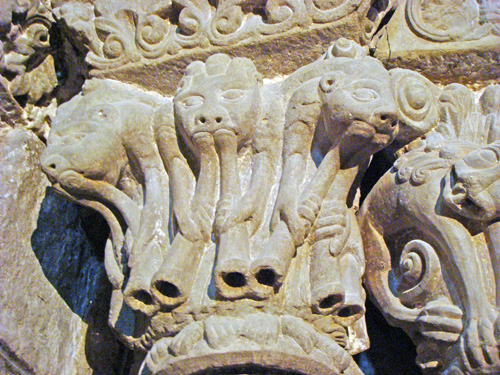
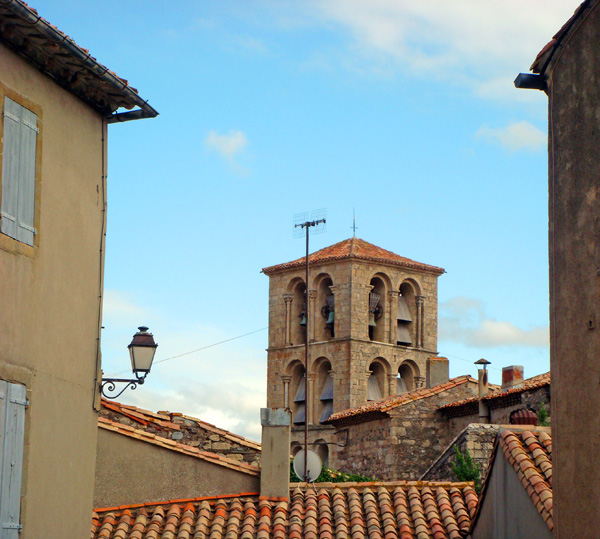
[A seven-sided church dome in a 12th C church near Caunes.]

I was planning to do a triptych here: Postsingular, Hylozoic, and Infinite. I got some canvas for it, and finished the middle one, a square meter.

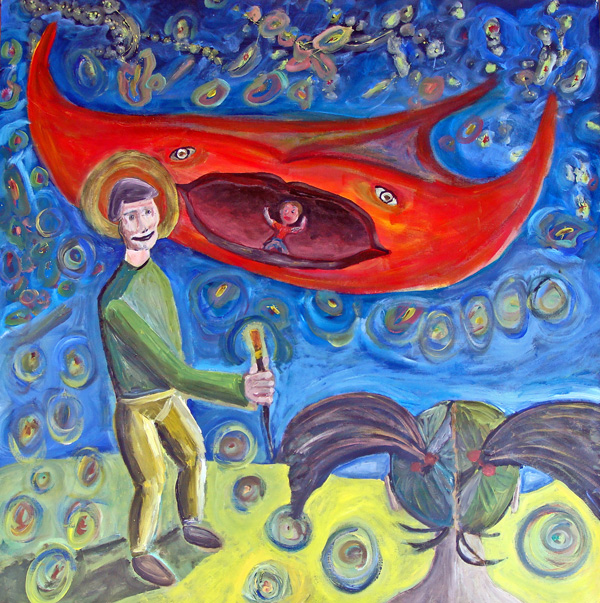
In the sky and in the foreground are circular blobs, representing the ubiquity of consciousness (every atom has a mind). It shows Thuy Nguyen with her pigtails in the lower right corner. You see her from behind, just the part and the pigtails and her bare neck. To the left stands a painter holding up a brush and looking towards her. He has a hat like Bosch wears in a drawing that’s sometimes said to represent him. Also he has a halo. I think of him as Bosch, as me, as Jayjay.

The largest and brightest thing in the picture is a flying manta ray, a Hrull mothership. Her mouth is open and you can see someone inside her mouth, like the people inside the body of the tree-man in the hell panel of Garden of Earthly Delights. This is Chu, who becomes a Hrull ship crew member. The manta ray’s mouth is vaginal, so Chu also resembles a fetus. There’s a logical flow from the pig-tailed young woman to the painter phallically displaying his brush to the small figure inside the manta ray. Woman seduced by magus becomes pregnant.

Doesn’t quite fit the book, as in fact Thuy seduces the young Chu and gets pregnant from that. But when I paint from one of my novels before actually writing the material, I’m using the painting to uncover possibilities. Maybe Bosch becomes besotted with Thuy, even though she’s only one foot tall relative to him. Or maybe we’re seeing Bosch steering the Hrull mothership (bearing Chu inside) to Thuy in the second to last chapter. Or, again, Jayjay could be the painter, and then the picture would make more sense. Thuy, Jayjay, and Chu.

So what I learned from the painting is that Jayjay does in fact become a painter like Bosch, maybe even a Bosch impersonator.

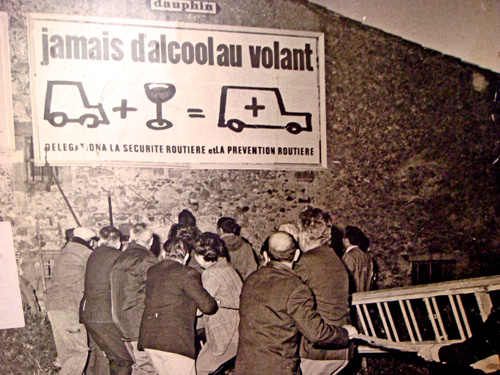
This is a photo from an exhibit by the winegrowers’ association that was up in the Caunes abbey before our group show. What we see here is a mob of enraged locals pulling down—a cautionary message about drinking and driving! They’re going after it as if it were a statue of Stalin or Saddam Hussein. This really cracked me up; I totally can’t imagine this demonstration happening in our puritanical US. Nobody would dare! Crimethink! Public safety is our scared cow. Not that I’m advocating drunk driving, mind you—but it’s interesting to see that societies can work from different sets of assumptions.

Glen says that he dreams of making a “breakthrough” and coming up with some new angle on painting. That set me to thinking about writing breakthroughs. In a way, I’m just happy to be able to write at all, and to get my work published. Maybe I made my breakthrough some time ago and am now enjoying my mature style. But maybe I am working for breakthrough too.


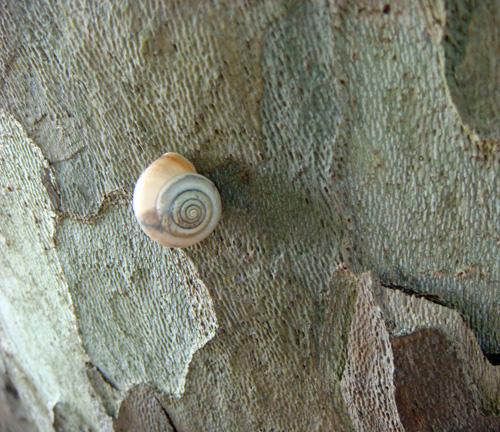
[Snail on a plane tree by the Canal du Midi.]

I do try and break through to new ideas each time out, but my characters and incidentals are much the same. I have a sense that trying for a breakthrough isn’t always a good idea, at least for me. It’s hard enough to write at all. Going for a breakthrough is that “knock it outta the park” thing—and you can end up whiffing. Saucer Wisdom was a deliberate breakthrough book, and it didn’t do too well in the marketplace. Maybe the trilogy I’m working on is a breakthrough. Or maybe it’s the same old sh*t. Like I say, the main thing is that I can do it. I love exercising my craft, making it funnier and vibbier and more gripping, step by step, tweak by tweak, polishing it like an icon.


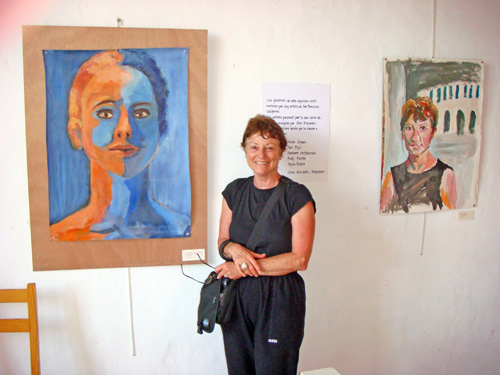
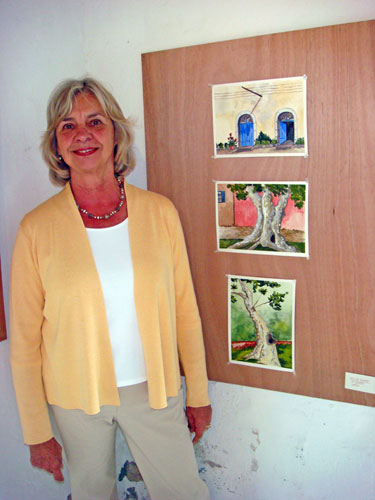
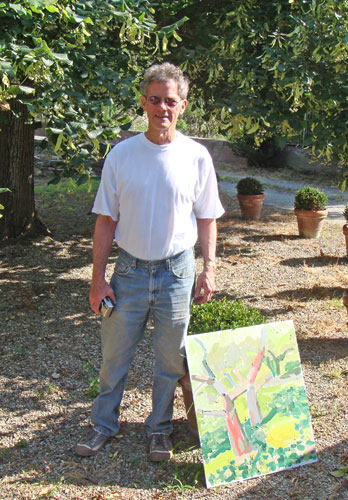
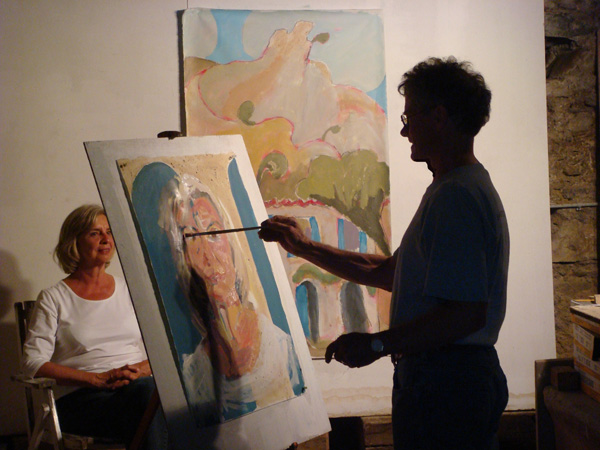
[Barbara Heffernan with one of her paintings, and her portrait by Kevin Brown]

Today we hung a little show in a room at the local museum. Paintings by our workshop members.

I have two of my pictures up. Glen’s picture wasn’t finished yet. Last night he was going to do a big push, but he didn’t get it together. He was tense.


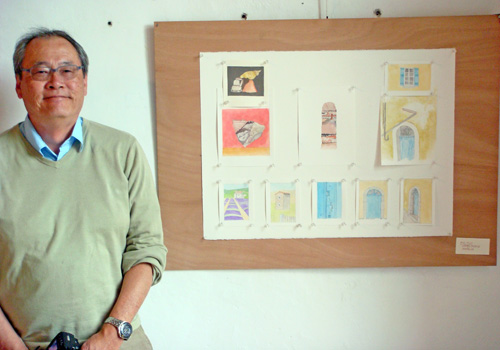
[Paul Fujii with his watercolors.]

The students’ mood and state of well being was very dependent on Glen’s moods. Imagine this for Bosch’s studio.

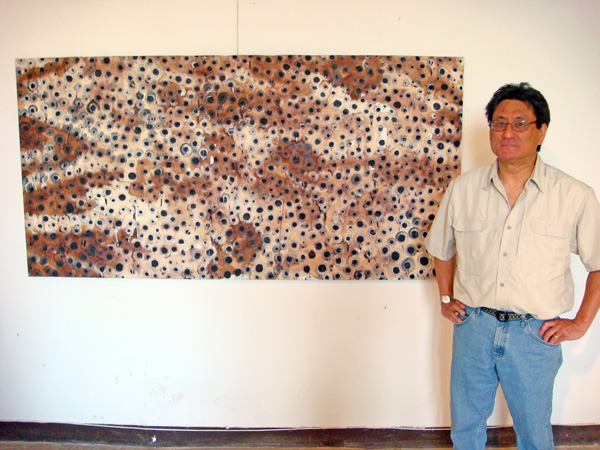
The opening of our group show was actually fun and the dinner was cheerful. Glen was in a good mood. On the night before the opening—after the rest of us had hung our pictures—Glen finished a piece about 8 ft by 4 ft, paper, an irregular pattern of black dots with white rings around them (acrylic) and then the paper laid on the floor and stained with a mug of black tea that stood on it and slowly dried overnight.

The effect was good, a kind of leopard skin quality. Glen called it Magellanic Clouds. I like the way he looks in this picture, so proud. He’s like, “Yaaar, I caught the big fish!” A little reminiscent of CA Turing spots as well, but funkier.

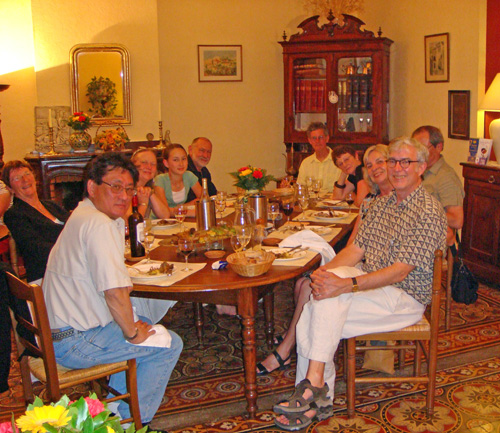
Glen was happy and we students were happy for him. We had dinner at a place in the tiny town of Citou on a back road. I don’t think a single car went by while we ate for four hours.

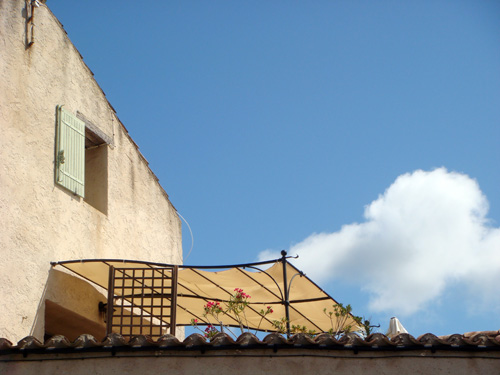
I had a landscape called Minerve in the show, which is the name of a town where I sketched the scene above, and painted the scene below.

I would have liked to see Hylozoic in the show but it’s not stretched, I painted it on a big square of canvas stapled to the wall. Now I’m worrying about getting that home, also my South of France painting, which is on a sheet of paper too big to fit in the suitcase. I rolled them up in foam.

Walking around the little medieval village of Caunes day after day. It’s so tiny. And on most of the streets you can’t see the horizon, or even any green. You just see the walls. It’s like being inside a very high-walled maze. The village. And when you get out into the green fields it’s such a relief. I see Thuy and Jayjay having this feeling in s’Hertogenbosch.

Glen lent me a vibby book, What Painting Is, by James Elkins. It’s a sustained analogy between painting and the medieval practice of alchemy. Paint is water (the medium) and stone (the pigment), and you’re trying to distill the fire of light. On the palette, the mixed paints are like excrement, the “prima materia” of alchemists. They paints transform unexpectedly. You don’t really know what you’re doing, it’s a somewhat magical and intuitive process.

I personally hate to try and think about the color wheel when I’m mixing paints—logical analysis feels wrong in this context. It’s much more pleasant to just muddle the paints together and see what I get, and if it’s not what I wanted, maybe I can use the “wrong” color somewhere else. This said, I am learning a few basics, like that cobalt blue and cadmium yellow make a nice green—but still, and here’s the alchemy of it, this mixture doesn’t always seem to work. I have to throw in an unspecified amount of white. Or adjust the amount of yellow.

Would be nice to have an actual alchemist in the story. Maybe Thuy and Azaroth are hanging out with one. A guy like in Bruegel’s drawing of a Nick Herbert or Phineas McWhinney type alchemist. “Al gemischt,” it says in the Bruegel drawing, which means all mixed up.
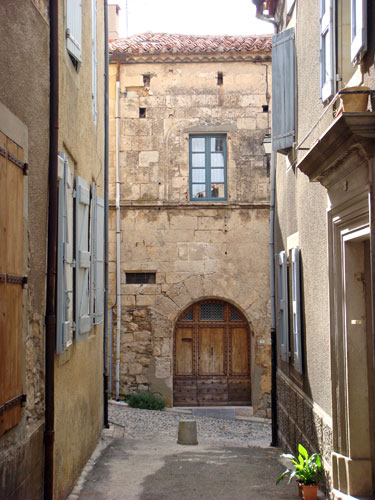
I’m planning to model my Infinite wing of the triptych on Bosch’s Venice painting of an ascent to heaven, where the image is (perhaps) inspired by the appearance of the water-mirrored round arches in the s’Hertogenbosch town canal. I can have Bosch point this out to Jayjay.

We took a little ride in a boat on the Canal du Midi. Exquisite.
And then it was back to the big city.
Painting in Caunes, France

Sunday, July 8th, 2007

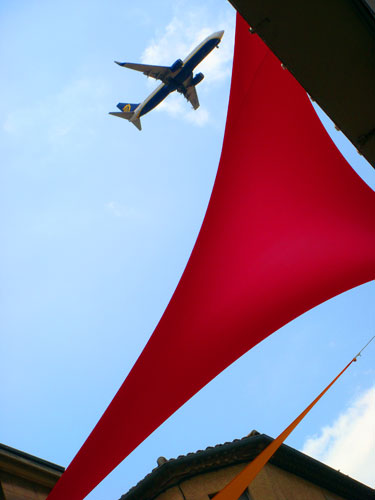
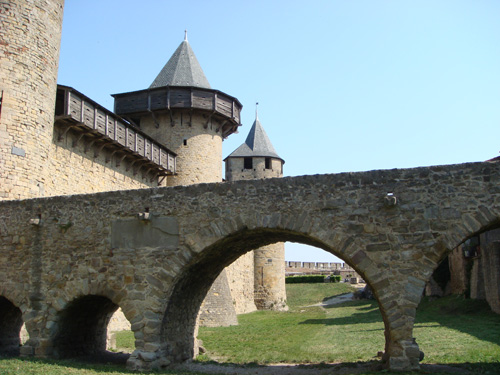
Carcassonne is a town in the south of France that features a medieval walled fortress that was heavily reconstructed in the 19th century by architect Eugène Viollet-le-Duc, who also worked on reconstructing the Notre Dame. The fortress itself felt kind of plastic and whipped, like Disneyland, and in the daytime it was crawling with tourists, they fly over on Ryan Air from Merrie Englande. We spent a night in the castle.

In the evening and morning the medieval city was pretty empty, and I could get into the medieval mind-set a little. I pissed in a grass meadow (moat-bottom) against the castle wall.

In the 13th century there was a big heresy in the Carcassonne area: the Cathars. As I understand it, they believed that the God of the old Testament was in fact Satan! Not so unreasonable, really, given all that “for I am a jealous God” stuff. My SF writer friend John Shirley says something like this in his novel The Other End, that is, he says the god who made our world is a demiurge who turned evil and became parasitic upon human worship and then became addicted to the vibe of human suffering. A line about Shirley comes to mind: “Eschatology is too important to leave to scientists and theologians.”


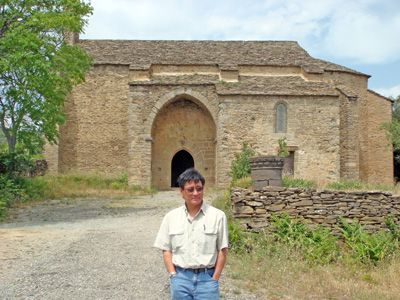
[Our teacher Glen Moriwaki by a 13th C chapel.]

Downhill from the walled fortress is the Low City, the realer part of Carcassonne, and we hung out there, buying some food and some paper for me to paint on. They have lots of red marble in the sidewalks and walls; that’s the product of Caunes, red marble from their quarry.

The market food was good. Croissants from the bakery every day, rubbery and yeasty and doughy and multi-layered. An apple tart from a bakery. Hard, chewy greasy salami. Serrano ham. Semi-soft cantal cheese. Olives.

Oddly enough the best meal I had in France was a coq au vin that Sylvia made in our apartment, with French chicken and wine and garlic and olives. The garlic here is damp and soft; not dried like in the U.S.

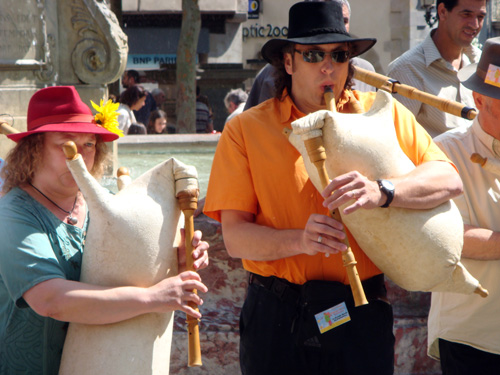
At the market in Place Carnot in the Lower Town of Carcassonne we saw a group of bagpipers (bagpipe=cornemuse) with bags that were inside-out goatskins, the whole goat with. They blew into the neck hole, played a flute coming out of one front leg and a drone coming out the other, and had one rear leg doing something for them too, with the other rear leg being the only one that had been snipped off and patched over.

SF concept: some alien using the skin of a dead human in this fashion.


[Star artist of the class: Kevin Brown.]

The days slide by, time as shapeless as sand. We get up, eat, paint, go to bed at any old time, nothing is punctual.

I got to show my slides to the group, and the teacher, Glen Moriwaki, gave me a really hard time about how big I sign my name. That was about all he talked about relative to my old pictures, which really got embarassing after a few slides.

But I like the guy anyway, he’s a character, an artist full of ideas. And I guess I’ll start signing my name smaller. I’d thought, all along, that it was funny and cute to sign my name big. Also I was doing it as a kind of Warhol goof, taking off on the fact that a key thing that makes my pictures potentially marketable is the fact that I’m a well-known writer, so the branding is an essential part.

When I raised this point later, Glen suggested that I could forget about the SF branding and try to reach a new audience of people who aren’t even interested in science fiction.

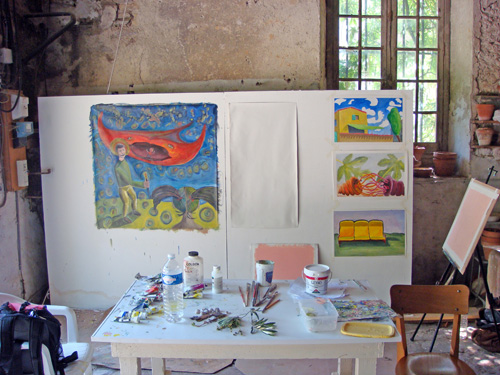
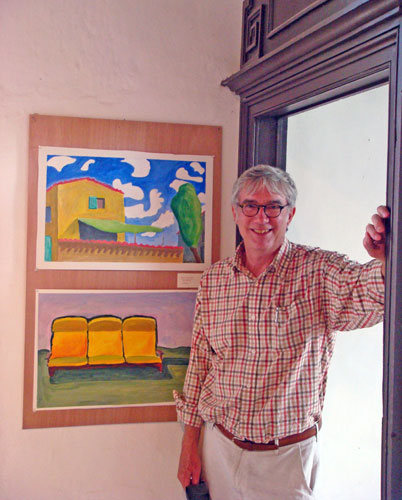
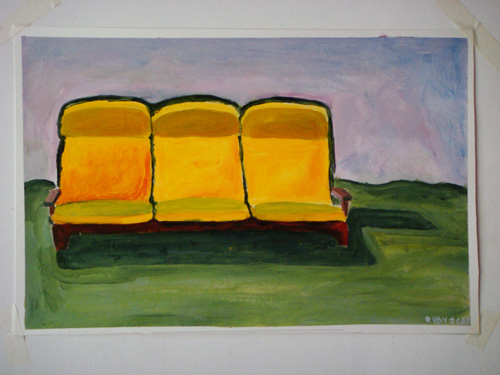
To break my habit of doing heavy SF paintings, I did a realistic painting of a yellow lawn couch, the style a little like Mel Ramos, a West Coast Pop artist. I was frikkin’ scared to sign it big…

Walking around the little medieval village of Caunes day after day. It’s so tiny. And on most of the streets you can’t see the horizon, or even any green. You just see the walls. It’s like being inside a very high-walled maze. The village. And when you get out into the green fields it’s such a relief. I see Thuy and Jayjay having this feeling in s’Hertogenbosch.

The other students are friendly, and accept me as a painter. It’s like when I started being a science-fiction writer. Everyone is, like, “Come on in, the water’s fine. The more the merrier.” Kevin painted a great portrait of Sylvia in about half an hour. He’s an inspiration. He rents the Live Worms gallery for his studio on Grant Street in North Beach.

Thinking more about Glen’s reaction to my slides, it might have breen that he was, like, flabbergasted by my paintings and simply couldn’t think of anything to say. Talking about this with Sylvia I said I felt like an outsider artist, and she said, “So what else is new?” Referring to my career as a novelist…

In any case, I’m here to learn, and Glen gives great advice on the paintings as they move along.

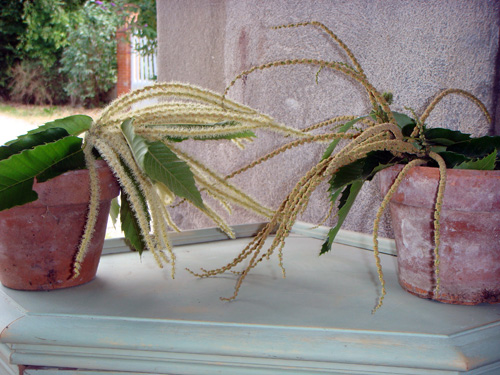
Still getting started on my workshop paintings, I wanted to paint these chestnut tree blossoms. I’d picked two interesting tendril-blossom flowers from a tree something like a chestnut.

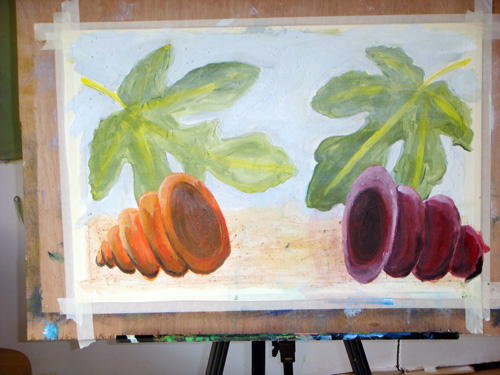
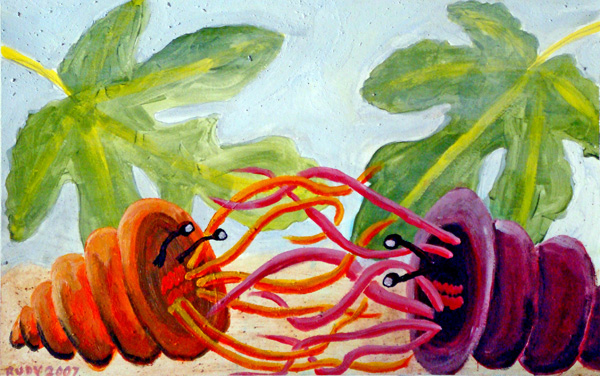
I got two fig leaves and traced their shape onto some thick (140 lb) paper. I painted in the leaves, and then I mixed some local red marble dust with acrylic medium to make my own pink paint. I used that for the ground, then added some ultramarine to get a bluish tint for the sky. I wanted the chestnut flowers in front of that. But it seemed too hard. And I wanted some SF.

I got to thinking about how old married couples are so entwined with each other, sometimes billing and cooing, sometimes bickering, and I decided to have the flowers be mollusks grappling with each other. I gave them shells and did the tendrils. I called it “The Old Marrieds.”

Trip to France. Cathedrals and Castles.

Friday, July 6th, 2007

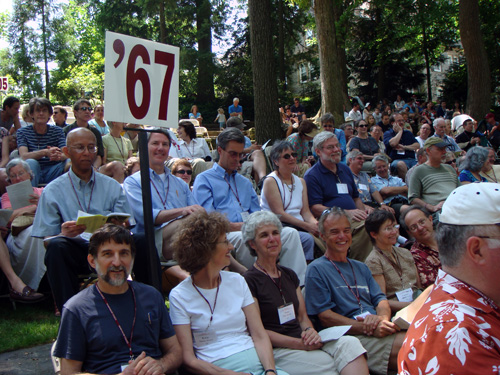
Where have I been? My wife and I went at our fortieth reunion at Swarthmore College, visited daughter Georgia and family in NYC, and then we flew to Paris, rented a car and drove to the southwest of France in Caunes near Carcasonne and the Pyrenees for a two-week painting workshop with Glen Moriwaki.

I got about five paintings done; one of my favorites is called Hylozoic like my novel. It’s a square meter.

And another favorite is a Theibaud and Hockney influenced landscape called South of France. Wanted to show these two right off, the “big fish” I caught on my expedition. I’ll write more about the painting workshop in a later entry. But today I’ll talk about the journey itself.

At Swarthmore, we did an alumni parade and then were herded into our lovely old commencement amphitheater for a series of talks. Sadly the programming of this alumni event was in the hands of money-grubbing morons. The Alumni Association works hand in glove, or in some even more intimate fashion, with the multiple-layered and ever-expanding bureaucracy that has turned the college into a business for generating money for hiring ever more administrators.

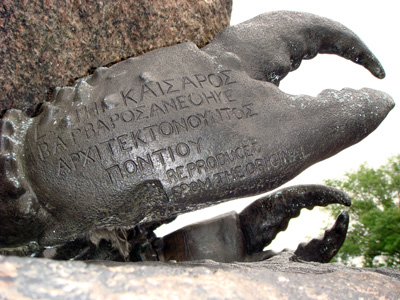
[Iron crabs hold up the “Cleopatra’s Needle” obelisk in Central Park behind the Met.]

After the money-raising talks, my classmates and I were wondering if we were the only class perennially in the grip of reflexive rebelliousness. Perhaps it has to do with the fact that when we graduated, our government wanted to send us to the slaughtering-fields of Viet Nam. They said we were cowards not to go.

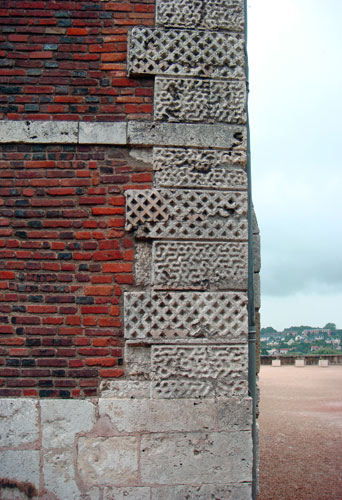
[A corner of Chartres cathedral.]

I dream that my classmates and I can plan an insurrection for our 50th reunion. We could drive the money-changers from temple; usurp the stage and speak of art, science, and philosophy. Play some music. Dance and tell jokes. Be silly and sentimental. Give the finger to the establishment one more time. Perhaps our 50th reunion class gift can be a detailed plan for how to cut the number of administrators by half…

After the reunion, we visited daughter Georgia and her husband Courtney and their daughter in NYC.

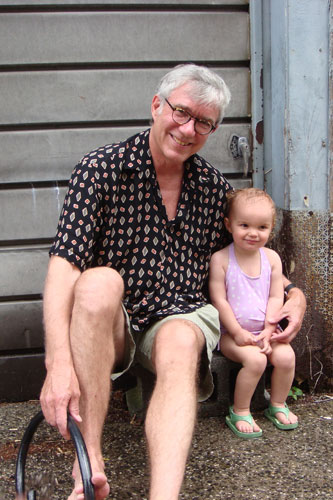
My granddaughter!

On the way south we spent nights in Chartres, Tours, Rocamadour, and Carcassonne.

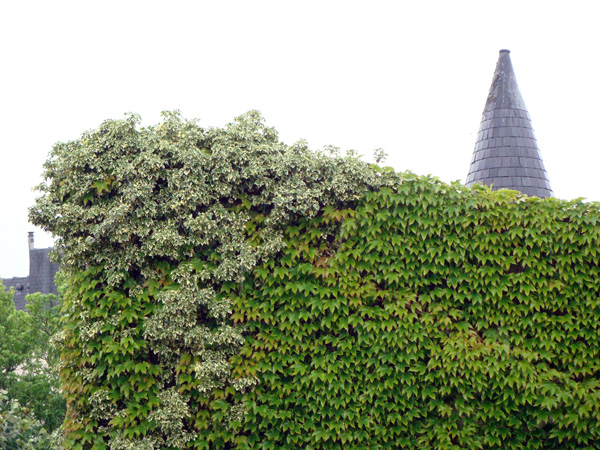
[A wall in Chartres. Gnarly ivy.]

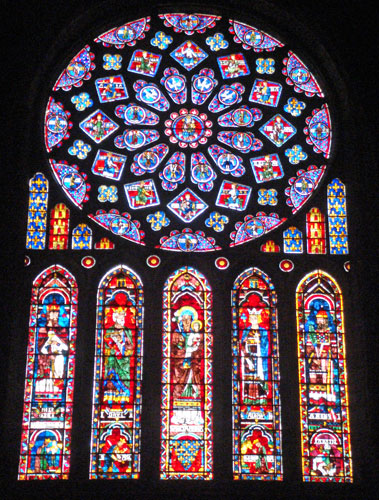
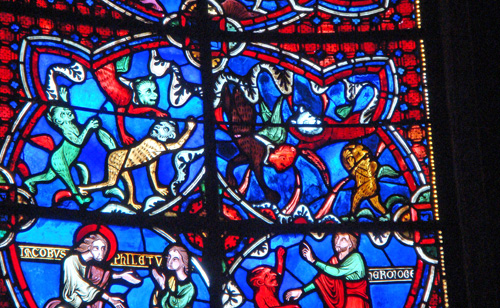
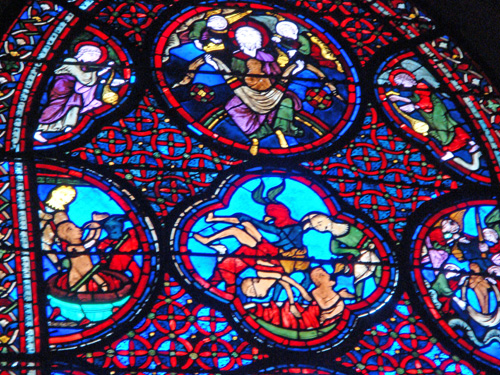
The windows at Chartres were wonderful, dating back to the 11th or 12th century.

[This and the next glass image are from the lesser known but awesome Gothic cathedral in Bourges; these windows also from the 12th century.]

I liked thinking the windows are nearly a thousand years old. We even took a little tour, and the guide pointed out that in the Middle ages most people didn’t read, so the cathedral itself was like a book, with the key facts of the religion on display.

The ultimate Sunday funnies. He showed us how to read the windows; bottom row to top row, often reading each row left to right.

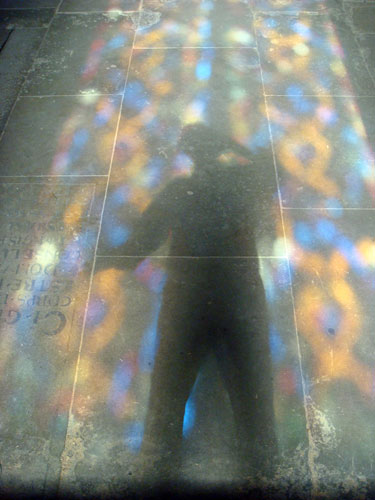
Stained glass windows are a great medium, a very heavy means of information transmission. Like runes or glyphs. And so psychedelic. In another church I sat with the sun shining through a stained glass window onto my face and slowly the colors against my eyes changed as the sun moved across the sky.

Standing, I was outlined in colored light.

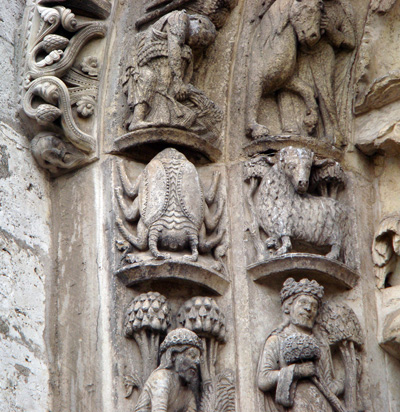
The portals of the cathedral are ringed with sculptures. I found one alien-like beast, but the guide said it was just a scorpion, for the zodiac sign.

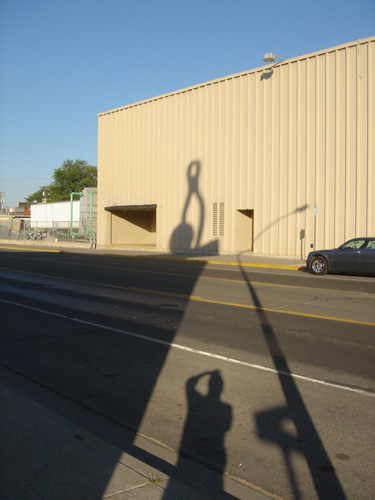
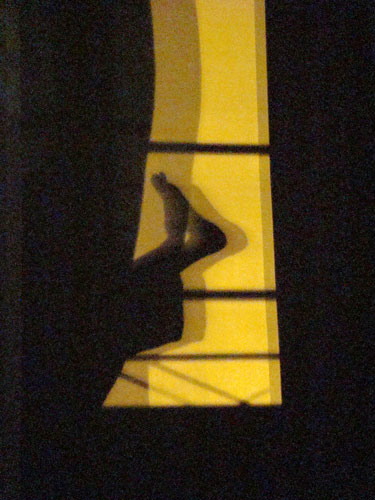
In Tours we had a nice cheap room overlooking a square. I had 3 a. m. jetlag there, light from the square through the window, content to look at my foot’s shadow.

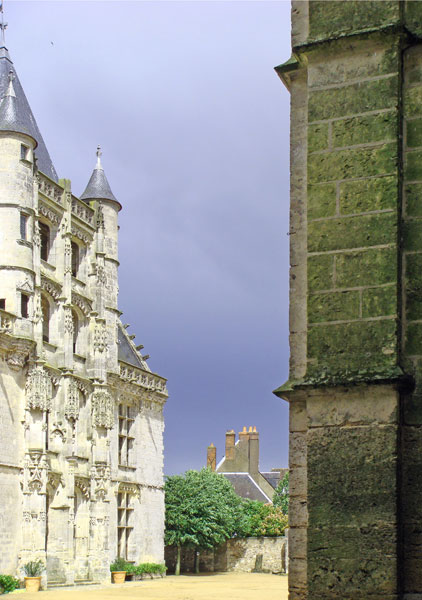
The big thing in Tours is to drive out and see castles of the Loire. We picked off Chateaudun and Chenonceau in particular.

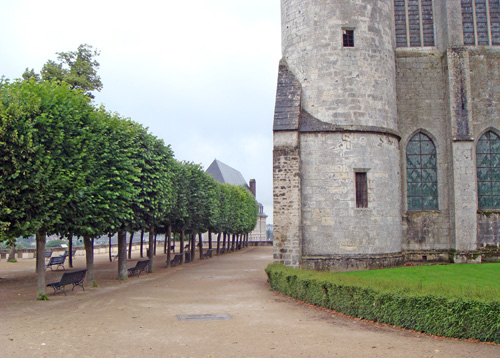
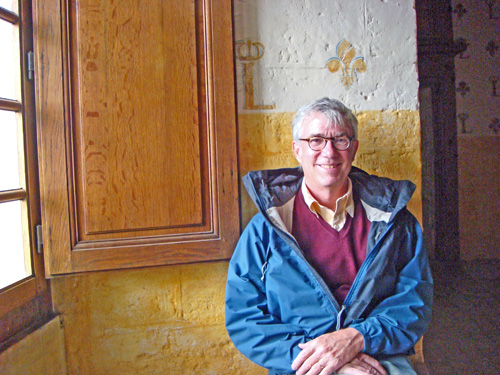
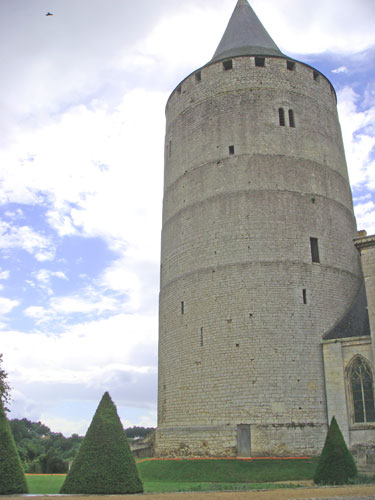
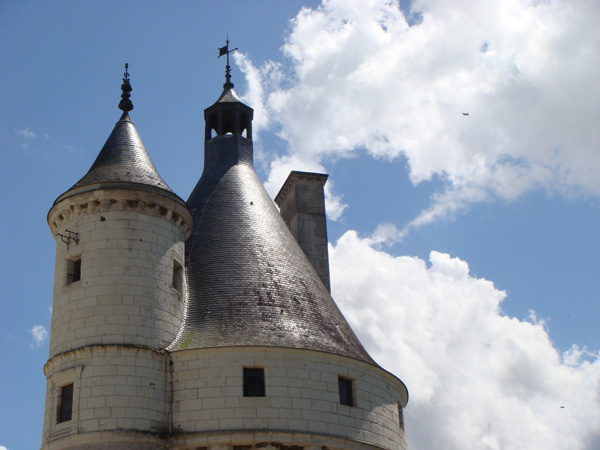
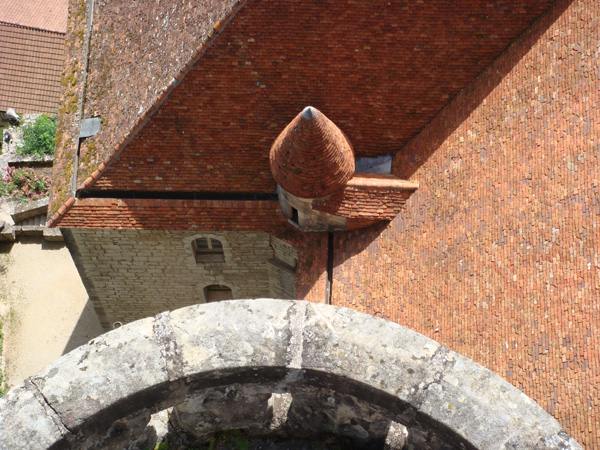
Chateaudun was off the beaten track and medieval. I love the conical tower and the conical-trimmed trees. And a crow in the air.

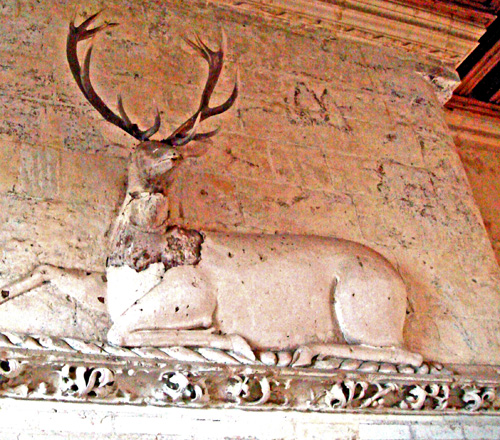
It rained at the castles. Inside a hall in Chateaudun they had a stone stag over a fireplace that segued into a stuffed stag’s head.

Peaceful and quiet.

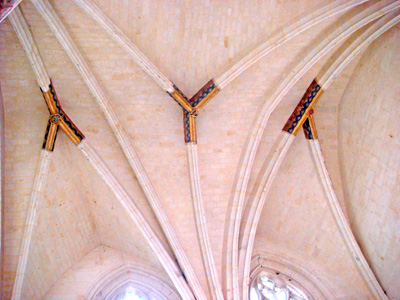
Asymmetric arches in the chapel.

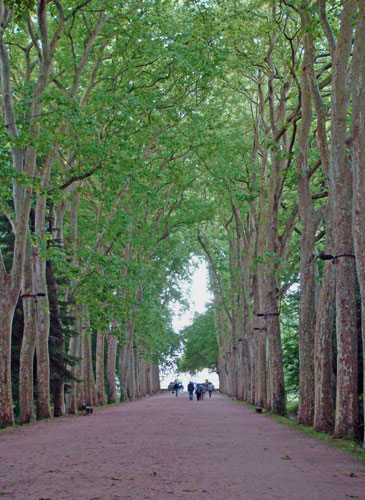
Chenonceau was the best, with a long leafy entrance path. The castle stretches across the Loire, a shallow not all that wide river. It has a long ball room set onto what was once a bridge.

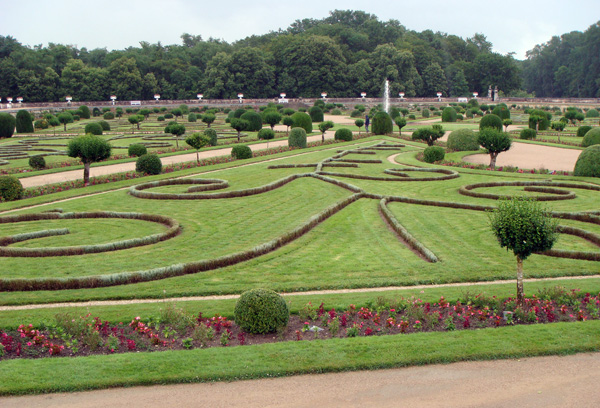
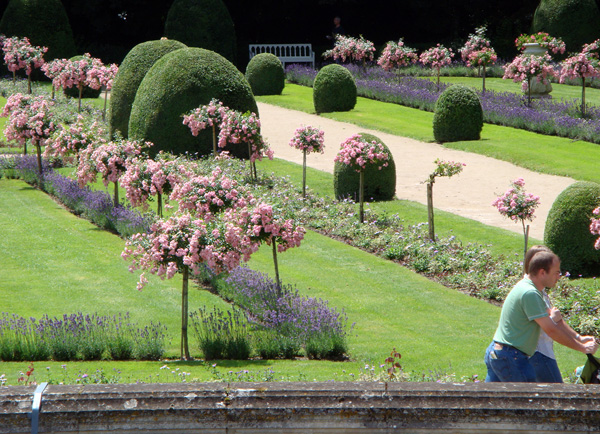
Amazing formal gardens.

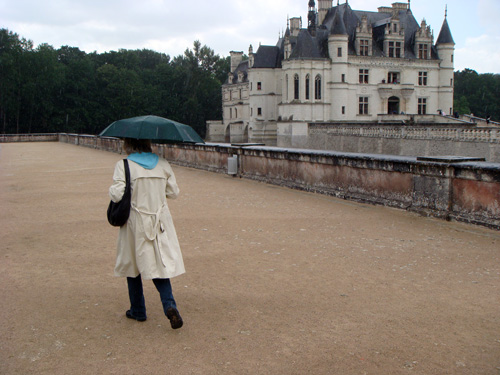
This was a very romantic day, the clouds coming and going.

Sylvia looked so cute in her white raincoat.

A rose garden on one side of the castle.

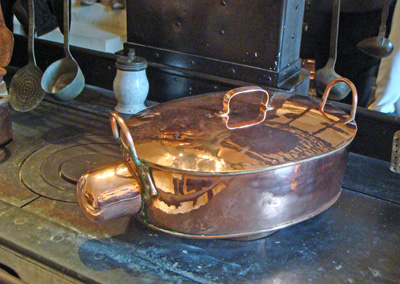
In the basement kitchen a special pan for roasting pigs, with snout-extension.

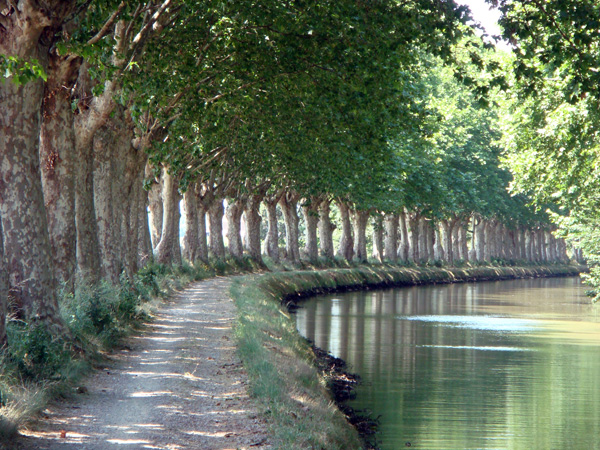
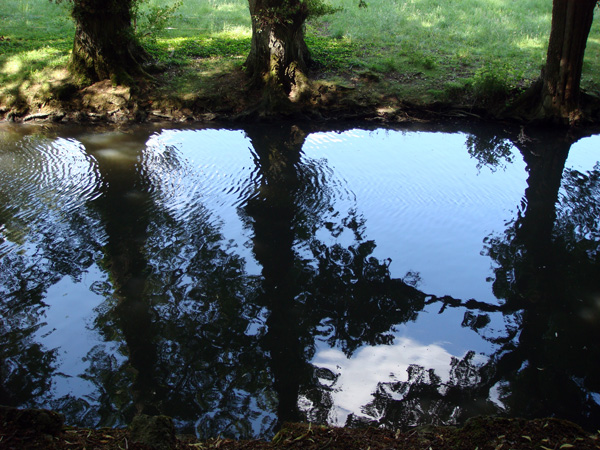
A beautiful little canal with plane trees growing next to it. I’d like to paint this.

Rocamadour was a wild card that I found in the guidebook.

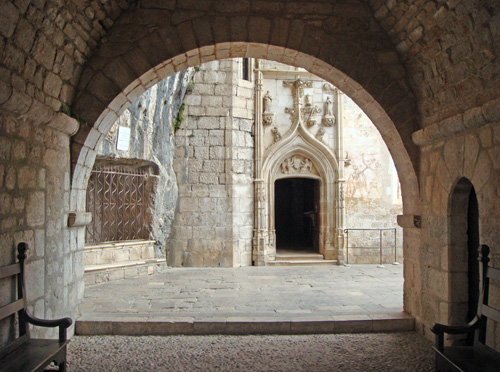
A bunch of chapels set into a cliff, with a castle on top and a little town at the base.

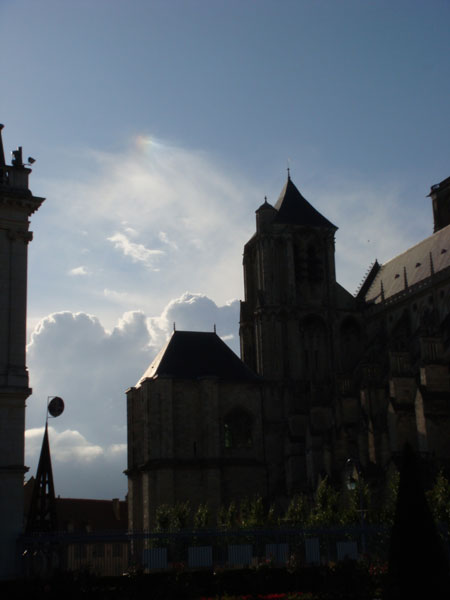
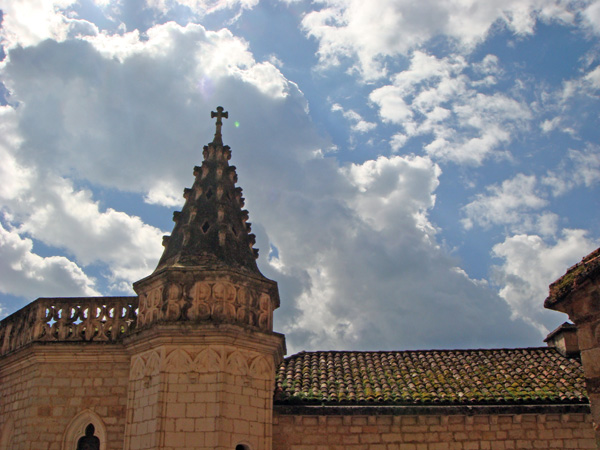
Incredible clouds behind the lacy towers.

Tons of swallows busy in the air all the time—swallows around all the castles, as a matter of fact.

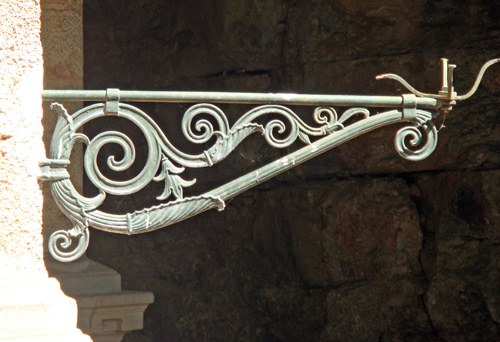
Incredible iron work.

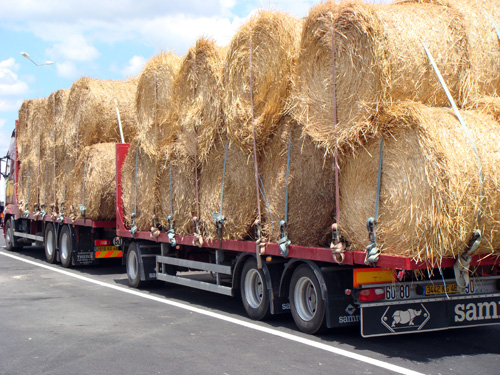
We hit the freeway to head further south. Note the rhino on the hay truck mudflap.

More Tulpas and Big Sur

Tuesday, June 5th, 2007

I’m just writing a scene where the Peng make themselves a tulpa house that’s a copy of this structure from Heironymus Bosch’s Garden of Earthly Delights. Thuy gets them to do it for a joke; not being mammals the Peng don’t get it about those two pink towers near the top left, flaccid and turgid.

I’ll be off-line for the rest of June. Meanwhile, here’s some more pictures from Big Sur, along with notes about “matter hologram” tulpa bodies. If you wonder about the made-up words I use, just type them into the blog’s Search box at the top right, press Enter, and you’ll find links to earlier blog entries where I discussed these same words before and perhaps even defined them.

When Charlie Stross writes about sending people as info patterns—like in Glass House—he has a nanotech gate at the targeted location, which builds the incoming person’s body atom-by-atom (after first editing or “redacting” the incoming info pattern, for security’s sake). Let’s call this the nanoLego model of body transmission.

For Hylozoic, I’m proposing a much more baroque way of having the Peng be sent. Their pattern is sent to Earth, same as in the nanoLego method—but then instead of building them a body, I have their info coded into a quadrillion-fold inefficient Peng ranch computation of slaved atoms spitting out paired-fermion De Broglie waves to create a matter hologram of a Peng, said hologram being dynamically updated by the distributed computation.

I’m not doing this because I think it’s more realistic or likely. I’m doing it for exiguous reasons, that is, I want to write a story where aliens are skimming off the gnarl of our natural computations. And it occurred to me that if aliens were going to be mulcting us of our gnarl, they should be using it for something important to them, and what could be more important to them than projecting copies of themselves into our world.

But in the story there has to be an internal motivation for the Peng going all around Robin Hood’s barn like this. If I don’t explain why they’re not using the easier nanoLego method, I’ll seem like I’m foolishly overcomplicating things.

So—let’s address this question in the novel, and claim that being in a tulpa matter hologram body is much better than being in a normal nanoLego solid matter body.

Better how?

Weak answer: it’s a luxury for the Peng to get such obscenely inefficient bodies. Like driving very fuel inefficient cars. Conspicuous consumption. “Oh dear, my body uses a quadrillion times as many atoms as your body. But, ahem, I can afford to.”

Better answer: A tulpa body is very hard to destroy, as it emerges from a million cubic kilometer computation. So it’s a safer body to have on a world with possibly hostile natives. Fine, but we could argue that a nanoLego body could pretty easily be reconstituted , so we need a stronger reason than this.

Best answer: a tulpa matter-hologram body has femtotech powers, which seem like superpowers. If you’re an ioneer in a tulpa body, then you yourself, qua epiphenomenon of a distributed quantum computation, are able to tweak your underlying computation—which fills the million cubic kilometers of Peng ranch surrounding you. Therefore you have telepathic direct matter control, that is, your thoughts can become objects—which are additional matter holograms that (at least as seen from the outside) behave just like normal nanoLego objects. You can build a house from nothing, turn a stone into bread, water into wine, make flowers bloom from your fingertips. You can levitate and move your body around as readily as a video game player moves Mario. (I won’t allow for teleportation though, not even within the volume of the Peng ranch, as, for story purposes, I’m limiting full teleportation power to humanoids.) You can shapeshift and change your form. Perhaps the Peng begin looking like—the horror!—human Realtors. “Call me Ducky. What would it take to earn your business today?”

By virtue of having installed all the tulpaware atom by atom on the Peng ranches, Jayjay could have lasting mental indices of the atoms in both the wilderness and the SF Peng ranches. This data could be stored in his endless lazy eight memory upgrade. But I’ll he didn’t pay close attention. He didn’t bother to remember.

But maybe Chu finds out the atomic programming by watching the Peng tulpas make themselves a tulpa house.

Jay—and he alone of all humans—does know the general mediumistic tulpa-programming technique, so with Chu’s memory help, Jayjay is able to reach out to each and every one of the atoms and put something else into it. Call this antidote the aether wind. It’s about “dusting off” the atoms, decohering them from the unitary quantum state that’s generating the tulpas. It should take our two boys a couple of minutes to psychically blow a puff of aether wind onto each and every atom of a Peng ranch

The Peng ioneers try to kill Jayjay and Chu while they’re decohering their Peng ranch atoms with the aether wind. They’re freeing the silps concentrically from around his house, so they’ll have rings of allies around. For their part, the ioneers are getting telepathic control of some of the low-gnarl animal minds, such as bears and mountain lions. And Gretta shapeshifts into a human woman Realtor to trick the boys.

But then the Peng (and the Realtor) start looking weird. They’re partial series sums now, what mathematicians call “jets”. This means both that the Peng tulpas each have a half dozen ghost images, and that their shapes are overly smooth in spots and with odd sharp cusps in other places. Their thoughts are a bit incoherent as well.

Kakar turns the aether wind back upon Jayjay, decohering his particles effectively pausing his quantum computation in mid-crunch. Jayjay is frozen in the midst of saying something to Thuy—a little like when Han Solo became a silvery sculpture on Jabba the Hutt’s wall.


Rudy's Blog is powered by WordPress