



Click covers for info. Copyright (C) Rudy Rucker 2021.


Archive for the ‘Rudy’s Blog’ Category

Wisconsin to South Dakota

Wednesday, June 25th, 2008

We were out West just now, visiting daughter Georgia and her family in Madison, Wisconsin, and daughter Isabel and family in Pinedale, Wyoming, driving overland between the two through Minnesota and South Dakota.

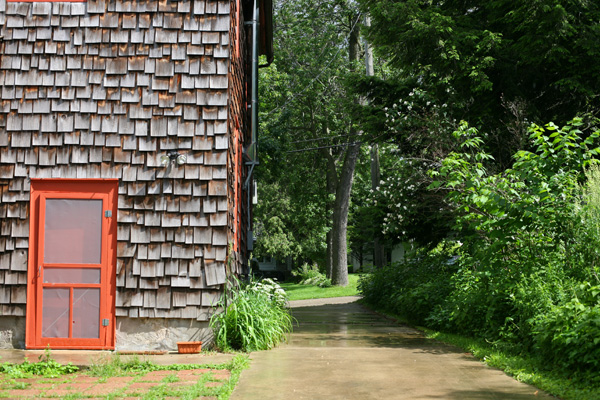
Madison is very lush. Even the weeds look like special garden plantings.

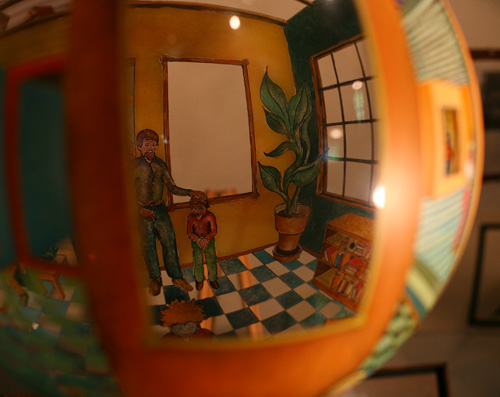
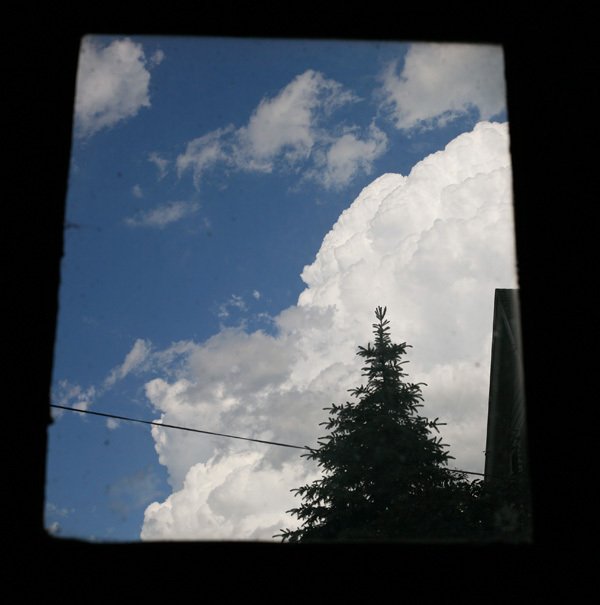
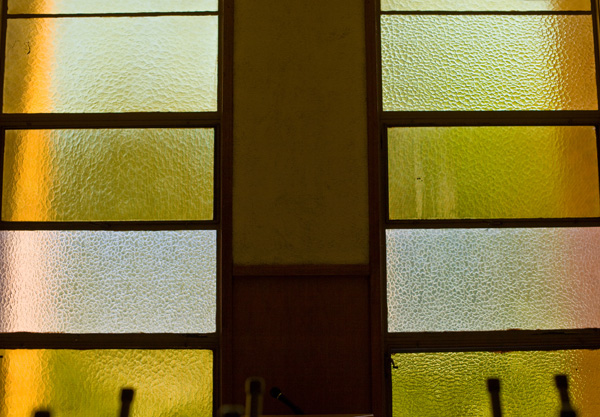
Georgia told me take this picture, through a window in her garage.

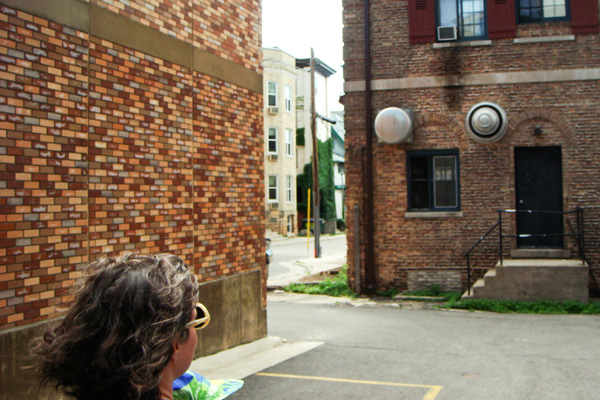
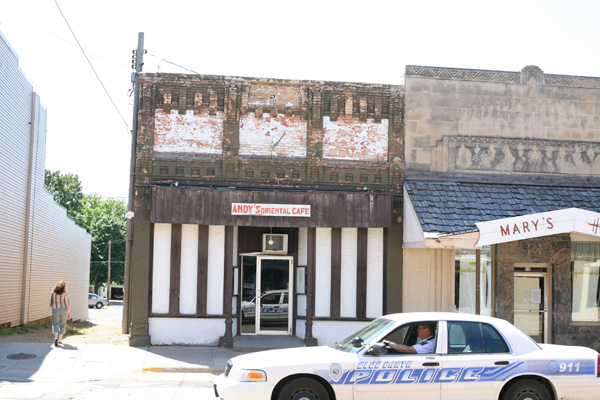
Downtown Madison has nice buildings and interesting alleys, not to mention two big lakes.

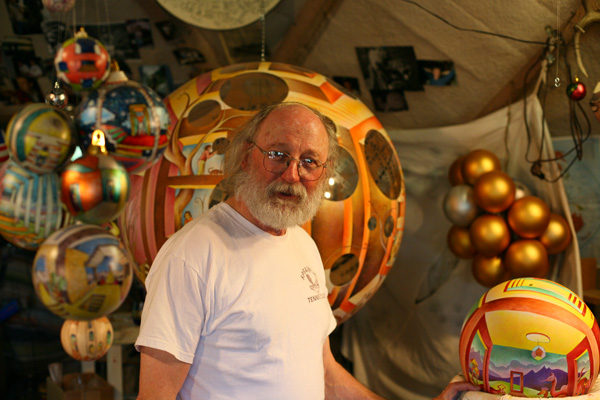
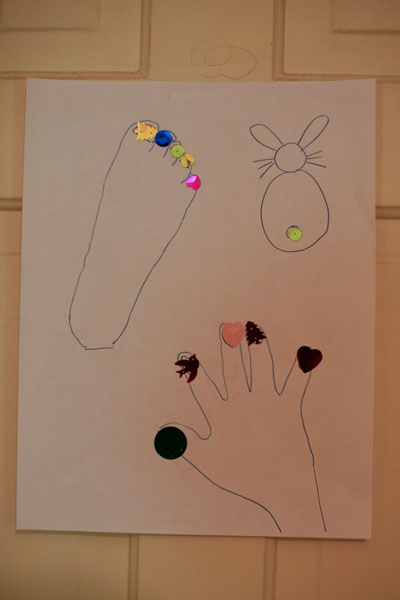
Sylvia made a nice Warhol-like drawing for our granddaughter, who glued on the sequins. Sequins have come a long way.

Minnesota was suitably vast and Midwestern.

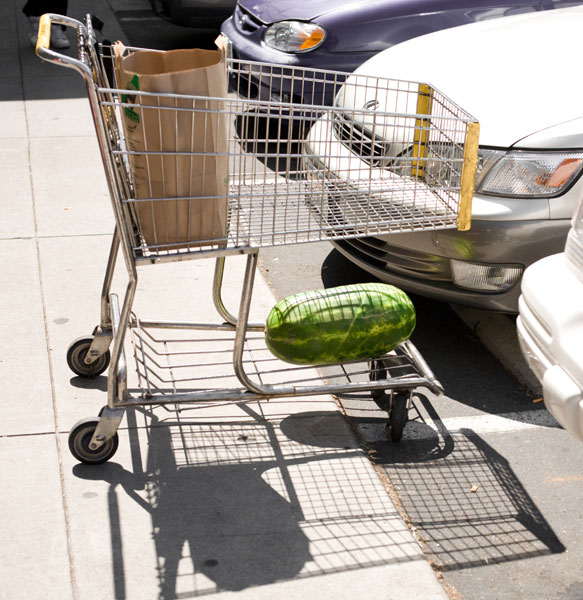
We stopped in a tiny town called Blue Earth, Minnesota, just because it seemed like a nice town name. Earlier in the day we’d hit a Wal-Mart to pick up some food. The Wal-Mart trademarked slogan now is kind of ominous, a single word: Always.
.

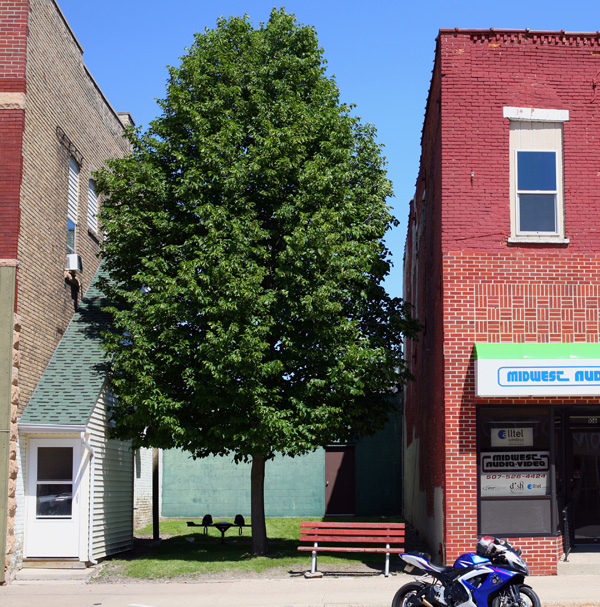
Blue Earth had a hippie store with dried fruit and this weird single-tree park.

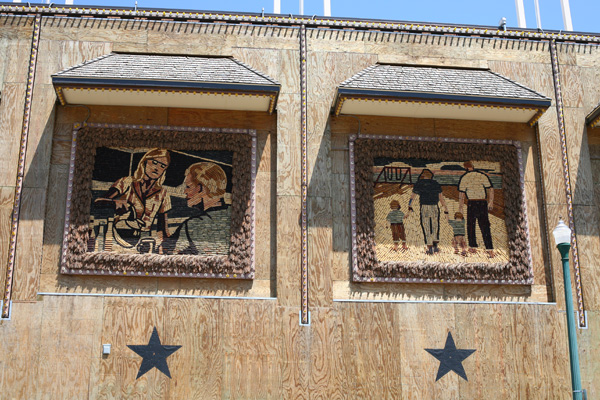
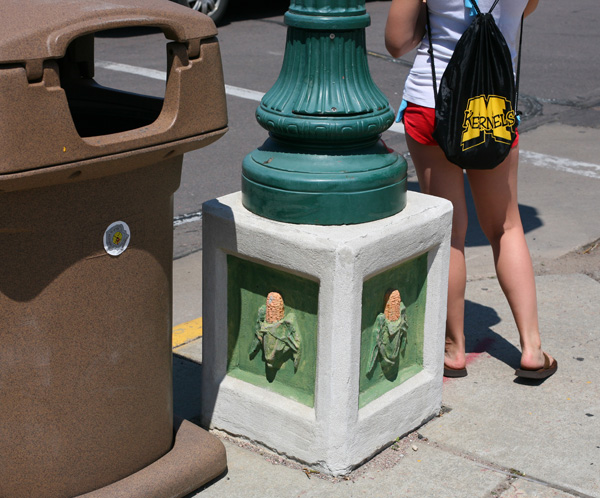
We spent the night in Sioux Falls, South Dakota, which was kind of a nice place, although there was an enormously loud ventilation fan right outside out window, a recurring problem on the trip. On the Interstate 90 in South Dakota you’re in this endless ocean of rolling grasslands, and get eager for a roadside attraction, such as the Corn Palace in Mitchell, SD. The murals are freshly tessellated from sawed-in-half corn cobs every year. They were corny.

The Mitchell high-school team is the Kernels!

The clouds were amazing in the prairies, feathery, vast, spaced out from horizon to horizon like cauliflowers in a field.

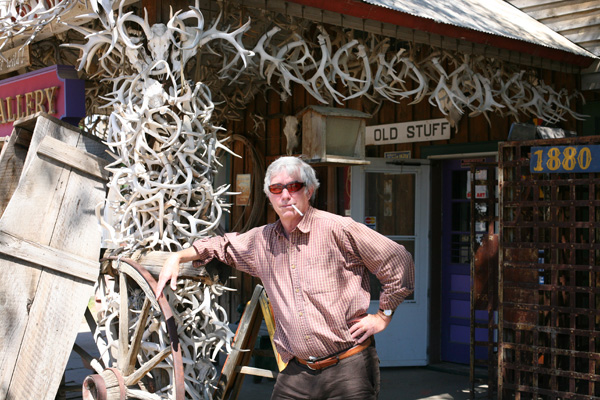
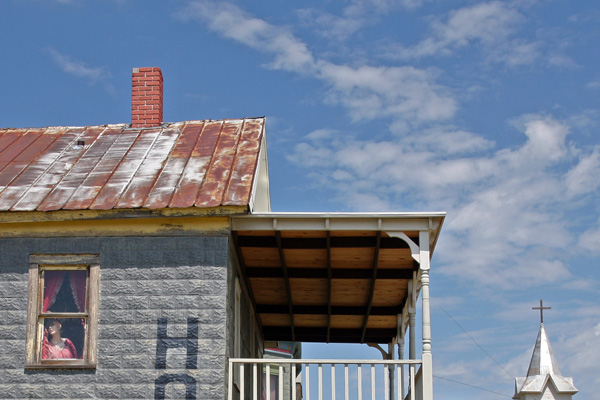
1880 Town was another SD roadside attraction. Note the mannequin of a woman in the upstairs hotel room. All the buildings were trucked in from all over the state, genuine.

It was surprisingly hot in the sun; a guy working there said it goes up to 120 in the summer. The guy was a retiree from Mississippi who parks his RV for free at 1880 Town in the summer and puts in a few hours a week as an attendant. His wife was with him, doing the same thing, apparently Work for RV Campers is a popular thing for retirees. Sort of reminds me of the pheezers in my novel Software.

I dug the peeling wallpaper in the hotel with the mannequin upstairs.

The RV Work-Camper’s wife told us that most of the buildings were kept up, but that the man who’d donated the hotel insisted it be kept as is till he died because he’d spent a night there in the 1910s. He’s 94 and he visits the hotel every day. Maybe he’s in love with the mannequin. Twilight Zone episode…

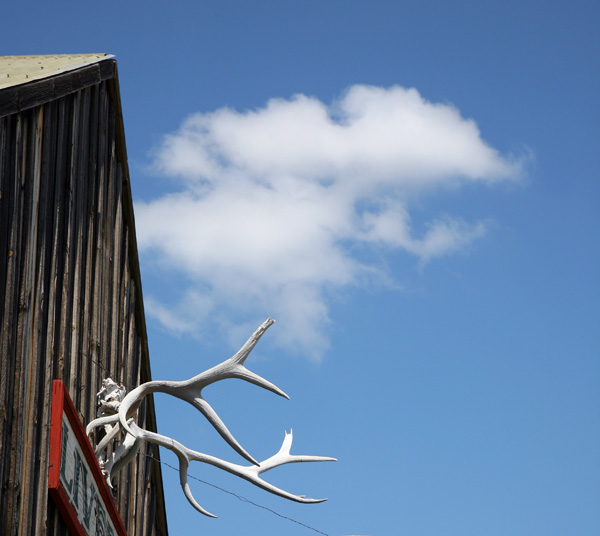
Antlers are a favorite form of natural gnarl decoration in the Wild West. One thing that struck me about the WW is that it only lasted 20 or 30 years. I’m thinking there was something similar in Silicon Valley from like 1975-2005, a 20 or 30 year transition period, and I happened to be here for most of it. Maybe I could get a memoir out of that.

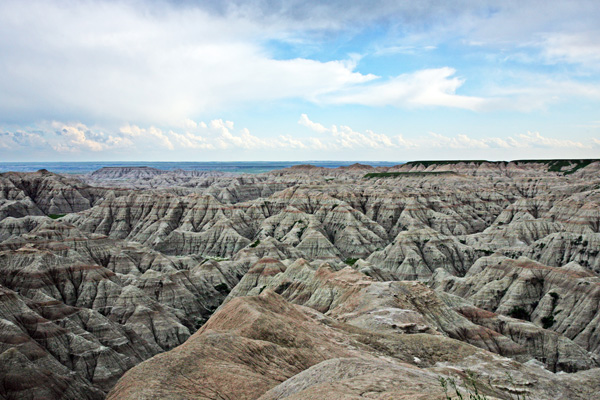
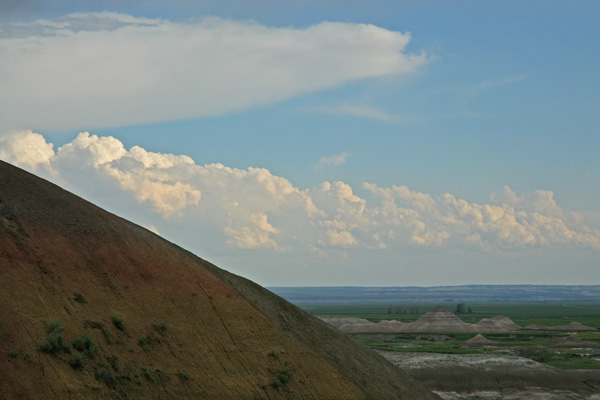
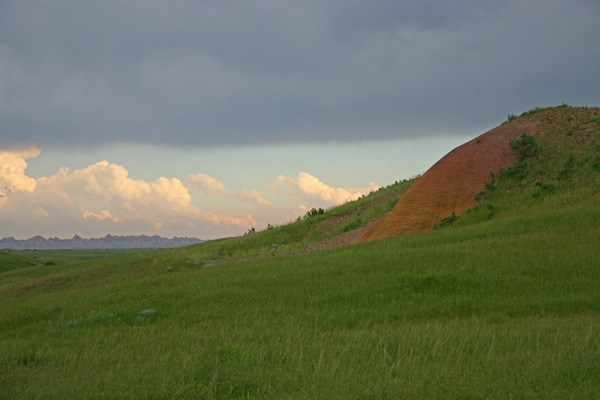
We hit the Badlands of South Dakota next. They aren’t all that big, but they’re pretty great.

What made it wild was that most of the time there was this enormous thunder cloud hovering over us.

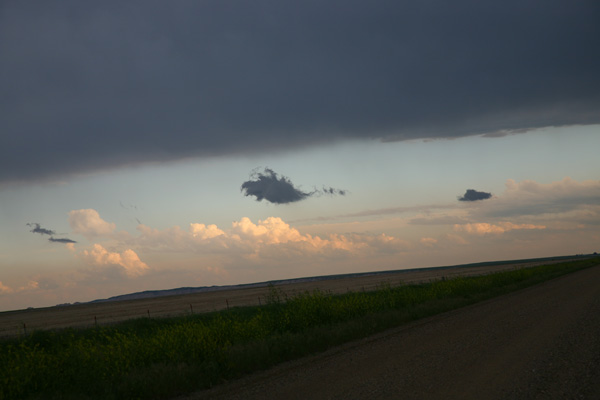
The clouds under the thundercloud looked dark and the far-away clouds looked light. I shot this intelligent-alien type cloud from my moving car. A flying jellyfish. I considered Photoshopping away the tilt, but the tilt makes it look more desperate and authentic. Shot moments before that intergalactic contact after which everything changed…

Suckling on the breast of Mother Earth.

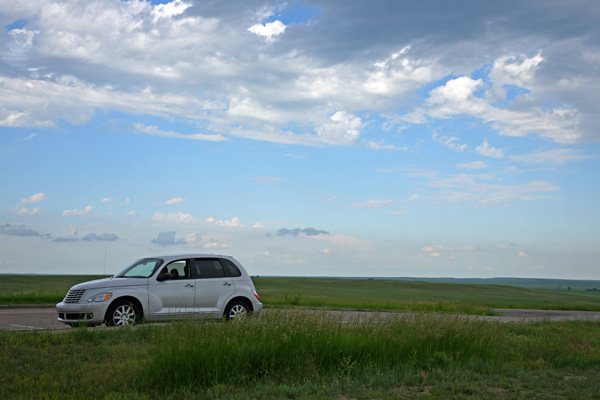
We were diving this nice PT Cruiser I rented. I like those cars a lot, although the mileage was only about 23 mpg even on the freeways, and the pickup isn’t that great if you really want to pass someone. If they could make a high-mileage turbo PT Cruiser, it would be irresistible.

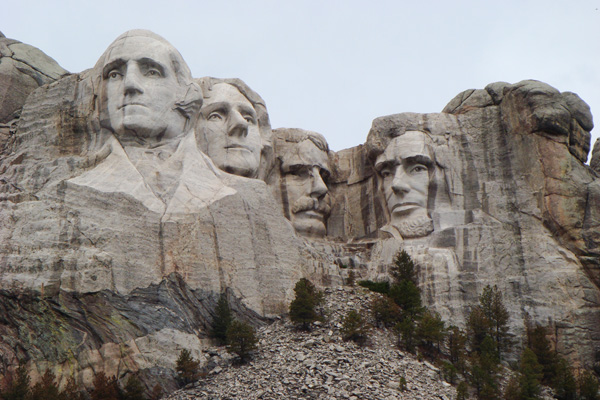
Gotta hit Mount Rushmore. The road to Rushmore from Rapid City is insane, a roadside attraction every thirty yards for like twenty miles. But once you’re there, the statues really are impressive, it’s intense to see the physical reality of something you’ve seen take-offs of your whole life. The guy who made them was a refreshingly nutty artist, Gutzon Borglum (Danish name).

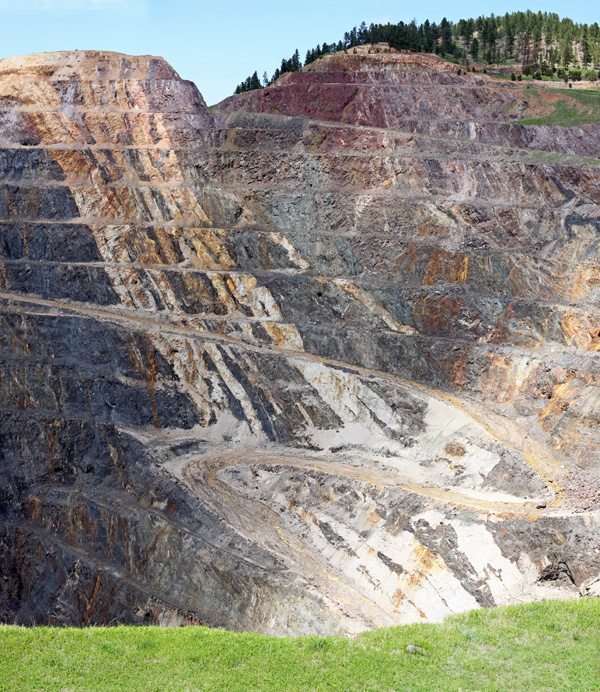
We stopped in Lead, SD, (pronounced leed) to check out the enormous pit-like “Open Cut” gold mine, now unused. For the sake of good public relations, the Lead Homestake Mining company doesn’t actually have a photo of the open cut on their website! I thought it was kind of beautiful though, smoothed off by the weather as it is, and with the lush green grass growing right up to the edge. An earthwork. Those diagonal stripes are veins of rhyolite.

Revising Hylozoic

Tuesday, June 10th, 2008

This is going to be my last blog post for a couple of weeks, as I’m going to be busy with other things.

I got some revision suggestions for Hylozoic from my Tor editor, Dave Hartwell. He felt that the first half reads a little slow, and he suggests I put in more chapter breaks to pick up the pace, essentially splitting each of the book’s chapters into 2 or 3 pieces.

That’s a good idea, I think readers find it easier to have a book in manageable chunks. When I was composing the book, I was into a “long breath” notion, cf. Jack Kerouac’s notion of a saxophonist playing a very long jazz chorus. I was thinking of each chapter as a kind of novella. But they do contain natural breaks, so it’s not hard to make some splits.

I’ll put in some extra wows at the new chapter ends to give them punch, and I’ll even subdivide some chapters with “***” breaks. At this point I see 19 chapters instead of the 8 I had before. The chapter titles?

Chapter 1: After Everything Woke Up.
Chapter 2 : Moving the House.
Chapter 3: Jayjay and the Beanstalk.
Chapter 4: The Missing Gnarl.
Chapter 5 : Alien Tulpas.
Chapter 6: The Peng.
Chapter 7: The Hrull.
Chapter 8 : Coma Nurse.
Chapter 9: Lusky.

And…

Chapter 10: Ergot.
Chapter 11: Hieronymus Bosch’s Apprentice.
Chapter 12: Painting the Thistle.
Chapter 13: Hrull Gel.
Chapter 14 Viral Runes.
Chapter 15: In the Stew.
Chapter 16: The Magic Harp.
Chapter 17: To the Gibbet!
Chapter 18: The Maelstrom.
Chapter 19: Transfinite.

My editor likes the Chu character, he said he was surprised how well he worked, and that it was refreshing to find an autistic character in an adventure novel where external stuff is happening, something which my reader Sarah Heacox blogged about as well.

I worry a little that the main thing I really wanted to write about, that is, hylozoism (everything being alive) doesn’t come through as strongly as I wanted. But, really, it does shine through pretty well. It’s better to take a light touch with this, I think, and not have every single object making a speech…

The revision work feels painfully clumsy and slow, and, as usual when writing, I’m anxious. I do worry that I made Hylozoic too complicated. I’m looking for ways to simplify the science ideas, but it’s hard to just take something out, as the whole thing gets to be like a mathematical proof or a Swiss watch—if you take out one of the gears, the thing doesn’t tick.

Maybe for some readers a certain background complexity of scientific ideation is a good thing? Said the crazy old man wistfully.

Yes, I know that I’m worrying too much. If I didn’t worry a lot, I probably wouldn’t write at all. Actually, my editor didn’t think the complexity is a problem at all. People just zip through that, it’s expected in modern SF.

I think part of my difficulty in working out the story is that all along I was seeing Hylozoic as the middle novel of a trilogy. On the one hand, a lot of complex back-story sloshed over from Postsingular, and on the other hand, I’d been trying to foreshadow some story and plot ideas for a third novel in the series that I was calling Transfinite.

I decided yesterday that I don’t actually want to go on and write that Transfinite as a third novel. I want to bail from this stress and cut it down to a two-novel series. Often, the sales of a third volume of a trilogy are lower than the sales of the two before—except of course for the exceedingly rare runaway smash. So why do it?

I recall that my 1980s novels Software and Wetware sold really well as a pair, and then, in the 1990s, when I added on two more to the series, Freeware and Realware, they didn’t sell so well.

Okay, so what do you call a pair of linked novels? “Duology” is okay, but I’d prefer to call it a “double feature”! In any case, it could still be that eventually I revisit the Postsingular series world and its characters with a fresh adventure. But this way, I’m free to take on something different for my next novel. Maybe something simpler next time…

By way of cutting my series down to a double feature instead of a trilogy, I plan to add a chapter describing in detail a scene that I’d set up for the start of Transfinite. Taking the time to add this material will probably delay the release of Hylozoic until Fall, 2009, instead of Spring, 2009.

Transfinite was going to start with an account of Thuy Nguyen’s trip into the transfinite, or “beyond infinity” (which is not a joke concept, despite what the movie Toy Story seems to suggest), with her husband Jayjay and the painter Hieronymus Bosch, who’s one of the characters now.

By the way, a preliminary draft of one of my Bosch scenes appeared in Flurb—although I’ve revised that piece a lot in the meantime, and am still working on it, as Bosch needs to be more particularized to work as a character.

For the new material in the final chapter of Hylozoic I’ll essentially fold that start of the projected third volume into a chapter-length “metanovelistic” account by Thuy Nguyen of her trip beyond infinity — she’ll just be telling it to her friends, knowing that it’s going out live on the Internet, abandoning her notion of selling the story, and just telling it now so that she can write an entirely different metanovel for her next work. I am Thuy, actually…

“It’s all tangled up,” protested Chu after Thuy told her tale. He’d been brooding about the muddled chain of cause and effect. “It doesn’t make enough sense.”

“It’s what it is,” said Thuy. “And now that I’ve told you this end part, I’m not gonna bother writing it up as a separate metanovel. Everyone on the web heard what I said. This story’s done right now, just as it is.”

Catch ya later, mischief-makers…

Go, Bo Diddley!

Monday, June 2nd, 2008

Good old Bo Diddley. His were the first record albums I ever bought, back in St. Matthew, Kentucky in the very early 1960s. My friend Niles and I treasured them.

I saw him in Louisville in 1963 with Niles at the Kentucky State Fairgrounds in a rock show, and with Sylvia in San Francisco in 1989 at a club, in San Jose in 1994 at a club with Ronnie Wood, 1998 San Jose Blues festival) and in 2000 in a club, and in Saratoga with my daughter around 2005.

Go, Bo Diddley!

I wrote a scene in my autobiographical UFO novel, The Secret of Life about seeing him at that show in Louisville, 1963.

[Video of Bo Diddley playing “Bo Diddley” on a 60s TV show.]

“You do know who Bo Diddley is, don’t you, Dee?” They were on their way to a holiday-weekend rock and roll show at the Kentucky State Fairgrounds.

“He had that hit on the radio. Hey, Bo Diddley.”

“And the new one. You Can’t Judge a Book by Lookin’ at Its Cover. He’s the best. He even builds his own guitars. You know I have four Bo Diddley albums at home, Dee?”

“That many! Tell me about the deeper meanings of Bo Diddley, Conrad.” Dee looked pretty good tonight. She wore a thin white cardigan, and a print dress with a Villager collar. Usually she wore sweatshirts.

[Click for Audio of Bo Diddley playing “Crackin’ Up.”]

“Well, my favorite song of his is called Crackin’ Up. It goes like this.”

Conrad proceeded to sing the first few lines of the song, capturing the sense, if not the exact sound of Bo Diddley.

He sang it loud, with just the right number of dit-duh-duh-dit-duuh-dit-dit-dits, his voice rising to a hoarse shout on the last line “You crackin’ up.”

“What’s buggin’ you?” said Dee repeating the line from the song. “I should play that for my parents.” Dee’s father was a career engineer for GE. He and his family were due to be transferred out to California in only one month. Conrad’s family was moving at the end of the summer. It was all ending fast.

“I first got that record when I was fourteen,” said Conrad. “I remember listening to it one day; it was the day that I really got the idea of rock and roll. I was alone at home, and I put on Crackin’ Up real loud, and I went and stood in front of my parents’ full-length mirror and danced a little, singing along, you know. As I watched myself, I realized that someday I’d be cool.”

Suddenly, finally, Bo Diddley and his band were out on the stage, red sequined tuxes and all. Conrad dragged Dee back to their seats. Diddley struck up a steady chicken-scratch on his git-box and began trading insults with his drummer.

“Hey.”
“What dat.”
“I heard yo’ daddy’s a lightbu’b eater.”
“He don’t eat no lightbulb.”
“Sho’ ’nuff.”
“Whaah?”
“I heard every time he turn off the light, he eat a little piece!”

Now the band was blasting an old tune called ’Deed and ’Deed and ’Deed I Do, with the incredible Diddley sex-beat, and over it, the soaring alienation of Bo’s strange, homemade guitar. Bo Diddley, the man, right there, in the flesh, black as they come, sweating and screaming—for a few minutes, Conrad forgot himself entirely.

Bo Diddley was the last act before intermission, and Conrad hurried down behind the stage to get a closer look at his hero. Incredibly, Bo Diddley was right there, standing around talking to some black women. He was shorter than he looked on the stage, and uglier.
“Are you Bo Diddley?” blurted Conrad, pushing his way forward.
“Yeah. I’ll do autographs after the show.”
“Can I shake your hand?”
“All right.”

They shook briefly. It was incredible, to be touching the actual meat-body, the actual living person that made the music Conrad loved so well. During the moment he touched Diddley, everything seemed to make sense. And then the moment was over, as usual, every moment over, over and over again.
They went halfway up the dark bleachers behind the stage and passed the bottle around. For some reason, Conrad was feeling a little desperate. Hank started talking. He was all worked up.

“Bo Diddley is right here, and all these crazy blacks are having a good time. Jesus! The sixties have begun! Why should we be all white at college and learn stuff to be faceless Joe bureaucrat with kids like us? I want this summer to last forever!” Hank trumpeted briefly with his lips. “I want to be black, I want to go hood!”

They stood there for a few minutes, leaning on a railing, Conrad staring upward, mouth open, staring up at the spot high overhead, in search of the Secret, the Answer to a Question unnamed, the Question whose annihilation is, in some measure, the Answer, for a time at least, though, no matter what, the Question always returns, making a mockery of yesterday’s Answer, but just here and now, at the Kentucky State Fairgrounds, July 5, 1963, Conrad has it, Conrad knows . . .

—Quotes from Rudy Rucker, The Secret of Life

Photo Equivalents

Sunday, June 1st, 2008

People sometimes ask me why I put certain pictures with certain blocks of text on my blog. Is there an orgainzing principle? Yes and no. That is, sometimes I try to connect things. But I more often, I don’t consciously think about the connections between the text and the images. I break the text into bite-sized blocks and insert the pictures so they have a good rhythm of shape and content.

I also rely on the Surrealist principle that any block of text “goes with” any image. The uinverse arranges to put them together as a teaching. And the connection emerges. The coffe cup represents the adrenaline and anxiety of revising my writing; the (somewhat overly subtle in this picture, I’ll have to try again) so-called caustic bright-line reflections are the elegance of the language that helps, the sludgy stain in the bottom is the residual contribution of human emotion.

Yesterday I finished my latest revision of the story about the Cyclic Universe that Bruce Sterling and I are working on. I think it’s about done, though Bruce may yet have more revisions. Current title for the story: “Colliding Branes.”

Evidently this is a photo of the two branes about to touch. An equivalent.

I’m also starting work on the the Hylozoic revisions. And whenever I take a break, I play with my camera and my digital darkroom.

I could photograph this gully every day. The background is in some ways more interesting than the foreground, but the eye seems to balk unless I put the foreground in focus. And I havent been able to get good tone with the aperature down at f22 for max depth of field. Oh well, always good to see some bokeh..

Shears bird bites bokeh!

The shot above was taken with a Canon 50 mm f1.4 lense wide open, and the similar shot below was taken with a Leica 50 mm f2 lens wide open. Which has the better bokeh? As always it’s maddeningly hard to say, due to the pictures being taken at different times of day and having different tweaks on them. And they were taken in different moods and therefore are entangled with different world views and completely different “equivalents.”

Speaking of bokeh, my fellow SF-writer/photographer friend Marc Laidlaw sent me a link to a summary of a computer graphics paper about creating bokeh in software. The page has a nice Java applet demo of bokeh.

The bad thing about hard “rolled condom edges” is, I think, that it means you have “echo” lines along something like a tree branch; the hard edges add up to make an echo just a little bit distant. And the hill dots wouldn’t do this.

I can visualize a story called “Good Bokeh.” These guys notice that the parts of reality you don’t pay attention to are in a very real sense blurred. Quantum mechanically, they’re in coherent complex states relative to you. Fuzzy. And good bokeh is if you can keep the outer world fuzzy and no harsh precise thing like a visit from the cops intrudes.

Maybe at the end he leaves the Magic Lens inside the house and goes outside and merges into the bokeh. Ahhhh…

Wire is 1D twisted in 3D…shades of String Theory!

Rudy, Jr., made this heart from steel when he was a (single) undergrad at UC Berkeley, the seaweed is from Four Mile Beach in Cruz. Makes a kind of tadpole together.

A detail of a shot of the Jesuit Residence on St. Joseph’s Hill, Los Gatos. I like the concept of the peaceful kingdom lying up in the sky past a building. I’ve always wanted to go into the background landscapes of Old Master paintings.

It’s butt-easy to shoot fruits and vegetables—they’re colorful with nice shapes, they don’t move, and the subject matter has a positive vibe. The hose peps it up.

I’ve always been intrigued that pioneering photog Alfred Stieglitz shot several series of pictures of clouds and called them “Equivalents,” These shots were snatched-up representations for his state of mind when capturing them.

I like the aesthetic notion of trying to spot something that matches your mood. Though it works the other way around, too, doesn’t it? Your mood gets into synch with what you focus on. Entanglement.

State of mind shooting this one: “Gee, what a pretty mare’s tail cloud; I love being up on this hill; I’ve been coming up here for twenty-two years; it’s a nice early summer day, thank you dear Gaia, I’m glad I’m sober, happy June 1st!”


Rudy's Blog is powered by WordPress