Click covers for info. Copyright (C) Rudy Rucker 2021.


Author Archive

Visiting Rudy in Oakland. Merritt Lake.

Sunday, September 4th, 2005

I’ll get back to Geneva-Budapest next week.

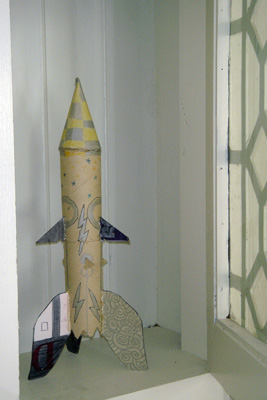
Yesterday we went to visit Rudy, Jr., in Oakland. He’s settling into a new place that has some nice built-in cupboards suitable for displaying such treasures as a (functional) rocket that he built.

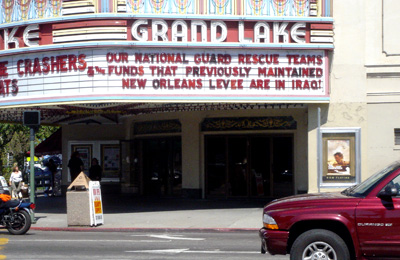
We walked over to a farmer’s market near Grand Street. The Grand Lake movie theater marquee bore a telling comment about the Chimp’s inept response to the hurricaine in New Orleans. A lot of people in Oakland have relatives in New Orleans. Here's on on-the-spot blog about NO.

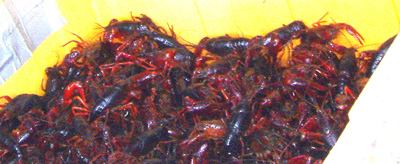
A guy in the farmer’s market was in fact selling crawfish, impressively lively and red, $5 a pound. So many lives to be bought so cheaply.

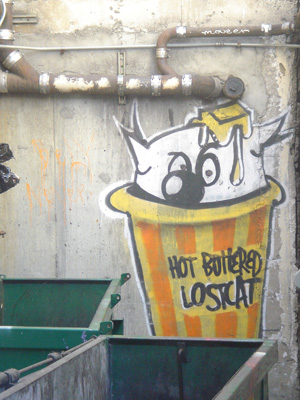
We saw a funny graffito in the alley behind the movie theater. Good coffee shop, good bookstore, seems like a good place to live.

We regrouped, then walked all the way around Merrit Lake, which is actually a dammed slough, with a free flow of ocean tide coming through.

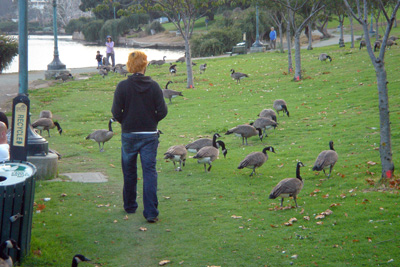
Lots of wild geese around the lake.

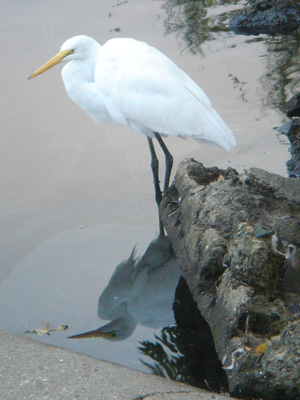
All kinds of birds there.

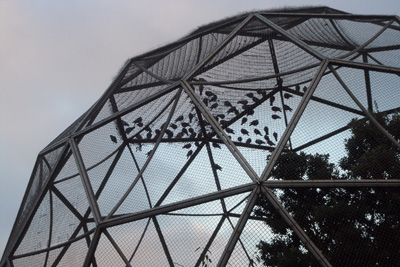
The only ones inside the bird dome were some chickens.

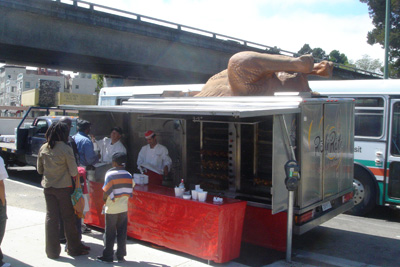
It's risky being a chicken.

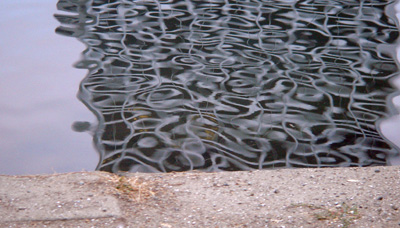
Nice reflection of a rectilinear building grid in the water, the squares turning into circles.

Geneva-Budapest #4

Friday, September 2nd, 2005

Budapest, August 11-16.

And then we went to Budapest for a memorial service for my deceased father-in-law Arpad.

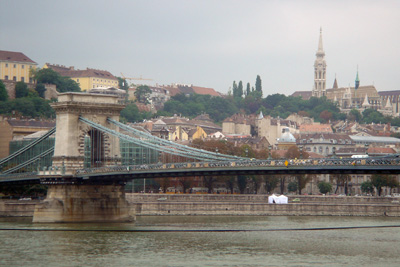
Budapest has two halves, divided by the Danube: the more residential and hilly Buda, and the downtown Pest. They have about seven bridges; the most famous is called the Chain Bridge. This picture is looking towards Buda, which has some old walls and buildings on top, collectively known as the “Var” or Castle. Like Kafka’s castle, a bit.

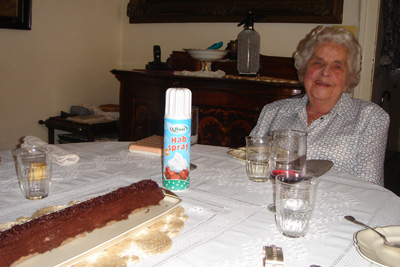
We spent a lot of time with my wife’s aunt Emmi, a lively old lady who lives on the fourth floor of a walk-up apartment building in Buda — she’s lived there for about fifty years. She made this special cake by rolling up chocolate and ground chestnuts. “Hab” means “Whipped Cream.”

Emmi told us a story about World War II. When the Russians took over Budapest, they were raping all the women. Emmi and my wife’s mother made their way from one basement to what they deemed a safer basement, pushing along five children in two baby-carriages (including my wife and her brother).

They went through big Calvin Square in Pest, and the buildings on each of the square’s four corners were on fire. Dead soldiers and horses lay everywhere. It was winter. Emmi said that later they would go out every day to cut meat from the dead horses; it stayed fresh enough, as the weather was so cold. “Have you had horse meat?” Emmi asks us then. “It’s good.”

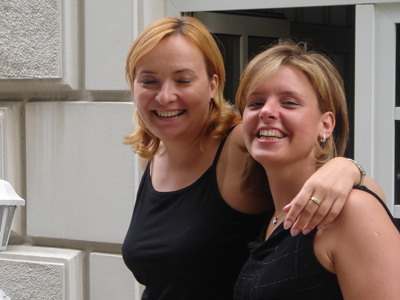
My wife has dozens of relatives in Budapest, here’s two especially cute ones: Andrea and Zsuzsa.

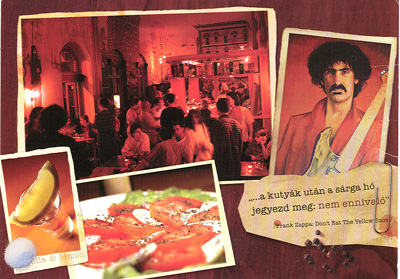
We came upon the Frank Zappa Caffe which happens to be next to my wife’s birth place house in Budapest, the very house where Emmi was headed that fateful night. What a treat to find Zappa here, my favorite musician. The waiter played the whole Hot Rats album for us.

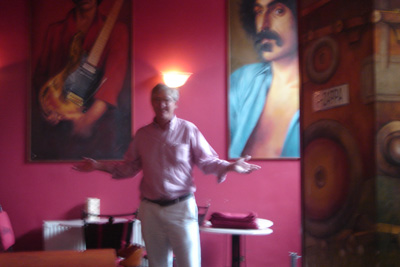
Zappa performed at this cafe once or twice, which is why they named themselves after him. Big paintings of him on the wall. So synchronistic to find good old Frank here.

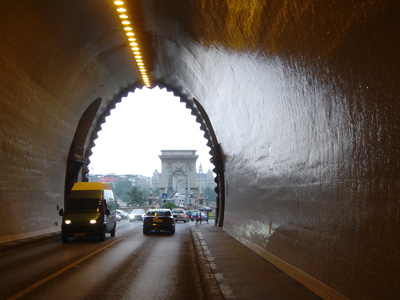
A tunnel cuts through the Var Hill, from Emmi’s Buda neighborhood to the Chain Bridge across the Danube to Pest. Looking at the egglike tunnel shape, I thought of Hungarian mathematicians solving differential equations.

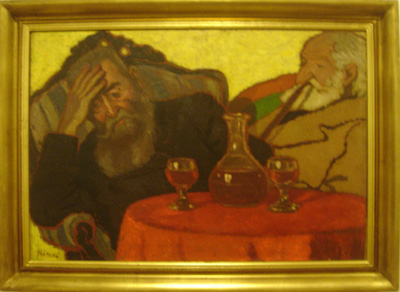
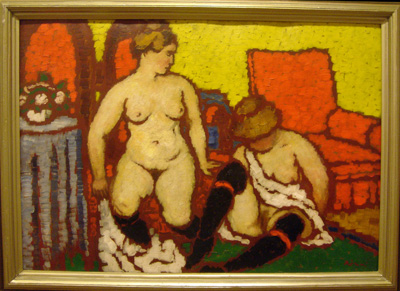
In the Hungarian National Gallery up on the Var Hill I saw some paintings by József Rippl-Ronai (1861 – 1927), a terrific post-impressionist.

Rippl-Ronai was friends with Gaugin, and is sometimes called a Nabi.

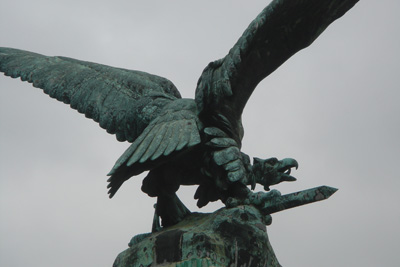
On the Var Hill is a statue of the Magyar totem animal: the Turul, a mythical and very bad-ass relative of the eagle.

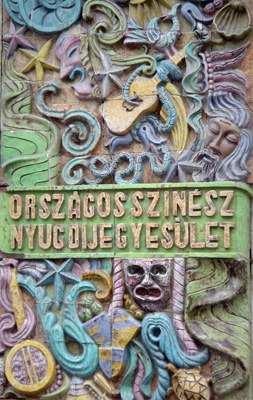
Walking around town, the signs began looking more and more like optometrist eye-charts to me, evenly spaced random symbols. This says something like “Retired Actors Rest Home.”

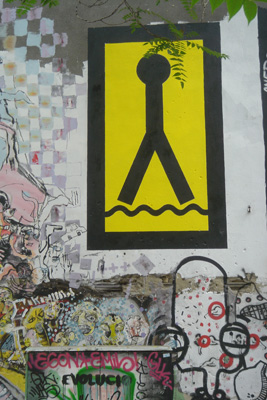
Maybe this graffitto represents a person walking on water?

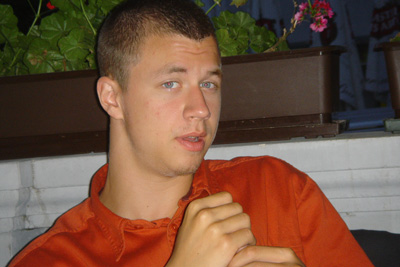
We had dinner with my wife’s cousin Rita and her son Gyorgy Szentgáli. He plays guitar and has some music syntheis software; he’s been making songs and posting them. My favorite is “Tengerparti Pára,” which sounds like a surf song. Oddly enough, Gyorgy had heard of the concept of surf music!

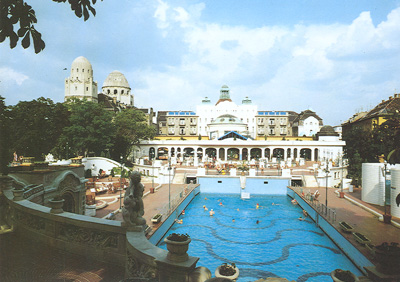
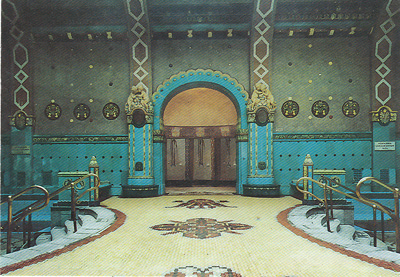
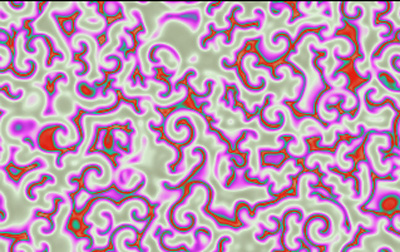
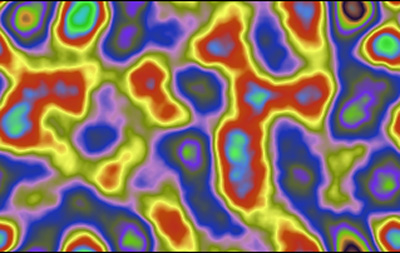
But wait — surf’s up in the Hotel Gellert pool! Budapest is famed for its hot springs, and one of the best public spas is connected with the old Hotel Gellert. That was about the most fun of all that I had in Budapest. I went to the Gellert thermal baths and swimming pools two days in a row. Not many photos here, I’ll just have to describe it and copy a couple of postcards and two new CA images.

I went in nine forms of water:

(1) Heated outdoor soaking pool. It feels a bit like Esalen, warm-soaking in the sun, but these aren’t of sulfur water, I smell chlorine.

(2) Large outdoor ocean-wave pool. I dive down to confirm that the water is alternately sucked into, and powered out of, large vents in the wall at the deep end. I love bobbing up and down in the deep end. Chest-high breakers form in the shallows, I even catch some short rides, but mainly stand there grinning, letting the waves splash out from my bod, big-chesting myself against the crests, spraying sparkling drops far and wide.

(3 & 4) 38° C indoor thermal bath for men, and 36° C ditto. Many of the men are nude, some wear little dick-hiding aprons, I have a bathing-suit. This is the real heart of the place, the water is naturally sulfured, non-chlorinated, continually refreshed. I stretch and do yoga to my heart’s content — I take my suit off for awhile, then put it back on. Men in pairs and groups are talking Hungarian, the voices echoing off the old-timey tiled barrel-vault ceiling. New, hot sulfur water pours into the pools from gargoyle mouths, I get right under a stream, enjoying the heat on my tension-pained back. The railings into the pool have heavy brass balls on the ends, I crouch and rub my back against one of these, massaging it. I went back to the Gellert the next day and did a steambath, a thermal soak, and paid for a real massage. The masseur was casual as a barber, like a Hungarian Seymour Moskowitz — a sarcastic college pal of mine. Wonderful. He kneaded me like dough, and sent me off with a friendly “go git ‘em, big gaah,” slap on the ass.

(5) A steambath so hot (50° C = 110° F) that moving around in it comes alarmingly close to scalding my skin: the motion causes me to contact more superheated droplets per second. It’s hard even to breathe in here, I can barely see through the fog, it’s perfect. But I don’t stay all that long.

(6) The heavy intense stream of the shower off the thermal bath is like being peed on by a divine, life-giving elephant.

(7 & 8) The indoor cool-water pool is an Art Nouveau temple, with a sliding roof open to the blue sky; a hot Sunday sun lays a square of gold on the blue water. At one end is a coed heated soaking pool, separate from the long cool-water pool. These pools smell nasty, like chlorine and sweat, not like the outdoor pools or like the healing thermal baths. I don’t stay here long.

(9) I go back outside and reenter the wave pool when it’s turned on again — seemingly it’s only on for like the first ten minutes of every half hour. Again I end up grinning in the shallows, loving the paracomputation of the waves, a happy California boy. And then, for my ninth form of water, I take an outdoor shower.

Geneva-Budapest #3

Thursday, September 1st, 2005

Debrecen, August 9-11, 2005.

Kids at an outdoor restaurant play “Kö, papir, ollo,” meaning “Stone, paper, scissors.”

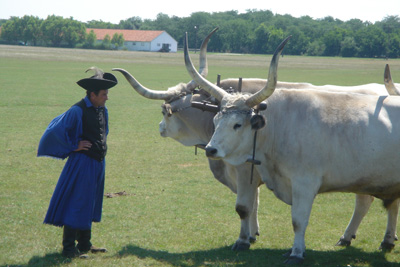
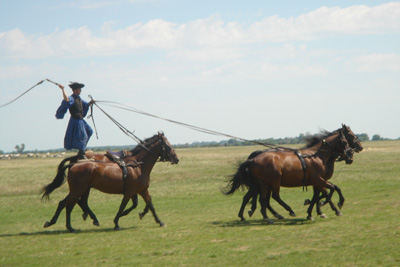
This far-east region of Hungary is like the Wild West of the US in that they used to have horsemen tending large herds of longhorn gray cows.

Their free range is called “puszta.”

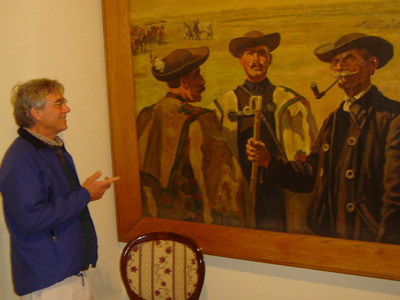
Big beautiful 1910 oil-paintings of horses and cowboys adorn the marble staircase of our grand hotel, Aranyi Bika (Gold Bull). It’s kind of like being in Billings, Montana, with the huge, open sky. We’re excited to be in Debrecen at the far east end of Hungary, almost in Romania or the Ukraine.

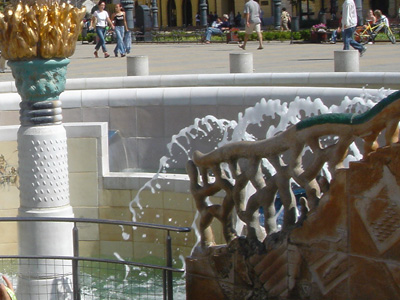
I like this gnarly fountain, with a railing that looks like the time-frozen water. I’m writing this in the big (triangular) Calvin Square of Debrecen at a table in the Gara Cukraszda, a cake and ice-cream shop. “Cukrasz” means “sugar.”

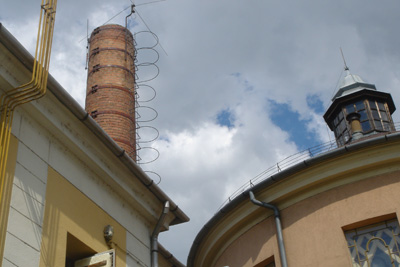
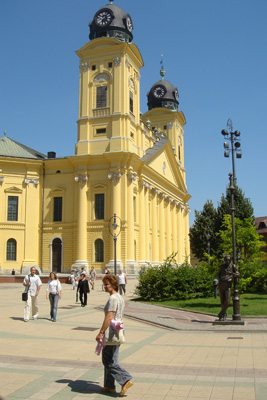
The enormous yellow two-toned Calvinist church of Debrecen is at the end of the square. Most of the Hungarian churches are painted yellow, they love coloring their buildings, as I mentioned before: yellow, pink and green.

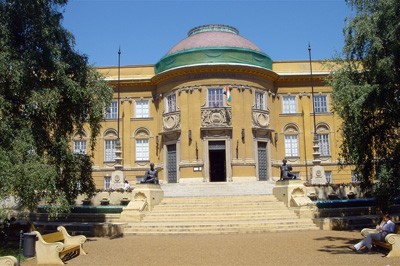
The Deri museum. Very bossy guards, guilt-provoking entreaties that I visit every room, these women are like aunts nagging you to take another helping of dessert. Dull metal artifacts, age-browned three-tined wooden pitchforks. The jewel of the museum is three large canvases by Munkácsy: Christ and Pilate, Ecce Home, and Golgotha.

I’m getting more of a sense of how Hungarian my wife is. In Debrecen we went to a handicrafts center, and two women her age were making cut-out felt appliqué items. She started talking Hungarian with them and they were so interested in her. They kept gently plying her with further questions, as fascinated with my California-Hungarian as if she were an exotic bright-feathered macaw flown in through an open window to perch on the back of a chair.

I sit in a courtyard in Debrecen, the Reformed theology college, dancing pine branches all around me.

I compare the old library here to the nanomachines dreams of the extropians. The lovely quiet books, half a millennium old. Idiocy to turn trees into paper, and even greater idiocy to turn paper into nanomachines.

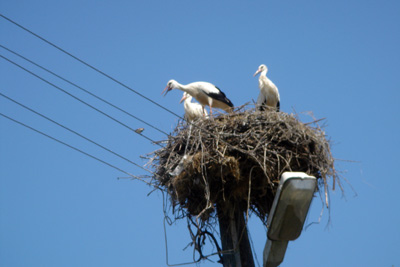
That picture's of storks on a power pole in the puszta. Think of the storks as humans, pecking at the sparrow nanonmachines.

What are the thoughts of the nanomachine clouds? Like cellular automata, BZ scrolls and gliders. Walker: intelligence = memory. The fluttering leaf is always saying the same things, or so it seems to me from the outside. But the tree is growing new leaves, twigs and branches as time goes on, fed by the light-eating leaves.

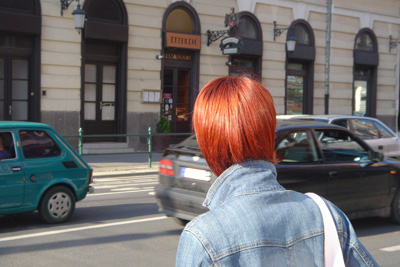
Lots of Hungarian women dye their hair red, it’s like the upiquitous blonde dye of California. Reds: cherry, strawberry, purple, violet, raspberry, every imaginable shade.

Thanks to the international SF connection, I met up with Donald and Csilla Morse, who teach in Debrecen, Donald being involved with the International Conference for the Fantastic in the Arts.

Always amazing to roll into a burg at the ass-end of nowhere and find it full of people doing their thing. The locals are into their soccer team today, Team Debrecen is playing a big-ass game against Manchester, it’s being televised on a giant screen set up in Calvin Square on the steps of that big yellow Reformed church tonight. We can see it out the window in the hotel above the Cukraszda. We have an haut-relief of a puszta longhorn on the bedroom wall.

At Donald's urging, we go see the amazing train-station-like Debrecen University. And then, walking around town we enter yet another church. A fat man is just inside the door, inert, like a fish in the shadow of a rock, hanging there. And a hunchbacked little old man is staring at the Virgin and Jesus in a glass case. Perhaps he’s praying for a miracle.

I had puszta-style gulyasch (goulash) for supper, with caraway seeds, meet from those longhorned grass-fed gray cattle, potatoes and dumplings, it was unspeakably delicious. Traditionally, gulyasch is made in an iron kettle hanging from a three-bar metal tripod over a fire. It told the waiter, “Holnap meg gulyasch,” meaning, “Tomorrow more goulash.”

Geneva-Budapest #2.

Tuesday, August 30th, 2005

August 6 – 9, 2005. Southern Hungary: Pécs and Kecskemét.
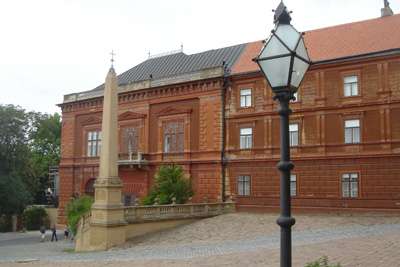
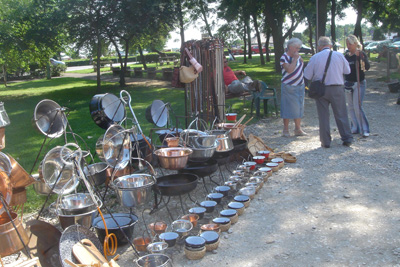
So we flew to Budapest, rented a car, and set off into the boonies of Hungary, starting with Pécs down south.
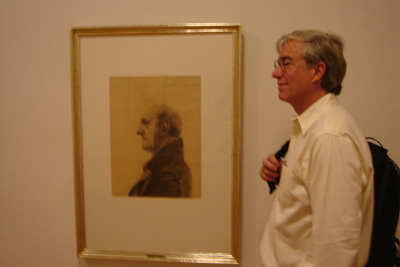
We’ve been eating goose liver nearly every day. The best is soft as butter and pink inside. A good lunch today as well, those handmade little dumplings and a creamy meat stew. The meals are cheap here in the Hungarian boonies. All we two can eat at a top restaurant is under $30. Back in California I’m a pescatarian, but when in Rome… We saw a fascinating museum devoted to the work of Pécs native Csontvary. Like Ensor, also a bit fauve.
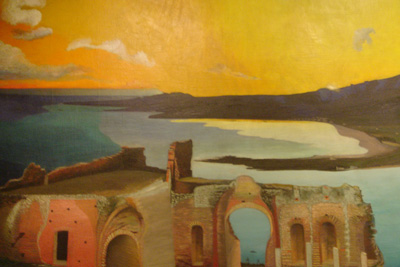
Csontvary was a self-taught artist, pharmacist by trade. Amazing work, some of it, with great scumbling, that is, lines of contrasting color lightly brushed over other colors. The guy was nuts, they say. I’m sorry to leave his pictures. A new mind to twink.
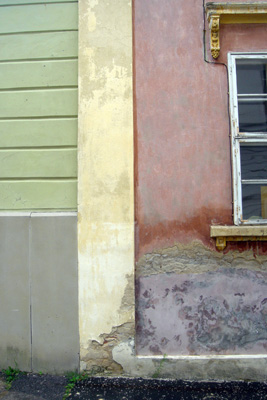
The buildings are great, like crumbling cakes, coated with 19th C ornamentation and painted yellow, pink, and pistachio.
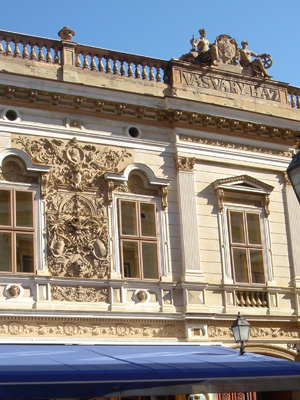
Saw a museum of Zsolnay porcelain, amazing art nouveau, deco, ersatz bronze-age pieces too, all these artists came into the Zsolnay company over the years.
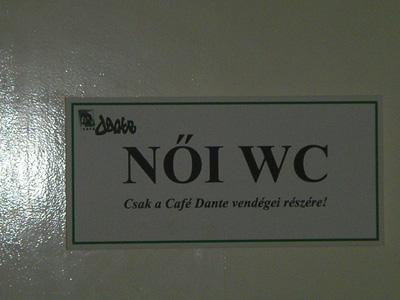
The Hungarian signs, it’s such an onslaught of bizarre words. I have very little pattern-recognition, everything has to be sounded out, and even then there’s no cognates. This sign means Women’s Bathroom, “nö” being “woman,” with “nöi” the possessive. I love that word nö. “ö,” by the way, is a gender-indefinite pronoun meaning “he, she, or it”.
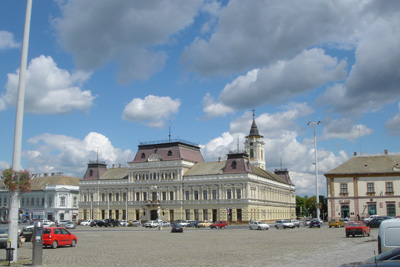
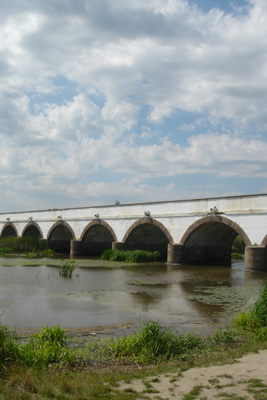
The next day’s itinerary: Pécs, Mohács, Nagybaracsk, Baja, Kalocsa, Kecskemét. Nagybaracsk = big peach = Sylvia, singing, happy to be in her native land. This picture is of Baja, which is not to say Cabo Wabo. Dig the sky.

We got into the road trip rhythm. Took a ferry across the Danube at Mohács, 12 km north of Croatia. I rode a ferry across the Ohio River when I was four or five, I was awed and a little frightened. This ferry on the Danube was cool, too, though the ride not long enough. I was proud that I could buy the tickets. I have better luck speaking German than English in the boonies. And I know a few dozen words of Hungarian.

The streets had little shade trees, unusually long-branched leafy trees, maybe elms. A bearded squeegee guy haunted the parking lot, looking like a peddler from a fairy tale.
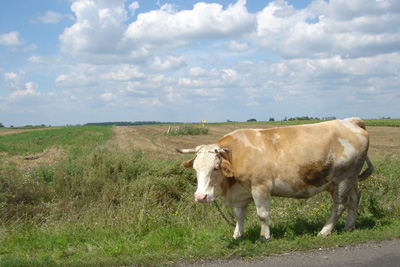
Country roads, green trees, fields of hay, corn, wheat and paprikas — the hay tidy in rolls. The skies have been pale watery blue with sweet cloud-puffs. Skies like this always remind me of when I was a young man (32-34) on a grant in Heidelberg, learning to write science fiction novels(White Light and Software).
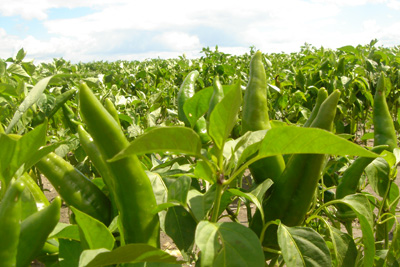
We saw fields of finger-like Hungarian peppers destined to be ground into paprika; we even visited a paprika museum in Kalocsa. They only started using paprika in Hungary in the 1700s. The pepper came here from … Mexico!
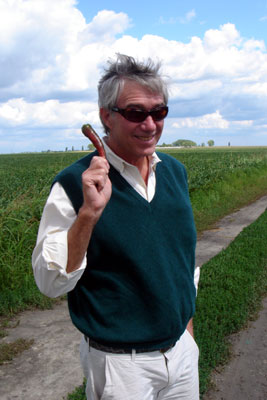
So paprika peppers are cousins of our friend the jalapeño and serrano peppers. What did the Hungarian use for spice before paprika, I wonder.
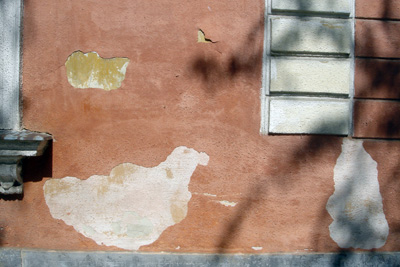
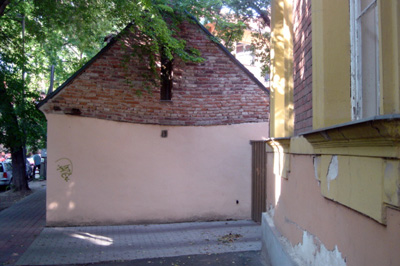
Lots of peeling stucco. This patch looks more or less like the map of Hungary. They have, I believe, seven neighboring countries. Listed clockwise, starting at the west side: Austria, Slovakia, Ukraine, Romania, Serbia, Croatia, and Slovenia. I think many Hungarians consider all of their neighbor countries somewhat shady, always with the exception of Austria.
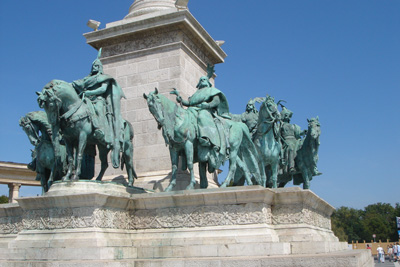
Genetically, the Hungarians a kind of pond of Magyar genes overlaid upon the indidgenous Slavonic and Germanic tribes; the Magyars showed up in, like, the tenth century, settling and interbreeding, horesemen riding in from the Carpathian basin north of the Black Sea. In Budapest there's a statue of the nine “heroes,” representing the leaders of the nine nomadic tribes who settled Hungary. They have great names: Arpad, Tetény, Ond, Kond, Elöd, Huba, and Tas. They have beards, mustaches, long hair; they look like Hells’ Angels. Arpad was the leader; that's him on the first horse. As it happens, my father-in-law's name was Arpad.
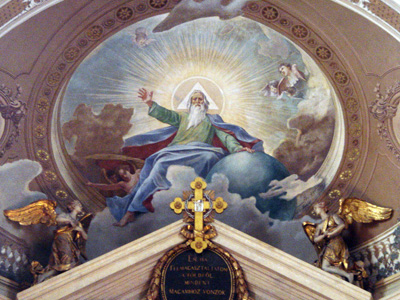
We ended up in Kecskemét, means “Goat Walk.” So many European churches paint God as a triangle, often with an eye inside like on the dollar bill, but sometimes with God’s head. I’m thinking about a godlike dark-matter being shaped like a triangular pyramid (tetrahedron) containing an eye, and ö’s name is Aum. Aum will free Sol system of the filthy nanomachines.
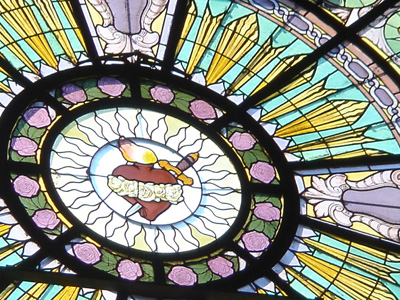
I have known Hungarians to say things on the order of, “Hearing my child’s sweet voice singing that lullaby was like a knife in my heart,” meaning that the experience was exquisitely touching and almost unbearably wonderful, tinged as it was by the awareness of looming mortality. “Do you love me?” “Seeing your face is like a knife in my heart.” This is known as Hungarian Drama; I'm prone to myself by now.
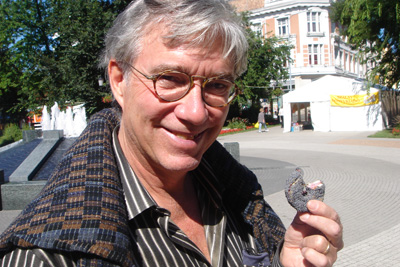
This is a really gnarly snack I bought at a market, the woman claimed it was marzipan (almond paste), but I dunno. It was flavored with cherry, wrapped in dried apple and rolled in poppy seeds. Like a fork in my stomach.
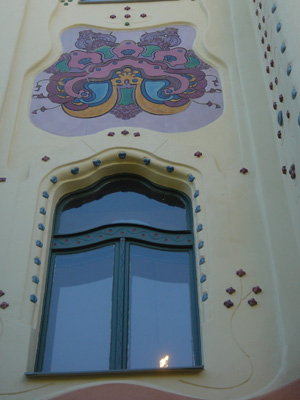
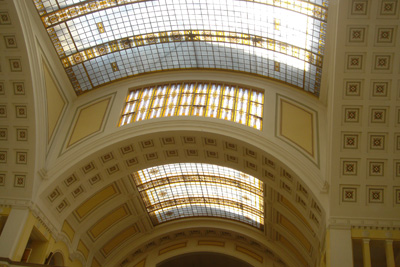
We went into an amazing Hungarian Art Nouveau building with, like, Peter Max tiles on it, big Zhabotinsky scrolls. Though I didn’t get any pictures, there are really a lot of Hungarian Art Nouveau buildings in a somewhat heavier kind of style than French or Belgian Art Nouveau.



Rudy's Blog is powered by WordPress