I’m gonna take a couple of weeks off from creating new blog entries. So Happy Holidays and a great 2 * 17 * 59 to all of you. [Factorization corrected after Fred Condo pointed out I'd posted it wrong. I was 17 when I finished hi-skool and I'm 59 now. Therefore…?]
I’d like to get a comment thread going that will keep some interesting stuff happening here. Thus my “End of the Year Question” on what life will be like after the Singularity.

By way of background, about two and a half months ago, I solicited comments from you readers in an entry called Need Help Understanding Supermind Experience.
I picked up some really useful ideas from the comments, some of which worked their way into a story called “Postsingular” that I sold to Asimov’s SF magazine a couple of weeks ago. And now I’m working on a follow-up story and I want more help from the hive mind.

The set-up:
The Earth is blanketed with self-reproducing nanobots called orphids (derived from “arphids” derived from RFID). Each of them is about as smart as a dog.
Rather that reproducing without limit, the orphids have thoughtfully leveled out at a population density of one or two per square millimeter on every surface on the planet (rocks, leaves, auto parts, skin).
Orphids use quantum computing; they propel themselves with electrostatic fields; they understand natural language; they’re networked by wireless.
They’ve settled onto people’s heads like lice, and they’re using magnetic fields to provide people with device-free orphidnet (super Web) access all the time. Thanks to their orphid lice, everyone is continually plugged in; everyone has a HUD (heads-up display projected over their visual field inside their brain). And thanks to the orphidnet anyone can in some sense see anything (or at least the orphid mesh on the object).
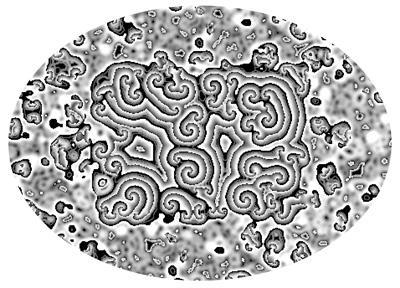
Higher-order AIs have evolved within the orphidnet — they’re called beezies. Some of the beezies are perhaps thousands as times as smart as us. And the smaller beezies are willing to help humans with tasks. Everyone has agents doing thought routines for them.
The question:
What will life be like in this post-Singularity world?
Here’s a few preliminary thoughts about this from my notes for my sequel to “Postsingular.” By the way, the story-in-progress has the working title “Bixie and Chu.”
How do people deal with the orphidnet day in and day out? Maybe they’re casual about it, used to it. After all, we’ve changed our tech so much since, say, Hieronymus Bosch’s time, but we act the same.
A lot of what people do is, no matter what the tech, based on the simplest biological needs.
Mating. Even if we have vat-grown children, there’s still competition to find a good partner to contribute a sperm or an egg, and to help raise your children. I think people would always prefer to raise their own children if possible, as this seems likelier to produce good outcomes.
Absolutely no privacy. Less shame about sex, less mystery. Yet, there are still the same reproductive issues, which are probably a root cause of modesty, which might be a way of playing one’s reproductive options close to the vest.

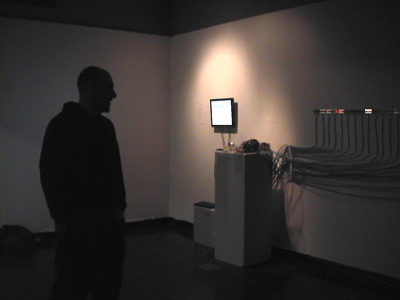
[Photo documenting my friend Charles Platt’s single day as a worker at a big box store.] Food, shelter, and what people own will inevitably be distributed according to the pyramidal inverse-power law statistics (a tiny number of very well-off people and a huge number of poor ones) that inevitably emerge in group computations.
But, with the orphidnet, you can get a lot of what you need for free, if people are generous, and why shouldn’t they be. Recycling. The whole world is a realtime EBay. You can always find leftover food. People set it out, like pies for bums. Just-in-time bread and breakfast. Couch-surfing is practical; particularly if there’s very little chance of crime.
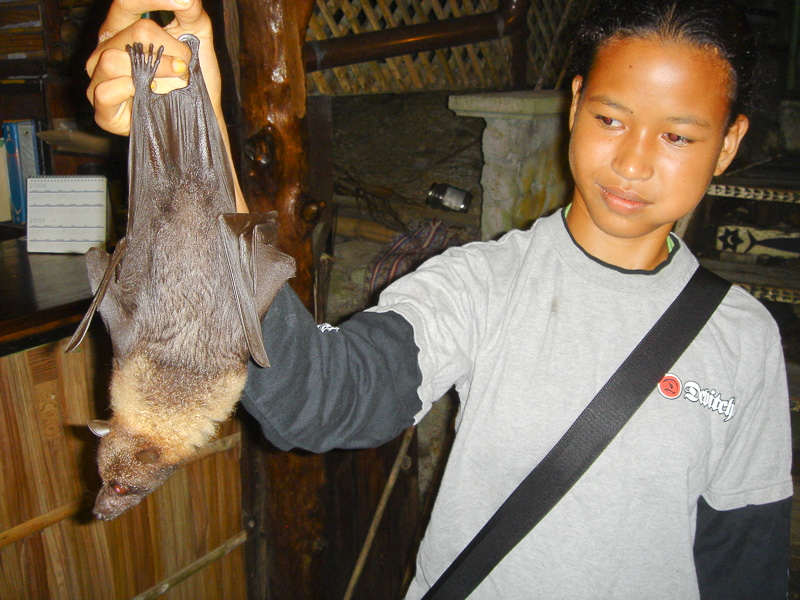
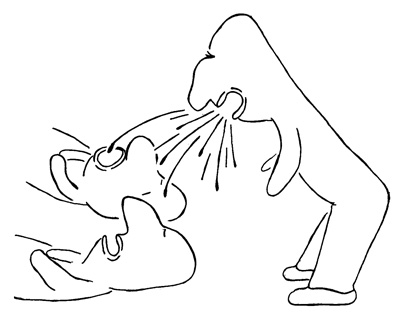
We might suppose that in the Postsingular world, when people talk, emoticons form around them, visible in the computeresque overlays that everyone has happening with their brains, the Smileys hopping out of a speaker’s mouth. Also there will be more functional images, e.g. a copy of a bat that you’re referring to.
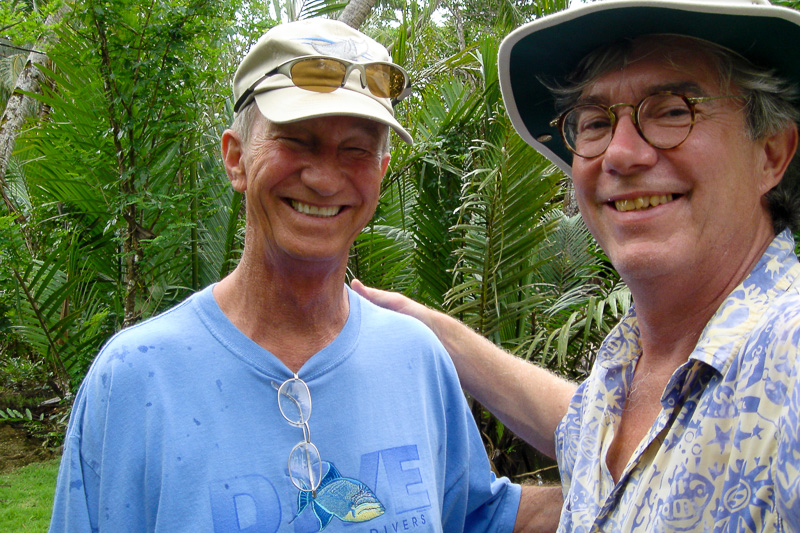
There’s a fad for going offline. “Going on the natch.” [That's my brother Embry and I in Micronesia, a high point of 2005.]
The orphids are in principle willing to turn off a person’s brain interface. Probably there will be some sleaze-ball spammer types trying to override that to push ads, scams, and political propaganda. (I’d like to have a scene with implacable orphidnet-controlled “shoon” robots attacking Heritagist spammers.)
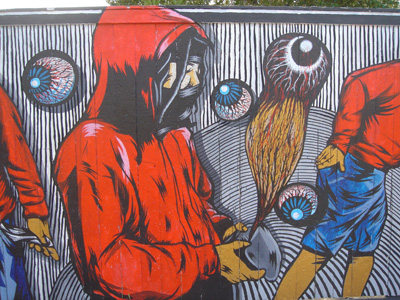
Violent crime has become impossible to get away with. People can always watch you; and even if they see you do the crime, the orphidnet remembers the past, so anything can be replayed. If you do something, people can find you and punish you.
On the other hand, you can still behave like a criminal if you have indomitable physical force. Like if, for instance, you’re the government.
Perhaps there are some war-lords as well. Thanks to the all-seeing orphidnet intelligence it might be hard for the government to catch and swat criminals.
After all, with the orphidnet, anyone can mount what I call a “Golden Man” defense (the name comes from a Phil Dick story where a mutant always knows what’ll happen next, so nobody can kill him). But if your pursuers have the same knowledge, maybe it’s a wash.
Conceivably the orphidnet beezies might favor certain people and give them the benefit of a deeper-ply look-ahead than is available to the common ruck and rabble.
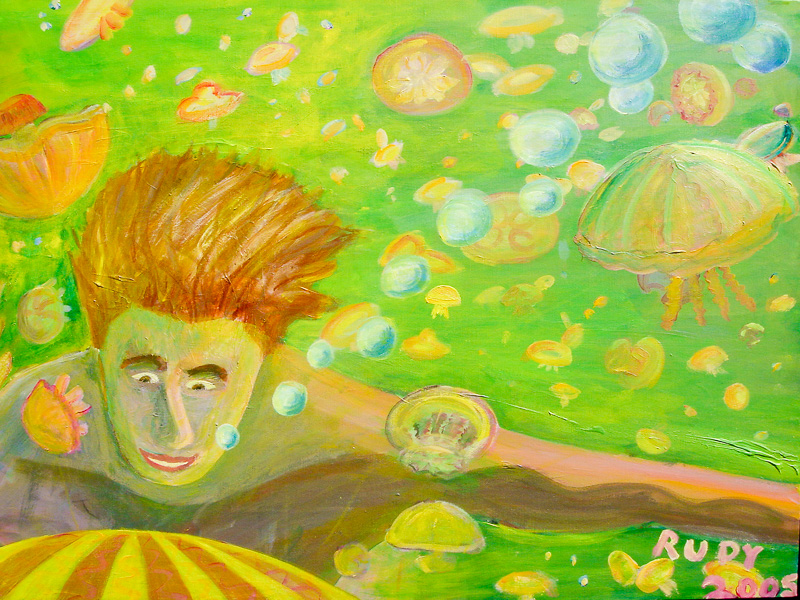
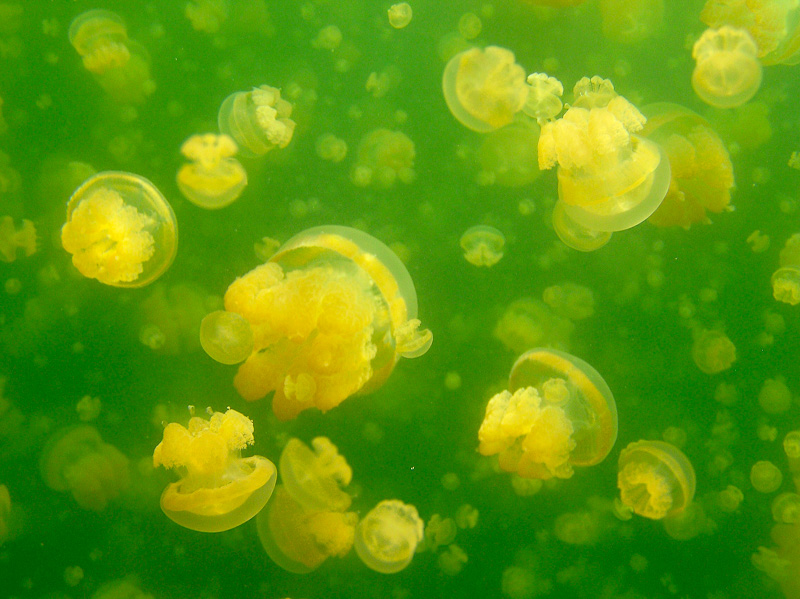
(Here's a link to large version of my “Bela and the Jellyfish.”)
Merry X and Happy New Y!