


Click covers for info. Copyright (C) Rudy Rucker 2021.


Author Archive

Propaganda and Zombification

Wednesday, February 8th, 2006

This week’s pictures are from the hills of Los Gatos and the Wilder Ranch beaches in Santa Cruz. The connection with my texts is oblique, aleatory, surreal. The meaning-seeking human brain can connect anything to anything. Proof: Every time you watch TV with the sound off, and with a CD playing music, there is a perfect fit between image and audio tracks. Even if you’re straight.

In my novel-in-progress Postsingular, I want AI control of humans via the orphidnet to be a real threat, but one which can be fended off.

For our physical orphidnet hookup, we have a mesh of orphids on our scalps, a few in every square millimeter, and these orphids are sending in gentle magnetic fields that diddle the brain in such a way that, acting in concert, the scalp mesh acts more or less like a wireless Internet hookup with (subvocalized) voice recognition and heads-up display.

People have control over this interface; they can turn off feeds if they like, they can even close down the interface entirely.

The evil AIs that I call “beetles,” however, want to find a way to (a. always on) make it impossible to turn off the feed, (b: propaganda) dominate a person’s thoughts, and perhaps even(c: zombification) directly run the person like a robot-remote.

(a) Always on. This is a bit of a battle zone that slides back and forth. The beetles find a way to wedge the gate open, the humans figure out a way to make sure it’s closed, the beetles find a new way to wedge it open, back and forth like that, akin to the ebb and flow of virus/antivirus wares.

As an example of how it might feel to have the door wedged open, think of when a websurfer gets stuck with a series of pop-up ads, each ad a new browser window, and they can’t close the browser without rebooting the computer. But you can’t reboot your brain.

[Gathering her strength into a mental lunge, Nektar closed down the image of the beetle for a moment of respite. She glanced over at her bedside clock. Ten fifteen in the morning. And now the minute hand bent up and out towards her, articulating itself into a beetle leg. The clock face dropped off, and a fresh beetle crawled out.

“You must record ad,” it insisted. “We exhaust time and patience. More punish.”] — From Postsingular, Chapter Three.

(b) Propaganda If you're an evil beetle and you have a person’s orpidnet door wedged open, domination is easy. You jam your victim’s brain with a torrent of leaf-blower noise, or scary blood gushes, or screaming, or devils, or tortured family members. And you tell them you’ll stop it when they do what you want. Another approach would be to lie to them and convince them of things. Or feed them very pleasant sensations when they do what you want, perhaps obsessing them with sexual imagery.

(c) Zombification. With zombification, I’m talking about direct control in the form of reaching into a person’s will or, even more basically, firing their muscle contractions yourself. As opposed to indirect control by threatening to show someone painful things, or by promising them pleasant sensations or by misleading them with false information. For reasons of plot and art, I’m inclined to hold back on zombification in Postsingular, and to deem it impossible, at least by means of orphidnet technology. That is, I plan to disallow the effects achieved by what I called a zombiebox in Wetware, a leech DIM inRealware, and an ooie in Frek and the Elixir.

Why, in the world of Postsingular will zombification be impossible? Well, I’ll say the orphid signals are gentle, weak and are constrained to certain outer-lying regions of the cortex, and can only produce illusions of sensory experiences: sight, sound, taste, touch, smell. We might also suppose the orphid mesh isn’t fine enough to really run a person, and orphids won’t bunch any tighter. This said, note that you can use propaganda to achieve very nearly the results of direct hard-wired zombification.

So it all comes down to the fight over being able to close off unwanted inputs. Spam wars.

[“Woo, woo, woo,” murmured Sonic, seizing the leg of a beetle and shaking his body so as to shower the virtual insect with — fleas? Little anti-beetle fleas, yes, purposeful, cobalt-blue sparks attaching themselves to Nektar’s tormentors. The flea-bitten beetles jerked and twitched, then scuttled away as if in a movie running backwards. Sonic the dog ran about Nektar’s cleaned-up mindscape, his body bright and transparent as a gout of water. He scratched and whined at Nektar’s filter cabinet, tugged it open with his teeth, then shook himself again, scattering anti-beetle fleas into the cabinet’s drawers.] — From Postsingular, Chapter Three.
Phil Dick

Monday, February 6th, 2006

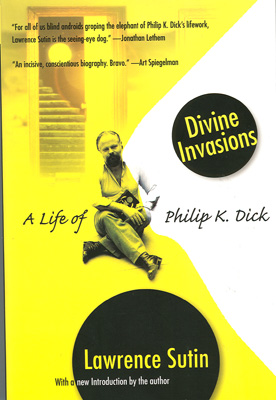
I just finished reading a gripping, although somewhat depressing, biography of one of my literary heroes, recently reissued: Divine Invasions: A Life of Philip K. Dick (Carroll and Graf, 1989, 2005 New York), by Lawrence Sutin. A page-turner of a book, almost like a novel.

The depressing aspect has to do with how many character flaws and psychic disabilities Phil had. But the book has some nice quotes from Phil about his writing style. I’ll page-number the quotes according to where they appear in the 2005 edition of Divine Invasions. I’ll start with two quotes about what I’ve come to call transrealism.

“I want to write about the people I love and put them into a fictional world spun out of my own mind, not the world we actually have, because the world we actually have does not meet my standards.” p. 4.

“And I always think, well, the ultimate surrealism … is to take somebody that you knew, whose life-time ambition was to sell the largest television set that the store carried, and put him in a future utopia or dystopia, and pit him against this dystopia, or place him in a position of power.” p. 54.

I think I’m becoming a bit less transreal as the years wear on. As a writer’s craft grows (and his or her friends get older and less interesting), he or she perforce moves beyond simple character-to-friend identifications. It becomes more fragmented, you piece together fake people from shards.

[Out at Wilder Ranch in Cruz yesterday. It's spring in California.]

In my current novel Postsingular I’m experimenting with Phil’s multiple third-person viewpoint technique, where he switches, sometimes on the same page, from seeing through one person’s eyes to another’s. Speaking of The Man in the High Castle, biographer Lawrence Sutin puts it this way, “The third-person voice is used throughout, but in an intimate, hovering matter, with characters shifted quickly into and out of prominence.” In a letter quoted in the bio, Phil says where picked up this technique.

“In the forties I got into novels written around that time by students at the French Department of Tokyo University; these students had studied the French realistic novels (which I, too, had read) and the Japanese students redesigned the slice-of-life structure to produce a compact, more integrated form … When I went to write The Man In The High Castle I asked myself, How would this novel have been written — with what structure — if Japan had won the war? Obviously, using the multiple viewpoint structure of those students…” p. 114.

Note that, if done ineptly, this technique leads to what’s denigratingly called “wandering viewpoint” — a common flaw in the work of tyro writers. But Dick can make it work as does, for that matter, Thomas Pynchon. I’m a little scared of the technique, and usually use a chapter break or a *** section break to separate the switch between active character-views.

Another artistic trick of Phil’s that interests me is that you should fold together two plots into one book to have a really lively novel, a book that’s what I call unpredictable, gnarly, and class four. I read the following injunction of Phil’s years ago, and I often think of it when I’m planning a book. To make a book cook, you want two plots, not one.

“Every novel of mine is at least two novels superimposed. This is the origin, this is why they are full of loose ends, but also, it is impossible to predict the outcome, since there is no linear plot as such. It is two novels into a sort of 3-D novel.” p. 256

Phil was into the notion of having someone’s mind permeate all of reality; he does this in Ubik and in The Three Stigmata of Palmer Eldritch.

“So Runciter and Ubik equals Palmer Eldritch and Chew-Z. We have a human being transformed into a deity which is ubiquitous … Salvific information penetrating through the ‘walls’ of our world by an entity with personality representing a life- and reality-supporting quasi-living force.” p. 154.

You might call it monistic panpsychism. I’m planning for a more pluralistic panpsychism in Postsingular. Although I guess there could be the underling cosmic minds of the three forces that I might call the Big Big, the Crooked Beetle, and Gaia.

The biography has some more background about the endlessly-discussed November, 1971, break-in at the house in San Rafael where Phil was living with speed-freaks. It could have been that one of Phil’s slushed housemates ripped him off. But he enjoyed spinning out a lot of alternate theories. My favorite: “Had certain ideas in his SF come too close to eliciting interest in his files? Also a disorientation drug (code name ‘mello jello’) had been stolen from the army, which was looking for leads to recover it.” p. 184. I love that drug name: Mello Jello. Right up there with merge, snap, quaak, sudocoke, ZZ-74, Substance D, Chew-Z and Can-D.

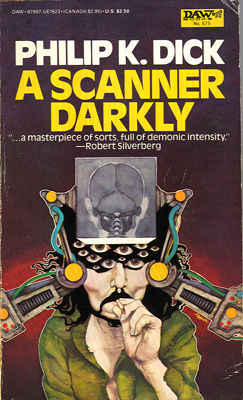
Phil transmuted the whole San Rafael experience into A Scanner Darkly, my all-time favorite of his books. I think it’s maybe the funniest book I’ve ever read, right up there with Burroughs’s Yage Letters. But it’s also tragic, which is what makes such a masterwork. It’s transreal to the max, although Phil in the afterword says, “I myself, I am not a character in the novel; I am the novel. So, though, was our entire nation at this time.” p. 201.

As for the pink light stuff after Scanner Darkly, I’ve never enjoyed that very much. To me, the novels begin to feel a little sober-sided, a little tendentious, and less multileveled and witty than before. It could have been that Phil was at some level putting us on. In one of his letters he imagines, not without a certain grim satisfaction, the following reaction to Valis:

“Too drugs, saw God. BFD.” p. 260.

With “BFD” of course standing for “big f*cking deal”. Like William Burroughs, Phil Dick had a pitch-perfect ear for street slang so real-sounding that it extrapolates well into the future. Hipsters are enternally still trying to be as far-out as Bill’s junkies and Phil’s heads.

All biographies end sadly. The tears of things. The human condition. The dark beauty of the death sentence we labor under.

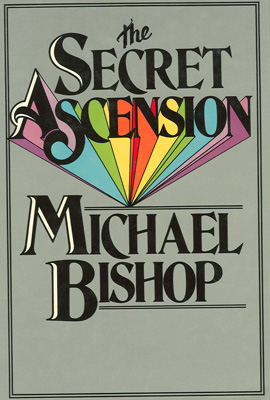
Synchronistically enough, the day after I finished reading Phil’s bio, my SF-writer friend Michael Bishop sent me a copy of his book The Secret Ascension: Philip K. Dick is Dead, Alas (Tor Books, 1989) — which starts up with Phil being felled by a stroke at age 53 … and with a new version of him leaving his body and coming to hang out in Bishop’s home town in Georgia. A lot of SF writers ended up writing fictional things about Phil, so powerful was his influence.

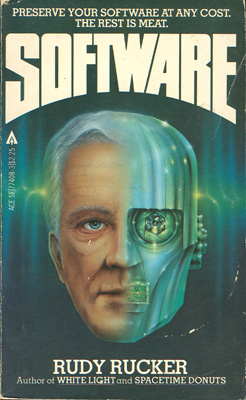
In 1991, in the wake of getting the Philip K. Dick award for Software, and again for Wetware, I wrote an essay “Haunted by Phil Dick”, alleging that I’d twice encountered his ghost. In this piece I was trying to sound a little badder and wacker than I really am. Phil knew all about striking a pose in his interviews. I was doing a Phil.


[The high castle where I write.]

Looking over Phil’s colorful, tumultuous bio, it’s hard not to feel like something of a cautious bourgeois. I do prefer having a relatively stable life; I think it gives me more energy, and better control over my work. But something also whispers, “So far, and no further? Raise the stakes. Push it like Phil.”

He was a Romantic artist, a doomed poet, a master stylist, an SF hero.

I love you, Phil.

Booksmith Signing Not Feb 21

Saturday, February 4th, 2006

Even though Boing Boing kindly blogged my planned reading from The Lifebox, the Seashell, and the Soul at the Booksmith on Feb, 21, it turns out I'm not gonna be in town for that.

The reading will be on Tuesday, March 7, 2006, instead, details to come later.

Julian Lopez-Morillas. Bill Gosper and Golly.

Friday, February 3rd, 2006

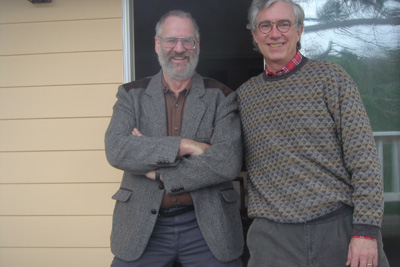
I’ve been sociable this week. I got together with Julian Lopez-Morillas, a Bay-area actor whom I knew from Swarthmore College. Julian is presently appearing in a supporting role in Ibsen’s The Master Builder at the Aurora Theater in Berkeley, located next to the Berkeley Rep. He’ll also be Prospero in The Tempest this summer, a good role for a guy our age.

And the next day I had lunch with the King of the Hackers, Bill Gosper.

I always think it's kind of amazing that I get to be friends with a guy who was really one of the very first programmers. It's as if I'd become a pilot at age forty (when I moved to Silicon Valley in 1986) and then ended up knowing Wilbur Wright. The computer thing has happened over such a short period of years. Actually Gosper’s only two years older than me, although he’s such a timeless monument, I tend to think of him as more my senior than that. Although in fact he's very youthful.

When I first moved to Silicon Valley, I was very eager to get to know Gosper, but was shy to call him. Come to think of it, I think the first time I got the nerve to call him, I was high on some weird concoction I’d gotten from the Mondo 2000 crew, and was under the impression we were coversing telepathically. He didn’t mind all that much; for a hacker, an impaired person is simply a different computational mode. In any case, I went to visit him at Symbolics in 1987, where he then worked, and he showed me some amazing Game of Life simulations that were based on a weird speed-up algorithm of his called “HashLife”. I remember him sharing the source code for the trick, but for me, this was strictly a case of the Mathematician Godfather: He makes you an offer you can’t understand.

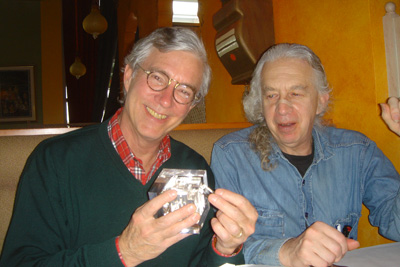
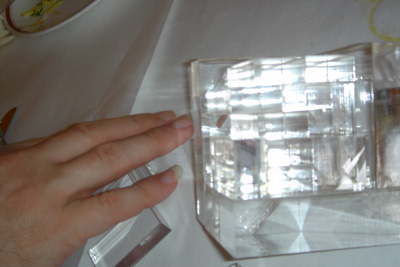
Yesterday, as always these days, I met Bill at a subcontinental Peninsula restaurant. He brought a bag of puzzles of his own inventions. This one here is an assemble-it-yourself-cube he made. Gosper has long fingernails and he’s taken to wearing a nose-opening tape — I didn’t ask why. More interesting things to talk about!

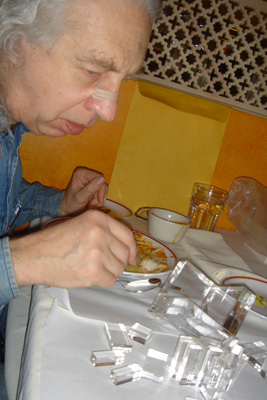
Bill also brought along his friend Peter Aiken-Forderer, shown here with Gosper’s “Twubblesome Twelve” puzzle.

And then we got down to the cellular automaton simulation known as the Game of Life, or simply as Life. Gosper is best-known for discovering the Life Glider Gun, back in the heroic days of computation in the early 1960s.

But now some young guys have included the HashLife hack in Golly, which is an open source, cross-platform Game of Life simulator currently under development by Andrew Trevorrow and Tomas Rokicki. It features an unbounded universe and uses Bill Gosper’s “hashing” technique to speed up the simulations. You can download it for free at Source Forge.

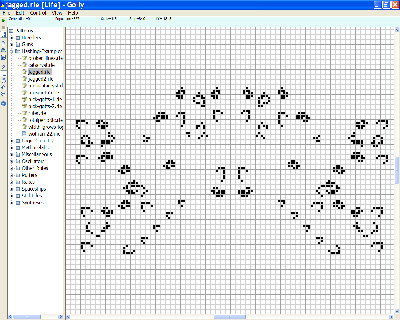
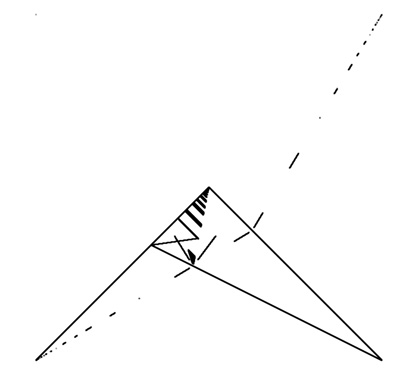
Above is a starting pattern for a rule called Jagged. Those little patterns in diagonals down near the bottom middle are called gldiers. This pattern will shoot out three big “spaceships” leaving exhaust, one spaceship moving to the right, one moving left, one moving up..

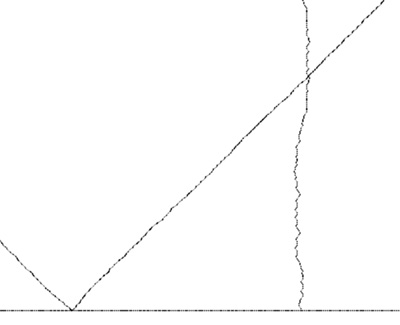
Above is the same Jagged rule, about five thousand update steps later, with the spaceships those heavy dots at left, top, and right, chugging away. The debris is doing some weird stuff on its own. The cool, gnarly thing to notice here is the waviness of those lines in the middle. The more-or-less vertical line is made of stable blocks of four marked cells each, and the more diagonal lines are made up of flotillas of moving Life gliders.

By the way, the dots you see in this zoomed out views of Golly Life worlds are no longer individual marked cells; when we zoom out like this, Golly simply marks as black any region that includes any marked cells at all.

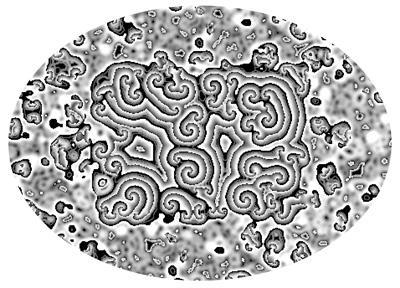
Here’s the Jagged rule after a hundred million update steps. By now the world includes fifty million marked cells. In the picture above, I’ve zoomed in on the spot in the middle of the lower line where it looks like three lines come out from a common point. Actually, the vertical “line” of blocks wanders back and forth to the left and right of the slanting glider streams. This is a universal class four computation par excellence.

Thanks to the HashLife hack, Golly can reach astoundingly far into the future. The picture above started out as 52 marked cells. And then I ran it through some trillion updates, generating some quadrillion marked cells, making the zoomed out pattern showed above. By the way, running this with Golly only takes a few minutes. Turn on the “Autofit” and “Hyperspeed” features and load the “metacrystal” pattern.

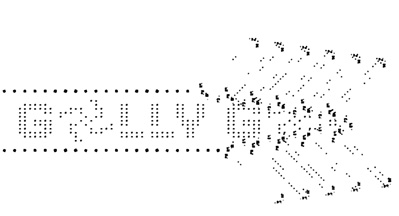
I alluded to the fact that Life is a universal computation, meaning that it can do pretty much anything. Here’s a pattern that spits out a ticker tape writing GOLLY over and over!

Life is wonderful.


Rudy's Blog is powered by WordPress