

Click covers for info. Copyright (C) Rudy Rucker 2021.


Author Archive

Hylozoic in Killeville

Saturday, July 21st, 2007

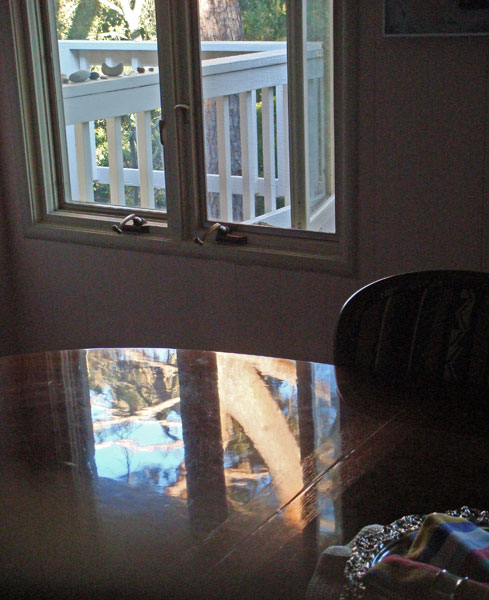
[Window view reflected in dining table.]

On the literary front, I’ve been pushing forward on my somewhat cyberpunk SF novel-in-progress Hylozoic , a sequel to Postsingular, which will be out in October. My first draft of Hylozoic is nearly half done; and once I finish writing the current Chapter Four (working title “Coma Nurse”), I get to jump my characters back in time to hang out with Heironymus Bosch.

Today I thought I’d paste in a passage that I wrote this week. The situation is as follows:

Jayjay and Thuy are newlyweds in a world where everyone has teleporation and telepathy and every object is conscious. Jayjay has unwittingly become a runemaster, able to reprogram the quantum computations around him. A distant planetary god called Panpenga has taken control of Jayjay via subdimensional telepathy, and she’s using Jayjay to “cast runes,” thereby reprogramming large volumes of Earth’s atoms into “Peng ranches.” In a Peng ranch, the atoms work in concert to generate matter wave holograms of ugly big birds called Peng—hailing from the planet of Pangpenga. It’s a new way of doing an alien invasion. (Ah, the joys of non-mundane SF!)

Panpenga wanted Jayjay to put in thousands of Peng ranches, all across Earth, but he balked. So Panpenga threw Jayjay into a coma, and now a pair of traitorous human realtors called Chick and Duckie are acompanying Jayjay and Thuy on a development road trip. Thuy is cooperating, as she fears Panpenga will kill Jayjay. For support, she’s brought her old girlfriend Kittie along.

To kick off the trip, the Peng-employed realtors head for Killeville, Virginia! Who’d be likelier to support a dehumanizing alien invasion than a fundamentalist church!

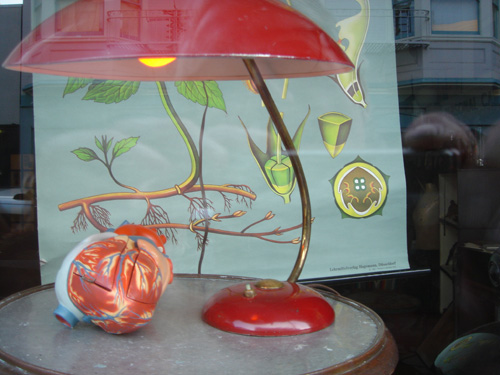
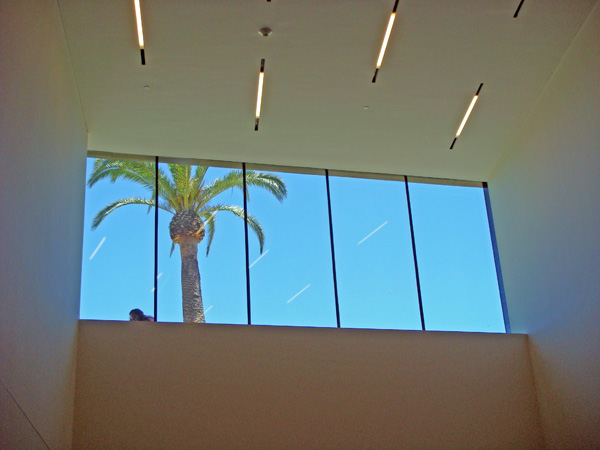
[Window at the DeYoung Museum, looking wonderfully interesting after viewing a somewhat dull show of photos by Hiroshi Sugimoto. I like the reflections of the fluorescent tubes.]

[Begin Hylozoic Excerpt.]

Before setting out, Thuy teeked a wheelchair for Jayjay. And then she, Kittie, Jayjay, Chick and Duckie hopped to the parking lot of the Candler Road Church in Killeville, Virginia, leaving the Peng behind.

It was a hot hazy Sunday morning; the lot was full. Odd as it seemed, many people down South still drove their SUVs, albeit retrofitted ones with solar cells and electric motors.

“I could really get some car-art gigs here,” said Kittie, looking around. “I could paint a Good Ole Jesus gutting an eight-point deer. And the Rapture, with Christians flying away and sinners screaming in fire-cracks. And the repentant Mary Magdalene in Mother Mary’s tender, womanly embrace.”

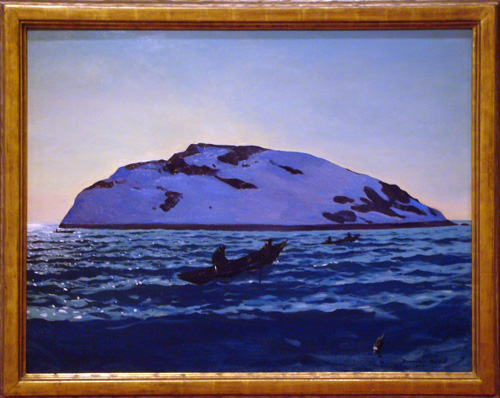
[Monhegan island painting by Rockwell Kent.]

Jayjay tossed his head back like an epileptic having a fit; his mouth flew open in a moan as showers of goose bumps marched across his skin. His wheelchair braced itself against the strain.

“Here we go again,” said Thuy with a sigh.

“What is it?” asked Chick, alarmed.

“He’s channeling Panpenga,” said Thuy. “He’s making Killeville into a Peng ranch.”

“Here,” suggested Duckie, offering Thuy a lace-trimmed hankie. “Hold Jayjay’s tongue so he doesn’t bite it.”

“He’ll be okay,” said Thuy. “Act like it’s not a big deal. I don’t want everyone staring at us.”

But a pair of Candler Road parishioners were already approaching: a rough complexioned young woman with a ponytail, and a loose-eyed youth in a tan cotton suit.

“Hi!” said the woman, lacing her hands behind her back and pushing out her breasts. “We’re Steve and Julie. Are you here for the eleven a. m. program? Donnie III does a powerful healing near the end.”

“Might could do this fella some good,” said her partner, Steve, hunkering down to peer under the wheelchair. Thuy flashed that the guy was an in-house security agent checking for weapons. He could have just teeped under there instead of bending over, but the fundamentalist Christians didn’t really approve of using their new mental powers.

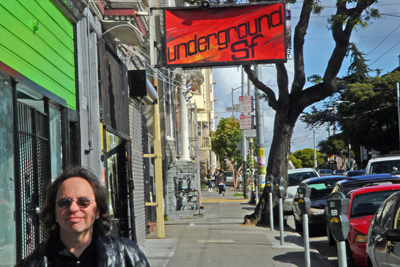
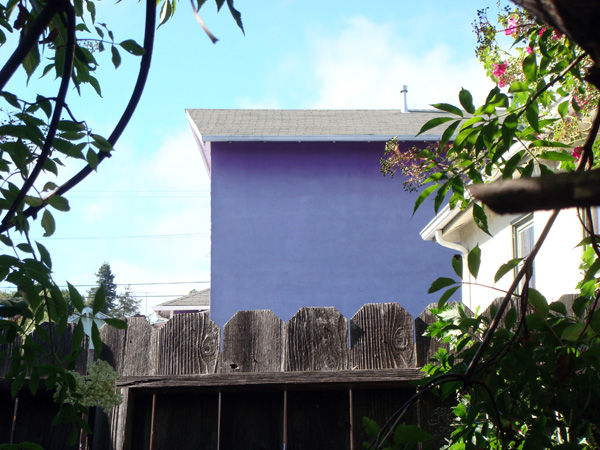
[Peaceful Berkeley.]

“We’re glad we’re in time,” said Chick. “We came all this way to soak up a sermon.”

“Not from around here?” said the ponytailed Julie. The skin on her cheeks was raw from scrubbing. “Are you from—from West Virginia?”

“Further than that,” said Kittie. “I’m a godless artist from gay CA.”

“I don’t think that’s funny,” said the man in the tan suit. Thuy noticed that he was clutching a zipped-up leather bible. The bible silp teeped Thuy that it was a pistol case.

Meanwhile Jayjay had stopped moaning. The local gnarl had been successfully repurposed; Thuy could see the change in the clouds and in the motions of the trees. It was just a matter of time until—

“Oh!” cried Julie. “Look, Steve, look!”

Strolling across the parking lot towards the church were a hog-fat older man in clerical vestments, an old woman with a sprayed bubble hair-do, and a rangy younger man in vestments as well. They were slightly larger than life size; their complexions were preternaturally clear and smooth. Panpenga had gotten Jayjay to mold these new tulpas into the forms of the deceased first family of the Candler Road church.

“Dr. Macon!” exclaimed Duckie. “With his wife Bonnie and their son, Donnie Macon, Jr.” Duckie had done her research. And now everything was going according to plan. “I thought—I thought they’d all passed on to their reward,” she added disingenuously.

“A miracle,” breathed Julie.

“Maybe so,” said Steve, nervously running the zipper on his case open and closed.

Thuy and her party joined the crowd following the three Peng into the Candler Road church. It was a cavernous indoor stadium, with Donnie Macon, III, standing upon a central dais before a robed choir. Donnie, III, was a lean, slit-eyed fellow, and he didn’t look too happy to see his resurrected forbears come swanning in.

Although Dr. Macon must have weighed well over three hundred pounds, he levitated, moving his body across the cavernous hall as nimbly as a character in a videogame. Fiercely grinning, he alighted upon the stage beside Donnie, III. His wife Bonnie and his son Donnie, Jr., flew to join him.

“We are blessed!” roared the Peng disguised as Dr. Macon. “We are blessed to revisit our home!” The beige-carpeted arena rang with wild applause.

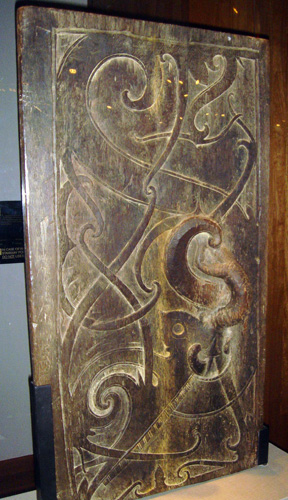
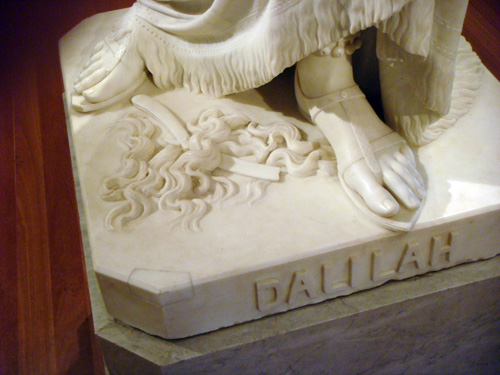
[Detail of my favorite statue in the DeYoung Museum.]

Thuy, Kittie, Chick and Duckie were standing just inside the entrance, clustered around Jayjay in his wheelchair. Jayjay began humming again, enabling Dr. Macon to turn a bible into a loaf of Wonder bread and a pitcher of water into grape-flavored sports drink. And then he sent a bouquet of plastic roses flying from his fingertips to alight upon Jayjay’s lap.

“The Lord has called me from my rest to introduce the Sleeping Savior,” bayed Dr. Macon. “Bring him up here so the folks can see him, Sister Thuy.”

Wearing a stiff, embarrassed grin, Thuy wheeled Jayjay up a ramp onto the stage. It was weird to be in the midst of an all-white crowd—like being inside a bag of marshmallows.

“The Savior has manifested Himself in the body of this ordinary, sinful Latino man,” exclaimed Dr. Macon. “He’s been a kiqqie, a rebel, an addict, a sensualist. He’s married to a formerly bisexual Vietnamese intellectual. The Almighty works in mysterious ways. He is bringing us into the End Times. You will know salvation soon. Gabriel’s trump will burst through the filmy sky. But until that glorious call, you must help the Sleeping Savior fulfill his mission.”

“These three are alien invaders!” interrupted the choirmaster; a charismatic woman with flowing red hair. “They’re disguised Peng! The bird things we’ve been seeing in the news!”

“You’d do better to call us angels,” said Donnie, Jr. He was leaner and more charismatic than his father. A huge cheer went up when he spoke. He’d been a popular pastor before his death in a drunken car crash several years before. He leveled a minatory finger at the protesting woman.

A moan arose from Jayjay, and the woman’s clothes were wreathed in fire. She rolled on the ground, screaming and trying to staunch the flames. Jayjay moaned again and she was doused in a gush of water.

“Do you still doubt us, Sister Vivian?” said Dr. Donnie’s wife Bonnie, stepping forward to help the disheveled, but unharmed, redhead to her feet.

“Praise Donnie,” croaked the choirmaster. “Praise the Sleeping Savior.”

“The Peng ranches are sacred zones,” said old Bonnie. “The Peng free us of fussy over-complication. Peng ranch people are more willing to open their stony hearts to the sweet honey of divine love. Peng ranch people don’t intellectualize over every piss-ant little thing.” Despite her human disguise, there remained something alien and bird-like in the darting motions of her head.

“You shouldn’t swear in the sanctuary,” reproved Donnie, III.

“Who are you to tell your grandmother what to do?” thundered Dr. Macon, wilting Donnie, III.

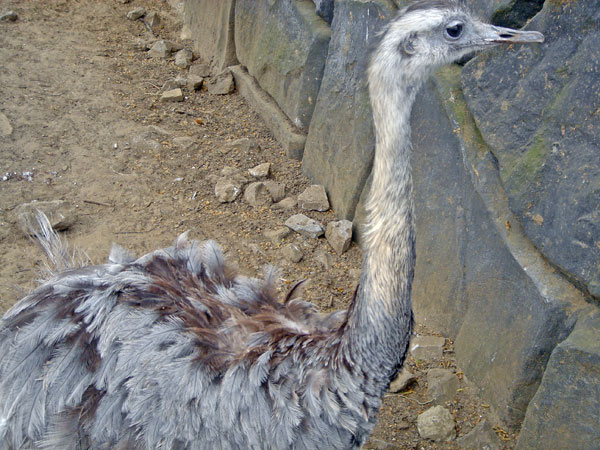
[A rhea modeling as a Peng. I see the Peng on rhea legs with kiwi bodies and ibis beaks. Though maybe that’s gilding the lily. Maybe just looking like rheas is fine. I’ve compared them to their ratite cousins: the ostrich, the cassowary, the kiwi, and emu. And our own South American rheas are, IMHO, the most gloriously odd-looking of the bunch. (Note however that the cassowary is the world’s most dangerous bird! They’re savage kickers.) Here’s a cool video of a family of rheas feeding on a crop in Brazil.]

“I enjoin this congregation to champion our Sleeping Savior,” intoned Donnie, Jr., holding up his hands. “I warn you, some will set stones in His pathway. Some will seek to do Him grievous bodily harm. You are His sheep, you are called to see your Shepherd into His pasture.”

“It’s not only the godless ones you’ll have to watch for,” added Dr. Macon. “Yea, verily, a race of evil devilfish will descend from our skies to threaten the Sleeping Savior. And they shall be known as the Hrull. Seek ye to exterminate them.” He paused, flashing another of his appalling smiles. “Lead us in a hymn, Sister Vivian: ”˜Onward Christian Soldiers!’”

As the congregation raised their voices in muscular song, Thuy took the opportunity to trundle Jayjay down the aisle to rejoin Kittie, Chick, and Duckie.

“Let’s bail,” said Thuy. “These people creep me out.”

[End Hylozoic Excerpt.]

Twins!

Saturday, July 21st, 2007

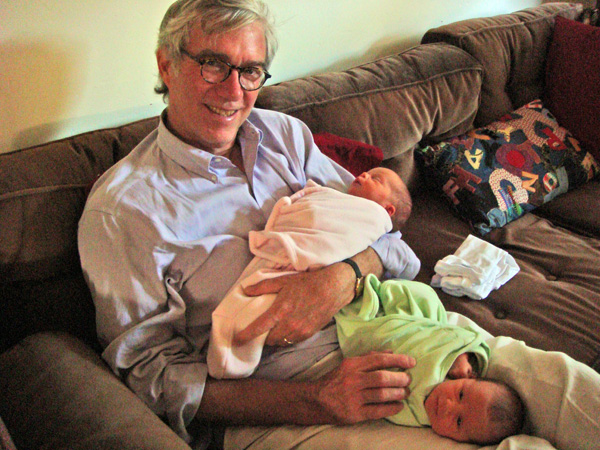
The main thing going on around here is that my son Rudy and his wife Penny have new twins! We’ve been visiting with them a lot. It’s wonderful to be with newborn babies. And two! When I hold them, they’re like little suns beaming good vibes into my chest, loosening the rusty hinges of my heart. I love how intent they are on what they do: sleeping and nursing. And I love the sweet, sincere crying: “La! La! La!” Their way of reaching out into the world. God bless them. Welcome, dear twins!

On Mundane SF

Sunday, July 15th, 2007

In 2004, Geoff Ryman and his Clarion West SF Writing Workshop students proposed a “Mundane SF Manifesto.” It’s no longer online, but the Wikipedia Mundane SFentry gives part of the manifesto, as well as some links to further discussion. The main current info source is the Mundane SF blog.

A rude person might imagine one of the Clarion students’ thought processes to be as follows: “I’ve always wanted to write like Henry James or John Updike or Jane Austen — don’t you just adore Jane Austen? But, frankly, it’s so hard to break into mainstream writing that I figured I’d try a genre first. And then I thought, why not be a science fiction writer! Only, then, when I start looking at sci fi a little bit, I find out that a lot of it is written by nutty loners, and it’s full of science and crazy ideas, and it’s not like Jane Austen or John Updike at all. So I’m thinking, why not get rid of all the weird icky science and write stories about people’s emotions and about the kinds of problems you read about in the newspaper?”

[Doin’ a Lindee on Mamma Mundane.]

I started brooding over Mundane SF again this week because Geoff has reprinted the manifesto in the latest edition of the (print only) New York Review of Science Fiction along with a thoughtful essay based on a talk he gave at the Boréal SF con in Montreal this April.

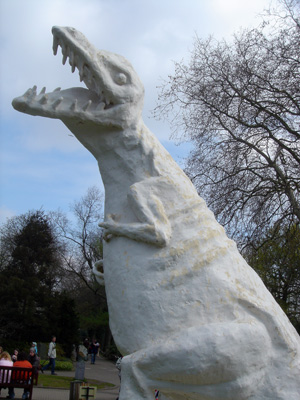
[What, no dinosaurs?]

The basic idea of Mundane SF is to avoid the more unrealistic of the classic SF tropes—or power chords, as I like to call them. Geoff feels that faster than light travel, human-alien encounters, time travel, alternate universes, and telepathy are absolutely impossible. He feels that if we draw on these unlikely power chords, we are feeding people wish-fulfillment pap.

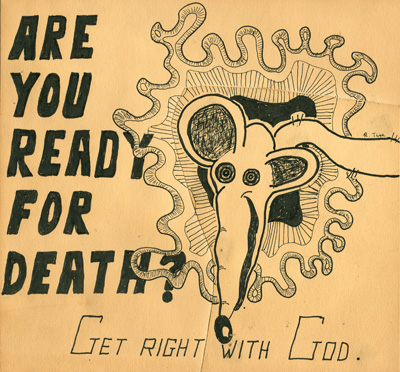
[No more second-hand God!]

Like me, the Mundanes would like to see SF as real literature. They feel that real literature mustn’t use fundamentally false scenarios. By the way, Ryman has very good lit chops, he has a cool modernistic novel 253 online—it’s in the form of a subway car full of people!

[Sketch-on wormhole conduit.]

Mundane SF is to be about picturing possible futures, drawing on such sober-sided Sunday magazine think-piece topics as “Disaster, innovation, climate change, virtual reality, understanding of our DNA, and biocomputers that evolve.”

[Why let the Pig’s media propaganda condition your practice of Art?]

I have so many objections!

I don’t think SF is necessarily about predicting possible futures. I’ve always felt that SF is more like surrealism. The idea is to shock people into awareness. Show them how odd the world is. Whether or not you draw on realistic tropes is irrelevant. But my personal practice is to allow really strange kinds of things to happen. This said, I do always to try and make the science internally consistent. Part of the fun of SF is making up explanations for your effects.

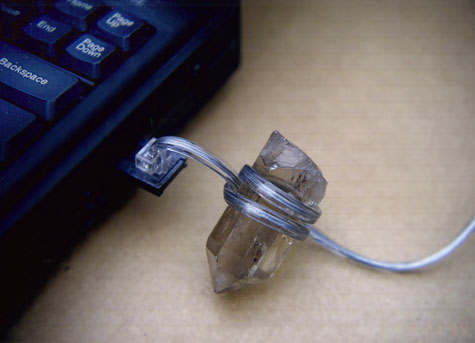
[A crystal-magic BS filter.]

Let it be said that futurism and SF are quite different endeavors. A rude person might say that futurism is about feeding inspirational received truths to businessmen and telling them it will help them make more money. SF is about unruly artistic visions.

Writing responsibly about socially important issues can be timid and boring. The thing is, science really does change a lot over time. Compare what we’re doing now to what we were doing in the year 1000. A Mundane SF writer of year 1000 might want us to write only about alchemy, the black plague, and the papacy.

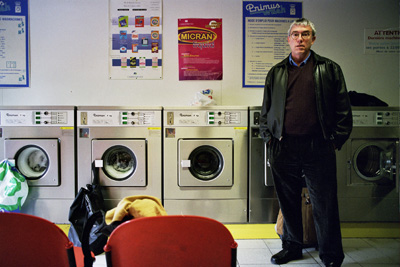
[Laundering my manuscripts.]

Not that Mundane SF really has to be stuffy. Come to think of it, my early cyberpunk novel Software was thoroughly mundane—everything in it could well happen—and it was pretty lively. Maybe that’s why I don’t see Software showing up on any lists of Mundane SF. Can serious literature be dirty and funny? Of course!

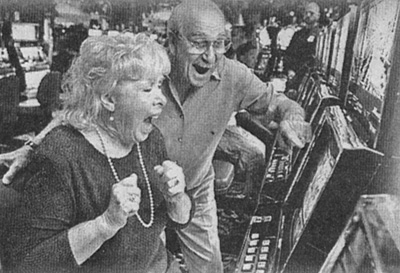
[Mundane writers are big winners!]

Despite my sniping, I do understand, for instance, Charlie Stross’s relish in accepting the Mundane strictures and writing a Mundane SF novel. Why not. It’s a form, like a sonnet or one-square-meter canvas. And, of course, clever Mundanes like Geoff Ryman know this. A manifesto needn’t be a universal strait-jacket. But maybe some forms are self-defeating. Like a novel that doesn’t use the letter E. Or a piano piece that doesn’t use the black keys. Or a painting with no red or yellow.

[Evidence of alien contacts mounts!]

Personally I’ve been growing less constrained from novel to novel—I keep trying to get further out into space. I was mundanely stuck on the Moon for a long time! I think it’s an interesting intellectual game to find valid scientific ways around the specific strictures suggested by Mundane SF.

[See the saucer?]

I agree that careless writers sometimes create logically inconsistent stories when using things like faster than light travel. But that doesn’t mean nobody should write about FTL at all.

Yes, FTL travel is hard. But I know of at least four ways to travel very rapidly. (a) The traditional way is to do down into the subdimensions and take shortcuts. And, no, you don’t have to do this via wormholes. Nor do you need to travel in large steel cylinders. Science finds new things.

[Sta-Hi Mooney teleports to the Crab Nebula.]

(b) A simple method that I’ve discussed in Freeware and in Saucer Wisdom is to send your personality as a zipped up information file and have it unzipped at your destination. This doesn’t go faster than light, but it goes at the speed of light, and seems to the traveler to take no time at all. Charles Stross used a weaker form of this in Accelerando, where people’s codes are packed into a ship the size of a soft drink can that travels at near-light speed. But, yes, when you get back home, a lot of time has elapsed.

[Scientist David Deutsch can prove any damn thing you want is possible.]

(c) Teleportation, based on quantum indeterminacy. There’s a finite (small) chance that I’m on planet Pengö near the Great Attractor as well as here. It’s not hard to imagine that coming improvements of quantum computation will make it possible to amplify the indeterminacy and collapse it so that I do the trip.

[A nicely broken-in yuncher can be found on the ceiling in this tenderloin crash pad.]

(d) The yunching technique described in my Frek and the Elixir (cf. also the Bloater Drive in Harry Harrison’s Bill the Galactic Hero). You wind some of your strings to get really big, then step across the galaxy, then shrink back down.

[What, no alien bar scene?]

As for aliens, perhaps they come via one of these rapid travel methods. But perhaps they are already here. Living in the subdimensions. What are the subdimensions? A power chord from the 1930s. Whatever is going on below the Planck length. We have no idea. Why not assume it might be interesting? Maybe aliens are those flashes you see out of the corner of your eye sometime. Maybe they’re aethereal protozoa in the atmosphere.

[Definitive proof that psi powers are real!]

When trying to justify telepathy—don’t forget that only a tiny fraction of our universe’s mass is the familiar visible matter. Most of it is dark energy and dark matter. As Nick Herbert has remarked—maybe some of that dark stuff is consciousness.

[Nevada is an alternate universe.]

Alternate universes are quite popular in modern physics. Something is going on in all those extra dimensions. Why not other worlds? Looked at in a certain quantum-mechanical way, each conscious being lives in a different parallel universe. Why should we settle for consensus reality?

[John Shirley among the Cro-Mags.]

Implausible as time travel is, it may be the SF power chord most commonly used by non-SF writers. If even the almighty “literary” writers get to use time-travel, can’t we lowly SF writers use it too? I’ve always wanted to write a time travel book and get it right. Surely this can be done. Rather than throwing up my hands, I prefer to continue searching for ways to be less and less Mundane.

Painting Workshop

Wednesday, July 11th, 2007

It’s so beautiful here in the south of France. Exquisite. Rocky and scrubby. The cypresses. The vineyards. Villages of piled yellow stones with red tile roofs. The real locals, like a guy who is the watchman at the marble quarry, they talk French so it sounds like Spanish. Languedoc.

It’s been very windy the whole time, like the wind in Big Sur, it gets on your nerves. A steady fitful wind is, by its very essence, “in your face.”

I’m fully off line here, which is great. I’m hardly even keeping journal notes. Just letting the experiences mount up and flow by. I like the flow of time here. Shifting sand. All the others have jet-lag, which makes time even more vague. The one kind of writing I’m doing is chipping away at the novel.

But really it’s about painting these days. I wake up at night and think about what I’ll paint the next day.

I’ve finished four paintings now, working six or more hours a day for eight days in the studio, which is a big old building in a field by a river, it’s a former saw mill for blocks of the local red marble from the Caunes quarry, “Le Carrière du Roi.” Only four more days to go here, I’ll miss this life.

Glen gave me really good practical advice about the pictures. He never talks about the content, just about the composition. Tricks to push things forward, or to avoid “triple points” (where too many lines come together).

I did a very nice final landscape, South of France. I was working on it at night in the studio and then I went outside and it was still a little bit light even though it was 10 p.m. and I had my brush in my hand and I was reaching out towards the trees and clouds and the house, moving my brush in the air, “painting” the things in place.

It was in the Wayne Thiebaud multiperspective style, a view of the vineyards with a piñon pine in the foreground. Glen like it, he said it was a very personal take on Thiebaud, a fantasy landscape, with a lot of rhythm. I suggested putting in a UFO, but got no encouragement on this front! I’m happy to be doing a straight landscape. I never thought I could do that. Glen’s brought me to a new level.

Riding my bike home after finishing my painting, Hylozoic¸ I was enthralled by the alternating shutters and doors in they yellow stone houses by the road. And on the porch, the wind feels like a paintbrush, a sweep of color.

In the tub this morning, rubbing my back with a washcloth, it felt like I was painting on blue-white paint. Imagine everything becoming color and gesture.

It’s all about painting these days. I wake up at night and think about what I’ll paint the next day. I wake up sore from the painting. Today I did yoga and I was seeing my muscle pains as colors. Not intellectually imagining this, but viscerally feeling washes of color in my brain. My forever-sore muscle along the right side of my spine oozed a pale cobalt blue as I squeezed it out. The sharp pain in my right shoulder a triangle of orange (made of vermillion and cadmium yellow). My legs a mixture of Mars black and cadmium red. The pain in my lower back is an acid green produced by mixing cobalt blue with cadmium yellow and white. Veins of thalo green creeping in.


[A seven-sided church dome in a 12th C church near Caunes.]

I was planning to do a triptych here: Postsingular, Hylozoic, and Infinite. I got some canvas for it, and finished the middle one, a square meter.

In the sky and in the foreground are circular blobs, representing the ubiquity of consciousness (every atom has a mind). It shows Thuy Nguyen with her pigtails in the lower right corner. You see her from behind, just the part and the pigtails and her bare neck. To the left stands a painter holding up a brush and looking towards her. He has a hat like Bosch wears in a drawing that’s sometimes said to represent him. Also he has a halo. I think of him as Bosch, as me, as Jayjay.

The largest and brightest thing in the picture is a flying manta ray, a Hrull mothership. Her mouth is open and you can see someone inside her mouth, like the people inside the body of the tree-man in the hell panel of Garden of Earthly Delights. This is Chu, who becomes a Hrull ship crew member. The manta ray’s mouth is vaginal, so Chu also resembles a fetus. There’s a logical flow from the pig-tailed young woman to the painter phallically displaying his brush to the small figure inside the manta ray. Woman seduced by magus becomes pregnant.

Doesn’t quite fit the book, as in fact Thuy seduces the young Chu and gets pregnant from that. But when I paint from one of my novels before actually writing the material, I’m using the painting to uncover possibilities. Maybe Bosch becomes besotted with Thuy, even though she’s only one foot tall relative to him. Or maybe we’re seeing Bosch steering the Hrull mothership (bearing Chu inside) to Thuy in the second to last chapter. Or, again, Jayjay could be the painter, and then the picture would make more sense. Thuy, Jayjay, and Chu.

So what I learned from the painting is that Jayjay does in fact become a painter like Bosch, maybe even a Bosch impersonator.

This is a photo from an exhibit by the winegrowers’ association that was up in the Caunes abbey before our group show. What we see here is a mob of enraged locals pulling down—a cautionary message about drinking and driving! They’re going after it as if it were a statue of Stalin or Saddam Hussein. This really cracked me up; I totally can’t imagine this demonstration happening in our puritanical US. Nobody would dare! Crimethink! Public safety is our scared cow. Not that I’m advocating drunk driving, mind you—but it’s interesting to see that societies can work from different sets of assumptions.

Glen says that he dreams of making a “breakthrough” and coming up with some new angle on painting. That set me to thinking about writing breakthroughs. In a way, I’m just happy to be able to write at all, and to get my work published. Maybe I made my breakthrough some time ago and am now enjoying my mature style. But maybe I am working for breakthrough too.


[Snail on a plane tree by the Canal du Midi.]

I do try and break through to new ideas each time out, but my characters and incidentals are much the same. I have a sense that trying for a breakthrough isn’t always a good idea, at least for me. It’s hard enough to write at all. Going for a breakthrough is that “knock it outta the park” thing—and you can end up whiffing. Saucer Wisdom was a deliberate breakthrough book, and it didn’t do too well in the marketplace. Maybe the trilogy I’m working on is a breakthrough. Or maybe it’s the same old sh*t. Like I say, the main thing is that I can do it. I love exercising my craft, making it funnier and vibbier and more gripping, step by step, tweak by tweak, polishing it like an icon.


[Barbara Heffernan with one of her paintings, and her portrait by Kevin Brown]

Today we hung a little show in a room at the local museum. Paintings by our workshop members.

I have two of my pictures up. Glen’s picture wasn’t finished yet. Last night he was going to do a big push, but he didn’t get it together. He was tense.


[Paul Fujii with his watercolors.]

The students’ mood and state of well being was very dependent on Glen’s moods. Imagine this for Bosch’s studio.

The opening of our group show was actually fun and the dinner was cheerful. Glen was in a good mood. On the night before the opening—after the rest of us had hung our pictures—Glen finished a piece about 8 ft by 4 ft, paper, an irregular pattern of black dots with white rings around them (acrylic) and then the paper laid on the floor and stained with a mug of black tea that stood on it and slowly dried overnight.

The effect was good, a kind of leopard skin quality. Glen called it Magellanic Clouds. I like the way he looks in this picture, so proud. He’s like, “Yaaar, I caught the big fish!” A little reminiscent of CA Turing spots as well, but funkier.

Glen was happy and we students were happy for him. We had dinner at a place in the tiny town of Citou on a back road. I don’t think a single car went by while we ate for four hours.

I had a landscape called Minerve in the show, which is the name of a town where I sketched the scene above, and painted the scene below.

I would have liked to see Hylozoic in the show but it’s not stretched, I painted it on a big square of canvas stapled to the wall. Now I’m worrying about getting that home, also my South of France painting, which is on a sheet of paper too big to fit in the suitcase. I rolled them up in foam.

Walking around the little medieval village of Caunes day after day. It’s so tiny. And on most of the streets you can’t see the horizon, or even any green. You just see the walls. It’s like being inside a very high-walled maze. The village. And when you get out into the green fields it’s such a relief. I see Thuy and Jayjay having this feeling in s’Hertogenbosch.

Glen lent me a vibby book, What Painting Is, by James Elkins. It’s a sustained analogy between painting and the medieval practice of alchemy. Paint is water (the medium) and stone (the pigment), and you’re trying to distill the fire of light. On the palette, the mixed paints are like excrement, the “prima materia” of alchemists. They paints transform unexpectedly. You don’t really know what you’re doing, it’s a somewhat magical and intuitive process.

I personally hate to try and think about the color wheel when I’m mixing paints—logical analysis feels wrong in this context. It’s much more pleasant to just muddle the paints together and see what I get, and if it’s not what I wanted, maybe I can use the “wrong” color somewhere else. This said, I am learning a few basics, like that cobalt blue and cadmium yellow make a nice green—but still, and here’s the alchemy of it, this mixture doesn’t always seem to work. I have to throw in an unspecified amount of white. Or adjust the amount of yellow.

Would be nice to have an actual alchemist in the story. Maybe Thuy and Azaroth are hanging out with one. A guy like in Bruegel’s drawing of a Nick Herbert or Phineas McWhinney type alchemist. “Al gemischt,” it says in the Bruegel drawing, which means all mixed up.

I’m planning to model my Infinite wing of the triptych on Bosch’s Venice painting of an ascent to heaven, where the image is (perhaps) inspired by the appearance of the water-mirrored round arches in the s’Hertogenbosch town canal. I can have Bosch point this out to Jayjay.

We took a little ride in a boat on the Canal du Midi. Exquisite.

And then it was back to the big city.


Rudy's Blog is powered by WordPress