

Click covers for info. Copyright (C) Rudy Rucker 2021.


Author Archive

Australia #4: Lord Casey and my Talks

Wednesday, December 16th, 2009

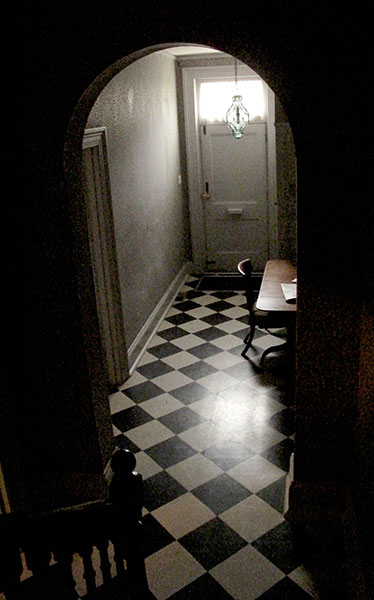
We settled into the Casey House in Melbourne. It was an elegant 1864 townhouse near Fitzroy Park, owned by an 80-year-old woman who lives in Sydney, in another of her properties. This place was originally built by an eminent Melbourne painter, and passed into the hands of Lord Richard Casey (1890-1976).


[Spooky front hall.]

He was born rich, and active in Australia politics—in the 1960s he was the Governor-General, that is the representative of the Queen of England. The present owner is Lord Casey’s daughter. She hasn’t removed the family furniture, books, art, and knickknacks.


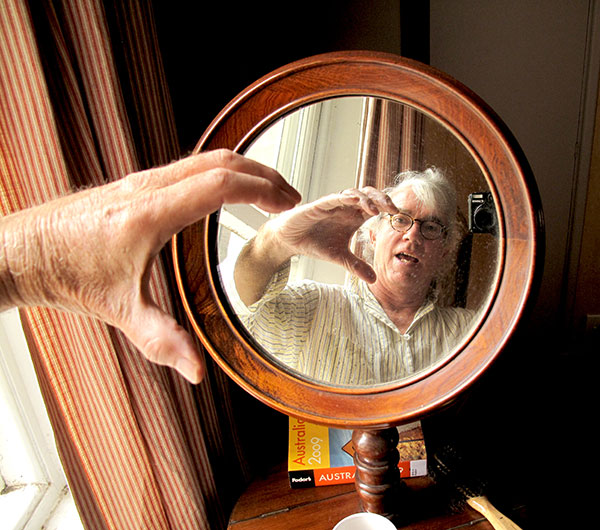
[Lord Casey’s shaving mirror.]

The property manager is instructed to rent the rooms only to artists, on a short-term basis. Leon’s partner Yolande knew an artist who’d roomed here, and she had the idea of getting us in. The rent is only about $70 per night. It’s very cool to be living here, it’s like being in an old movie. I have a great shaving mirror.

The bedroom doors don’t lock, and in the bedroom next door is a who’s here for the same conference on media art that I’ve come for. It’s like being in a grad school dorm.


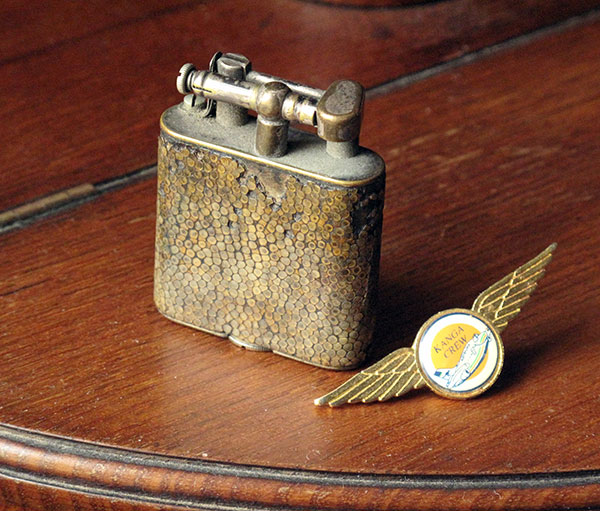
[Lord Casey’s lighter and a “Kanga Crew” pin from an airline.]

The cupboard in our room has a shelf filled with various personal possessions of Lord Casey. And ivory handled hairbrush, a case with small mustache brushes, a silver egg cup, a marvelously intricate brass cigarette lighter with green lizard hide wrapped around it. I’m half-tempted to take a souvenir, but I feel it would be too risky to taunt the spirits of the dead. The house does have a haunted feel.


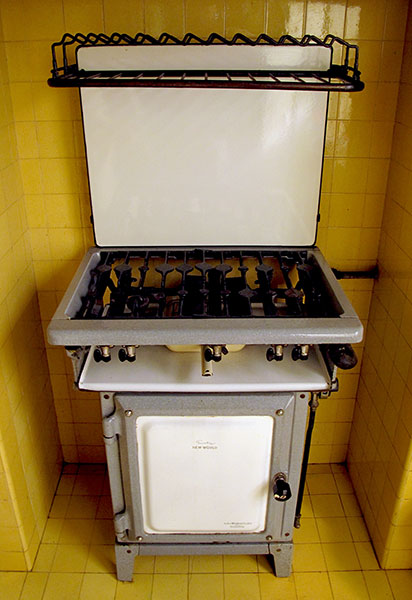
[Icon-like stove in the old kitchen.]

I can see using this place in my novel-in-progress, Jim and the Flims. I want to put in a scene where Jim’s not-really-a-friend Skeeves finds the golden sarcophagus of Amenhotep I with the bodies of Weena and Charles inside it. I figure the sarcophagus could be on the locked third floor of the Casey house, in an abandoned painting studio, beneath a skylight, it’s polished surfaced reflecting the slow play of the sky.

I had three talks scheduled in Melbourne, each one different.

The first two talks were at the Burwood campus of Deakin University in Melbourne, and the third was with Leon Marvell at the “Re:Live” conference on Media Art at the Victorian College for the Arts.

Talk 1: “My Life as a Writer”. I was more than prepared for this one, having just finished my third draft of my autobiography, formerly called Nested Scrolls and currently entitled Rudy the Elder.

Talk 2: “Life is a Gnarly Computation,” was a talk I’ve given before. I connected with a fractal artist fan of mine online who lives in Melbourne, Mark Townsend, and he met me to ride out to the talk with me. He worked on a fractal flames program called Apophysis, based on another fractal program by yet another friend of mine, Scott Draves, who used to hang around San Francisco doing shows, he called himself Spot. The worldwide network of SFictional computer pioneers!

Talk 3: My conference talk with Leon, called, “Lifebox Immortality … and How We Got There.” I spoke extemporaneously and Leon read a paper aloud. We had two Q&A sessions, one after each of our talks, it was good. Leon’s talk had a passionate, mystical tone. I should also mention the Melbourne SF fan, Tony..who came to all three of my talks. Good on ya, Tony!


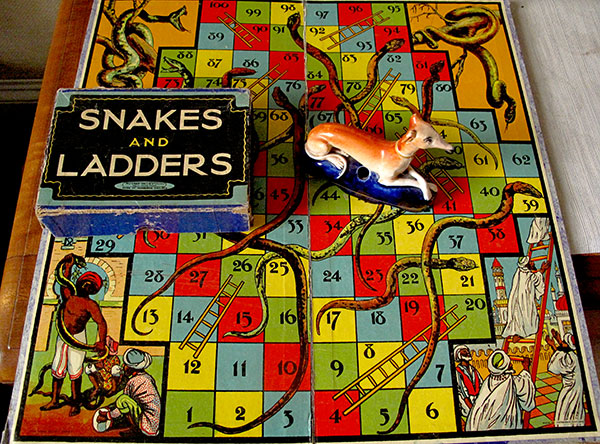
[Old board game in Lord Casey’s house.]

I got a couple of SF ideas while answering the questions at the Lifebox presentation. Like, what if your lifebox becomes so good at emulating you that it starts getting hired for your speaking gigs instead of you? And what if your lifebox becomes corrupted, seeming to reveal unsavory (and heretofore unknown-to-you) details about your life. And then maybe there’s a blowback effect whereby you in fact begin making those nasty aspects of your re-edited life come true.


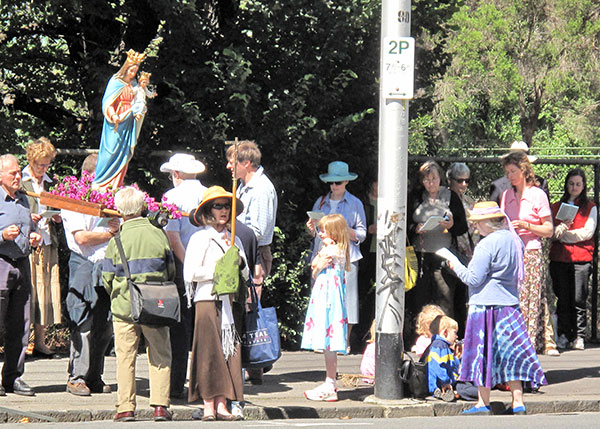
[Pro-life demonstrators outside a Melbourne fertility clinic.]

Sylvia pointed out that a lifebox would be more engaging if it remembered the individual interlocutors. This would be feasible—the lifebox could create mini-lifebox models of the people it talks to, remembering their interests, perhaps interviewing them a bit, and never accidentally telling the same story twice—unless prompted to.


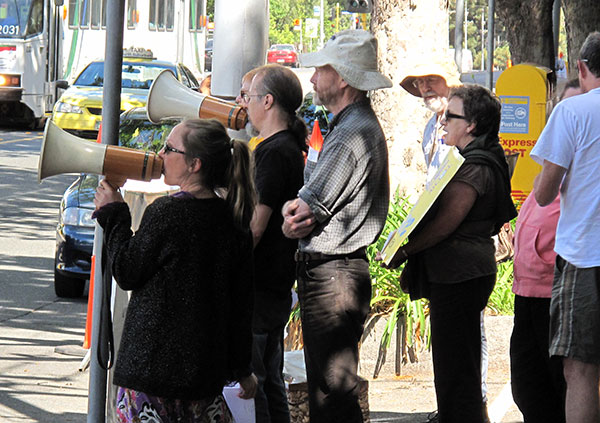
[Pro-choice demonstrators on the other side of the street, outside the same Melbourne fertility clinic.]

By the way, I don’t think it would be that hard to train a computer program to act as a reasonably good interviewer. It could start with data on the interviewee, and mine a list of topics. As the interview progressed, the agent could hark back to things that had been mentioned, or create questions pairing together things that had been mentioned. Now and then the interview agent could throw in a somewhat random or even dadaistic question. As often as I’ve been interviewed, I well know that the interviewers often don’t bring much intelligence to bear upon their questions.

Australia #3. Aboriginal Art.

Wednesday, December 16th, 2009

As I’m going to reprint some Aboriginal art images in this blog post, I need to caution that some Aboriginal people prefer not to see art by their people reproduced, particularly if the artist is deceased. So be warned, and don’t view this post if you’re sensitive to these issues.

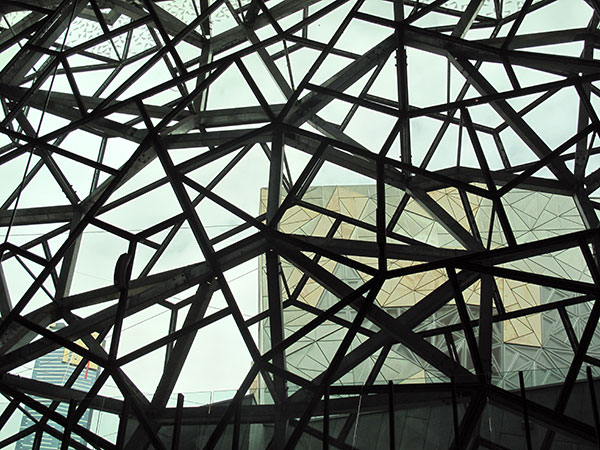
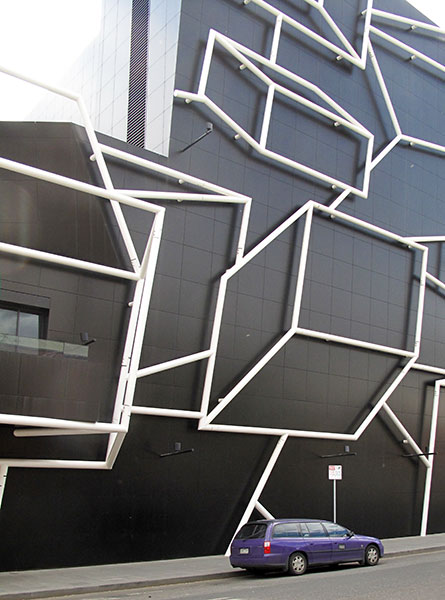
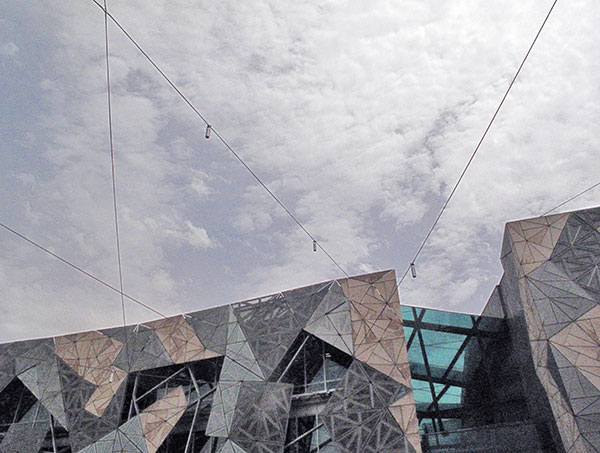
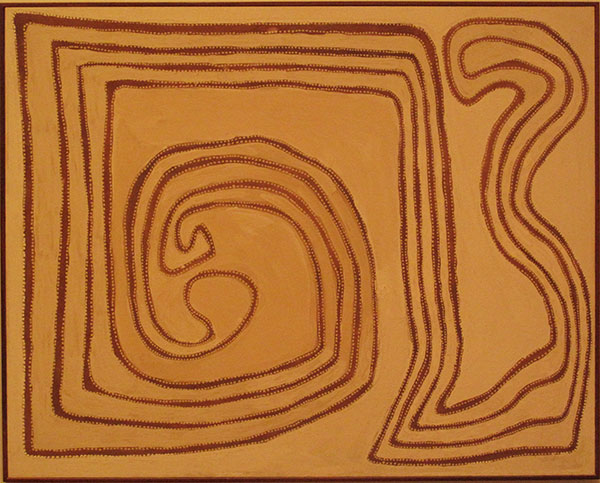
The heart of Melbourne holds a large art museum complex in what’s called Federation Square. All the buildings in the complex are patterned with irregular Penrose-like tiles on the outside. We saw some galleries of wonderful Aboriginal (they often say “indigenous” as well) paintings inside the NGV (National Gallery of Victoria) here. Many of these are super-pointillist and somewhat abstract-looking, they’re made from dots which are sometimes painted on with sticks or with Q-tips with the cotton torn off.

Many of these pictures have a story or a “Dreaming” associated with them, although the story isn’t at all apparent to the untutored eye. Many of the pictures are also in some sense topographical, mapping out the geographical patterns, the practical uses, the spiritual vibes, or the mythic tales associated with regions where the painters live.


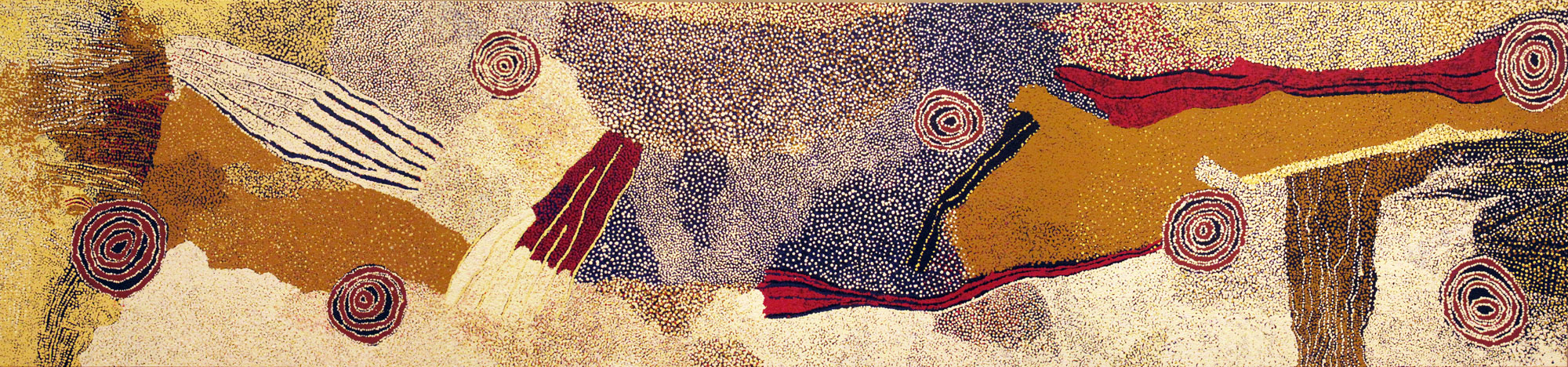
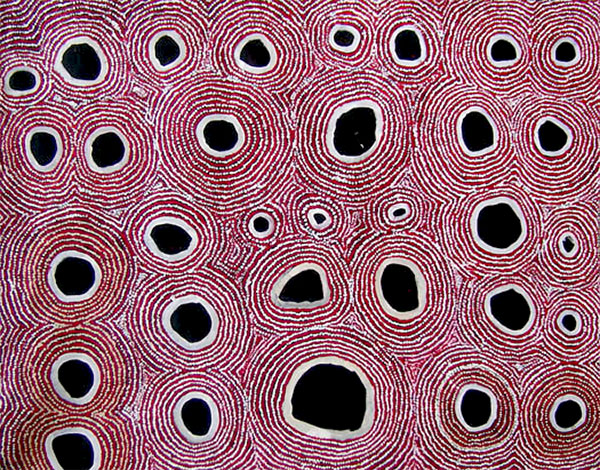
[“Rockholes and Country Near the Olgas,” 2007, by Kumanara “Bill Whiskey” Tjalpaltjarri. Click for larger version.]

One topographical picture that I liked was by the artist commonly called Bill Whiskey Tjalpaltjarri (1920-2008), “Rockholes and Country Near the Olgas,” painted in 2007, when Kumanara was 87 years old. So far as I know, he used this same title for all of his pictures. A rockhole is, I believe, a water hole. In this work, The dots bunch up here and space apart there, like windblown fog, several layers deep, and he does subtle things with the colors like having dark blue dots upon black ones. It was a very long picture, and reminiscent, in its own way of David Hockney’s “Mulholland Drive.” I worship this picture by Kumanara Tjalpaltjarri, I went back to look at it three times—my patched together photo doesn’t do it justice.

It would be fun to make a topographical map of my own neighborhood and home town as seen from above, using patterns and colors to show some of the things I’ve experienced on this familiar home territory. I don’t think I’d have the patience to use dots, but maybe I could use some other kinds of small patterns.


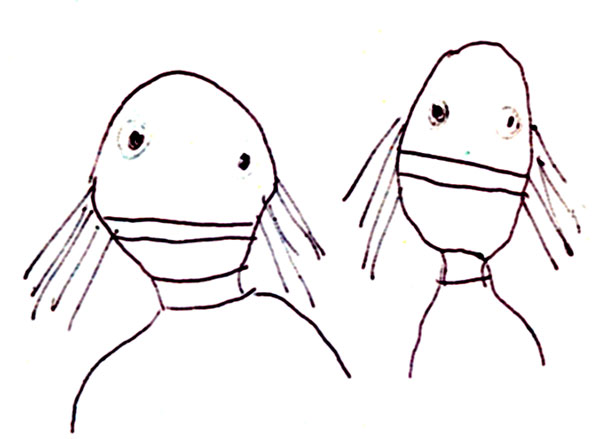
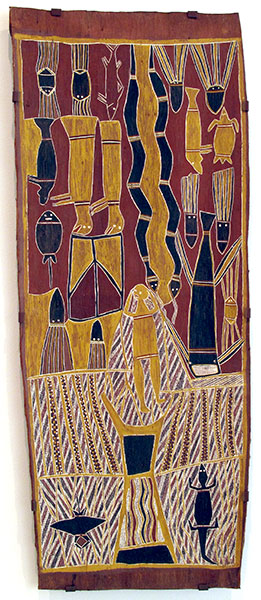
[I didn’t manage to get a photo of Yirawala’s work, but I made a rough pocket sketch of his “Mardayin Ceremony” of 1979, seen in the National Gallery of Victoria.]

I was also stuck by some large drawings done with “earth on stringy bark” in Marrkolidjban, in the Northern Territory. Stringy bark is bark from a peeling eucalyptus tree, somewhat like the euc we happen to have in our yard back in CA. The artist, Yirawala , is one of the most famous of the Aboriginal bark artists, and is sometimes compared to Picasso.


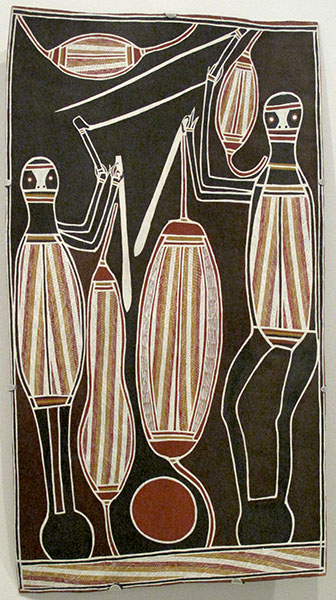
[“Two Tunmirringu Fighting,” Bark painting by David Malangi, Arnheim Land (an area on the north coast of Australia), seen at the Gallery of New South Wales.]

It’s interesting how hard it is for most of us, as adults, to draw in the diagrammatic style that we used as children. And then we labor to get back to that clarity. It’s like the Aboriginal artists have short-circuited the whole process of primitive-to-advanced-to-primitive. Artistically speaking, they’re still in the Garden of Eden.

Long story short: in the West, we started with ideograms and abstractions, got realistic, and tried to get back to the ideograms. In Australia they stuck with ideograms…and got really good at it.


[“Thunder Spirits (Birimbira)” by Munggurrawuy Yunupingu , 1861, Arnheim Land, seen in the Gallery of New South Wales in Sydney. Dig those jellyfish with the dangling tendrils.]

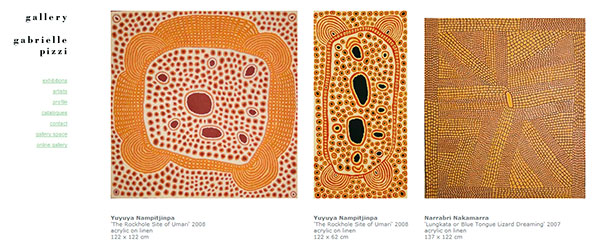
During our trip, Sylvia and I also went to some commercial galleries selling Aboriginal art. One of them, the Gallery Gabrielle Pizzi in Melbourne, was particularly good, up on the third floor of a downtown building like a classy New York gallery. Check out the “Paintings” section of their “Online Gallery,” I have a screen capture below.

The pictures were selling for about $10K; many of their painters live in the middle of Australia, east of Ayers Rock. One work, by Kim Napurrula, who paints with the Papunya Tula art movement, impressed me particularly, although I don’t have a good photo of it. It was like a great abstract painting, but with a vital sense of there being an underlying story. Wonderful colors, all in shades of red, orange, beige, yellow, brown, and black. Kim is from a family of Aboriginal painters, it seems to be a kind of passed-on craft, as painting was in Europe in the Middle Ages.

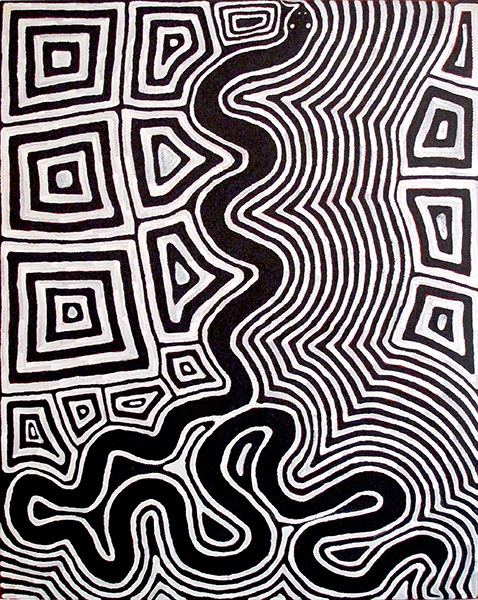
[“Tingan Motifs and Snake,” by Ronnie Tjampitjinpa, who’s very popular. Seen in the Gallery of New South Wales.]

In Sydney we visited the Art Gallery of New South Wales, a museum which lies in a huge city park. Their display of Aboriginal art was just amazing. I’ve learned that the Aboriginals of Australia are maybe the oldest continuous civilization on Earth—they went along doing more or less the same thing for 60,000 years, the Aborigines, and they have some very elaborate belief systems. The art is still very much alive—I’m still having trouble understanding the sociology of how it’s created—it’s quite different from in the U.S.


[Painting by Simon Hogan, 2009. Shown as part of the “Tracking the Wati Kutjara – Spinifex 2009” show, photo (C) Cooee Aboriginal Art Gallery. Here’s a link to page with all the pictures in the show]

We saw some more Aboriginal art in the wonderful Cooee Aboriginal Art Gallery in Bondi, near Sydney. I was quite interested in the work, and the owner, Adrian Newstead, talked to us for a long time. He showed us pictures of the artists at work, he goes out to Western Australia to hang with them. Their current show is from the “spinifex” region of the desert—spinifex being an Australian plant—Adrian showed us a picture of the artist Simon Hogan working on the picture shown above. .


[Rover Thomas, “Dreamtime Story of the Willy Willy,” 1989, a painting of the path of a desert whirlwind, at the National Gallery of Victoria in Melbourne.]

I find it so cool that the Aboriginal art pictures, which look abstract really are, in a sense, representational, depicting, as I mentioned above, specific home territories of the artists. According to the notion of the “Dreaming,” supernatural beings emerged (and are still emerging), and these creatures follow specific paths across the length and breadth of Australia. These paths are called songlines, in part because different tribes at different spots along the line will have a song about a part of the supernatural being’s history. As the Aborigines used no written language, the songs and the graphic designs they make served as their recorded history.


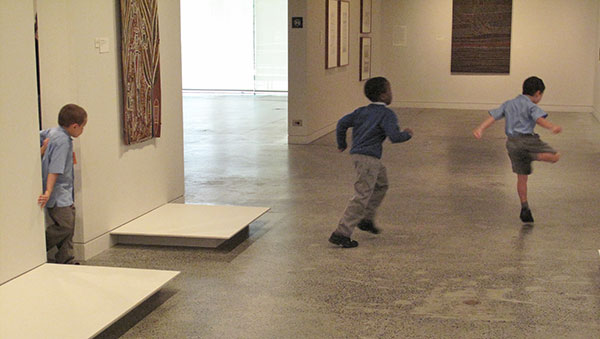
[Kids on a school tour in the Sydney Gallery of South Wales.]

The whole deal of Aboriginal Art is really different, and I’m still figuring it out, reading three books on it right now. One of the books is art-historical: Howard Morphy, Aboriginal Art (Phaidon, London, 1998). The second is a journalistic account of the recent uptick in the market for Aboriginal art, and about the odd ways in which it’s produced and marketed: Benjamin Genocchio, Dollar Dreaming (Hardie Grant, Australia, 2008).


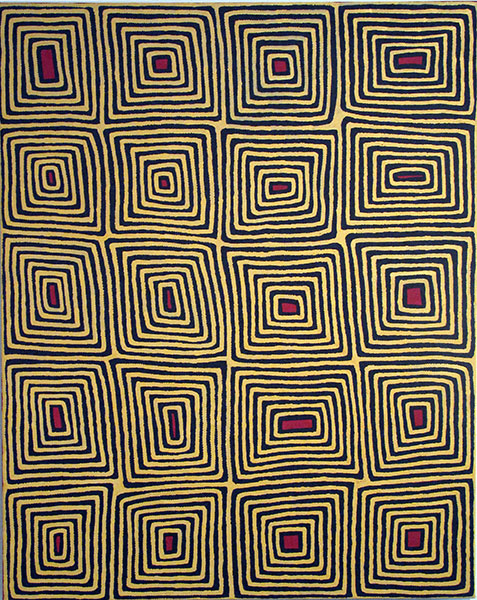
[Antoher painting by Ronnie Tjampitjinpa, in the Gallery of New South Wales. Ronnie’s work is easy on the Western eye, it’s at a nice funky nexus between Aboriginal art and Op art.]

As I understand it, in the 1960s some enlightened forces within the Australian government had the idea of giving the Aboriginal people art materials and promising to buy any and all paintings that they made. And, as happens, some small percentage of the people have turned out to be great artists. Of course any number of the painters are not all that artistically gifted, and the more touristy art galleries are showing art that’s not so good.

The third volume I’m reading is a memoir or travel book by Bruce Chatwin, The Songlines (Vintage, London 1998), and is the most literary of the three. It’s beautifully written and has some profound theories about Aboriginal culture.

One minor flaw I found in The Songlines is that the white female characters seem rather bland and interchangeable. But the the white males and the Aborigines are quite sharply limned and colorful. Another odd thing about the book is that, about half-way through, Chatwin seems to run out of material—and fills most of the second half with pasted in excerpts of his old writing journals. And the old journal entries don’t have any obvious relationship at all to Aboriginal culture. But I suppose Chatwin would have compared his compositional trick to intersecting two mythic songlines in the Australian outback. In any case, it’s a wonderful book.

Australia #2. Seeking Platypus Bill Implant

Monday, December 14th, 2009

Leon Marvell is the head of the film program at a public college here, he’s on the Burwood campus of Deakin University. He was able to get me grant money for the trip here, both to give a talk at a conference on media art, and to be a “Thinker in Residence” at Deakin for a week.

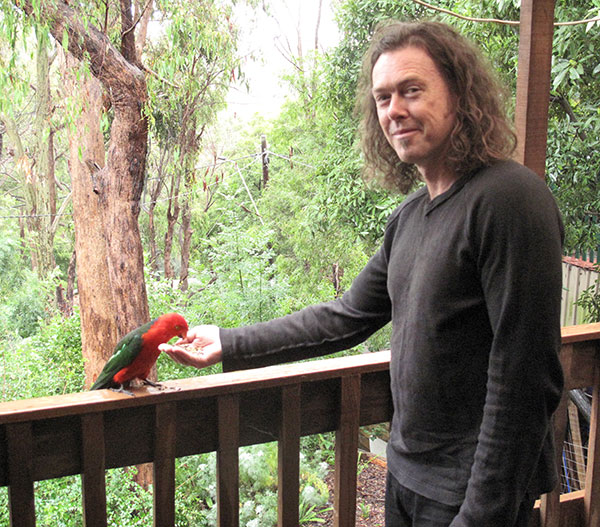
Here’s Leon with a wild parrot. Leon and his partner Yolande live in an area that’s slightly like the Santa Cruz mountains—there’s lots of eucalyptus trees, and tropical birds. They drive on the left side of the road. The accent can be hard to understand.

We stayed at their house for a couple of days. One day it rained all morning and we played Scrabble in Leon’s house. Leon and Yolande refrained from using unfamiliar Australian words on the board, but they did teach us a few.

For instance a “pie floater” is a meat pie set into a bowl of green pea soup, with some bright red tomato sauce on top of the pie. When Leon was a boy in Adelaide, his grandfather would take him to town and the big treat would be a pie floater. Some people jokingly refer to the town as Addlebrain.

Saturday evening, Leon cooked us some kangaroo, which wasn’t bad, more or less like venison. I felt slightly guilty.

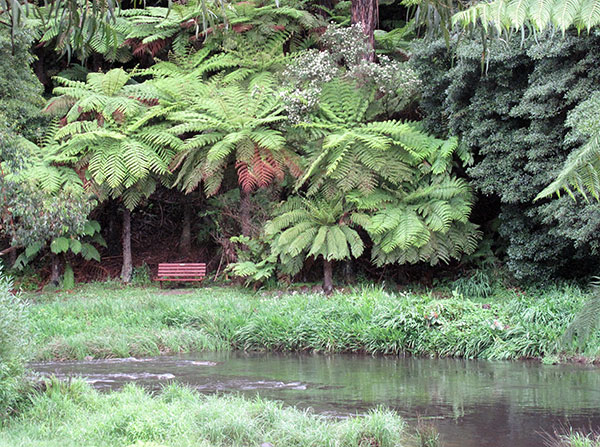
On Sunday, Leon and Yolande drove us deeper into the mountains into a rain forest, where we saw a really big kookaburra bird, the size of a chicken, in a tree. Sylvia saw a lyre bird with extravagant tail. We walked among tree ferns and saw the enormous “mountain ash” the size of a redwood. It’s actually a type of eucalyptus (they have about sixty different kinds of eucalypts here) with peeling bark and pocked with clumps of moss.

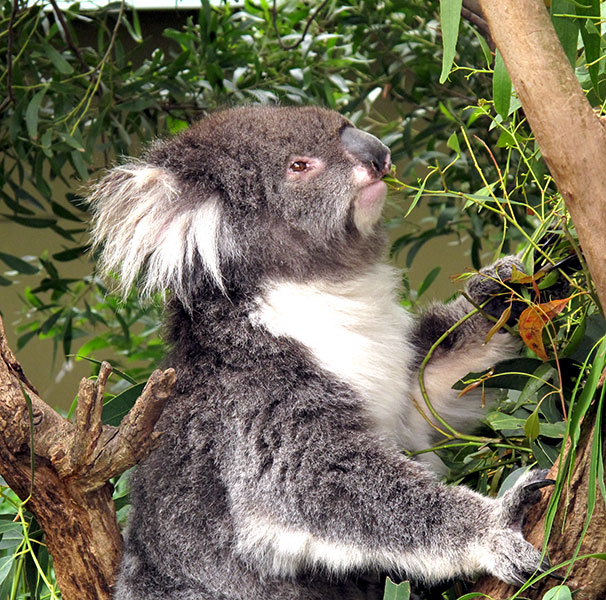
On Monday, they took us to a kind of zoo near their house, and we saw all the canonical Australian animals: kangaroo, lyre bird, koala, echidna, and the platypus.

The koalas don’t actually look like bears at all. In fact they look more like Mao Tse Tung.

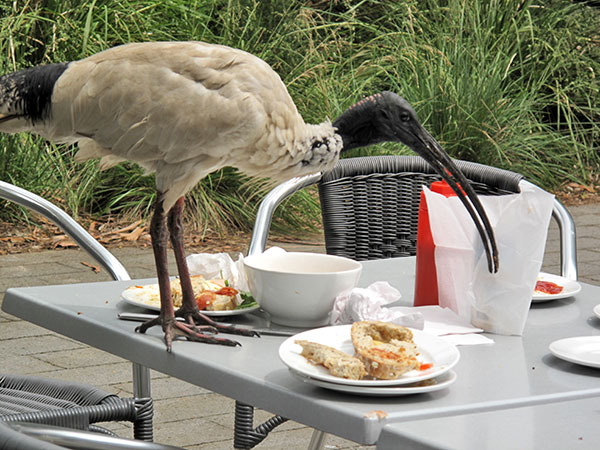
We had lunch in the cafe there, and the ibis birds were all over the table. I’d always thought ibises were Egyptian, but they’re all over Australia, getting down and competing with the pigeons, even though they’re supposed to be sacred birds (cf. Thoth, the divine scribe, with the ibis head).

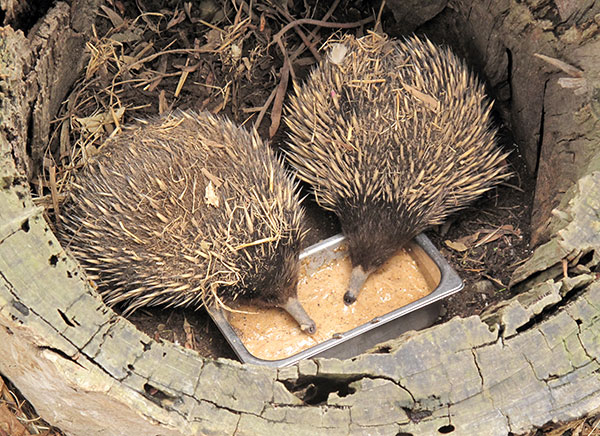
We saw some echidnas, who are hedgehog like monotreme mammal critters who, like the platypus, lay eggs and nurse their pups.

The platypuses were great, a male and a female, in separate tanks, very large tanks, dimly lit to simulate night, with leafy branches and rocks and worms and fresh-water shrimp that the Ozzies call “yabbbies.” The furry little platypuses swam around a lot. They close their eyes, nostrils and ear-holes under water, and find their way by using their soft, electrosensitive bills. Truly a sixth sense. The bills pick up the oscillating electrical fields of living objects in particular, although I suppose there might be some fields coming off inanimate objects as well. What a great way to perceive the world.

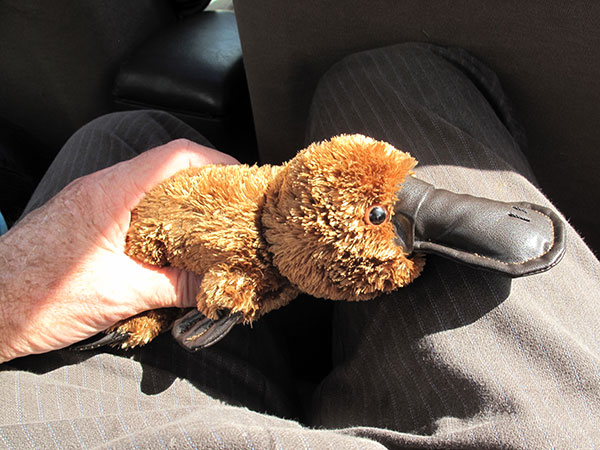
It was too dark in the zoo to get a picture of the platypuses, but Leon kindly gave me a stuffed one to treasure. Leon claims a baby platypus is called a “puggle.”

Yolande’s mother and brother are taking part in a platypus-counting program in Adelaide—each person goes out at night and tries to spot one in a certain area. As things stand, platypuses are so retiring that nobody knows how many of them there are.

I’m imagining an SF story where someone gets a platypus bill implant—and how they then see the world. They can sense sexual partners, or a wad of money, or drugs.

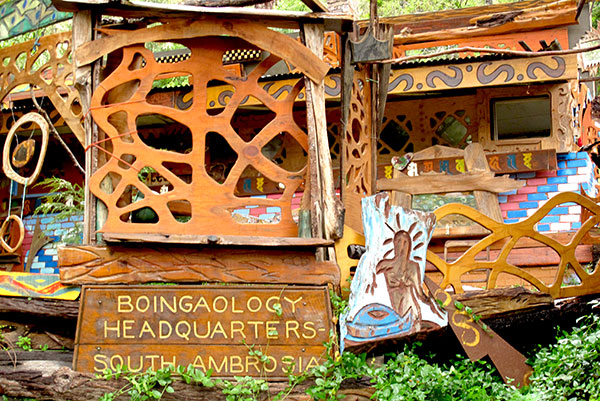
On a drive near Warburton, Leon showed us the rambling self-built house of “Boinga Bob,” which the owner terms a center of Boingaology.

Right on, Leon, and thanks for everything!

Australia #1. Going to Melbourne.

Sunday, December 13th, 2009

I’m just back from a nearly month-long trip to Australia with Sylvia. It was, in part, an academic speaking gig. We were in Melbourne, Sydney, Cairns, and the Great Barrier Reef. I’ll blog some of my travel notes and trip photos over the coming days.


[Carved “fairy tree” in Fitzroy Park in Melbourne.]

Flying into LA at night on the trip down was impressive. It’s an image I’ve seen in films, the great grid of lights— but to be there in person felt…epic. In a plane you can also look straight down and sense your height—it’s not just a panoramic view. You’re embedded and, to some extent, at risk. I was thinking of all the things people were doing down there at that very moment—eating, watching TV, fucking, getting high, arguing, with one or two even in the process of dying or being born.


[In the Victoria Market buildings in downtown Melbourne.]

We left on Tuesday and arrived early on Thursday morning, thanks to the International Date Line. We’ve been busy Turing ants the last two days, leaving trails hither and yon, scavenging scraps of food, culture, shopping. In some ways it’s like the U.S., in that it’s a young country, but there is a European feel as well. In the downtown part of Melbourne, there’s quite a few impressive old stone buildings, and an old shopping arcade with a tiled floor and a fancy ceiling. Indeed, many of the blocks have interesting little alleys or “laneways” cutting them in half, often with cafes on the laneways.


[“Luna Park” amusement park entrance in St. Kilda district of Melbourne.]

The city of Melbourne is pretty big, 3 million, and there’s many faces to see. Many fair British types, but lots of Chinese and Vietnamese, and some Indians and Indonesians as well. Some of the Brits are pasty and lumpy, but many are handsome or beautiful. From 1901 to 1973, the country had a “White Australia” policy of excluding non-white immigrants—ironic, of course, in the face of the fact that the Aboriginal natives are dark-skinned. You hardly see any Aboriginals in the cities of Melbourne and Sidney by the way—they seem to live up north or in the central and western deserts.

We rode a streetcar to a funky beach suburb, like Santa Cruz but grottier and bigger. St. Kilda. At the beach it was 100 degrees Fahrenheit and the bay water was listless and utterly flat, with dead blue jellyfish on the shore. We had a nice lunch in a beachfront place, glad to be in some air conditioning, I had a Pacific fish called trevalley, it was good. After lunch we went wading and suddenly a squall was whipping up waves and blasting us with blowing gritty sand. The wind was maybe 70 mph, with some rain in it, and we all hid inside. And then the squall was over and in that half hour, the temperature had dropped to about 75. The Australians didn’t seem surprised.

It’s interesting to keep on exploring the city. Cities are like fractals, or like Nature herself—as you delve deeper, you keep on finding new details. We were in Melbourne so long—eleven nights—that it started to feel like when I spent a semester in Brussels a few years ago. It moves beyond sight-seeing and becomes a matter of living in a new place.


[Kangaroos lie on their backs and scratch like dogs.]

Being on vacation, at first I didn’t feel too much like writing, which means that I felt a little blank. Writing wakes me up, centers me. But not feeling compelled to write is kind of relaxing. Like I’ve retired from life.


[Federation Square is cool.]

We’re sight-seeing, doing things like having a chai latte tea at the Riverland pub terrace between the Yarra River and Federation Square. The teapot is full of pods and seeds and leaves floating in steamed milk. I have a special sieve for straining this invigorating ichor into my cup.


[A Shrine of Remembrance for the war dead in Melbourne.]

All in all, this is one of those trips when I don’t really know what I’m doing or why I’m here. It’s all kind of pointless and random, like, why am I giving these talks, and why Melbourne? Well, because they paid me to come. It’s nice to be out of my normal life, with a new city and so many unusual people to see.


[Street scene in Melbourne.]

Everyone has been very friendly in Australia, I feel it’s a similar to Canada in the sense that it’s an English-speaking country that isn’t so conflicted and torn by internal contradictions as is the U.S.


Rudy's Blog is powered by WordPress