



Click covers for info. Copyright (C) Rudy Rucker 2021.


Author Archive

Plans For The V-Bomb

Wednesday, June 22nd, 2011

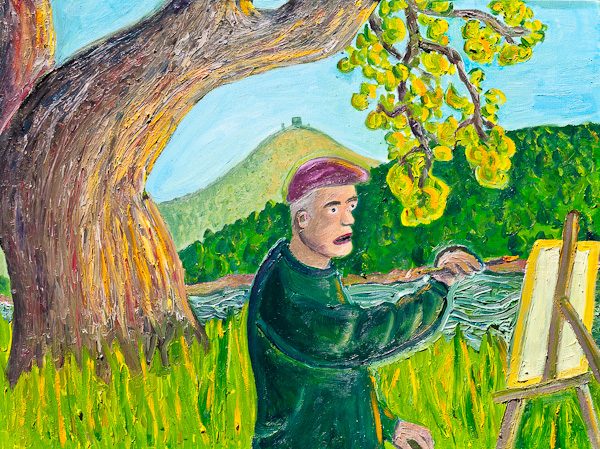
I finished my painting of my friend Vernon Head near Mt. Umunhum and the Guadalupe Reservoir south of San Jose last week. I used a palette brush more than usual. Vernon’s a good painter, you can see some of his oils here.

I want to get back into my novel Turing & Burroughs now, but I’m still painting, a piece called V-Bomb. I think the painting is helping me with the novel.

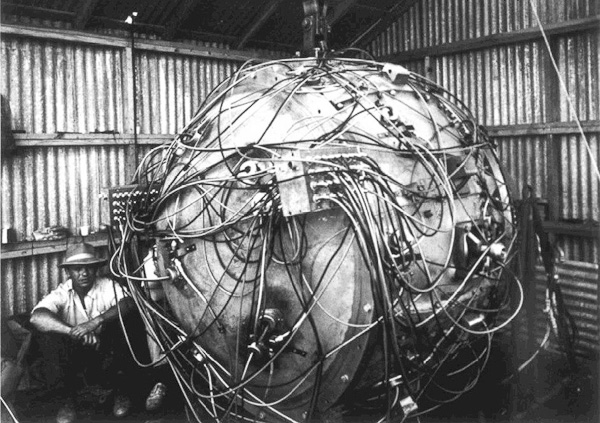
The V-bomb is a device that Alan Turing is going to use perhaps to remove these parasitic skug creatures from Earth—or perhaps to spread skugs all over Earth. We’ll suppose that the V-bomb rays are expected to pass through matter, so there’s no particular need to set it off high up in the atmosphere. It’s just sitting in a tin shed in the Frijoles Canyon near Los Alamos. Like this:

I found another big stash of bomb photos online, including this one of the of the Trinity bomb, shown above, with gnarly exposed wiring. It was built in Los Alamos, they called it The Gadget, and it exploded in the first nuclear weapons test of an atomic bomb, which took place on July 16, 1945, near White Sands, New Mexico.

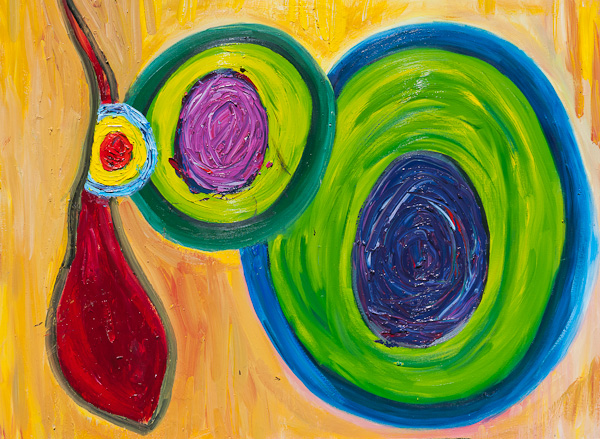
That cross-legged guy suggests the idea of Turing getting inside the V-bomb. And instead of expanding outwards, the V-bomb implodes. I got the imploding idea from my painting V-Bomb that I’m currently working on. I kind of ruined the painting today…a lot. The colors are horrible. But I did get the layout the way I wanted.

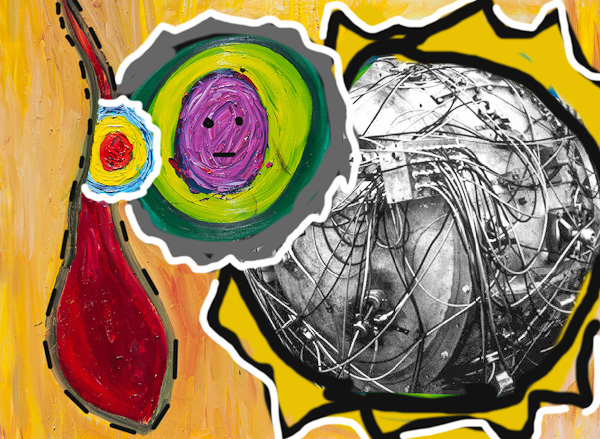
It’s just a stage. Version 2. And now on to Version 3. I’ve recently developed this habit of photographing my painting in its current state, and then collaging or drawing in extra bits in Photoshop, and using that as a mockup for the next stage. So here’s the mockup for Version 3.

The win for me in this process is that sometimes working on a painting can give me an idea for a piece of fiction I’m working on.

My idea in the mockup above is that Turing is squatting in the V-bomb on the right, and then he’s vaporized and becomes the living essence of the blast—which is shrinking towards a tiny size—and then, when the blast is sufficiently compact, a rip opens up in the fabric of space, and Turing slides through into the afterlife.


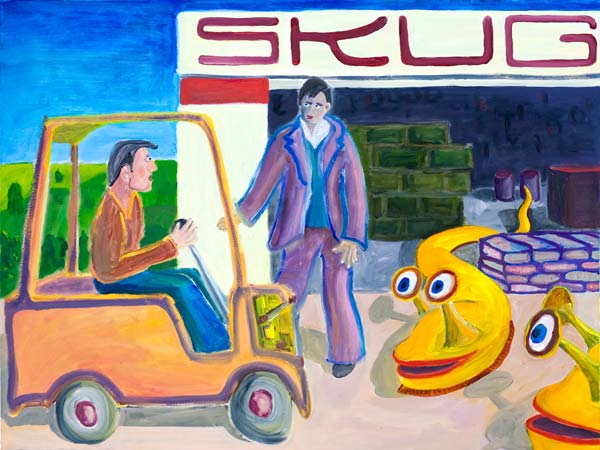
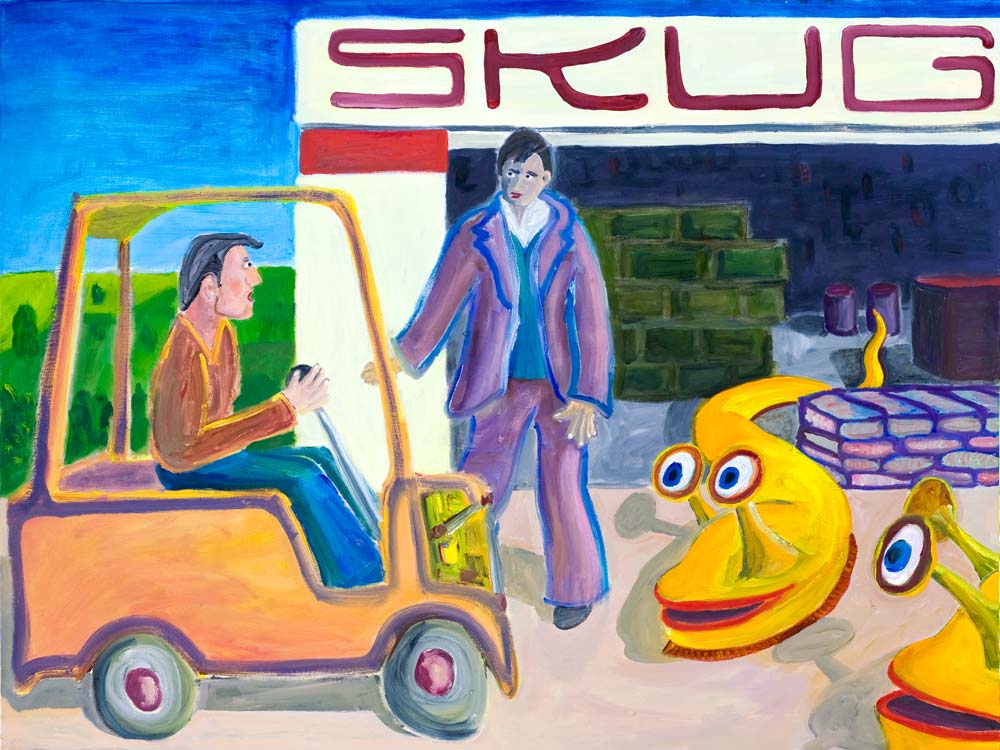
“Turing and the Skugs”, 40″ x 30″ inches, Oct 2010, Oil on canvas.” Click for larger version.

Note, however, that he’ll need to send out some rays—or perhaps some logic paradox?—to destroy any free-ranging skugs, and to restore any skuggers to their normal state.

My Oddest Fan Letter

Monday, June 20th, 2011

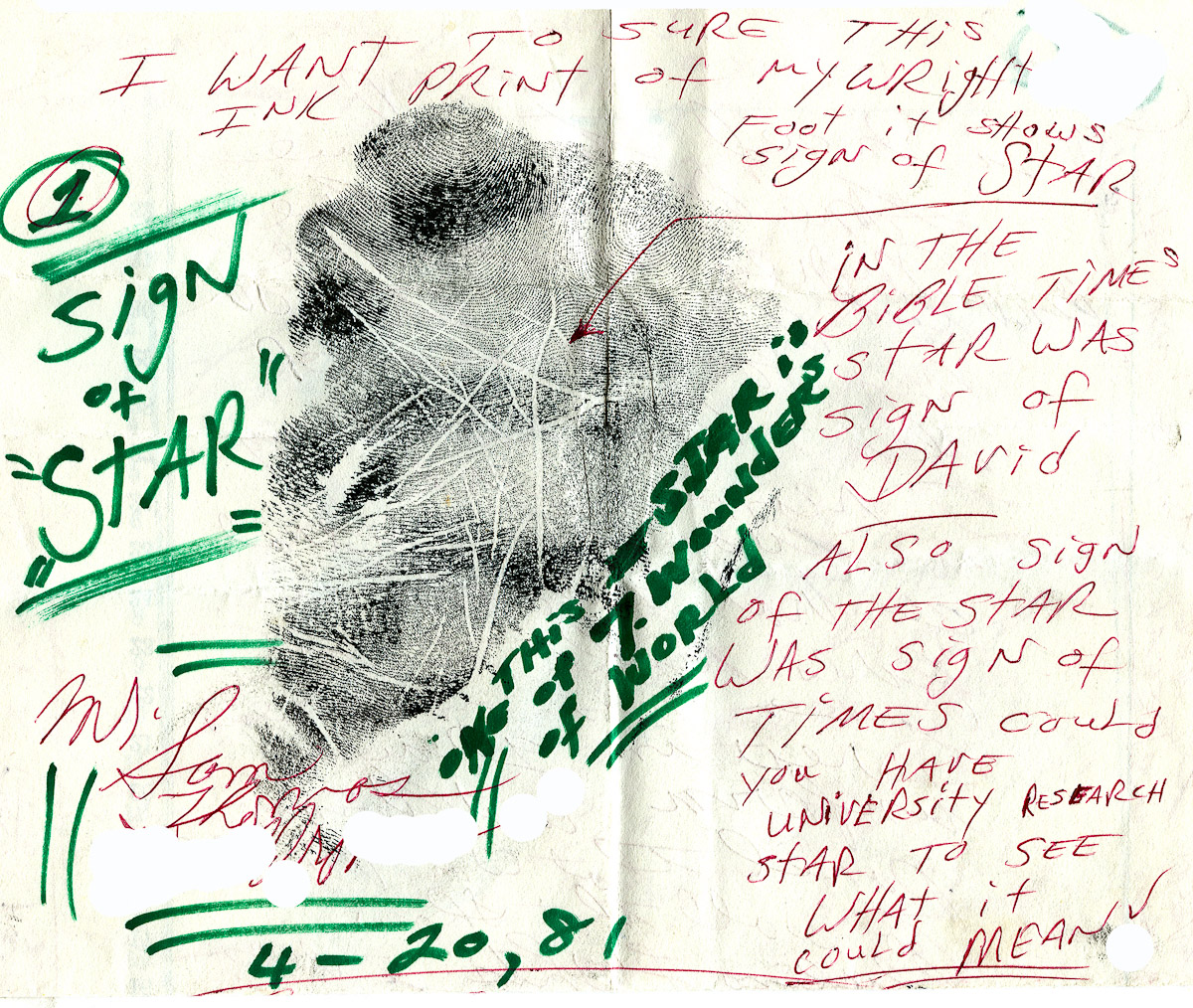
Looking through my image files the other day, I unearthed my oddest fan letter ever—and, believe me, there’s been some stiff competition over the years.


Click on the image to see a larger image.

This arrived in 1981, shortly after my first published novel , White Light. I’d crafted a subtle tale about the 1960s, higher infinities, and the afterlife. And having read my book in a prison library, some guy smeared ink on his foot, stomped on a piece of paper, and sent me the results. In his mind we were literary peers—and I should collaborate on a book with him.

A book about the wrinkle on his foot.

Fathers Day. Stan Ulam.

Sunday, June 19th, 2011

First a word about Father’s Day. I’m lucky enough to have children and to have known my father. It’s wonderful to think about the generations rolling on.

I hope all fathers and sons get some nice hammock time today or a reasonable equivalent thereof. Slack.

When my father died, he had very few possessions. I “inherited” four or five things of his, including a worn cardigan sweater, a Swiss knife, and an egg-cup that my daughter Georgia had made for him.

Thinking about the “rolling onward” and “eternal recurrence” aspects of being a son or a father, I took a picture of Pop’s eggcup with a little can of Royal Baking Powder that happens to be in the Spanish language. The cool thing about the Royal label, well known to mathematicians and cartoonists, is that it incorporates an endless regress.

I think I got hold of this can about 25 years ago, soon after moving to CA, when I was still surprised to see Spanish, and I (with deliberate incongruity) used the name “Polvo Para Hornear” for the name of a landmark in my novel The Hacker And The Ants.

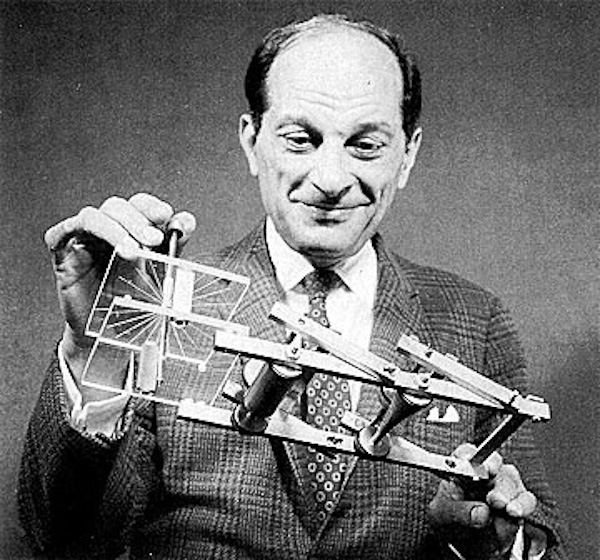
Switching topics now, I’ve been doing research on Stanislaw Ulam this week. He’s going to appear as a character in my novel Turing & Burroughs. I like this photo of Ulam happy with some device he’s cobbled together perhaps to model some arcane physical concept like the notion of a nonlinear springs he discussed in his classic “Fermi-Pasta-Ulam” paper, FPU for short.

For more on this topic, see the software and papers on my Capow page, where I used continuous-valued cellular automata software to run the FPU simulation, reproducing some of Ulam’s results, such as the ergodic long-term reoccurrence of states for the cubic nonlinear CA.

Wikipedia has a good entry on Ulam, but I also found a very interesting essay (although somewhat eccentric and perhaps overly critical) by his mathematician friend (?) Gian-Carlo Rota: The Lost Cafe.

Summary: Rota says Ulam was lazy, didn’t like to work out the details, preferred the flash of insight. He was as sort of alienated and sarcastic, didn’t like authority, felt that ultimately everything was meaningless. Undisciplined. Generous and kind. Liked getting into new fields and picking off the interesting big results. Often didn’t get around to publishing his results, just shared them informally. He had green eyes.

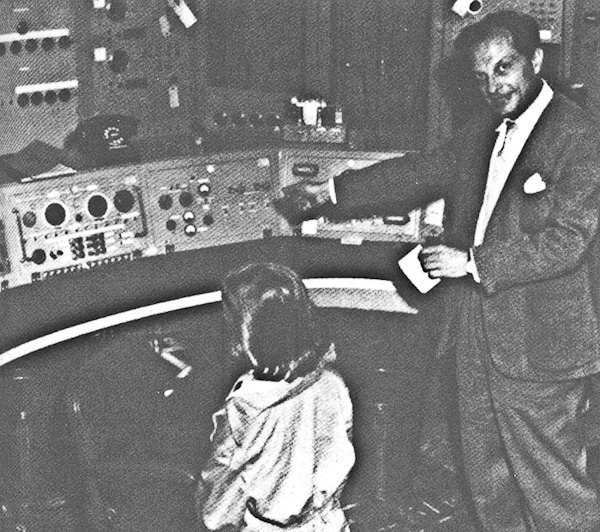
Classic photo of Ulam and the MANIAC computer with his daughter Claire. I first saw this photo in Ulam’s autobiography, Adventures of a Mathematician. I wrote LANL and got permission to use it as an illo in my Lifebox tome.

Ulam is known for his work on the H-bomb, indeed he’s sometimes called the father of the H-bomb. Ulam and Edward Teller made a joint application for a patent on the H-bomb!

In wondering if Ulam was “evil” for helping to invent the H-bomb, keep in mind that he was from a Jewish family in Lwow, Poland, and that he and his brother happened to escape to the US in 1938. The rest of his family died in the holocaust. Perhaps this motivated him to help the military of his new home country.

Another factor in Ulam’s work here was that of scientific obsession. Ulam didn’t get along with Edward Teller, and he developed his design for the H-bomb partly in a desire to demonstrate the Teller’s original design for such a weapon was wrong. Teller then jumped on Ulam’s design and worked on it some more.

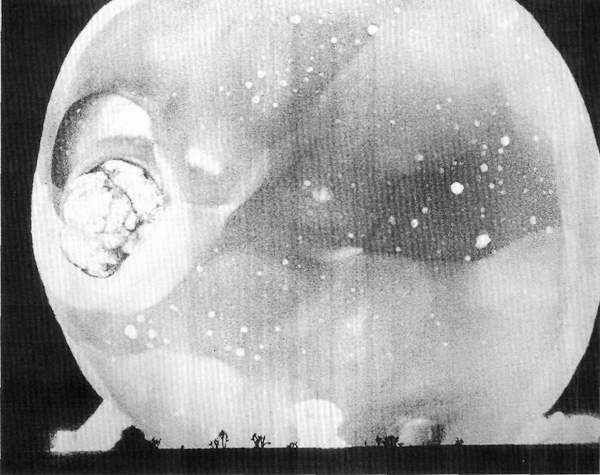
Photo of an A-bomb fireball, from a photo-rich Russian site. Note the Joshua trees about to be consumed. I’m intrigued by the irregular spots on the fireball. No natural phenomenon is ever completely uniform.

Death vs. Immortality

Friday, June 10th, 2011

I’d like to thank Emilio, Steve H, Rick York, and Justin, for their kind and encouraging comments on my previous post, “My Brain Event as a Jump-Cut.”

There’s nothing like a good bull-session about death and immortality! I’ll fuel the discussion with a few further remarks sparked by the comments.

(1) It will never be absolutely certain that death really is the end. There’s so much that we don’t know about the universe. But, given my personal experiences, my inclination these days is to go ahead and accept that death is the end, and see where that leads me. It’s worth mentioning that, throughout history, people have often used the promise of immortality as way to take advantage of their followers. Perhaps it’s just as well to accept the very high probability of total dissolution and find ways to get past the fear.

A related point. It’s very healthy and reasonable to fear and to avoid death—that’s what gets us through our lives! But we might learn to take a different view of the final and unavoidable encounter with the Reaper.

(2) It’s correct that it’s not accurate to use “black” to refer to the experience of total lack of consciousness. That’s just a conventional term for “no visual input”. But if there’s no “eye” and no brain, it isn’t even black. It’s void.

It’s also true that the void is what precedes my birth. (Unless I want to claim that my soul is reincarnated, and that between incarnations I hang out in the Heavenly Clouds, and when, eventually, I get overly interested in watching a man and woman having sex, I get pulled back into the material plane, down into a fertilized egg.)

I would say that the unconsciousness you experience during total anesthesia or as the effects of a brain event does have a different quality from the unconsciousness felt during sleep. There are no dreams and, upon awaking, no sense of an intervening passage of time. Thus my use of the phrase “jump-cut”.

I think it’s a unpleasant sensation at two levels. First of all, we like to feel that, at any time, we’re at some level monitoring our body and keeping it save. Secondly, the experience (or non-experience) of a total mental void is, as I’ve been saying, a stark preview of death.

(3) There are various partial forms of immortality that we comfort ourselves with, such as genetic immortality or software immortality. On the genetic front, we might, if we’re lucky, leave some children behind, bearing our genetic info and some of our memories. On the software front, you might make an impression on people, perhaps as an educator or a social worker. Another form of software immorality is to leave books, recordings or works of art.

These forms of pseudoimmortality mean something to us, even if actual death truly is a matter of lights-out and that’s all she wrote. When you’re younger you’re often concerned about living long enough to do things you feel you need to do—you want to taste the pleasures of life, and it may be that you also want to set up some pseudoimmortality of the genetic or software forms.

I still remember my terror, as a teen, at the prospect that I might die a virgin. If you’re fortunate, you live long enough to check off most of the things on your list. And at this point death begins to lose some of its sting.

(4) The SF notion of creating a replica of oneself, as in my 1982 novel Software, is a perennial favorite, popular these days among Singulatarians and Transhumanists.

Perhaps you save off your brain software and copy it over to a healthy young clone, for instance. Or perhaps, at some later time, as Steve H suggests, some future biohackers do this for you, creating an emulation of your brain software based on whatever lifebox type data you left behind. (“The blog is the road to immortality!”)

I’ve always been intrigued by the existential questions that arise here. Even if I manage to create a new Rudy, my old self still enters the void. My new self may have the illusion of being a continuous extension of my old self, but nonetheless, my old self—(and what does that really mean?)—is annihilated. I delve into this in more detail in my non-fiction books Infinity and the Mind and The Lifebox, the Seashell and the Soul.


Rudy's Blog is powered by WordPress