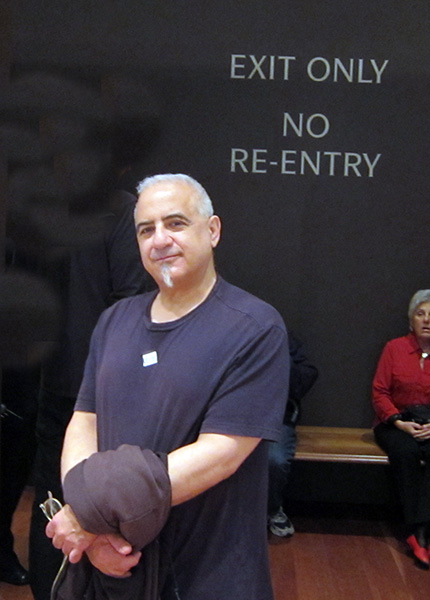
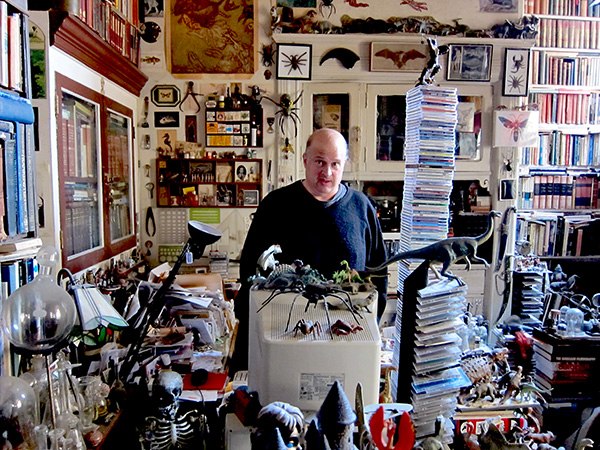
Sylvia and I were up in San Francisco two days ago. I visited with my artist friend Paul Mavrides, and then the three of us went to see the show “Post-Impressionist Masterpieces from the Musée d’Orsay” at the de Young museum in Golden Gate Park.
[Paul Mavrides outside the Post-Impressionist art show…he selected this pose.]
I mentioned to Paul my idea of having Turing blunder into the fake town set up by an A-bomb test-site, and Paul said this had been used not only in Indiana Jones and the Kingdom of the Crystal Skull, but also in a 1954 Mickey Rooney comedy called The Atomic Kid, and in the last episode of the first season of a 1986 TV series called Crime Story. I don’t think I’ll look at either of those, but the fact that the idea’s been used three times makes me feel a little more free about using it again. It’s kind of a standard trope by now.
In the evening Sylvia and I went to a reading at Booksmith on Haight Street, and had supper at one of my favorite Mexican restaurants right next door, Balazo (which means pistol in Spanish).
[A guy cleaning the copper trim at Balazo.]
I checked out some big cartoon books at Booksmith, one of which included “Death Sentence,” a comic from Tales of Terror #14, March, 1954, with art by Sid Check. A scientist grows some protoplasmic slime in a glass bottle, much like Alan Turing culturing his skug in my novel. By tweaking his culture with I think radiation, the scientist gets the stuff to undergo “forced rapid evolution of 1,000,000 years,” effectively becoming a creature typical of the far future. Some of the goo gets into a cut on the scientist’s finger and then, “He was a changing, shapeless mass of ulcerative protoplasm.” The goo splits and redivides, eating everyone in sight. Perfect.
While at Paul’s I glimsed Doctor Hal Robbins in his laboratory. He’s gearing up for a new round of his “Ask Dr. Hal” performances.
It was great being in San Francisco at night in the fog. Such a sense of promise and excitement. I hadn’t been on Haight Street for about a year, and it looked a little better than I’d remembered—usually I always just go to Valencia Street these days. There really are some good clothes stores on the Haight, the restaurants aren’t bad, and there weren’t as many gutterpunk panhandlers as usual.
And while I was in town, I checked out the wall space at Borderlands Café on Valencia, planning the arrangement for my art show there in November…next month.
I want my character Alan Turing in Turing & Burroughs to make friends with a woman. What if he meets up with an early electronic composer, as he has some facility in that direction thanks to his Delilah analog voice encryption project.
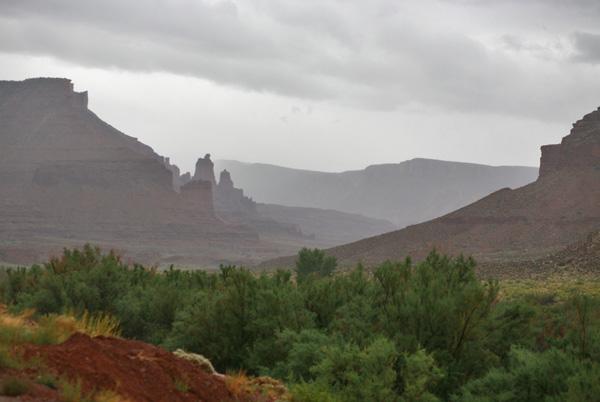
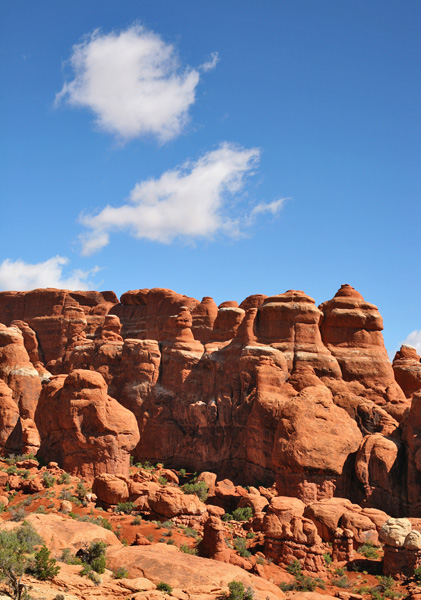
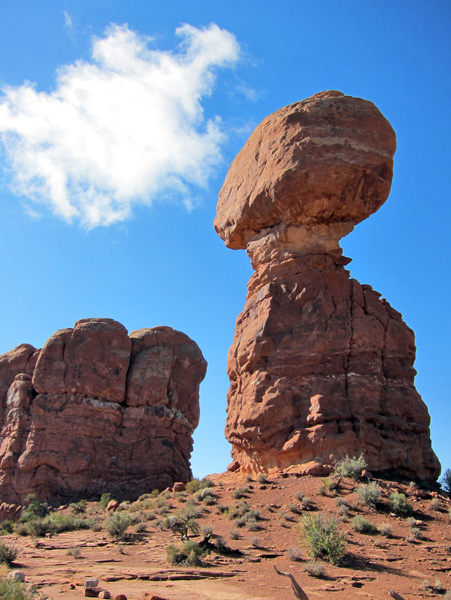
[Today’s photos are mostly from around Moab, Utah, and particularly from the Arches National Park, although the photo above is of an aspen near the Flaming Gorge.]
They barely had the phrase electronic music in 1955. They called it musique concrète, see Wikipedia history of electronic music. Some called it acousmatic art, where that weird word means you can’t see the source of the sound. They used Ampex tape recorders, sampling natural and manmade sounds (like factory noises and ship sirens and motors) collaging them, speeding them up, slowing them down, echoing and looping. Sometimes playing a tape track with live instruments.
I’ve been reading the cool book of interviews, Pink Noises for inspiration. One woman in there, Annea Lockwood, taped a burning piano, the mike wrapped in asbestos. And she went the length of the Danube, taping it’s various sounds.
[Coming into Moab in driving rain. High plains drifters.]
Burroughs himself was really into tape recordings for a time, come to think of it. Edgard Varèse and Karlheinz Stockhausen were active in the late 40s and early 50s. They had the idea of synthesizing music via electronically produced signals. In the U.S., John Cage was involved with the Music for Magnetic Tape Project. Turing’s friend Christopher Strachey wrote a music program for a computer based on an early Manchester computer.
[Earlier: long portico shadow at Yosemite Lake Hotel.]
My fictional character named Judy Green is the woman composer. I’m thinking she’s gay, and Turing, who sometimes skug-shapeshifts into a woman named Abby, is pursued by her. The “imitation game” to the second power.
I see Alan Turing (mostly shapeshifted into a simulacrum of William Burroughs, but sometimes looking like Abby) driving from Palm Beach to SF with someone like Neal Cassady. Certainly Neal himself could fit into the story, given that we have Burroughs already. But I feel some uneasiness about writing about Neal. It might be gauche, derivative, dull. I don’t want to come across as a Beat fanboy. It would be better to invent my own madman. Make it fresher. Yes, I enjoyed writing the Burroughs chapter, “Tangier Routines,” and Burroughs might even come back. But that doesn’t mean I have to put in pop-up cameos for every single Beat.
[Gotta love those “hoodoo” formations.]
So okay, the cross-country driver isn’t Neal. I recall the name of a character who was just about to make an entrance when I broke off work on a never-finished novel in, I think, 1982. I think his name was Vassar Fogarty. Vassar could be Alan’s driver instead of Neal. A (fictional) lesser-known friend of Burroughs’s.
And Vassar could be into some soul-sleeping jive along the lines of Neal’s Edgar Cayce stuff. Only it’s sort of true, and Alan is picking up telepathic or chthonic vibes.
Maybe Turing doesn’t like Vassar at first. Vassar’s a bumptious blue-collar stoner, and it seems like Alan would have to be sexually attracted to him. But at a personal level, Turing dislikes him initially. He’s won over into some intricate mind analysis game. Maybe Vassar gets Turing to be stealing gas and food. And Judy is making music out of it. And using her tape recorder to rob people.
[Pure Wile E. Coyote territory.]
While in Abby form, Alan tells Judy that his friend is getting a ride to SF with another friend, Vassar Fogarty, and Abby can ride along. When Judy gets in the car, it’s just Alan and Vassar, and she’s uneasy. Vassar wants to have sex with Judy and she’s putting him off. Alan calms Judy, and at the edge of town he shapeshifts into Abby. Vassar is impressed. Suppose they go for a sexual three-way that night or the next. Alan/Abby is happy to be getting Vassar’s embraces, and Judy’s happy to be making it with Abby as well.
It might be interesting, after they get to San Francisco, to have Alan use skug power to swap genitalia with Judy Green. The couple would be a metaphor for a certain kind of man-woman pair. “She wears the pants.” Oh, I don’t think I’ll do that, the readers might not like it. And Alan wants men, not women. He’ll get a real boyfriend.
[Ambient gnarl.]
Re. Alan’s boyfriend in SF, I figure he’s not Allen Ginsberg, for the same reasons why I don’t want to use Neal Cassady as a character. But the boyfriend is, I think, an experimental film maker along the lines of Bruce Conner. And the film maker and Alan do go to the famous Gallery Six reading where Ginsberg read “Howl.”
[Stalking the giant ants along the Colorado River.]
I’m thinking I’d like to work some giant ants into the novel. The first SF movie I really really wanted to see (and my parents wouldn’t let me go) was Them, a giant ants movie. Giant ants are very 1950s, after all. I just watched the movie again last night on Netflix instant watch, it was awesome, even if the ants are just ten-foot stuffed toys being waved by grips off camera. The ants resulted from the radiation mutations from an A-test of 1945, and the movie is set in 1954. Perfect.
Possibly Turing causes the giant ants with his tinkering? Perhaps the pursuit of the giant ants leads him into the A-blast? I’m tempted to reprise the scene in that otherwise weak 2008 movie, Indiana Jones and the Kingdom of the Crystal Skull, where Indy wanders into a fake suburban town set up to test the effects of the blast, and the houses are full of mannequins. Alan could have Burroughs along with him for this, heaping scorn on the ”˜burbs.
Benoit Mandelbrot burst upon the public stage with his extravagant work of genius: Benoit Mandelbrot, Fractals: Form, Chance and Dimension (W. H. Freeman, San Francisco 1977). As Mandelbrot himself might put it, “I know of very few books … in which so many flashes of genius, projected in so many directions, are lost in so thick a gangue of wild notions and extravagance.”
(He made this remark about George Kingsley Zipf’s book, Human Behavior and the Principle of Least Effort. The Mandelbrotian word “gangue,” more commonly used in French, refers to otherwise worthless material in which valuable ores or gems may be found. It’s pronounced like “gang” in English.)
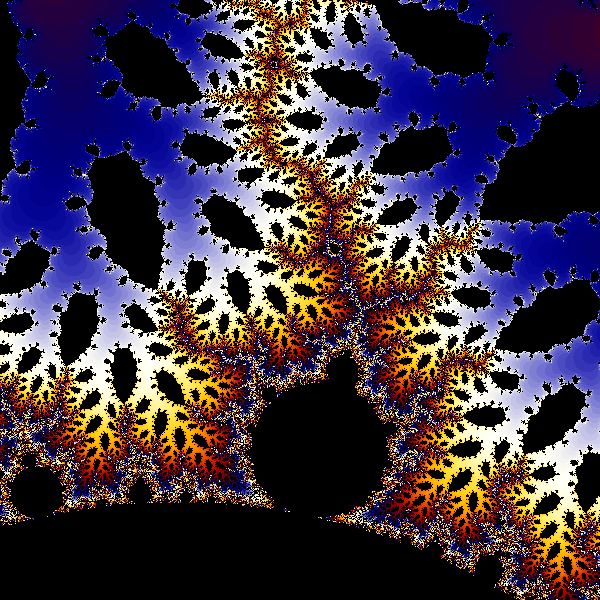
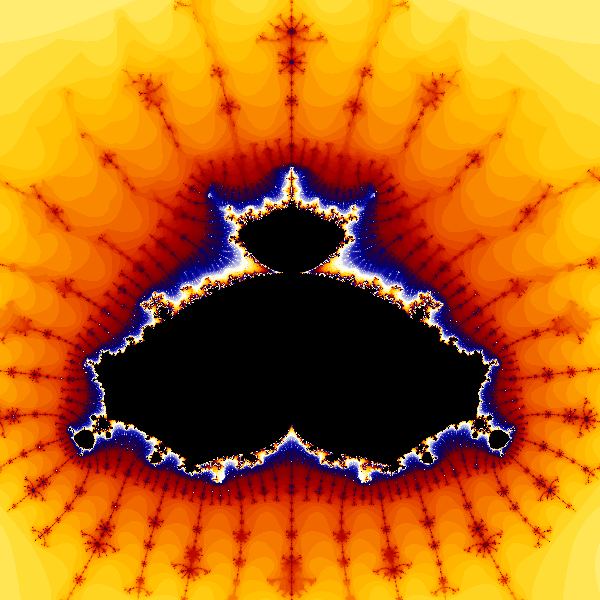
Detail of the MandelCubicWhoopDiDoo Cubic Mandelbrot Set.
I went to Mandelbrot’s house early in 2001, when I was involved in an abortive project to try and make a large screen (IMAX) science movie featuring some huge, prolonged zooms into the Mandelbrot set.
The movie, which was to be about fractals, had the working title Search for Infinity, a title which was dictated by the producer, Jeff Kirsch, director of the San Diego Space Center Museum. Jeff was committed to presenting the film as being about infinity instead of being about fractals, as he felt many more people would be interested in the former than the latter. And in a mathematical sense, fractals are indeed infinite, in that you can zoom into them, forever finding more levels of detail. It’s an infinity in the small, rather than an infinity in the large.
Detail of MandelCubicInvasionOfTheHrull
The very talented film maker Ron Fricke (Konaequaatsu and Baraka) was committed to shooting the film, and I was going to write the script. Ron and Jeff were also bent on including Arthur Clarke in the movie as a character. And Ron wanted the movie to star a computer-brained space probe who was afraid to fly off into the endless void of interstellar space. Jeff had scored a development grant for the project from the National Science Foundation and we worked on preparing a final proposal over a couple of years.
Taking all the story constraints into account, I put together ten or eleven successively more refined treatments for a film script, resulting in a fairly reasonable treatment, The Search For Infinity, which you can read online.
But, like so many films, the project was never realized. The sticking point was that we failed to get the needed the million dollar grant from the National Science Foundation. One reason I visited Mandelbrot was in fact to try and win his support in case the NSF were to ask his opinion about the project, but he was unenthused about it, I don’t know exactly why. One of his issues was that it was wrong to bill the film as being about infinity, when in truth it was about fractals — I agreed with him on this point, but this wasn’t something that I could get Jeff and Ron to go along with.
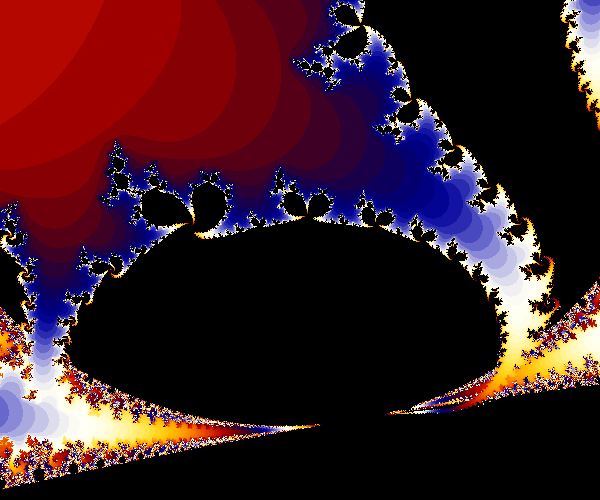
Detail of MandelCubicPacMan
The rest of this post consists of excerpts of my journal entry of January 14, 2001, regarding my meeting with Benoit. I published this as an endnote to my tome on the meaning of computation, The Lifebox, the Seashell, and the Soul, but I thought I’d post it on my blog today as well.
RudyMars
Mandelbrot is waiting for me at the end of his driveway, he’s worried I might not find the house as the address on the curb is covered by snow. A white-haired balding man, stocky, somewhat diffident, he sees me, I wave, he doesn’t wave back, not sure yet I’m the one he’s waiting for, when I’m closer he says “Are you Rudy Rucker?” We introduce ourselves, shake hands, I tell him I’m thrilled to meet him. In the house his wife Aliette greets us, Mandelbrot disappears to take a pee I suppose, then we sit in a cold room with some armchairs. They don’t seem to really heat their house. He sits on an odd modern chair with parts of it missing, a collection of black corduroy hotdogs. He wears a jacket, a vest, a shirt, trousers with a paperclip attached to the fly to make it easier to pull up and down, I guess he’s 75. Rather rotund and, yes, a bit like the Mandelbrot set in his roundness and with the fuzz of hairs on his pate.
RudyFatBud
He starts talking almost right away, an incredibly dense and rich flow of information, a torrent. Fractal of course, as human conversation usually is, but of a higher than usual dimension. It’s like talking to a superbeing, just as I’d hoped, like being with a Martian, his conversation a wall of sound paisley info structure, the twittering of the Great Scarab.
His wife listens attentively as we talk and from time to time she reminds him to tie up some loose thread.
RudyHorse
Mandelbrot doesn’t seem overly vain — as I’d heard him described by some rivals. Certainly he has good self-esteem, but I think it’s well-earned and justified.
I repeatedly feel a great urge to go out and have a cigarette. The firehose-stream of information in his strong French accent — I have to cock my ear and listen my hardest to process it. Conscious of his wife watching me listen to him. I imagined she’s judging how well I seem to listen, and when once I smirk as he says something a bit self-aggrandizing, she catches my expression and I imagine her giving me a black mark.
He isn’t clear exactly what Jeff is trying to do with the movie, how Jeff plans to fund it, what his (Mandelbrot’s) role is supposed to be, etc. I explain it as best I can; we don’t really expect Benoit to do much more than to say that that he doesn’t find our project totally absurd. He seems to want to exact some kind of concession; at the end I have the feeling that he considers Jeff’s emphasis on “infinity” to be a deal-breaker, to the extent that there might have been a deal.
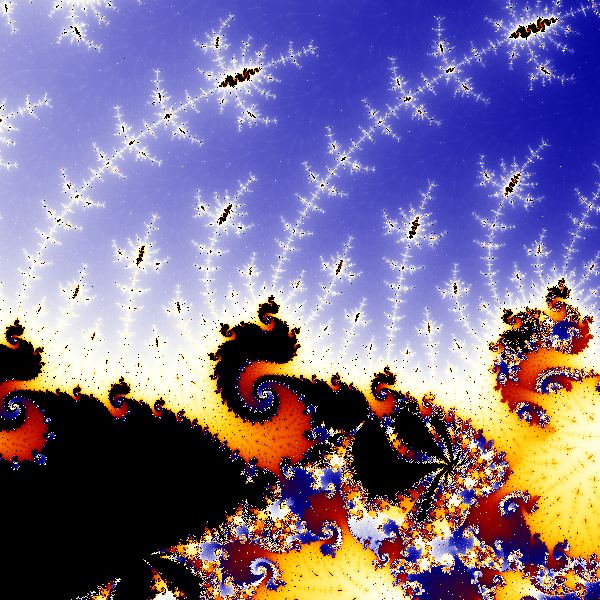
RudyRockets (detail of the Rudy Set). Lower down in this post is an animated YouTube zoom to the Rockets.
I mention how much he’s affected my view of the world. I mention also that I’m as excited to meet him as I was to meet Gödel. Mandelbrot says, “Oh Gödel didn’t talk much, I saw him at the Institute, I was von Neumann’s last student.” I rejoinder, “Well, Gödel talked a lot when I saw him, I was working on something he was interested in,” and Benoit is impressed.
In the event, it’s not really like meeting Gödel because I’m not so young and starry-eyed that I see Mandelbrot as a mythopoetic guru. Yet it is like meeting Gödel in the sense that for these two special oasis hours midway in the long caravan of my life I’m talking to someone whom I feel to be smarter than me. An ascended master.
YouTube movie of a “Rockets” zoom into the Rudy Set.
I’ve been thinking some more about ways in which Mandelbrot resembled the Mandelbrot set, it’s a conceit I’m bent on playing with. As I mentioned yesterday, he was rather round about the middle, even bulbous, and his clothes and his head were indeed adorned with any number of fine hairs. He appeared and disappeared from my view several times; he’d get up and leave the room and then return. Perhaps each time it was a different bud of him that came back in!
A key point in perceiving his multi-budded nature is that his wife in many ways resembles him: accent, age, attire, knowledge about his work. She was in fact a mini-Mandelbrot set hovering near the flank of the larger bud I was talking to. The two of them were connected, of course, by a tendril of love and attention, rather hard to physically see.
[Zoom into a quintic Mandelbrot set, ending near MandelQuinticLeopard.]
At times I felt a bit of menace from Mandelbrot, as when he was repeatedly asking that we not bill the movie as being about infinity. I felt some anxiety that he might somehow do something against us if we didn’t accede. He has, one imagines, a wide range of influences. What was going on here was that I was sensing the presence of the stinger at the tip of the Mandelbrot set. A stinger so fine as to be all but invisible, a stinger that, as he grew somewhat agitated, was twitching with rapid movements that made it yet harder to see. But nevertheless I could feel its whizzing passages though the air near me. Palpable menace.
In the end, as I understand it, Mandelbrot did in fact go out of his way to sabatoge our plans to make that movie. So I have mixed feelings about him.
But I will say that, with his discovery of fractals, Mandelbrot totally changed the way I see the world, and in a good way.
RudySanskritBud
You made a difference, Benoit. Thanks for unveiling the world’s mysteries a bit more than before.
A new story, “Good Night, Moon,” that I wrote with Bruce Sterling is now online for free at Tor.com. And if you want, you can listen to it in podcast form, read by me. You can click on the icon below to access the podcast via Rudy Rucker Podcasts.
Recently I’ve been reading a book of journals by Alan Ginsberg, edited by Gordon Ball, Journals: Early Fifties Early Sixties, Grove Press 1977. My idea is to have Alan Turing meet up with Ginsberg in Berkeley in the spring of 1955, at the time when Ginsberg was writing Howl.
I’ve copied out some passages that seem useful in terms of getting Allen G’s character or in terms of fitting him into my novel. The photos today are from the Yellowstone portion of our recent road trip through the Wild West.
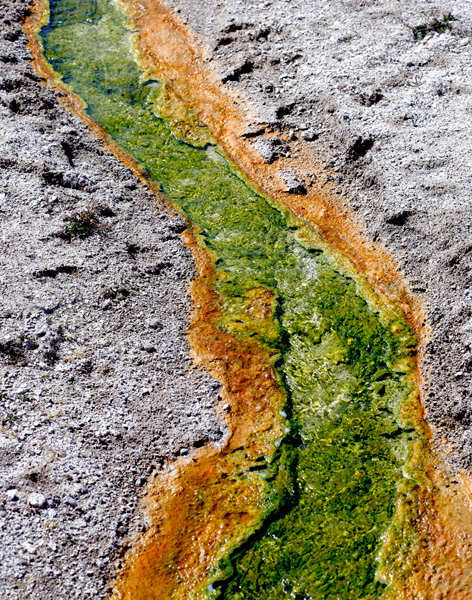
[Varicolored algae in a hot-spring stream.]
New York City, March-June, 1952
Alan gets marijuana (“T”) and peyote from a friend, Bill Keck, who says the sense of God is, “When the universal order seems organized—when everything I see seems to belong to one organism, when everything about me swings, together.… With T you are observing everything in unison order harmony swinging organized organism—with peyote you are part of it.”
He eats some peyote at his parents house and sits in the backyard writing notes while his relatives visit with the family inside. “…eyes closed toward light leaves in eye a golden glow hue—which darkens when you pass hand over lidded eye. It made me feel like a very transparent sort of organism.”
“When the wind rushed through the grass you can see the green grass vibrating on the brown ground.”
Still on that trip… “The houses around here seem so primitive, with their poor television antennae tacked on to the patched up chimney—” “And I hear relatives’ honking mechanical voices in the house.”
“…there’s so much to say from the bottom of the heart—but not say in open—people really can’t stand much reality—or me, hate to think of anyone talking back to me.”
“What can you do with such a f*cking universe?”
A dream. “…I am in bed with a [lover] who covers me over with cloth on which are obscene hieroglyphs, one for each part of my body—they are supposed to act on my skin—while he watches I have sex with hieroglyphs.”
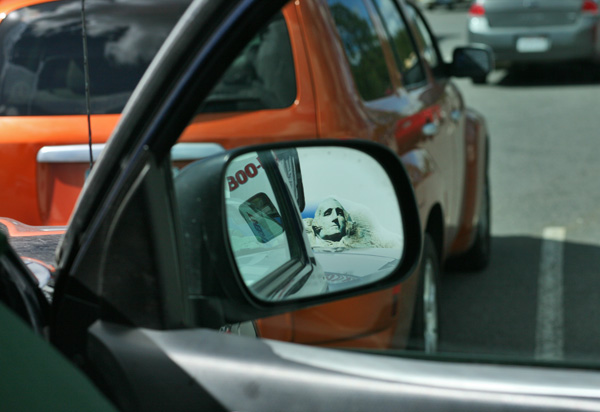
[Car mirror reflection of a U-Hal van with Mt. Rushmore painted on the side, seen in the parking lot for Old Faithful.]
In the Yucatan, Mexico, 1954
He dreams a movie of William Burroughs and reconstructs the dream, which is rather apposite for my novel.
“Bill in Europe—but can’t remember the dream O flat horrible reality closing in at morn after night of spectacles…Bill is shadowed by a spy from the future—spy from another dimension in hideous 3rd class train ride—set in background of Europe in the rain and decay…involving cross-passages of time. Fragments of a great ”˜routine.’ Bill looks frightened—realizes he’s been followed all along… Then—great change—a look of weariness & boredom, ennui, powerlessness and resentment. Deenergized. Then rage, a look of great annoyance—He lapses into a kind of insanity… Fate or the future was after him with its rational inanity—his insanity defeats their plans—Bill still conscious playing the routine. Like the routine which felled him laughing on kitchen floor…in N.Y.”
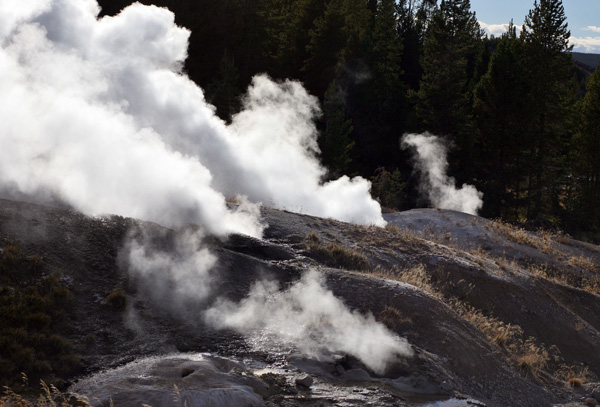
[The steaming vents like portals to the underworld.]
In Uxmal alone. “Chichén—the main kick was the wild acoustic—somewhere in the middle of all these buildings is a place where you can clap your hands and be heard in heaven.”
“…only intensest writing is interesting, in which whole life direction is poured for profusion of image & care of surface and stipple & and sensual muscle of soul river thought.”
Worrying about my fate again—that a small breeze of nostalgia fluttered in my heart, thinking a moment past I had someone in the room I loved with me—no ghosts—a man of flesh to talk to and hug.”
“Sudden clearing where the sunlite bursts down as a great white shower.”
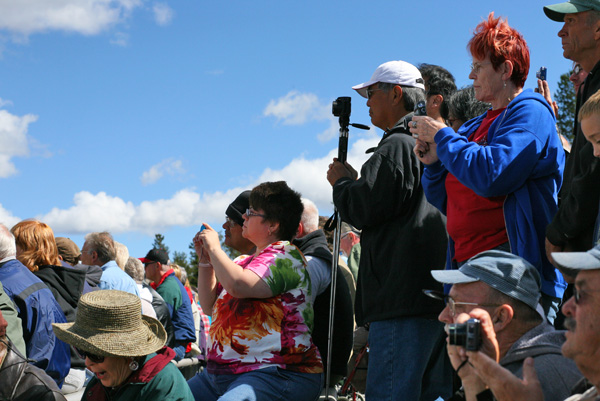
[People waiting for Old Faithful to spout.]
Visiting on the finca (ranch) of a woman he’s befriended, Karena Shields. “All the Jungle: all these rocky ruins: And suddenly in the ease and lethargy of monthlong guesthood on the ranch the singleminded conception of a vast Unfathomable god—and writing, the gift of writing thought seems like a candle in the wood.”
He thinks about the reporters at U.P. (United Press) “…thinking how feeble & scrawny those reporters are in their nests, thinking they are men of action, all they do is sit up at their typewriters full of sharpness or wiseacre of cynical knowledge of limited situations priding themselves on scrawny specialties of knowledge like Bullfighting or Railroads etc. & drinking at nite, like fat short man of U.P. I spoke to, full of defensive own paltry pride, small lives up in the News building, their whole actual horizon.”
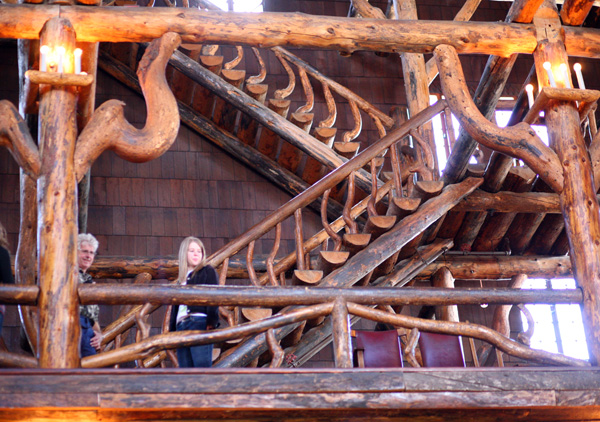
[The awesomely gnarly staircase in the Old Faithful Lodge.]
Mar 23, 1953, beautiful written Sketch of Salto de Agua, using many unusual or coined words. “tinred & tile rust roofs” “sparsely dotted thatchroofs on little hill on other side” “vasty armadas of white fragmentary clouds in bright sky” “recurring crow of cocks from this side and that challenging and responding in various cockly hoarse tones as if the existed in a world of pure intuitive sound communicating to anonymous hidden familiar chickensouls from hill to hill.”
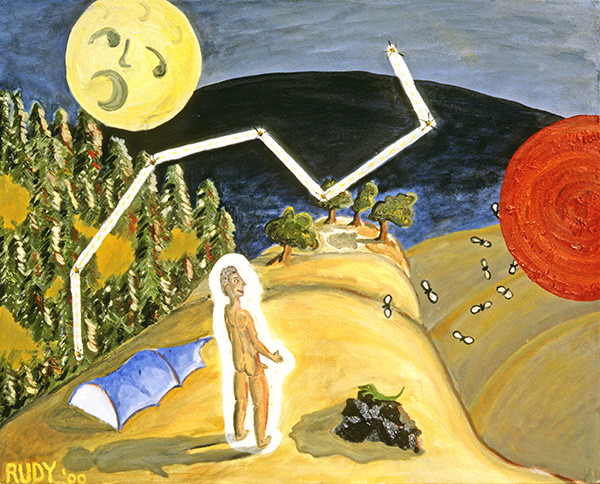
That evening he sits on the bridge there, “watching moon move over the hill you can see it rising and follow its destination thru the clear dimension of the sky in a slow circle from hill on one horizon to mountain on other, having the whole sky spread out unbroken but by stars in all 360 directions.” [I saw something like this one night camping alone on a hill top in Big Sur.]
[My old painting, “Big Sur”, oil, 30” by 24”, August, 2000. Finding the North Star via the Big Dipper, I noticed how Earth’s turning around the axis through this Pole was bringing up the moon and bringing down the sun. The flies bit me.]
Still in Salto de Agua. “The Kiosk proprietor a civilized looking citizen in a disgusting sort of way—acne and fatso glasses.”
Back on the Shields finca, April 16, 1954, Good Friday. “& palmtrees appearing again in the balmy wind presaging a rain—shifting their fronds in the wind with a dry soft rattle sound, so much like animal hairy windmills—insectlike in fact, like monstrous insects long white bodies encased in scales and at the top conglomerated in the head nerve center all these rattly animal feelers that move lethargically in in the direction of the wind, settling & unsettling as in water.”
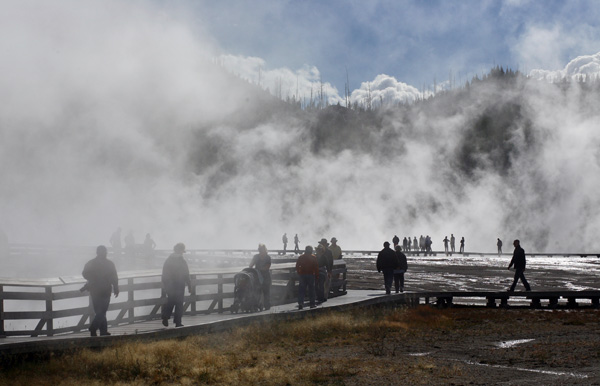
[The tourists in the steam like shades in the afterworld.]
“The word Time—Like a great silver wall blocking the sky… One might sit in this Chiapas recording the appearance of time, like painting—the palmtree so much suggesting an animal force spraying up in slow time.”
Dream of walking around New York City with Jack Kerouac. “Impression of the unknown miles of movies & bridges & houses & alien life in Brooklyn, how one could go walking alone (or with others) not to explore but to enjoy & be awed by the vast human scenery just as one goes walking thru mountains in awe. For kicks, not to map the streets.”
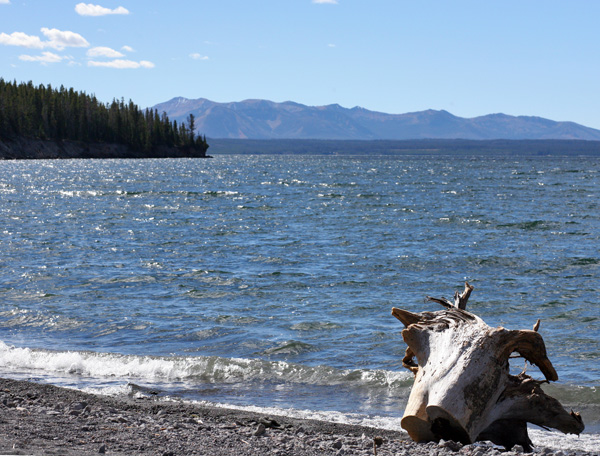
[Yellowstone Lake]
Back in California, 1954.
“Of an eternity we have a number of score of years… I have had several months near joy, and of that perhaps one day doing what I inmost want and of that a minute of perfection.”
On June 17, 2954, he’s staying stay with Neal Cassady and his family in Monte Sereno, near San Jose, California. He’s in love with Neal, mooning over him. “I feel like a strange idiot, standing there among wife & children all to whom he gives needs of affection and attention, aching for some special side extra sacrifice of attention to me—as if like some nowhere evil beast intruding I were competing for his care with his own children & wife and job which seems to occupy energize bore & tire him.”
He drafts a poem called “Serenade” with this phrase, “The bomb appeared intolerable, light and radiance, and afterwards the grey world appeared as a ghost.”
In Berkeley, Fall, 1955.
Allen writes some fourteen-syllable haikus.
“The madman emerges from the movies: the street at lunchtime.”
“The moon over the roof, worms in the garden. I rent this house.”