







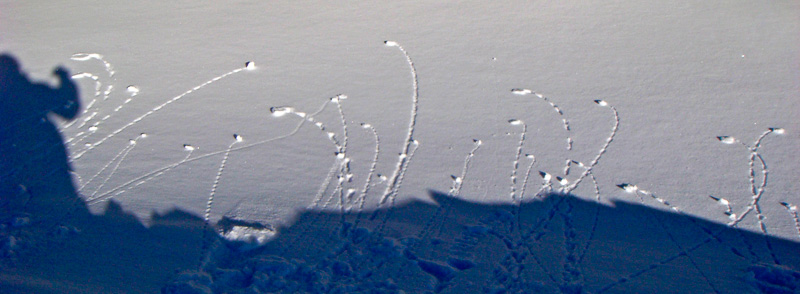
I’m in Pinedale, Wyoming, visiting my daughter Isabel and doing some cross-country skiing among the aspen trees. They have great patterns like eyes on them. Today’s pictures are all from Pinedale, which is a nice example of an RR “real reality” far richer than any VR “virtual reality” we’re ever going to see.

In the last couple of weeks I twice noticed people online questioning my scientific accuracy when I claim in Postsingular that it’s bogus to talk about porting humanity into a complete virtual model of Earth. So today I want to explain some of the reasoning behind my claim.
Arguments for Vearth are sometimes start by talking about an imaginary substance wittily dubbed “computronium” by one of my favorite writers, Charles Stross. In Accelerando, he says computronium is “matter optimized at the atomic level to support computing.”

Although it’s a cute idea, I think computronium is a fundamentally spurious concept, an unnecessary detour. Matter, just as it is, carries out outlandishly complex chaotic quantum computations just by sitting around. Matter isn’t dumb. Every particle everywhere everywhen is computing at the maximum possible rate. I think we tend to very seriously undervalue quotidian reality.
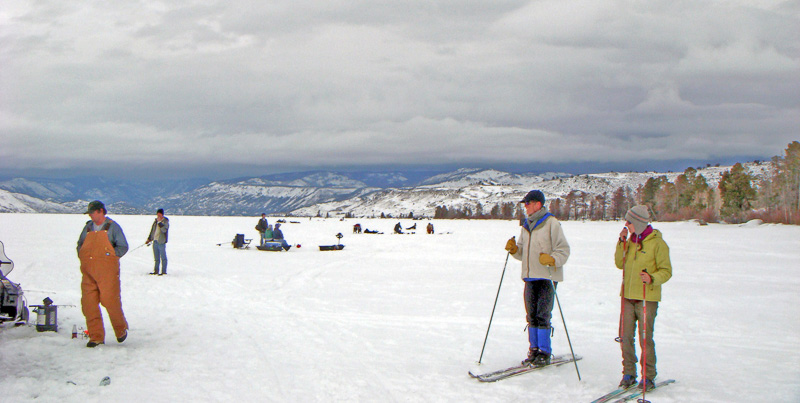
[The ice fishing derby on Lake Fremont in Pinedale]
In an extreme vision—which is the one I disparage in my novel Postsingular—Earth is turned into a cloud of computronium which is supposedly going to compute a virtual Earth—a “Vearth”—even better than the one we started with.

This would be like filling in wetlands to make a multiplex theater showing nature movies, clear-cutting a rainforest to make a destination eco-resort, or killing an elephant to whittle its teeth into religious icons of an elephant god.

[Alley near the Teton Court Motel]
Ultrageek advocates of the Vearth scenario like to claim that nothing need be lost when Earth is pulped into computer chips. Supposedly the resulting computronium can run a VR (virtual reality) simulation that’s a perfect match for the old Earth.
As I’ll explain below, this is factually incorrect. Before getting into that, I might also ask why someone would passionately want to believe that we can be translated from flesh into bits? There’s something ascetic and life-hating about the notion. It’s a bit like a religious belief; one thinks of the old “work now, get rewarded in heaven” routine.

[Game heads on display in Ridley’s Grocery (formerly Faler’s)]
Anyway, let’s get back to my main point, which is that VR isn’t ever going to replace RR (real reality). We know that our present-day videogames and digital movies don’t fully match the richness of the real world. What’s not so well known is that computer science provides strong evicence that no feasible VR can ever match nature.

[Girl holding a fish as if it were a stuffed animal]
This is because there are no shortcuts for nature’s computations. Due to a property of the natural world that I call the “principle of natural unpredictability,” fully simulating a bunch of particles for a certain period of time requires a system using about the same number of particles for about the same length of time. Naturally occurring systems don’t allow for drastic shortcuts.
For details see The Lifebox, the Seashell and the Soul, or Stephen Wolfram’s revolutionary tome, A New Kind of Science—note that Wolfram prefers to use the phrase “computational irreducibility” instead of “natural unpredictability”.

[On a ridge above Fremont Lake on a climb led by Sherpa Iz-teng]
Natural unpredictability means that if you build a computer sim world that’s smaller than the physical world, the sim cuts corners and makes compromises, such as using bitmapped wood-grain and cartoon-style repeating backgrounds. Smallish sim worlds are doomed to be dippy Las Vegas/Disneyland/Second Life environments.

[A lo-resolution lodging near Pinedale]
But wait, answer the true-believer ultrageeks, if you do smash the whole planet into computronium, you have potentially as much memory and processing power as the intact planet possessed. It’s the same amount of mass, after all. So then we could make a fully realistic world-simulating Vearth with no compromises, right?

Wrong. Perhaps you can get the hardware in place, but there’s the vexing issue of software. Something important goes missing when you smash Earth into dust: you lose the information and the embodied software that was embedded in the world’s behaviors. An Earth-amount of matter with no high-level programs running on it is like a powerful new computer with no programs on the hard drive.

[Non-bit-mapped wood grain]
Ah, says the VR true believer, what if the nanomachines first copy all the patterns and behaviors embedded in Earth’s biosphere and geology? What if they copy the forms and processes in every blade of grass, in every bacterium, in every pebble, and so on?

But, come on, if you want to smoothly transform a blade of grass into some nanomachines simulating a blade of grass, then why bother pulverizing the blade of grass at all? After all, any object at all can be viewed as a quantum computation! The blade of grass already is an assemblage of nanomachines emulating a blade of grass. To the extent that you can realize an accurate VR world, the exercise becomes pointless.

Just as she is, Nature embodies superhuman intelligence. She’s not some piece of crap to tear apart and use up.
***
By the way, I have written a full-length essay expanding on some of these topics; it’s called “The Great Awakening,” and you can read it free online. It appeared in Asimov’s SF magazine in August, 2008, and in the anthology Year Million, edited by Damien Broderick, from Atlas Books in August, 2008.
For my answers to the many comments on this post, see my next blog post.
March 3rd, 2008 at 9:05 pm
Yep, this is why VR as imagined in the 80’s was always a sham, and why synthesized actors are similarly unattainable. This was obvious to folks working in CGI by the late 90’s, despite huge strides in simulating natural phenomena– there will always be more reality in reality than can be synthesized– this is why so many visual effects are built upon sampled, reconstructed reality as opposed to databases trying to simulate reality from scratch.
Still, virtual realities are very real, they just have different qualities from rr– isn’t a 3D multiplayer game a virtual reality? And don’t many of them have striking natural phenomena? Not just like reality, no, but they provide enough visual and situational cues to the viewer to impart _a_ virtual reality.
Anyway, we’re at a wonderful point in display technology to have a new kind of VR– flat panel displays are now big and detailed and fast enough to play very high quality 3D images (with the right glasses), and we’re seeing a resurgence of 3D films, but I think the only “content” (hate that word…) with staying power will be captured reality– people you know, telepresence at sporting events or concerts or plays, the ability to have a simulated window that looks out on a _real_ vista.
March 4th, 2008 at 6:32 am
In the virtual worlds that we now inhabit in games, the 3d environment is rendered only when it needs to be. The character viewing the world exists in a bubble of reality that ends where they can no longer perceive it. Could the same not be true of a vworld, and if so, wouldn’t it take considerably less processing power than a persistent world that really exists at all places and times whether or not it is being observed?
I’ve argued with friends in the past that we could conceivably be living in such a vworld right now, but they’ve thrown the same Rudy Rucker argument back at me – that in order to simulate our universe, you would essentially need a simulator that is equally complex.
Since we can logically conceive of nothing that is larger and more complex than our infinite universe, that seems like a moot point to argue. But doesn’t the evidence provided by quantum physics obliquely point at a universe that in some way responds to either observation or the lack of it? I’m not arguing that every phenomenon in our universe must have some sort of purpose, but with a bit of imagination isn’t it possible to make a long and dubious leap to theorizing that the universe is tracking what is being observed? And once that theory has been thrown out there, couldn’t a system that tracks observation also be rendering reality in a finite bubble around all “observed” particles? It’s just a crazy whacked out idea, but the thought of it entertains me. We’re already living in a vworld!
March 4th, 2008 at 6:51 am
Seems to me that you don’t have to create a virtual world that mimics everything in the real world. All you have to do is fool the entities in the Vearth, and we humans are pretty damn easy to fool.
That said, the whole concept is silly to me. I don’t get why anyone would want to.
March 4th, 2008 at 6:57 am
I think it’s fair to say that a computer simulation can never recreate our universe with complete accuracy. Who says it needs to, though? Our senses – and those of our telescopes, microscopes, et al. – have well-defined limits. In Accelerando, a tip of the hat is made here and there to the fact that the simulated environments aren’t as detailed as the real world – I believe it’s in a bar/cafe scene at some point where someone asks about the Planck length in the simulated space. So while I wouldn’t argue that it’s possible to completely recreate the world in a simulation, I think it’s reasonable to say that – given sufficient “computronium”, as Stross put it – it would be possible to set up a virtual space that was “real enough”.
March 4th, 2008 at 7:20 am
The real world may indeed be infinitely rich and complex, but the bandwidth available for your senses to perceive it is extremely limited and simulating your sensory inputs is a task many orders of magnitude easier than actually simulating the world.
March 4th, 2008 at 7:38 am
Like you say, there’s not a real point to uploading everything, since everything is already here. The point of being able to simulate things sufficiently well that no one can tell the difference is to create minds, either by copying existing ones or by building new ones. In order to simulate something, you must first understand it quite well. People notice things like bitmapped wood grain and insufficiently accurate physics models. If you can simulate a person on a computer sufficiently well that they don’t notice the difference, then you can do things like send copies of them to other planets, keep backups in case of damage, optimize their thinking to eliminate cognitive biases, eliminate the need for sleep, etc.
Yes, I’m handwaving over a lot of philosophical weirdness about what it means to copy a mind, or to what “mind” actually refers, as well as a bunch of technical problems, such as the fact that we still have very little idea how the brain works. My thesis is that you don’t have to upload everything, just the stuff you want to hack on. I have no interest in hacking grass, but becoming a more directly autopoeic cybernetic immortal has some kick to it.
March 4th, 2008 at 7:58 am
You had me at “hello,” well actually, “I’m in Pinedale”. Great argument.
March 4th, 2008 at 7:58 am
‘I dunno,’ you mean a good program could use textures and models from our own memories to display a realistic world to us, but no two people would see the same sunset. Places like WalMart and McDogfood already seem like cheap, low-res simulations to me, and that kind of inferior decorating is spreading like gray goo.
No, erasing this world to make another one would be nuts. Making another one just like it would be cool, though. Turn Jupiter into computronium, or Mercury, and make a really hardcore Second Life. Why wouldn’t you want the real Grand Canyon to compare to your digital version? The real Miss March to compare to your scanned-in version? Gotta think BIG – destroying the world is standard mad scientist stuff. Making ANOTHER world would be more fun.
Seriously, I’d make a bunch more of me instead of grinding myself up to make one just like me. I’d make about twenty copies of my wife first thing. Why stop at one Earth? Make one with robots and flying cars, one with dinosaurs, one where flowers talk and white rabbits carry watches (but we’d all have to carry vorpal swords on the subway). Make Middle Earth, Ankh-Morpork, New Crobuzon! Not Detroit and Cleveland and Philly. Or Baghdad . . .
March 4th, 2008 at 8:44 am
In a sense, this whole argument can be reduced to a line from Randall Garrett’s 1966 book “Too Many Magicians.” Quote: The best symbol for a thing is the thing itself.
March 4th, 2008 at 9:32 am
It’s like in The Rocky Horror Picture Show, where the doomed rock star says, “I know drug real from real real!” Well, we know virtual real from real real.
March 4th, 2008 at 9:46 am
There seems to be two arguments here. The first, that Rudy makes is that destroying our universe doesn’t mean we can recreate an exactly simulation of it. The second, not really mentioned, is that the first argument doesn’t mean that we aren’t already in a simulated universe.
Maybe the best explanation for plank time / length and all the other quantum weirdness is that we are in a simulated universe and we are viewing the computational limits of that simulation. Maybe our simulator does take some short cuts with respect to the what’s “observed” and what’s not. We could do they same things in our simulated universe, probably with pretty good results. The issue is an algorithmic one — does the computational complexity of tracking everything observable use more hardware than just simulating everything?
March 4th, 2008 at 9:52 am
a few points come to mind, considering the rampant spread of the mp3 i would venture to say that human perception has a large amount of tolerance for quality degradation. It is pretty easy to trick us http://web.mit.edu/persci/people/adelson/checkershadow_illusion.html
and really that is all the computational power required, enough to trick our perceptions. if we believe ourselves (and friends, and pets, etc) to be in a perfect VR then the RR of it is insignificant. we have all had dreams that seem perfectly real, how much power was needed to create that dream?
for me though, the interesting VR is that which does not seek to recreate, but to provide an experience unlike anything RR has to offer http://www.quelsolaar.com/love/screen_shots.html
March 4th, 2008 at 10:08 am
Rudy,
I’ve admired your work for years but I think you’ve completely missed the mark on this one. The Singularity (at least from my point of view) isn’t necessarily about simulating reality (though simulated models of real phenomena are unquestionably useful for tons of real world applications) but, rather, modifying real objects to have more capable and durable substrates. The only difference between “me” in a biological substrate and “me” in a utility fog is that the former is limited in its capabilities and extraordinarily fragile whereas the latter is infinitely mutable and near immortal. This is a “life-affirming” notion not a “life-hating” one. I love all of the zany, unpredictable complexity of life more than anything which is why I don’t ever want it to end. I also take some exception to your notion of “VR” and “RR” being somehow fundamentally different (at least from an experiential perspective). Our conscious perception is already several layers removed from platonic etic reality and colored with our hopes, dreams, fears, sensory limitations, etc. Why should the sensory fidelity of an mmorpg character be any lower than the fidelity of an angel, demon, alien, or talking beetle?
I have to say that what bothers me most about your stance is that your literature was one of the biggest influences in helping me form this perspective. Cobb Anderson seemed to understand that soul=software as well as the desirability of continuing to run that software indefinitely. Felix Rayman seemed to understand that high fidelity perception can encompass much more than our biological sensory apparatus can accommodate. Did I completely miss the mark in your writings?
March 4th, 2008 at 10:52 am
Yeah – VR will very soon fly straight past rR (with a small r.) It doesn’t need to match nature – it need only match your perception of nature, with ain’t much.
March 4th, 2008 at 11:11 am
From rocks to Lego to the best VR, the fun is the process of re-creation rather than the result itself. Today’s tech allows us to create new worlds to try, rendering futurology to a whole new era of showroom-like experiences. Let’s forget about doing a poor Xerox of the world – or planet – we have messed with and we can start modelling visions for our future.
And, by the way, I see a lot of good reasons for a limited shelf life for humans: without deadlines, we do nothing 🙂
March 4th, 2008 at 12:59 pm
Essentially, everything Rudy said about RR is right on the money. But, isn’t the point of creating VR is to make it different?
I’m not a game player, but I’ve been reading science fiction for 55 years. I love RR, but I want to bend the rules. For instance, develop a physics which would allow for faster-than-light speed. Who wants to take 40 years to get to the nearest star? One would hope that VR offers not a substitute for RR, but an alternative, which is fun to explore, enhances creativity and, maybe, teaches us how to value the Reality in which we do live.
Why would anyone want to recreate the world we live in? It is already better than we can make it, let alone understand.
March 4th, 2008 at 1:53 pm
I agree with ChristopherMoody, the singularity that Bill Joy refers to is not a Matrix computer game simulation. The notion of using the local universe to create a completely simulated VR is fairly repugnant and hopefully not the extent of great ideas that come to pass. The concept involves the acceleration of technology to jerk level beyond human perception so that the “linear” “human” achievements are occurring in nanoseconds rather than centuries. If you slowed the process down enough it wouldn’t even be surprising.
What happens after the singularity level event is speculation. We could easily be destroyed, we could become godlike powerful, become cyborgs. My favorite is that the godlike ai computer mind could reorganize all matter in the universe and that the dimension containing our universe would recognize our universe not as an ignorant blob but something like a cute puppy.
And then some marine comes along and throws the puppy over the cliff.
March 4th, 2008 at 1:57 pm
“Natural unpredictability means that if you build a computer sim world that’s smaller than the physical world, the sim cuts corners and makes compromises, such as using bitmapped wood-grain and cartoon-style repeating backgrounds. Smallish sim worlds are doomed to be dippy Las Vegas/Disneyland/Second Life environments.”
This is the part I disagree with. The VEarth doesn’t need to simulate all that detail perfectly, it only needs to simulate it to the same degree that we can perceive now. We will be able to do this very soon. There are huuuuuuuuuge amounts of detail we can’t perceive that doesn’t need to be rendered, which is computational power which can be used for other things.
Like laserdragons.
March 4th, 2008 at 2:10 pm
I think this post misses an important point: we don’t have to recreate the real world, only something that plausibly looks like it. Even though we cannot, say, completely forecast the weather for even a week from now, we could render some very realistic-looking clouds that move entirely in agreement with the laws of science and even throw some randomness into it, too. We could do it so that any measurement would be unable to tell these simulated clouds apart from real ones.
To use a more concise metaphor: even though we cannot accurately forecast the result of a sequence of coin flips, even with prefect knowledge of all relevant laws of physics (there’s too much uncertainty — or we’d need a gigantic supercomputer), we can very easily produce a plausible sequence of outcomes, without actually tossing a coin, which are mathematically indistinguishable from the original.
Another related point: one wouldn’t have to recreate the whole Earth, but only its surface down to a certain depth (say 100km) and then use some sufficiently realistic model for the interior. The resulting savings in material would be enormous and would allow for even more than slight inefficiencies in matter usage.
This is just playing devil’s advocate, but honestly I did not find the previous arguments at all convincing.
March 4th, 2008 at 2:33 pm
While I agree that classical computer cannot ever reproduce the richness of phenomena in our universe, your analysis ignores three possibilities:
1. Quantum computing, if it turns out to be more than a toy, very easily could duplicate pretty much the whole universe in something like 10^300 fully entangled qubits. Seth Lloyd’s works on quantum information talk a lot about this.
2. We may eventually be able to commandeer enough matter to accurately simulate the entire earth, at least to a high-enough degree (say, no deviation down to the electron level for the first trillion years). True, this will likely take a while, and the political considerations are literally unimaginable, but the life-extension guys make some interesting arguments.
3. In the nanomachine world you describe, the advantage to replacing the blade of grass with pseudograss is that pseudograss is _programmable_. If you tell your wall to get out of the way, you break your nose. If your wall is made of smart matter, it says “Pardon me!” and shuffles out of your way.
Greg Egan’s “Permutation City” is also pretty darned relevant to the discussion.
March 4th, 2008 at 3:08 pm
Dear all, just for the sake of philosophical accuracy, let me ask you this: Does the word “reality” mean anything without quotation marks? Can we really know “reality”? Because it seems to me -as well as to Kant, Nietzsche, Wittgenstein and many others- that there is no “reality” out there, just interpretations, perceptions, a collective hallucination tinted by emotions and interests that we agree upon only to fulfill the practical business of living. Therefore, every “reality” is a virtual reality, never reaching the actual thing. Besides, what is the bloody point of simulating the whole world? Are we going to replicate the fearful simmetry of tigers when there is almost none left? Yep, it is so cool I feel a chill in my spine. By way of example, there is beautiful Chinese-inspired story by J.L. Borges. An emperor wanted to create the best possible, the most painstakingly precise map: every minute detail, every nuance, every shade and shine had to be there. Well, to be true to the project they had a scale problem: the map could only be 1:1; the map and the land would be the same. The project was abandoned? Why bother then? Just because we could? Plese, let us get real here and build something funnier like a T.A.R.D.I.S. Cheers, mates!
P.S.: You have a gorgeous blog going on, Rudy. Keep it up!
March 4th, 2008 at 5:53 pm
Don’t forget that vearth would actually require dev, test, and staging environments to enable all phases of the testing cycle. The number of bugs in assemby test alone boggles the mind. Post-release bugs are what we refer to as the “paranormal”, and people like jesus are no more than test user accounts with admin rights.
March 4th, 2008 at 7:55 pm
Do you suppose that Nature might have some sort of auto-immune response should any one part of herself start tinkering too much?
Saying that there are details that need or need not be included in a simulation sounds like hubris. I can’t perceive quarks, but I’m glad they’re there, doing whatever it is they do.
‘Sides, who wants to give ultimate control to all the hax0rz out there anyway? 4chan the size of the universe? No way…
March 4th, 2008 at 8:28 pm
Of course, if due to a lack of enough computronium you end up running in a reduced-resolution world, and you yourself were running at reduced resolution, *how would you know*?
I want to know two things: (1) how do you handle the heat dissipation? Mumbling about reversible computation just puts the dissipative part of the computation into the initialization and readout steps. (2) Where do you get the energy to turn conventional matter like silicon or iron into raw, unprogrammed computronium? Every square meter of material you devote to solar energy collectors is material that isn’t computing.
But with that said, there’s a lot of planetary volume that we don’t need to simulate at the atomic level. Do we really need to simulate the geophysical dynamo at the earth’s core that generates the magnetic field that creates polar auroras? Do we really need to simulate the details of the mantle anomaly that keeps Hawaii’s volcanic hotspot in the same place while the islands drift northwest over it at a few centimeters per year? Do we care if we doom the sulfide-converting bacteria that are eaten by the crabs, mussels and tube worms kilometers below the surface along the mid-Atlantic ridge? If we don’t simulate the never-seen beautiful cave formations below New Mexico in unexplored regions of Lechuguilla cave, will anyone miss them any more?
March 4th, 2008 at 8:34 pm
I think Sam Walker articulated the key point here – it’s not so much about creating a simulation of reality, but getting higher up in the causality chain. It is amazing that matter is performing such computation while just sitting there, but we don’t have access to it, we have no way of making it do our bidding except by blunt force that applies to trillions of atoms.
We need to get down there, have our conscious decisions exert a causative force at an atomic level. It’s nice that my will is the ultimate result of ribosomes, but I want my ribosomes to obey my will. Heck, as it is now, I can’t even control my cells. I can barely control tissues – bulk movement of organs, or through them, movement of bulk matter, is the best I can do. Not good enough! Computronium, here I come.
March 4th, 2008 at 11:40 pm
You make an excellent point, Rudy. Indeed, when you consider how rich and detailed and complex the world around us is, it’s staggering to imagine how much more so the real one must be…
March 5th, 2008 at 12:59 am
There is a very clever story called “The Monkey People” that I remember hearing as a little kid. In it there is a village in the Amazon rainforest. A man suddenly appears who can cut monkeys from tree leaves that can do anything they are asked. The villagers grow lazier and lazier as they ask the leaf monkeys to do more and more for them. Eventually the monkeys take on every task the humans ever performed; even thinking and breathing. Having given up their hopes, dreams, and aspirations along with their troubles, the humans fade into a state of endless blandness.
I believe the version I heard was part of collection of kid’s stories by a company called Rabbit Ears. Its an interesting cautionary tale about laziness in general, but it also is a very compelling warning about giving up too much of what makes us human.
The next time something interesting is going happen with the “singularity” is its first power failure. GG to the people who downloaded their souls; your backup is just a copy.
March 5th, 2008 at 1:42 am
I don’t know if it’s worth pointing out but computronium predates Charles Stross (http://en.wikipedia.org/wiki/Computronium)
March 5th, 2008 at 3:49 am
Atoms are the pixels of our world.
Electrons and quarks are the binary bits.
March 5th, 2008 at 5:09 am
I think theres one other interesting point here.
We already live in a simulation. Every one of us.
We already have a simulated VR presentation of the world –
running on the cybernetically feedback-looped brain wetware supercomputer.
Thou this one works like the bubble model mentioned above – by rendering only the parts that sensory input hints at being present. The brain then renders this environment by presenting prelearned textures mostly formed at childhood, then only finetuned later, getting more rigid with time. Also most of our responses are similar – prelearned patterns we apply automatically in life.
Also, we know that all matter computes all the time – and with a pretty high efficiency. Isnt this somewhat like saying that everything is Consciousness? With increasing levels of computational powers coming with increasing levels of order and complexity of the organism.
This is what I am interested in – not building another simulation, but getting to the bottom of what it is we already are experiencing.
March 5th, 2008 at 9:01 am
I’m not so worried on the singularity concept, since it just seems to be an vision of a possible end.
The life-hating bit though…personally, if my mind could stay intact, I’d like to see the stars. What’s so magical about your body that you’d lose your joy in life by changing it? If I’ve lived my biological life, worn out my original body, I’d choose to continue thinking and living.
My body is a wonderful machine, but I see many ways it could be better.
The techie dream here is simple – I am me, no matter what body or form I have.
March 5th, 2008 at 12:24 pm
A lot of people here are defending a technology that doesn’t exist, possibly couldn’t exist, and probably shouldn’t exist. Make your computronium co-exist with the natural world we all know and love/hate, and then maybe we’ll talk. But as a replacement, no thank you.
March 5th, 2008 at 12:33 pm
My own fantasy isn’t Vearth but Earth 2.0. Keep nature, just add to it. For instance, how about giving every cell on Earth a molecule-sized computer to use? The difference between Vearth and Earth 2.0 is that on Vearth the nanocomputers own the cells, and on Earth 2.0 the cells own the nanocomputers.
March 5th, 2008 at 12:37 pm
something my previous comment inspired me to consider: i have never learned the physics behind cloud motion, but the clouds in my dreams seem perfectly real (as far as i can recall) is it possible that the rules for these systems are built in and dreams call on them? what i am asking is; does the human brain already have all the software needed to create a 100% believable VR? if all of this is built in, could my brain OS run your program?
March 5th, 2008 at 12:42 pm
As someone who’s been developing software since childhood, it’s always seemed obvious to me that software can create “worlds” that contain far more information than the computer and software contains when looked upon as static entities.
The classical example is the game Elite – it has thousands of “worlds”, all with different names and descriptions. On many of the computers it ran just the names would fill up their memory many times over. It worked by using a pseudo random number generator seeded with specific values in a hierarchy to make it predictable and usable to generate parameters for each world from.
The seeming complexity of the resulting “universe” to an observer is far greater than the real complexity. But the real complexity of the world draws heavily on the result of functions that are trivially simple, yet produce extremely complex patterns as output.
Of course it’s reducible complexity, and there may certainly be complexity in the real world that isn’t.
But how much is needed?
My answer would be very little. We can’t predict the arrangement of individual atoms in a large object. Why would a simulation even try? If someone do point an electron microscope at an object in the simulated world, the simulator can pick any random arrangement and we wouldn’t know better.
I’ve long wanted to get time to make a large scale game using exactly that principle to present a world that is extremely complex to the observer, but where the complexity is created only as needed, and discarded as soon as it can be (i.e. when an observer has been away from an area long enough that something would likely have changed, those factors would be regenerated based on formulas and randomness rather than stored and simulated).
Part of the idea stemmed from looking closely at exactly Elite, and extrapolating. When you jump to another star system in Elite, it throws away the local “world” entirely, and it calculates the description of the new world from formulas and perturbs the local market rates for good by some random factors, and uses randomness combined with some factors from your behavior to start filling that world in with other ships. Jump back to the original system and ships that were just there will have disappeared, but that’s just a shortcut too far. Even if the simulation of other ships continued for a while each place you visited, it’d save vastly over simulating the whole “universe”, and it could trivially start throwing away details by applying other formulas:
How many ships on average would jump out of the system every minute of game time? So delete that many ships from the simulation ever minute that passes. How many will have flown out of range each minute at their current or realistic speeds and headings? Do the same. It doesn’t need to be precise to fool you every time.
The truth is that humans don’t have the intellectual capacity to keep track of particularly large number of details. The amount of data we remember from any minute of our lives is a small fraction of the amount of data thrown at us. Only what an observer remembers and that can be expected not to change need to be accurately reconstructed if the observer comes back to the same location.
In other words: A tree won’t fall in a virtual forest when noone is around to hear it fall, so there’ll be no sound, no fall and no tree, no gust of wind from the fall, no bacteria eating and insects eating away at it, etc.. Only when the observer comes back to the forest may there suddenly be a fallen tree there.
There’s literally an infinite number of shortcuts that can be taken that a human observer, or even 6 billion of them, won’t notice. Nobody has time to see every tree in the world or study each of them closely enough to know if they’re all based on the same small set of parameterized models, for example. You could easily enough parameterize the models enough that there could be billions of times more unique instances than a human could see during a real lifetime. And of course a human don’t remember all the details of even a single real tree.
All of this is even assuming you run a simulation at full speed. There’s no reason you’d have to. Barring fundamental physical restrictions on consciousness that we currently have no way of knowing anything about, you’d only need to be able to store all the data needed for a realistic simulation, and be able to simulate a small fraction of the world at a time.
If it takes a thousand years to simulate a minute of virtual earth, then so be it, if it’s a virtual earth with none of the limitations of the real one.
Frankly, the only issue that is open for question is the nature of consciousness and whether we _can_ simulate it. If we can accurately simulate consciousness, then a virtual earth is a piece of cake.
March 5th, 2008 at 3:26 pm
It seems I’m a little late to the party, but here’s my two pence:
To quote from Rucker’s post:
“This is because there are no shortcuts for nature’s computations. Due to a property of the natural world that I call the “principle of natural unpredictability,†fully simulating a bunch of particles for a certain period of time requires a system using about the same number of particles for about the same length of time. Naturally occurring systems don’t allow for drastic shortcuts.”
Rucker’s argument is fair enough as far as it goes but the whole point of the statistical mechanics invented by Gibbs and Maxwell and Boltzmann is that once you know enough particles in a system you can make accurate statistical statements about that system.
So we have the gas laws, the laws of thermodynamics etc.
Another point worth making is that current developments in spintronics (computations using the “spin” of electrons) offer a layer of computation beneath that of atomic matter.
I concede that at some point “fudging” will have to take place, but as I pointed out before: statistical mechanics isn’t really fudging. Diffusion can be accurately modelled without having to model every single damn particle.
Anyway my gut feeling is that if something like a singularity happens it will be much weirder than simply grinding up the Earth into nanomachines then running a simulated Earth on the nanomachines.
I mean c’mon, if you’re a superhuman intelligence what’s the first thing you’re going to do? Create the perfect lay? Work out the formula for the perfect cup of tea (of course, according to Douglas Adams this is a much more difficult computational problem than most anything else…).
March 6th, 2008 at 5:07 am
MY CREATORS WENT TO UNCANNY VALLEY
and all I got was this T-shirt
I think part of Rudy’s thesis might be what robot designers call the ‘uncanny valley’ effect; no matter how real they make an android, it’s not realistic. We take in thousands of details like the shine of hair, the wetness of eyes, breathing speed, eyeblinks, posture, confidence of movement, and we know a dummy from a man even in dim light. Real humans emit noises and displace air and make rustling sounds and collide with door frames. Saberhagen’s Berserkers could never make a realistic ‘Terminator,’ even after centuries of studying the humans. I know an M.D./film expert who hates CGI because there’s never any weight to these huge dragons and werewolves. He’s right, but I couldn’t put a cursor on what exactly was wrong with them until he pointed it out.
Christopher, I don’t think either you OR Rudy are missing the mark, or maybe it’s more like Rudy’s using a full-choke double-barrel shotgun instead of target shooting. Cobb Anderson had respect for intelligent life, the Little Kidders enjoyed eating people’s brains, and the boppers and humans didn’t have much sympathy for each others’ plights. I’d like my software to run forever, but not in a pig’s body or a boring little box sans genitalia. Going on forever might be boring unless there was a point to it . . .
I suspect that there would be a Moore’s Law of Computronium, too: every six weeks we’d improve the firmware to need less and less raw computronium. Start by turning Deimos into computronium, and use that to calculate how to simulate Vearth with a small bucket of computronium. In a couple of years everything in the universe would run off some computronium in a basement somewhere. Probably Rudy Jr’s basement.
March 6th, 2008 at 6:08 am
Great comments, people. I put my responses into my next blog entry,
http://www.rudyrucker.com/blog/2008/03/05/limits-to-vr-2-answers-to-comments/
March 6th, 2008 at 7:28 am
McBob says: “The techie dream here is simple – I am me, no matter what body or form I have.”
Simple indeed. And had Descartes’ mind been an independent entity, not embedded in his biological substrate, at the time he cogito ergo summed, then maybe there’d be some merit to the idea.
March 6th, 2008 at 9:51 am
In my opinion VR will never happen because machines and programs will laways be flawed because human is flawed and nature isn’t calculatable it’s an absurdity that scientist struggle to grasp. Sci-Fi writers wax notions and hypothesis the way scientist did about the big-bang theory, if you read the Tao alot of what he wrote (I know Tao isn’t his real name but it escapes me) and see the way the world is today plus I think humans will be extinct before we can master the perception of VR and nature will resume like it did when the meteor hit earth supposedly or whatever wiped out the dinosaurs, than the ice age, reading Ishamel confirmed this notion, human nature and our unwavering ego is like a rabid vaccum willing to consume everything, Bradbury showed this and so did Dick, it’s the harrowing truth one in which we refuse to see the mirror scares us so and for good reasons to, I may be wrong but history hasn’t been very good to us for every progress we take major steps back that undermines the advancements we once had. Life is bleak in social aspects but when we turn to nature it’s alright and since VR is a byproduct of society it’ll never stand or be made or exsist because we are corrupt and VR will be contaminated by our egos and thusly it’ll fail, fail miserably and never be VR. Plus the philosophical delemas involved will too much to make into a simple code for a computer to digest, even if they become automated and can have their own intelligence, well I shutup and stop my nonsense, I never been to college so what do I know, I just make observations and this is my opinion of what I see around me.
JON
March 6th, 2008 at 9:57 am
Also a comment to Steve: No matter how realistic special effects get we have the uncanny ablity to tell tham apart from the non special effects objects, it’s instinctial to us to distinquish fantasy from reality and that’s all VR is, is a fantasy, nothing more and as Dick states, that is the key distinction between Sci-Fi and Fantasy fantsy can’t happen but in Sci-Fi it is taking the things of today and stretching them into absurdity where it has a feeling of that it could happen because the way our world looks today, it looks like a logical conclusion if things keep going the way they are. Well keep posting comments I’m learning so much on this blog thanks!!
JON
March 6th, 2008 at 4:39 pm
some people say i don’t know where is is – but is it real BOB or just a Marshall DOBBS? have yu many ideas we knead the dough for the point of Transmutationalism – into the spectacles -trust yu is well & keep up the good work – Easter rising mothering sunday gone, what next St.Patricks Day
G
March 8th, 2008 at 3:13 pm
Few people will argue against your point, a replica of the physical world to the lowest level isn’t going to happen, so you’re absolutely right in this regard, however I think you missed the point of virtual reality entirely.
The idea of virtual reality is a ‘metascape’ of human imagination, the processing power to create a fully immersive world is well within grasp. When you have to power to morph and sculpt your entire virtual existence to your heart’s content, completely bypassing the physical limits that these very fundamental interactions impose, nobody will care that the nanoscale behavior of virtual matter is not quite ‘perfect’.
I don’t think anyone is suggesting completely disassociating with the physical world, but if you believe that people would rather go skiing on a real mountain because it has real atoms, I think you’re greatly exaggerating the number of people that really give a damn.
March 9th, 2008 at 1:45 pm
Quote:
“I think we tend to very seriously undervalue quotidian reality.”
With Rudy Rucker’s permission I’d like to make that a T-shirt slogan.
🙂
I’ve worked in a computer game company for many years. And one thing strikes me about computers: The more I get to know them, the less they impress me.
And the promises of coders impress me even less: how many times now have we been promised Artificial Intelligence?
If reality was a program, it would have crashed a long time ago.
March 11th, 2008 at 3:56 pm
still can’t find the end of the string theory maybe the string was 2 SLACK – is something happening yet i drink & bless yu all
March 14th, 2008 at 2:21 am
I personally think that the dream of computronium doesn’t lie so much in creating a ‘Virtual Reality’ as an ‘Immersion in Reality’.
I read this wonderful essay a while ago on consciouness being the eleventh dimension in String theory, which argues that what we call consciousness is a pervasive quality present in all ‘matter’.
What makes us humans so ‘special’ is that we are gaining more and more access to this pervasive consciousness over time through the establishment of meaningful connections within the pervasive consciousness.
Therefore creating computronium is nothing more then infusing what we humans have come to appreciate as important: meaningful interconnection, back into the fabric of the universe and in doing so we can immerse ourselves into the true nature of reality; because we all know this whole 3+1D reality thing we’re experiencing is just one random configuration of all possible realities right?
That’s why I would like to leave you all with a timeless quote from Bill Hicks:
‘Today a young man on acid realized that all matter is merely energy condensed to a slow vibration, that we are all one consciousness experiencing itself subjectively. There is no such thing as death, life is only a dream, and we are the imagination of ourselves.
…Here’s Tom with the weather!’
March 14th, 2008 at 5:03 am
That’s why we have VR Photography! 🙂
http://www.360cities.net
enjoy!
Jeffrey Martin
March 14th, 2008 at 1:42 pm
“Just as she is, Nature embodies superhuman intelligence. She’s not some piece of crap to tear apart and use up.”
Ya know, Rudy, if you keep this up you could become a smart guy. You could even write books!
March 26th, 2008 at 3:55 pm
heyas it maybe sow allowing fer the string ‘well strung & vibrating sounds like a Lyre in the Nlight note (CIV3 – Zappa) – so where is the piano? oh there is hanging like CUBA not grande but upright stiff & full of starz
April 11th, 2008 at 1:43 pm
And why do you think that we need a virtual reallity? We will probabbly NEVER explore the whole reality we are in due to its infinite complexity. So I ask… after technological transcendence or any major technological progress we would get very much better ourselfs. We have no need to create a fake reallity… i think the bigerr need is loving and control this one for a start dont you think?
Anyway WHO knows the natural patterns and the whole genom and every process and physical law of the universe to recreate it. We need brain transfer or nanomachines and such… screw virtual world… We will stay here, evolve, improve, and explore.
May 15th, 2008 at 4:03 am
Much of the Earth’s mass is not currently doing useful simulation work — for each ton currently doing quantum computing to be a cloud, there are tons and tons of rocks whose quantum computing to be a rock isn’t really useful to humans… you could argue that in a perfect world you’d want to simulate all that stuff. But why?
You could still go mining — computer games already simulate detailed physics for things you are near and less detailed for further away things. So when you tunnel through the rocks, the detail is filled in. They just do not bother simulating the sound of trees falling in forests where there are no people around..
Likewise, the effects of billions of tons of rock which is currently inside the Earth can be approximated, and then you’ve ended up with billions of spare tons of computronium and still have the same human habitat..
And that’s ignoring the fact that a simulated Earth probably wouldn’t actually require all the features that the real Earth comes with. To pick a relevant recent example, we could omit the earthquake generating engine provided by the magma without anyone missing it very much…
There is another way in which you can compress the simulation, and again it’s one we already use.
We can do car crash simulations which obtain good results. The results may not be exactly the same as those obtained from crashing real cars, but then neither are the results of two car crashes — we just consider the “real” world to be the “correct” answer. Inside a simulation, “good enough” becomes “correct” — in the case of crash simulations we consider the result to be real enough to be able to design physical artifacts based on the data gathered from virtual ones
Crucially, the “world” computes its result in a tenth of second using several tons of metal. The “simulation” computes its result in (maybe) hours using a few grams of silicon.. We may not care if the simulation of the Earth runs at half speed on half the mass of the Earth. We’ll be inside it and won’t notice and the outside universe does not seem short on available time…
I’m not saying the idea of building a duplicate Earth in a computronium core is particularly sane, I’m just disputing your contention that it necessarily requires at least as much computronium mass as the Earth itself.
May 20th, 2008 at 6:42 am
Katie, I talked about some of your points in my follow up post on this topic. The short answer is that the gain you’d get by not simulating the inside of the Earth is just a linear gain (by, like, a “mere” factor of billion), and what we are looking for in order to really crush a computation is an exponential gain by, like, a factor of ten to the thousandth power.
Re. crash simulations, they are very rough and approximate. Like you don’t get the subtle dents and tears in the metal, the cracks in the paint, the full spectrum of sound, and so on. “Real compared to what?”
May 20th, 2008 at 3:30 pm
First off, I’d like to jsut say that I’d likely qualify as a singulitarian. This is mostly because of subjects I write about That said, these are beutiful ‘shots, I say this because I can’t get enough of experiencing things. However, I also subscribe to more Kantian concepts of reality; My reality isn’t yours and vice versa. I have 20/100 vision (terrible) but my vision doesn’t seem blurry to me. I can hear my name in conversation from across the house, but I don’t know what someone elses ‘bad’ hearing sonds like.
I’m trying to imply that ‘reality’ is a unique result of our own sensory intake. To say that it is ‘more real’ than what a computer can give is pretentious. That is because it implies we’d try to simulate the intangible concept of reality. We can only see an incredibly small band in the electromagnetic spectrum, our minds work in 3 dimensions (many leading theories clock in over a dozen) and we think blindingly slow.
Assuming reality is a dynamic, malleable thing (hypothetically, so I don’t get rebuked right off the bat because of conflicting views) it could expand into something truly posthuman. We could see the solar winds, feel the weather systems of an entire continent, memorize the exact makeup of a single blade of grass. We don’t wholly experience reality as is, simply by taking things for granted and the like. To say we have “Real Reality” right now seems to me very pretentious and shortsighted.
So anyway, no worries, not trying to wage war here, I just like debate. However, I distaste being typecast as an “ultrageek.” Buzz terms are definitely not a way to win over the opposite party. So, anyway, I know this is out of date, but I read it, so I’m making my two cents about it known aswell.
May 21st, 2008 at 2:11 pm
Aaron: Certainly I’m all for sensory amplification via cyborg devices.
My point is that we are continually carrying out reality-entangled quantum computations, far richer than anything that can be done on any digital machines in the near future—and that it’s a mistake to put too much mental energy into the digital machines around us both because they are somewhat feeble and because, viewed in the light of the history of technology, digital computation will most likely be utterly outmoded in a couple of hundred years. This isn’t “pretentious,” it’s a philosophical, scientific, and historical fact about the world we live in.
As far as I know, I didn’t call YOU an ultrageek, although if you want to take the word personally, feel free to adopt it as a banner. Having worked as a C++ programmer, I certainly have an ultrageek side myself.
May 22nd, 2008 at 7:10 pm
Well, that’s comforting to know, I just finished a C++ class myself, still a newcomer, though. Anyway, I suppose the vote’s still out on what our future will be (and always will be, likely, which is the reason why all SF writers, myself included, are only liars with varying degrees of deftness.)
Other than that, I’ve seen it raised earlier that we may opt for all sorts of other things then a canned reality. What we could achieve in a world where we can write the rules has fewer limits than you may imply, even if the limit on definition and clarity is a major one.
Though I do acknowledge true reality is likely going to persist and be desireable. We may, however, see a similar situation in the game vs. reality relationship many people have these days.
Anyway, I’m going to wrap up by saying I think Stross isn’t a bad writer. I was a big fan of Atrocity Archives and somewhat of Accelerando. I suppose we can poke holes in his work or anyone else’s but we might as well be barking our way up fog. SF is more than anything about conjecture.
So I suppose I’m more interested in new conjecture and not as much in defacing Stross’ work or anyone else’s. The best way to deal with a concept that seems hackneyed is to dilute it with new ones. Let’s show the fantasy boysd we still have some steam! 😛
May 23rd, 2008 at 9:05 am
Charles Stross is one of my favorite writers, and it was his magnificent ACCELERANDO that set me down the path of writing POSTSINGULAR and HYLOZOIC. The fact that Charlie’s work goaded me into criticizing some of the things that his CHARACTERS do is by no means a criticism of the AUTHOR’s thought and his writing.
May 23rd, 2008 at 1:25 pm
I second that emotion! Stross is not only the autopope, but the autoprophet. IMHO he should take longer writing the books, but obviously he’s busting to write the next one and the next one, which is also good. Rudy has better characters, but then Stross is young. Relatively young. Younger than me, anyway. Where does he get off being so damn good anyway, the whippersnapper?
September 21st, 2008 at 11:14 pm
I’m new to this topic and Virtual Reality in general, so please bear with me. I haven’t read the author’s books or all of this blog but in haste I’ll just jump to my inquiries:
Could it not be possible to create virtual subatomic particles that function at least remotely similarly to real life subatomic particles? Could not the Hadron Collider give us the necessary clues to finally understanding the mysteries of the atom enough to transfer the physical atom into a virtual earth atom? If so, our software engineers could recreate earth and all or a portion of its geology and evolution from scratch by tinckering with virtual elements. Now that we have a genome handy and can map the entire human DNA, could we not produce a virtual baby that accurately resembles a real life baby and grows and lives according to its virtual genetic programming acting according to its virtual environment?
BTW, I recently read an article speaking about the possibility of building supercomputers that are built out into the sea and use seawater to cool them and to generate the electricity to power them. Pretty fascinating stuff!
Like I said, I am completely new to VR. Any constructive feedback would be appreciated.
October 5th, 2008 at 7:19 pm
A very good blog post if I may say, I do understand you are impressed by the scenery and landscape, textures of the real world with all their details. Yes at the moment the virtual world doesn’t allow such detail but as technology evolves things will change on this aspect and will start to look more realistic which is the goal of many virtual platforms I think. We can already see how the first “mirror worlds” start making their entry just with the goal of reflect the real world as much as possible as they can in the virtual world. Your impressive snow landscape will become possible in a few years from now inside a simulation enviroment.
February 18th, 2009 at 3:31 am
Rudy – of course I agree with “But, come on, if you want to smoothly transform a blade of grass into some nanomachines simulating a blade of grass, then why bother pulverizing the blade of grass at all?”. But I would certainly consider transforming the blade of grass into some nanomachines simulating something else, like maybe a virtual heaven where I can have a few thousands subjective years of fun with the proverbial 70 virgins, or a few thousands subjective years of fun doing something else.
February 18th, 2009 at 3:45 am
Re “Just as she is, Nature embodies superhuman intelligence. She’s not some piece of crap to tear apart and use up.”
Well, nature is certainly not some piece of crap to tear apart and use up, but it is not either something to mystically revere. I would never tear apart and use up some parts of nature like my friends or my doggy, but have no objections to doing so with other parts or nature. Building a house, and also cooking a meal now that I think of it, are examples of tearing apart some part of nature and using it up.
August 24th, 2009 at 12:21 pm
The post and the following comments here compose a fantastic discussion about a very difficult subject. I think it is happenings like this that makes blog far more interesting than they would otherwise be without such interesting exchanges. It is tough to envision just what virtual reality technology will continue to change into–it will undoubtedly get better and better at simulations–but whether or not it can fully ‘replace’ what already exists is quite a different story altogether.
July 5th, 2010 at 12:41 pm
One thought on this that I don’t think has been mentioned is the application of VR need not be a recreation of our reality at all. Consider the idea of you live you’re whole life in rR, providing a high level of intellectual assistance to it. You find yourself at the end of (in a natural sense) and are given the choice of a true death, thus embarking on down the path of the unknown, or, living on as a scanned simulation of yourself. You’re payment for this choice is to live on, being little more than a source for those in the real world to consult at their leisure, for their needs, never getting more of an experience in post-life than what they choose to add, subtract or change for their entertainment. You’re life becomes their sitcom, fantasy, horror, or soap opera. So it’s your choice; death or purgatory.
July 18th, 2010 at 10:15 am
Nice, Blog, Rudy.
But doesn’t the Bekenstein bound imply that there are limitations to ‘real Reality’ as well ?
There are upper limits on entropy and information. Add the odd notion that black hole entropy is proportional to the surface area and not to its volume.
Are Space and Time ‘grainy’ ? This could mean we are living in a Holographic Universe, and this could be a simulation as well, even though this is not nescesarily the same as VR.
Maybe Google the ‘Simulation Argument’ by Nick Bostrom.
October 19th, 2011 at 7:25 am
Wondering if we can use some of your photos on our website, you will be credited.
Thanks,
Serese Kudar, Marketing Director
October 19th, 2011 at 7:56 am
Serese, I think it’s fine if you use some of my pix with credit on the Pinedale site. An honor! But send do me an email about this for my records, listing the pix you want to use. If you Google “email rudy rucker” you can find my address.
February 16th, 2012 at 4:40 pm
If the world needs to be changed, change your mind, ie. your consciousness, and you can have a reality, or virtual reality, that is however you want it to be. It seems like this need to physically recreate the world into a more idealised form is an attempt to gain control over it, but if you have control over your mind (by whatever means) you can have the perception of control without involving everyone else.
Plus I can’t help but wonder that minus death, because this seems to be a bit about avoiding it, evolution grinds to a halt. I don’t think the human imagination is up to replacing evolution. I could never have imagined some of the things I’ve been lucky enough to see in my lifetime. This planet is already worlds within worlds. And without the real risk of death our performance and experience of life is made more shallow. As with fiction and character identitification, or games and stakes, the reader/player needs to care about the outcome in order to invest in the journey of getting there. I realise a lot of people would like the idea of endless life, endless pleasurable variety and novelty, but without the punctuation of trauma or death, there’s no story.
Sorry if I’ve dragged on a bit, but motivations interest me more than whether something can be done or not. Interesting thread!