Rudy’s Blog

Support this blog ... buy Rudy's books!

Postsingular, Mathematicians in Love, Mad Professor, The Hollow Earth,
The Lifebox, The Seashell, And the Soul, and Frek and the Elixir!

Original material on this blog is Copyright (C) Rudy Rucker 2007.


Archive for December, 2005

Dead Pigs Song on Dante Sculpture. New Rudy Story Online.

Saturday, December 31st, 2005

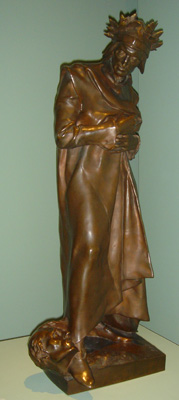
In 1982 I was the singer for a short-lived Lynchburg, Va, punk band called The Dead Pigs. We did some covers, and I wrote a couple of songs for the band. One of my songs was inspired by seeing an 1897 Jean-Paul Aube sculpture of Dante.

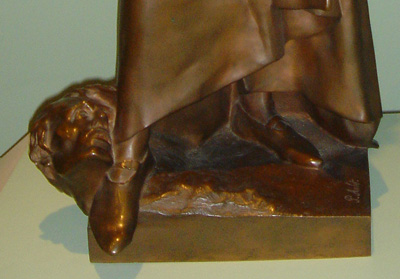
I ran across a copy of this sculpture in the Stanford Cantor Arts Center the other day. The thing about this work that caught my fancy is that there’s a head — perhaps that of a damned soul — attached to the Dante’s foot or ankle. Here’s the picture and some of the words to the song I wrote.

I’m a man who’s been crazy,

There’s a head stuck to my foot.

I kick and the room gets hazy,

There’s a head stuck to my foot.

I don’t know where to put it,

And it’s really gettin’ hard.

Nobody wants to touch me,

For the head is my body, the head is my body,

The head is my bodyguard.

And do your folks think you are a stranger?

Do your friends say you be too weird?

It’s hard to live with much danger, baby,

Year after year after year after year.

***

Speaking of Lynchburg, I have a new “Killeville” science-fiction story online in the possibly final issue of Eileen Gunn's way-hip Infinite Matrix webzine, with an illo by A Fluffy Bunny (shown above). The story is “The Men in the Back Room at the Country Club“; it's something I dreamed for years of writing, kind of blend of Phil Dick's “The Father Thing,” American Graffiti, the Book of Revelations, Linklater's Dazed and Confused, teen horror movies, door-to-door religious tract pamphleteers, my long-term concern over the evil of Pig Chefs, Earth vs. The Flying Saucers, and memories of some men who played cards all day in the men's locker room of a Lynchburg country club.

I wrote the story in 2003, and it's very tight and clear and funny, but some might find it — disturbing. None of the usual magazines would run it. So it's nice to see it in print at last. To make this the sweeter, one of Robert Sheckley's very last stories is in the same issue of Infinite Matrix! Rude Boy says check it out.

And as you party tonight, keep in mind the closing lines of “The Men In The Back Room at the Country Club”:

…pay close attention to the fluid dynamics of coffee, juice and alcoholic beverages. Any undue rotation could be a sign of smeel.

The end is near.

Happy New Year!

Brainstorms About The Orphidnet. Visit with Greg Benford

Friday, December 30th, 2005

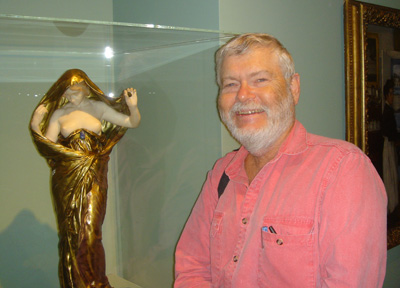
Almost cleaned up from Xmas now. About two weeks ago I asked for some thoughts on “Life After The Singularity”. Here’s some choice thoughts from the comments, with my own remarks in square brackets. For illos today, I’ll put in some pictures I took recently. The first two I got while walking around the Cantor Art Center at Stanford with fellow SF writer Greg Benford yesterday. This first picture shows Greg with a Louis-Ernst Barrias sculpture entitled, “Nature Unveiling Herself Before Science.” Very harrumph fine piece of work.

Brian B. I'm assuming the orphids and beezies are neutral agents. [Yes. The orphids are neutral at a hardware level, and the beezies who emerge in the orphidnet aren’t going to care that much about us --- although it may be that they want to affect people to create more or better orphids.]

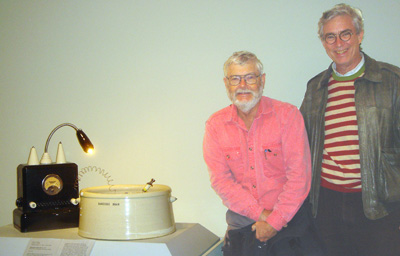
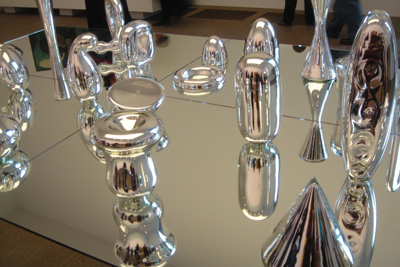
[Rudy and Greg with a sculpture called “Dangerous Brain Bowl”, part of a “Fired at Davis” show at the Cantor Art Center.]

Steve H. How easy/hard would it be to hack orphids? [I think I’ll say this is impossible, at least for the story I’m currently working on. The orphids out there, autonomous, neutral, incorruptible, always on, like a force of nature.]

Would lack of privacy turn us all into blushing wallflowers or egomaniacs. [Good issue. An objective correlative for blogging.]

What kind of cursing-out could you give someone if you could accompany it with a Powerpoint show in 3D? [Yes, I see virtual Smiley faces and emoticons in 3D. Also models of rude things.]

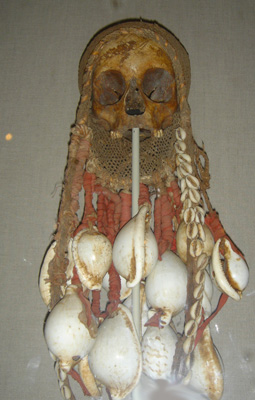
[Photo of an African ancestor mask in the De Young Museum in SF.]

If I wanted to become President would I campaign to the humans or the beezies? [I think the beezies are neutral about our politics. But they might sell info to a party that helps their campaign. I’m seeing a deal between the beezies and some oilmen who control a supply of piezoplastic they want to use for shoon bodies.]

Would the orphids get mad if we brushed off our chairs before sitting down, or painted a surface they were stuck to? Would they stick to wet paint, or maple syrup? Could you get a picture of your colon anytime from the orphids you just ate? [I’m thinking of the orphids as lively enough to squirm out from under paint, and sticky enough that you can’t brush them off. I hadn’t thought about the ones you swallow. We might as well suppose that all of our body cavities are lined with orphids as well.]

[Also in the DeYoung.]

Still Steve H. With orphids in our ears we wouldn't need iPods. [Right. They’re like lice on our heads to give everyone broadband orphidnet hookup. I’d been thinking of them putting sounds in your head via nerve stim, but its nice to think of them making noise in the ear as well.]

How would Metallica keep everyone from downloading their album as they recorded it? [Good point. I guess intellectual property is tougher than ever. Of course watching someone record an album or write a book takes a lot longer than just getting the finished product. And there’s still something nice about the physical object.]

The Golden Man defense has attack points: “Get uphill and drop rocks on 'em. Put the precognition-defended people in positions where knowing doesn't help.” [Good point. But if you’re precognition is good enough, nobody’s ever gonna get you into a tight spot like that.]

Thomas Terashima. What exactly do the beezies want? [I’m thinking they will want physical bodies. I’m considering various kinds of bodies. In exchance for certain kinds of bodies, the beezies might actually “pay” people by giving them high-quality predictions.]

Currency will be replaced by virtual coupons for orphid swarm resources. [Great idea. That plugs right into my own line of thought.]

Marshall. I would like to start an oasis where electricity didn't work and you just breathed air. [Wouldn’t we all! The orphidnet is a kind of symbol for the invasive pervasive wireless world. Maybe the oasis guys can be ‘control naturals.’]

***

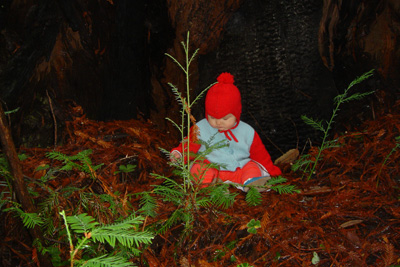
This is a faerie baby I happened to encounter in the Big Basin woods! She had with her a map of the spiral galaxy she comes from.


More Sheckley

Thursday, December 29th, 2005

I got a nice comment on my Sheckley appreciation from Martin Olson, who has a wonderful and touching eulogy eulogy of the Sheckman in a thread on Making Light, which is a blog run by Patrick & Teresa Nielsen Hayden. Marty also reminded me about the www.sheckley.com site, and I’m right now downloading a one-hour talk-show video from there.

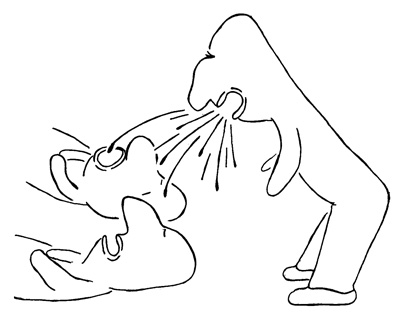
Marty mentioned something I’d forgotten; I worked a Sheckley-like short-short story about one “Boba Shekk” into my transreal futurological novel Saucer Wisdom. It's about a somewhat shecked-out writer who makes two “ohmie” clones of himself so as to be able to satisfy the demands of a Hollywood contract. He spreads his personality as a virus that gives him a cold; that is, to transfer himself, he sneezes on two tank-grown clones. [Here’s my illo for the episode, and a quote. As I recall, I drew the illo first, then thought it slightly resembled Bob, and then decided to give my character a variant of his name.]

“Your personality is like a disease they're catching?” says Etsuko. “Your memories? What if you went out into a crowd?”

“It would be a beautiful thing, wouldn't it,” says Shekk, grinning and loudly blowing his nose. “Gesundheit, baby.”

The little story is dark and satirical — one of the clones convinces Boba that he was the clone. I do imagine Bob would have gotten a kick out of the homage. But I confess to not having checked it with him.

End of Year Question: Life After the Singularity

Monday, December 19th, 2005

I’m gonna take a couple of weeks off from creating new blog entries. So Happy Holidays and a great 2 * 17 * 59 to all of you. [Factorization corrected after Fred Condo pointed out I'd posted it wrong. I was 17 when I finished hi-skool and I'm 59 now. Therefore...?]

I’d like to get a comment thread going that will keep some interesting stuff happening here. Thus my “End of the Year Question” on what life will be like after the Singularity.
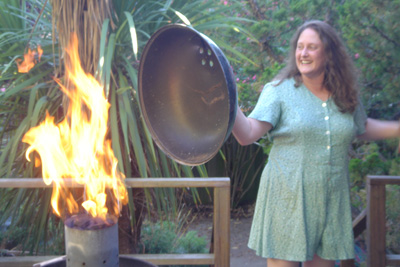
By way of background, about two and a half months ago, I solicited comments from you readers in an entry called Need Help Understanding Supermind Experience.
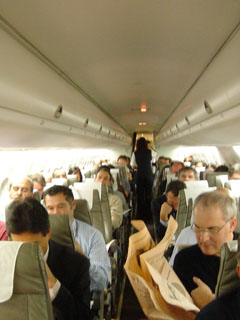
I picked up some really useful ideas from the comments, some of which worked their way into a story called “Postsingular” that I sold to Asimov’s SF magazine a couple of weeks ago. And now I’m working on a follow-up story and I want more help from the hive mind.
The set-up:

The Earth is blanketed with self-reproducing nanobots called orphids (derived from “arphids” derived from RFID). Each of them is about as smart as a dog.

Rather that reproducing without limit, the orphids have thoughtfully leveled out at a population density of one or two per square millimeter on every surface on the planet (rocks, leaves, auto parts, skin).

Orphids use quantum computing; they propel themselves with electrostatic fields; they understand natural language; they’re networked by wireless.

They’ve settled onto people’s heads like lice, and they’re using magnetic fields to provide people with device-free orphidnet (super Web) access all the time. Thanks to their orphid lice, everyone is continually plugged in; everyone has a HUD (heads-up display projected over their visual field inside their brain). And thanks to the orphidnet anyone can in some sense see anything (or at least the orphid mesh on the object).
Higher-order AIs have evolved within the orphidnet — they’re called beezies. Some of the beezies are perhaps thousands as times as smart as us. And the smaller beezies are willing to help humans with tasks. Everyone has agents doing thought routines for them.

The question:

What will life be like in this post-Singularity world?

Here’s a few preliminary thoughts about this from my notes for my sequel to “Postsingular.” By the way, the story-in-progress has the working title “Bixie and Chu.”
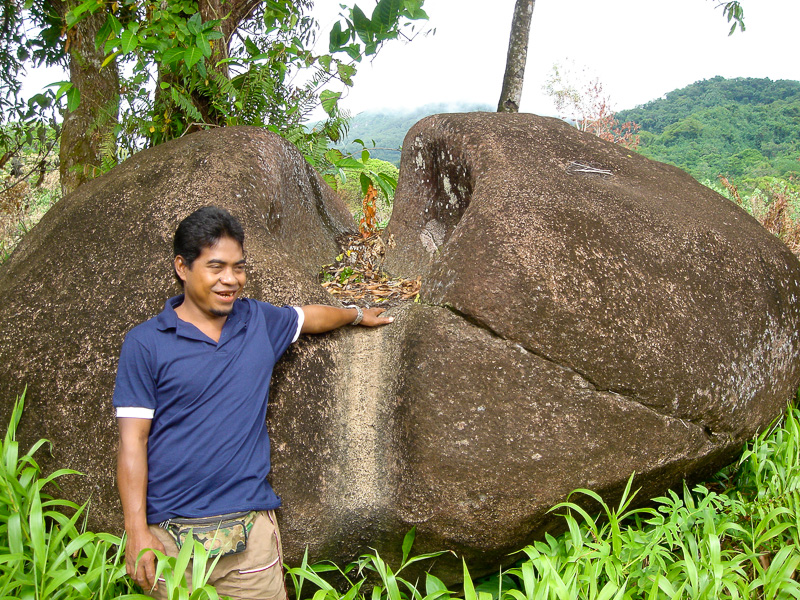
How do people deal with the orphidnet day in and day out? Maybe they’re casual about it, used to it. After all, we’ve changed our tech so much since, say, Hieronymus Bosch’s time, but we act the same.

A lot of what people do is, no matter what the tech, based on the simplest biological needs.
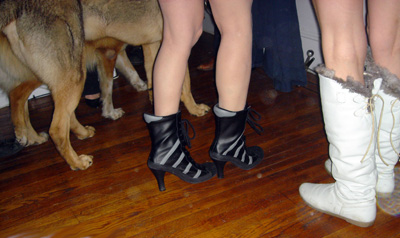
Mating. Even if we have vat-grown children, there’s still competition to find a good partner to contribute a sperm or an egg, and to help raise your children. I think people would always prefer to raise their own children if possible, as this seems likelier to produce good outcomes.

Absolutely no privacy. Less shame about sex, less mystery. Yet, there are still the same reproductive issues, which are probably a root cause of modesty, which might be a way of playing one’s reproductive options close to the vest.

[Photo documenting my friend Charles Platt’s single day as a worker at a big box store.] Food, shelter, and what people own will inevitably be distributed according to the pyramidal inverse-power law statistics (a tiny number of very well-off people and a huge number of poor ones) that inevitably emerge in group computations.

But, with the orphidnet, you can get a lot of what you need for free, if people are generous, and why shouldn’t they be. Recycling. The whole world is a realtime EBay. You can always find leftover food. People set it out, like pies for bums. Just-in-time bread and breakfast. Couch-surfing is practical; particularly if there’s very little chance of crime.
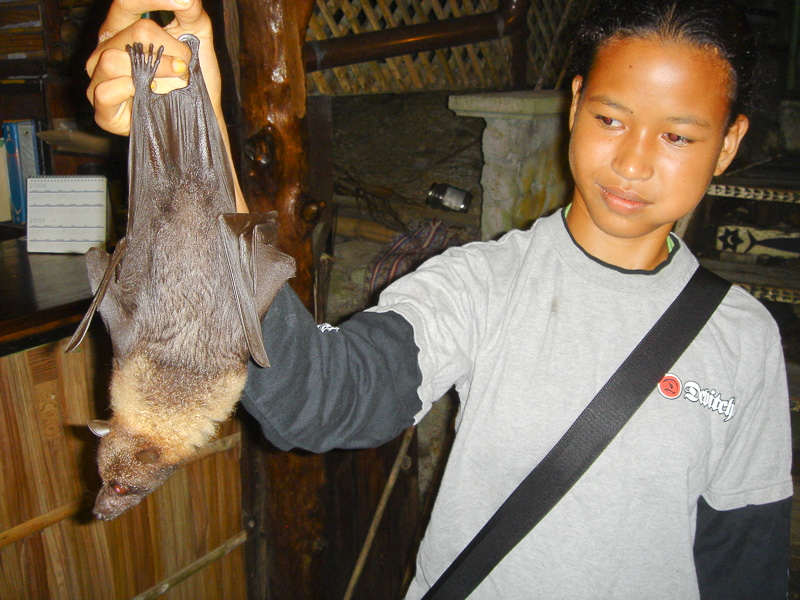
We might suppose that in the Postsingular world, when people talk, emoticons form around them, visible in the computeresque overlays that everyone has happening with their brains, the Smileys hopping out of a speaker’s mouth. Also there will be more functional images, e.g. a copy of a bat that you’re referring to.
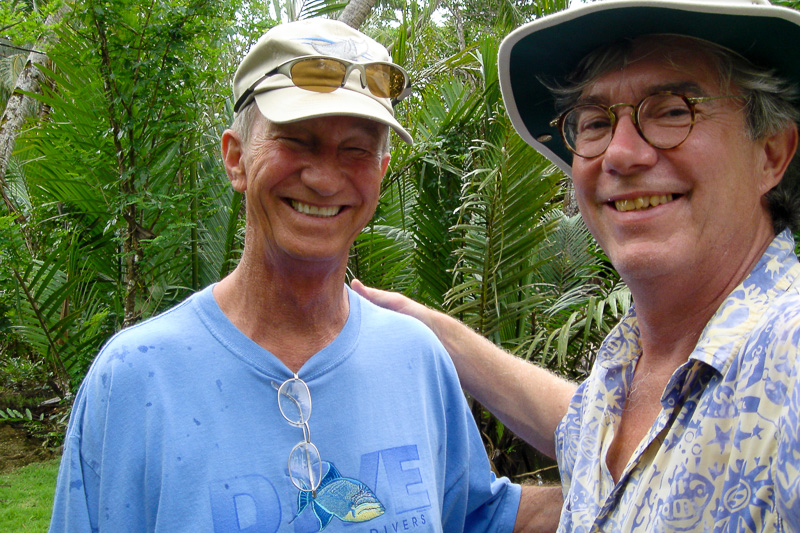
There’s a fad for going offline. “Going on the natch.” [That's my brother Embry and I in Micronesia, a high point of 2005.]

The orphids are in principle willing to turn off a person’s brain interface. Probably there will be some sleaze-ball spammer types trying to override that to push ads, scams, and political propaganda. (I’d like to have a scene with implacable orphidnet-controlled “shoon” robots attacking Heritagist spammers.)
Violent crime has become impossible to get away with. People can always watch you; and even if they see you do the crime, the orphidnet remembers the past, so anything can be replayed. If you do something, people can find you and punish you.

On the other hand, you can still behave like a criminal if you have indomitable physical force. Like if, for instance, you’re the government.

Perhaps there are some war-lords as well. Thanks to the all-seeing orphidnet intelligence it might be hard for the government to catch and swat criminals.

After all, with the orphidnet, anyone can mount what I call a “Golden Man” defense (the name comes from a Phil Dick story where a mutant always knows what’ll happen next, so nobody can kill him). But if your pursuers have the same knowledge, maybe it’s a wash.
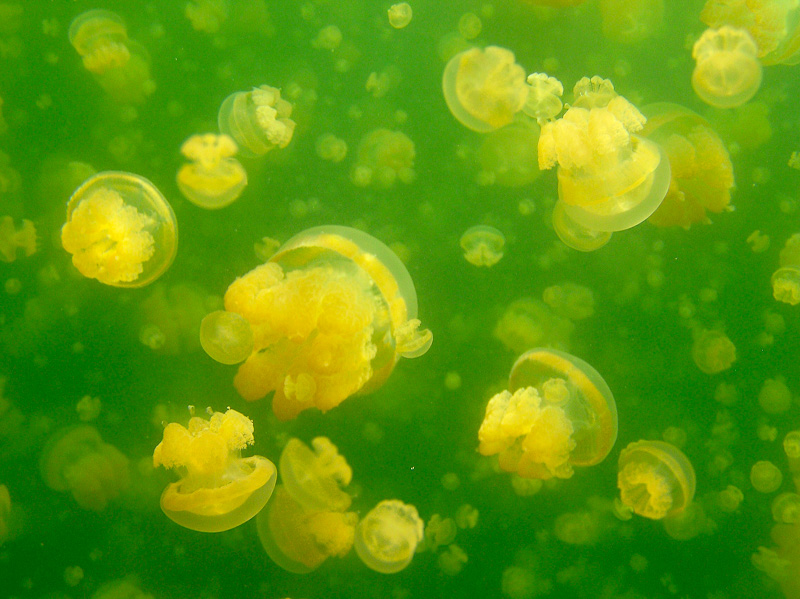
Conceivably the orphidnet beezies might favor certain people and give them the benefit of a deeper-ply look-ahead than is available to the common ruck and rabble.
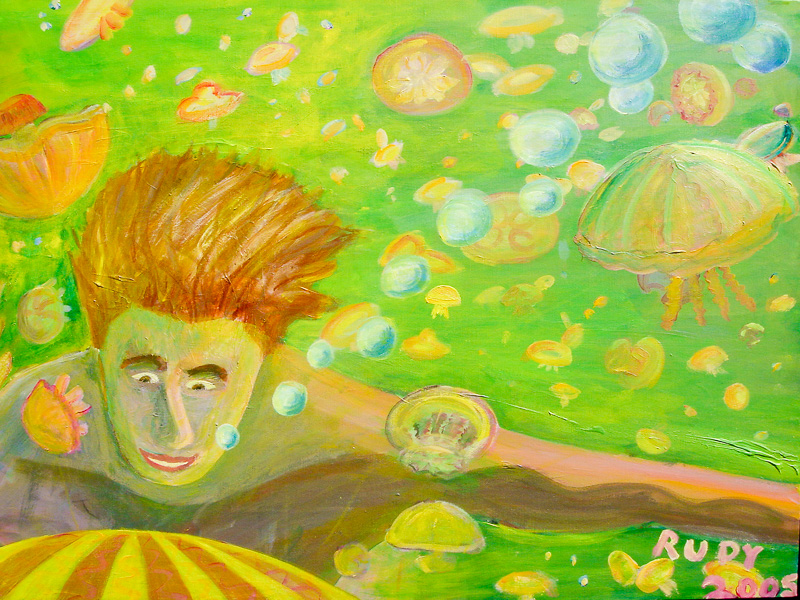
(Here's a link to large version of my “Bela and the Jellyfish.”)

Merry X and Happy New Y!

Student Blogs on Computation and Reality

Sunday, December 18th, 2005

I finished my Philosophy and Computation class. It was fun to teach again. Two of the students made blogs for their semester projects. Lots of interesting stuff. Emil's is in a more finished state. Check ‘em out.

Emil Rojas

Greg Garcia

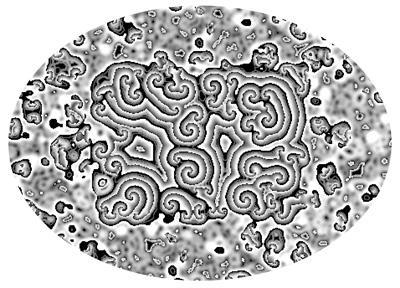
The photos today are of a reversible CA installation with video feedback by my student John Bruneau, also from the same class.

Most of the lectures are online in podcast form. Click the button to access them.


Last Gasp Comix Party, San Francisco

Saturday, December 17th, 2005

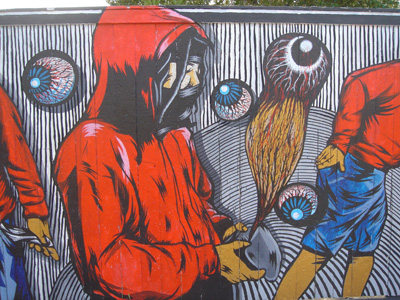
Yesterday I went to San Francisco to go to a party; first I met up with my son Rudy at the Monkeybrains World Headquarters on Folsom Street. I saw a cool graffitti painting. Looking at that writing, I feel like I’m in a science fiction novel, which is a place I like to be.

The party was at Last Gasp, a San Francisco comix and graphic novel publisher that’s been around since the days when the Zap-o-saur thunder lizards roamed the Earth.

I introduced myself to the host, Ron Turner. People were lining up to say hi to him, influential underground publisher that he is. Like a cross between Santa and the Godfather.

Our friend cyclecide Linda works at Last Gasp: I asked her if she braids Ron’s beard, she said, no, his daughter-in-law does that.

Somehow I’d imagined I’d know a lot of people here, but I hardly knew anyone. But Rudy and his friends are always nice to me. One was dressed like a clown with a gold tooth, which went great with a scary circus clown poster from the Last Gasp collection.

I ran into my cartoonist Zaposaur theropod pal Paul Mavrides. Last Gasp has a large collection of original cloth side-show banners suspended on rollers.

Rudy and I rooted around among them the banners, and saw a giant anteater.

Also vampire bats attacking a cow.

I got a picture of two archetypal underground San Franciso women. If you tell strangers you’re photographing them for your blog, it makes you almost legit. Speaking of bloggers, Scott Beale, a.k.a. Laughing Squid covered the party as well; he has some terrific pictures.

I’ve been up in San Francisco a couple of times recently. Last week I went to the “Writers With Drinks” reading at a Mission venue called The Make-Out Room.

I didn’t get any clear pictures. They had a nice disco ball. My writer-friends Terry Bisson and Karen Joy Fowler gave terrific readings. Standing in for them is this a picture of Isabella Rossllini in Blue Velvet, which I saw in the afternoon at the Castro theater. What a star she is.

Last week in the afternoon I walked through Dolores Park. Sometimes I think we should move to San Francisco.

R.I.P. Robert Sheckley (1928 - 2005)

Monday, December 12th, 2005

My favorite SF writer Robert Sheckley died last week.

I posted some memories of him a couple of months ago when he got sick.

A few more notes.

In the mid-1980s I co-edited with Peter Lamborn Wilson and Robert Anton Wilson an edgy SF anthology called Semiotext(e) SF (AK Press, Edinburgh 1989). I got Bob to mail me Xeroxed pages from his journals, which we included as a piece called “Amsterdam Diary.” Let me quote three good bits here.

“How much reading of other fiction writers must I do to convince myself that the finest work done is woven out of the author’s own experience, his own and no others, no matter how much he chooses to disguise or exploit the fact.”

“Good fiction is never preachy. It tells its truth only by inference and analogy. It uses the specific detail as its building block rather than the vague generalization. In my case it’s usually humorous — no mistaking my stuff for the Platform Talk of the 6th Patriarch. But I do not try to be funny, I merely write as I write. In the meantime I trust the voice I can never lose — my own. The directions of its interest may change, even by morning. But what does that mater if I simply follow them, along for the trip rather than the payoff (always disappointing), enjoying writing my story rather than looking forward to its completion. Wise-sounding words which I hope describe where I’m really at.”

“Two weeks until my 50 birthday. The thought, the mood, of impending doom. Fifty is well enough — but what about 60, what about 70? What about death, a second away or 20 more years, but looming up faster every year. They go by faster & faster as one grows older. What happened to the golden inexhaustible summers of my youth? Maybe they weren’t always golden, but they did seem to stretch on forever. I thought I’d never grow up.”

Robert did me the signal honor of writing a very warm and hilarious preface for my collection Transreal (WCS Books, Englewood CO 1991). He initially protests, “What is Rucker trying to do to me? Why did he select me for this job? Why is he seeking to undermine me with his mind-experiment, why does he want to invade my mind with the contents of his trashy situations, with the faecid droppings of his clever simian mind?” But then he relents. “This is SF rigorously following crazy rules. My mind of science fiction. At the heart of it is a rage to extrapolate. This is what Rucker does. Among other things. At the heart of it is a rage to extrapolate. Excuse me, shall I extrapolate that for you? Won’t take a jiffy. And so we have it. Rudy the crazed mathematician, like a poet hidden in the light of thought singing songs unbidden ‘til the world is wrought to sympathy with hopes and fears it heeded not…”

In return, I got the opportunity to write a preface for Sheckley’s Minotaur Maze (Pulphouse, Eugene OR 1990). I said, “The paramount quality of Sheckley’s writing is the purity of his language. The timing of his cadenced phrases is exquisite. His richly charged clarity arises, I would say, from the excellent moral qualities which Sheckley as a writer exemplifies — he is a man in love with writing and with the simple sweetness of life.”

One final quote from the Sheck-man himself in Minotaur Maze, one to bring tears to the eyes: “The premise could be seen wavering, there were repercussions of a rhetorical nature, and the author could be glimpsed, a ghostly figure of unbelievable beauty and intelligence, trying desperately, despite his many personal problems, to put things together again.”


Rudy’s Blog is powered by WordPress