

Click covers for info. Copyright (C) Rudy Rucker 2021.


Archive for November, 2004

Starting a novel. Raindrops.

Tuesday, November 9th, 2004

These days I’m starting work on a novel about two mathematicians in love with the same woman. I think I’m calling it Mathematicians in Love, although originally I was thinking of it as Crazy Mathematicians. I’m working on the third of four scenes making up Chapter One, a scene where my character Bela Kis has been walking on Ocean Beach with a girl Alma Ziff whom he’s falling in love with.

Starting a novel is scary and hard. It’s like you’re picking the seed to grow a whole universe from. So much depends on every word. As chance would have it, seeding is a theme of the novel, as my characters will at two points be picking a seed to grow a new alternate universe to hampajump into.
''

Writing yesterday felt really good. Time’s been so heavy on my hands. When I’m writing, I’m in the zone, the ozone, mindless as in “the Zen doctrine of no mind,” absorbed by my craft — and the minutes and hours melt away.

It makes me anxious for the material to take on life. It’s gonna break my plot! An author needs to have graceful degradation of function while experiencing an increasing loss of control.

I’m happy and excited that it’s going so well. Running and running and finally jumping into the air, flapping, and yes, once again I’m aloft.

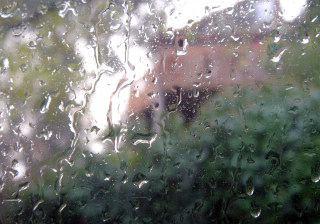
The other day I took Isabel to Ocean Beach, mainly for fun, but also to get some beach images in my head for Chapter One. And now I’ve written the beach part, and Bela and Alma are sitting in the Java Beach coffee shop looking at rain running down the window pane. So this morning to simulate rain, I set up the sprinkler in our back yard to hit the bedroom window and sat and looked at that for awhile.

The drops aren’t all that round, their edges are scalloped and jagged.
''

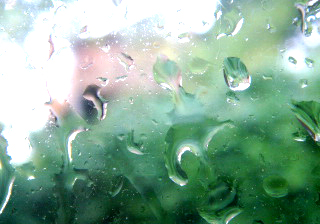
Big and small drops accumulate on the glass, and then one drop starts moving, and makes its way down, zigzagging as it “eats” the drops it gets near. Some of the drops get lucky and set off a big trickle. These guys are “riding the Tao.”

It looks like a sliding drop is sniffing its way. It moves left and right, influenced by the presence of droplets, and perhaps also by dirt, oil, soap residue on the glass. Note also that the trickle speeds up and slows down.

The trickles are objective correlatives for the lives of my characters. Or objective correlatives for people writing novels.
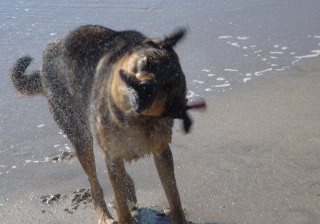
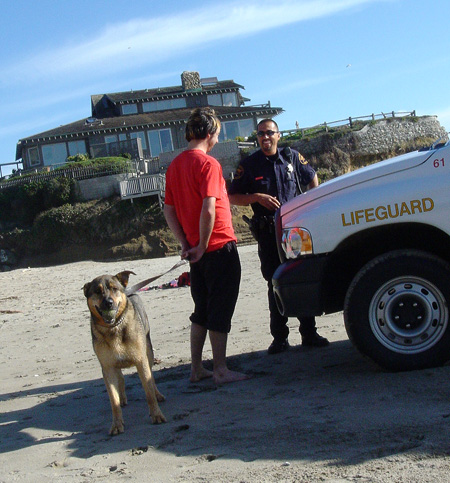
Santa Cruz, Twin Lakes Beach, Dog.

Saturday, November 6th, 2004

''

Son Rudy's dog Slug shaking. I love the motion implicit in dog-shakes, like an Italian Futurism painting. Made it to the beach two days in a row, thanks to Isabel being here for a visit. Yaar.

Later a beach cop stopped to scold Rudy for not having Slug on a leash. Rudy tied his belt to Slug's collar, but the artifice was seen through.

''

Ocean Beach.

Saturday, November 6th, 2004

''

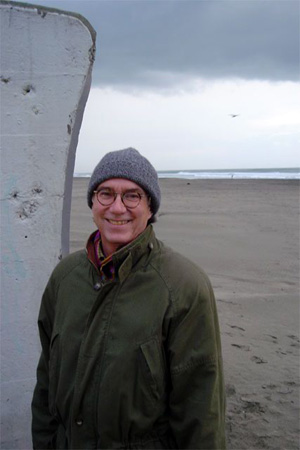
Ocean Beach notes, made 11/5/2004,for use in my Mathematicians in Love novel. Walking there with daughter Isabel. Photos by Isabel.

Container ships chugging past toward the Golden Gate.

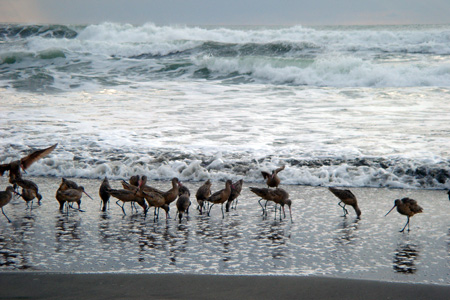
Little birds running like their legs are wheels, their bodies don’t move, how nice it would be to cup one in your hand and feel its heartbeat. The little white ones are plovers, the big ones with up-curved beaks are godwits. Here's some godwits digging in the sand.

''

The horizon line isn’t straight, its wavy, scalloped, undulating. Giant waves out there, far outsiders.

The waves closer in were smooth and clean, like slow gray hills, with perfect lips and spray blowing back off them towards the sea.

It was a marbled cloudy sky, with shafts of afternoon light coming down through rents in the cloud cover, pillars of light like fingers of God.

''

Crossed the dunes and the beach grass. Tropical plants in the highway divider, cacti.

The coffee shop is called Java Beach, at the corner of Judah Street and La Playa. They have a checkered floor. Black leather couches. A character sitting there, older man in a flat hat and wearing a red carnation. People doing homework on laptops

Cyborgs, future of humanity.

Thursday, November 4th, 2004

One more interview question from Arianna Dagnino in Italy. (On November 19, 2004, I'm on a panel about “Digital Eternity” Futurshow 3003 in Milano, and Ari is the moderator.)

Q 160. We humans used to think of ourselves as the key players on stage. And we want to stay at the centre of it: we’ve been using children and/or works of art and science to grasp a sense of immortality, of life that still goes on after our death. But maybe one day the human race will simply disappear to be replaced by more intelligent beings (robots?). Is there any hope for us in the long run — at least as a race, if not as individuals? What is a human being going to look like a hundred or a thousand years down the line?

A 160. As you say, even if an individual achieves personal immortality, there’s social sorts of immortality. Your genes may survive in your descendants, and your ideas may survive in the minds of others. A society has a kind of hive mind which we all participate in, and the hive mind is potentially immortal.

I think it’s very unlikely that we would be replaced by purely mechanical robots. Biology is vastly superior to mechanics — for instance, unlike machines, biological organisms have homeostasis, that is, an ability to repair themselves. But what could happen is that, on the one hand, we begin to tinker with the genome, altering our biological make up and, on the other hand, we create mechanical devices to augment our bodies. Certainly in a thousand years we can expect to be cyborgs, that is, genomically tailored biological beings with mechanical add-ons.

Amputees are already using very high-tech artificial limbs. And I don’t think a brain prosthesis is out of the question. I often write of a device that I call an “uvvy” for “universal viewer.” It’s a soft wireless computing device that rests on the nape of your neck and gives you instant cell phone abilities, internet browsing, and access to your lifebox database. At some point a person without an uvvy might not be considered a whole person at all.

But even though our bodies will be upgraded in various ways, I don’t think human nature won’t change very much. When I wrote my novel about the age of Peter Bruegel , it was borne in upon me how similar the people I see on the street are to the people in Bruegel’s paintings. My prediction is that people won’t change very much, and the overarching hive-mind of human society will also remain much the same.

We are close to having the uvvy, what with our increasingly powerful wireless devices. Cell phones have already greatly changed the details, if not the essence, of social dynamics.

What’s still missing is a seamless user interface. Actually inserting wires into one’s brain is something that people will, quite correctly, never be willing to do. But perhaps we might be able to create tightly focused magnetic fields capable of interacting with the neurons in the brain stem. More realistically, we might wear what I call “stunglasses,” which combine a heads-up display with the user’s surroundings. Lightweight sensor-equipped fingerless gloves might allow someone to “type” simply by twitching their fingers. Everyone will have an uvvy within a hundred years. Cyberspace will ooze out of the machines to permeate every aspect of daily life.

But, even so, we’ll still be the same kinds of people: lustful and greedy, noble and inspired.

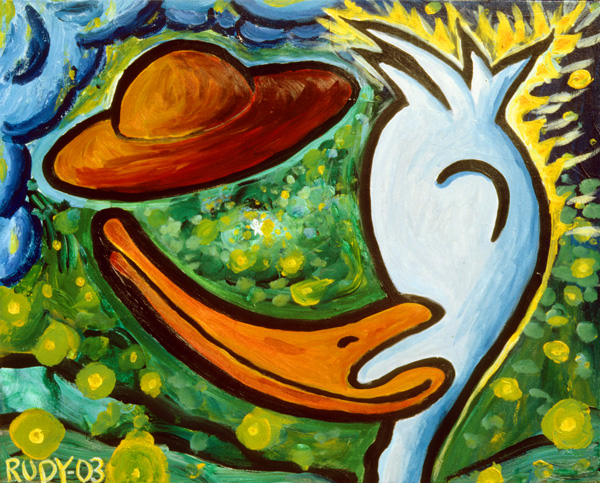
Forget not the eternal verities of human nature as depicted in the supremely wise Carl Barks tales of D. Duck.

''


Rudy's Blog is powered by WordPress