Postsingularby Rudy RuckerTor Books, October, 2007. Buy the ebook from any ebook seller. |
Free CC edition.
(This page last updated December 6, 2021.) |
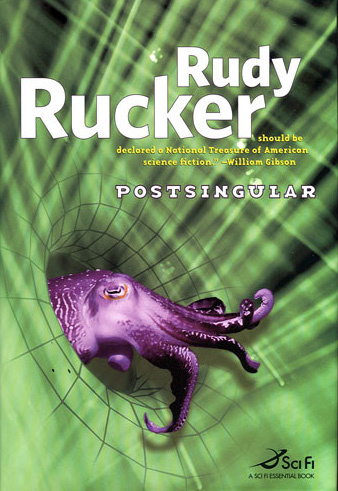
Summary
Postsingular and its sequel, Hylozoic, are in the cyberpunk style of his classic Ware tetralogy. What will happen after computers become as smart as humans and nanotechnology takes on the power of magic? What happens when all of our reality is mirrored within the "orphidnet" metaverse of the postsingular cloud? Stranger things than anyone ever imagined. Nature will come alive.
Writing Notes
Check out the 2.5 Meg PDF file postsingularnotesposted.pdf, a 300 page document containing the working notes for the book. The document inlcudes drawings, plus internal and external hyperlinks.
Reviews
"Rudy Rucker should be declared a National Treasure of American Science Fiction. Someone simultaneously channeling Kurt Gödel and Lenny Bruce might start to approximate full-on Ruckerian warp-space, but without the sweet, human, splendidly goofy Rudy-ness at the core of the singularity."
--- William Gibson, author of Pattern Recognition
"Rudy Rucker is the most consistently brilliant imagination working in SF today"
--- Charles Stross, author of Accelerando
"Rudy Rucker never fails to leave me breathless. . . Reading one of his stories is like a reset button on reality: when it's over, the whole universe looks slightly different...and much stranger."
--Spider Robinson, author of Night of Power
Alt-cultural folk strive to save Earth from digitized doom in this novel from the prince of gonzo SF. A computer mogul's threat to replace messy reality with clean virtuality and by a memory-hungry artificial intelligence called the Big Pig propels nanotechnologist Ond Lutter, his autistic son, Chu, and their allies on an interdimensional quest for a golden harp, the Lost Chord, strung with hypertubes that can unroll the eighth dimension and unleash limitless computing power. ... Rucker favors the flower power of San Francisco over the number crunching of Silicon Valley. His novel vibrates with the warm rhythms of dream and imagination, not the cold logic of programming ... Playing with the math of quantum computing, encryption and virtual reality, Rucker places his faith in people who find true reality "gnarly" enough to love.
--- Publisher's Weekly (C) Reed Business Information.
Always willing and able to embrace sf's trendiest themes, Rucker here takes on the volatile field of nanotechnology and the presumed inevitable "singularity" of human and computer unification. In a series of interrelated vignettes, he describes the calamity that befalls nanotech inventor Ond Lutter and his would-be benefactors when Ond unleashes a variety of self-replicating nanobots. In one episode, trillions of microscopic bots, dubbed nants, chew up Mars to create a colossal Dyson Sphere orbiting the sun. When the nants move on to Earth to transform every living being into a virtual-reality doppelganger, Ond saves the day with a nant-busting virus. The real fun begins, however, when Ond "improves" on the nants with apparently benign nanobots, called orphids, that blanket every surface and provide plugged-in users three-dimensional access to every conceivable scrap of knowledge and experience. ... His devoted fans and dazzled newcomers to him will revel in his willingness to push technological extrapolation to its soaring limits.
--- Carl Hays, Booklist
When it comes to unique voices in science fiction, few can claim to have quite as distinctive a style as Rudy Rucker. Postsingular is packed full of the larger-than-life weirdness that has become his trademark; classic genre tropes and clichés rub shoulders with mathematical theorems and wild technological speculation, delivered in prose that captures the the languid vibe and hippie undercurrents of California. ... Rucker's quick-draw style acts as a sleight-of-hand that allows him to slip some of sf's biggest tropes and ideas beneath the reader's radar, as well as touching some very human character aspects that are often skipped over (or, worse still, rendered tiresome) by the pens of others. Postsingular has all the bells and whistles that only a computing professor could provide, but never at the expense of the story.
---Paul Raven, Interzone
Rudy Rucker's new novel Postsingular is pure Rucker: a dope-addled exploration of the way-out fringes of string theory and the quantum universe that distorts the possible into the most improbable contortions... A kick-ass, weird-ass post-cyberpunk novel...This is one of the most fun, strangest, most thought-provoking sf novels I've read.
---Cory Doctorow, BoingBoing and BoingBoing(two reviews)
This book is densely written...yet also captivatingly plotted for sheer narrative verve and laced with plenty of humor and suspense. Walking a tightrope between information overload and thriller action, the book captures the heady zip, zest and buzz of the post-singular milieu, a world where miracles are commonplace but structured logically to provide real challenges, risks and triumphs.
---Paul DiFilippo, SciFi.com
Rucker writes with a hyperactive level of inventiveness that seems to owe bits in equal measure to Lewis Carroll, William Burroughs, and Ray Kurzweil. Rucker can be enormous fun to read, and there are some stunningly bold ideas here.
---Gary K. Wolfe, Locus
Any true singularity pretty much by definition has to be so over-the-top that it would stun present-day minds. This is over-the-top as only Rudy Rucker can do it.
---Tom Easton, Analog
It's fast-paced and subversive: nanomachines dismantle all life on Earth and send everyone to a virtual world, and you're still only on page 20. Postsingular turns the singularity, the mythical moment when we all transcend our humanity and become cyberer, into something much weirder and more ambivalent. Just as other cyberfiction is becoming more cautious in its predictions, Rucker takes wilder and wilder leaps into outer possibility.
---Charlie Jane Anders, San Francisco Bay Guardian
Postsingular is hugely enjoyable. It's never boring, and never gets bogged down in difficult info-dumps. Rucker's ideas are simple and elegant, despite the complex thinking behind them shown in his working notes. Exotic concepts such as shoons, orhipds, beezie and a universe 1.8 Planck lengths away in another dimension all seem natural and logical without the need for dense scientification to justify them. Highly recommended, and when you're done take a look at the working notes for further insight into Rucker's ideas and inspirations.
---Patrick Hudson, The Zone
Rudy Rucker is well-loved for tons of things, but I am totally in love with his characters. Not since Philip K. Dick has there been an author more able to drill down to what exactly makes us human and expose it for everyone to see. Postsingular—which deals mostly with society’s total, overnight change and the people who get mixed up in it—has an unbelievably awesome, unbelievably human cast of characters, from the dumpy scientist to his autistic genius son, to the street kids who have huge dreams and small ambition. Every word of dialogue is pitch-perfect, and along with a fairly adventurous interdimensional plot, Postsingular is my favorite Rucker book in years.
—Ryun Patterson, Bookgasm, Best Sci-Fi Books of 2007
(Reviews of Rudy Rucker's Other Books)