

Rudy’s Blog

Buy Rudy's books! Click covers for info.                 Blog text and images copyright (C) Rudy Rucker 2012.


Archive for December, 2009

Australia #10. Final Days in Cairns.

Tuesday, December 29th, 2009
Share

[This is my last post about our Australia journey.]

After the dive trip, they dropped us on Lizard Island, a largely deserted spot that has an airstrip, a small and posh $1000-a-night resort, and a $10-a-night campground. The first European to live on Lizard Island was a guy called Watson who was trying to make a living by harvesting “beche de mer” or sea cucumbers, to be sold in the Far East. Any edible thing that’s shaped at all like a penis has always been culinary gold—consider also the stiff quills within shark fins and the horns of rhinos. Not that you’d really want your penis to look like a sea cucumber…
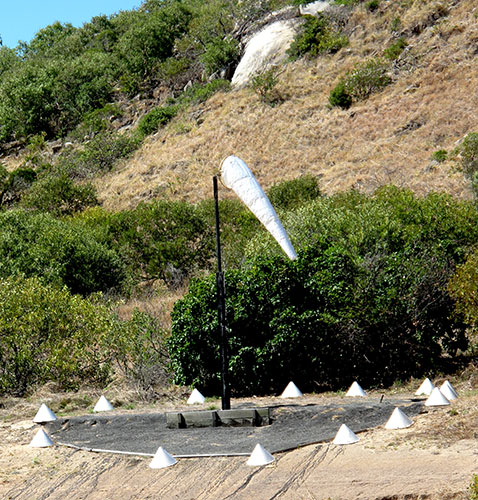

[The totality of the airport control equipment on Lizard Island is a windsock.]

We hiked through some bush to get to the deserted asphalt airstrip. The hike was nice, a touch of the real Australia, all weird plants and red rocks, with the sun implacably beating down and our bodies bathed in sweat.

I saw a three or four foot long lizard amid the scrubby rocks. The lizard was shy, and went to hide beneath a rock. Trying to make conversation with a Japanese diver woman who spoke no English, I pointed to the lizard. “Godzilla eat Tokyo!” She brightened up at the name of the city, understanding only that. She pointed to herself. “Kyoto!”

And then we flew back to Cairns in a tiny plane, low above the water. After all the intensive diving, I felt a little dizzy and off-kilter, it would be several days until my ears really felt clear and normal again. I didn’t sleep very well on the boat, perhaps because of the overeating. And I think I caught a bit of a cold from a Perky-Pat-like woman who’d cough across the table all during breakfast.
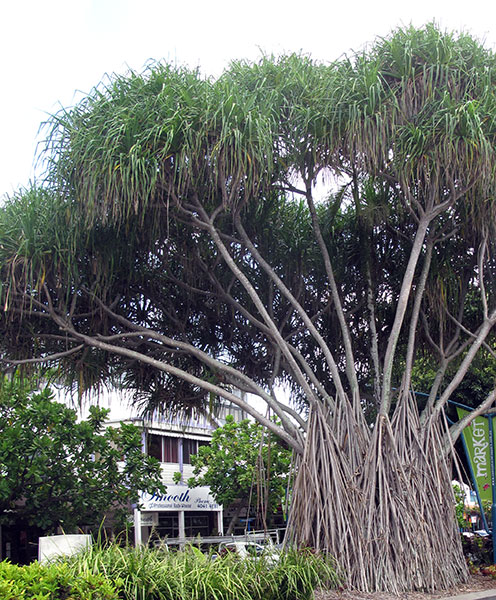

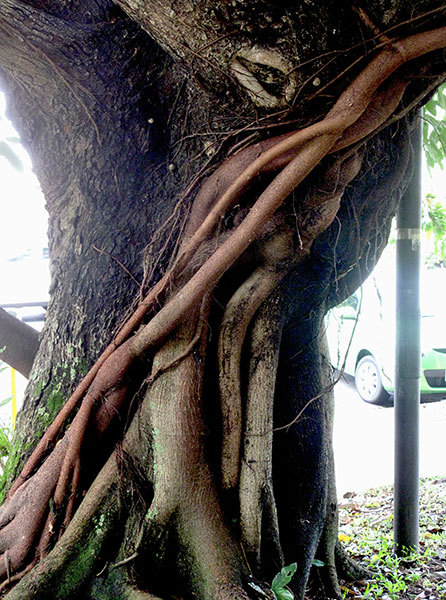
[A “curtain fig tree” in Cairns.]

And we spent the last two nights in Cairns, just killing time and soaking up some more Australian vibes. We considered making another excursion from there, but we were too tired and, as it turned out, just hanging around Cairns was fairly interesting.

One night we walked into a random live performance in an art center near our hotel, and they were doing a freak show, kind of like they do in San Francisco—eating razor blades, putting their elbows into bear traps, shocking themselves with a car battery, standing on the belly of a dwarf woman who’d arched herself into a bow above a bed of nails. But it came across more like a high-school talent show than like something really edgy.

It was gray, drizzly, and over 100 degrees each day. I rented a bike and rode along the waterfront both days. It was so hot that it didn’t matter if it rained on me.
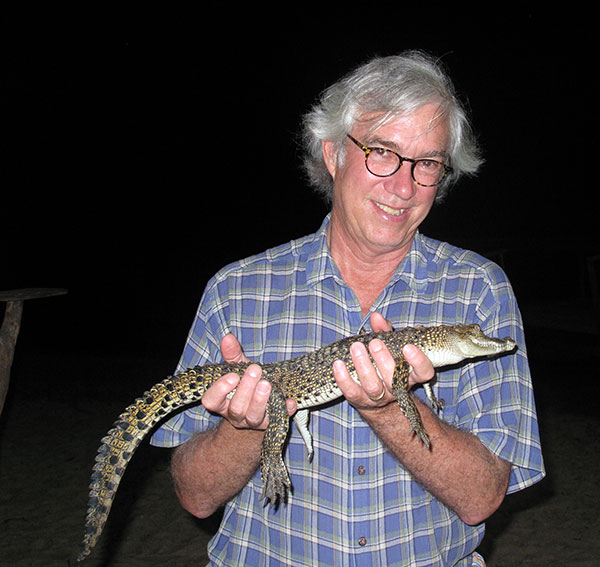

[Me with a young crocodile, much warmer and softer than expected.]

Cairns is on a mud flat that’s in fact inhabited by crocodiles, so they don’t really have a beach. Instead they have a nice strip of park by the water, about a mile long, and a giant wading pool for kids to play in, the biggest shallow pool you ever saw, at least an acre in size.

At the north end of the waterfront, the mangroves start up, totally dense, and full of birds. I saw a kind of white pelican with a long sharp beak, a nice-looking bird. At the south end, there’s a yacht harbor and then some docks for heavy-duty ships that included an oil tankers. I liked riding around that part, it felt, once again, like I was closer to the “real Australia.”
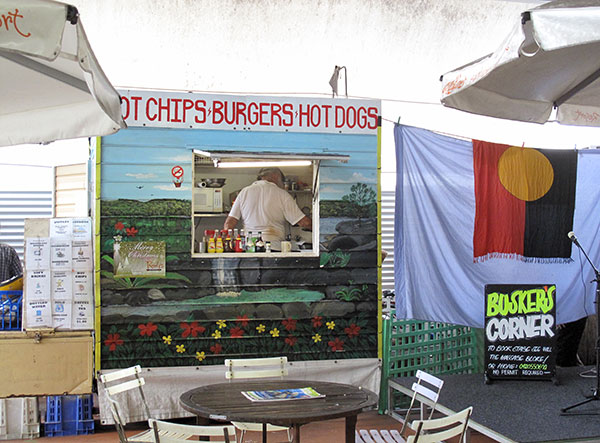

[Burger stand by a big open market in Cairns. That flag on the right is the Aboriginal flag.]

I bought a nice Aboriginal-made boomerang. I’ve had a thing for boomerangs ever since I sent in my savings to buy one from an ad in Boy’s Life magazine fifty years ago. We saw a great fruit and vegetable market with lichees, durians, star fruit, multiple varieties of mango, and a tusk-like ten-pound vegetable that turned out to be a single bamboo shoot.

A fair number of Aboriginal people live around Cairns—I didn’t really see any of them at all in Melbourne or in Sydney, other than the guys selling didgeridoos on the Circular Quay in Sidney. I sat for awhile in the Cairns town square near the bus station, digging the Aboriginals. The ones who noticed me were quite friendly, although it was more common that I was pretty much invisible to them.
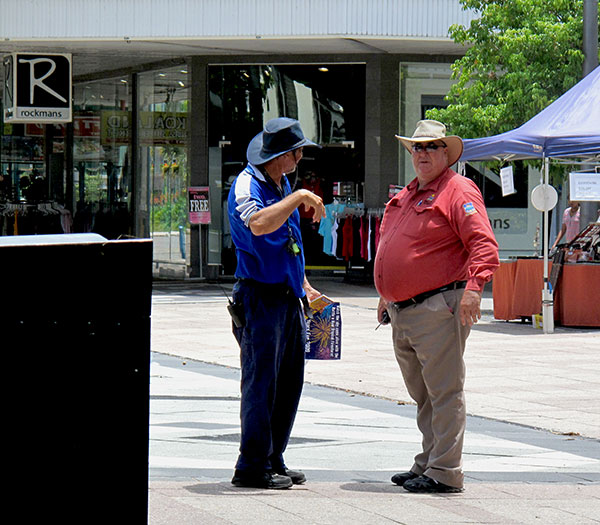

[Cairns security guards.]

One couple was having a prolonged argument, a man and a woman, a yelling match, the woman saying, “You don’t know me.” As if by prearranged signal, they stopped quarrelling and walked off just before a couple of security guards appeared. Down near the water I saw a number of Aboriginal families having picnics.

The heat was killing me, a really shocking temperature, maybe 105 by noon. The outdoor cafes have rows of fans swirling beneath their awnings. I went back to the hotel and sat in the lukewarm water of the pool reading Henry Miller’s collection, The Cosmological Eye—an old edition I happened to pick up during my travels.
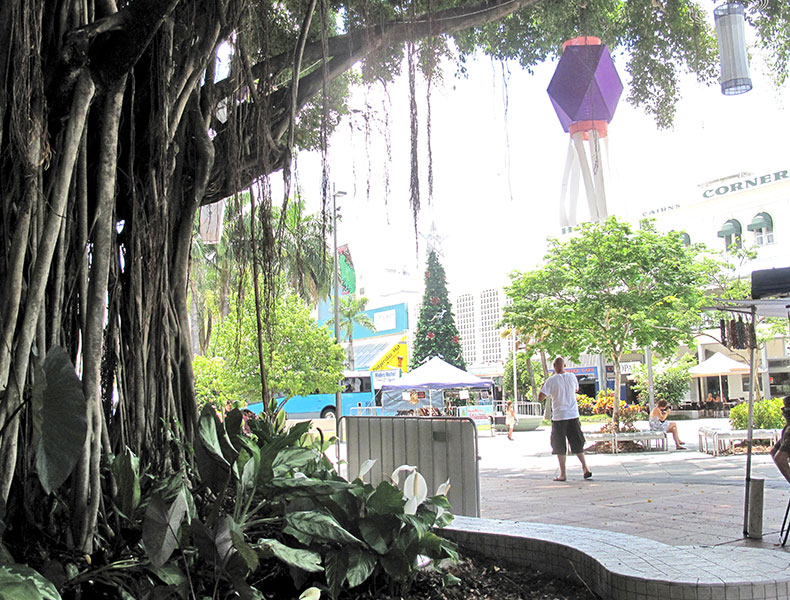
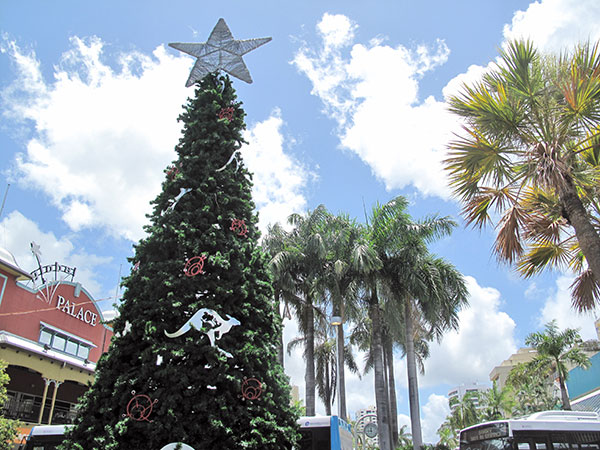
There was a holiday vibe in the air, and the town’s slogan was “SumMerry Christmas.” They had a big Christmas tree decorated with images of kangaroos—I showed a close-up image of it in an earlier post. Speaking of roos, I never did get to see a big mob of kangaroos in person like I’d hoped. I think I mentioned that the ones we saw in the zoo near Melbourne were rolling on their backs and scratching like dogs. I did see, on the TV in the hotel room, a kangaroo hopping across the fairway of the Australian Open golf tournament.
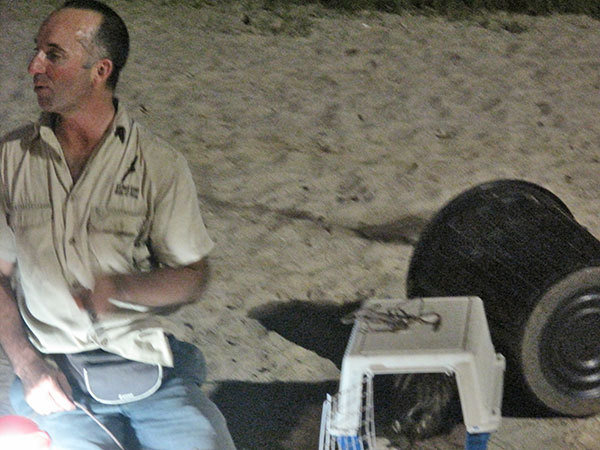

[Menagerie man in Cairns.]

One the very last evening we saw a guy—either he was a park ranger or an eccentric street performer—doing a kind of show down by the water. He showed us a quoll, which is one of three carnivorous marsupials native to Australian continent, the other two being the Tasmanian devil and the Tasmanian tiger.
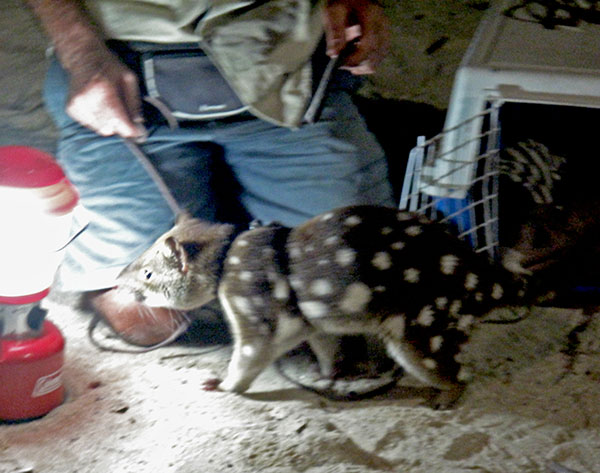

[A quoll.]

The quoll is a little bit like a cat—but not much like a cat—it has a triangular head with a prominent snout. Note that a quoll is not at all similar to the teddy-bear-like koala, even though the name sounds somewhat the same. The quoll’s fur was dark brown with big white spots, and, as we watched, the keeper fed this guy a rat, a piece of chicken, and the tip of a kangaroo tail. The quoll was all business, very self-possessed, he paid little attention to us gawkers.

For a final treat, the animal impresario produced a two-foot-long baby crocodile for us to hold and pose with (photo appears earlier in this post). The poor little guy’s mouth was taped shut. But I was happy to touch him—he was smooth and slightly warm, soft and supple. Maybe I can put a crocodile into that novel I was working on before I left—Jim and the Flims .

Farewell, antipodes!
Share

Australia # 9. Diving the Great Barrier Reef.

Monday, December 28th, 2009
Share

(I’m still finishing my series of posts about a trip my wife and I took to Australia last month. This is the second-to-last of the Australia posts.)

We made our way into downtown Cairns, returned our rental car, and hooked up with our live-aboard dive boat, the Spirit of Freedom. It’s nice and big, we have a room with a private bathroom, a double bed, and four portholes. Good stuff.


[Our boat.]

We tooled out about thirty miles to the Saxon Reef and did two dives. It turns out the Great Barrier Reef isn’t the one big monolithic thing, it’s more like a series of medium-sized reefs (like Saxon Reef) lined up along a curve that’s a couple of hundred miles long.

On Saxon Reef, we saw sharks, a turtle and some giant clams—I mean giant as in four feet across. I worship these creatures, they’re like yonic gods, embodiments of the female creative force, each of their cracks veiled by mantle bearing an elegant one-of-a-kind leopard-spot Turing pattern, and with fringed holes in the mantle displaying the clam-goddesses secret innards—disks and fringes of a creamy white.

And then we steamed all night to the vicinity of Ribbon Reef #10 (another feature of the Great Barrier Reef), maybe a hundred miles from Cairns. It was raining most of the time.


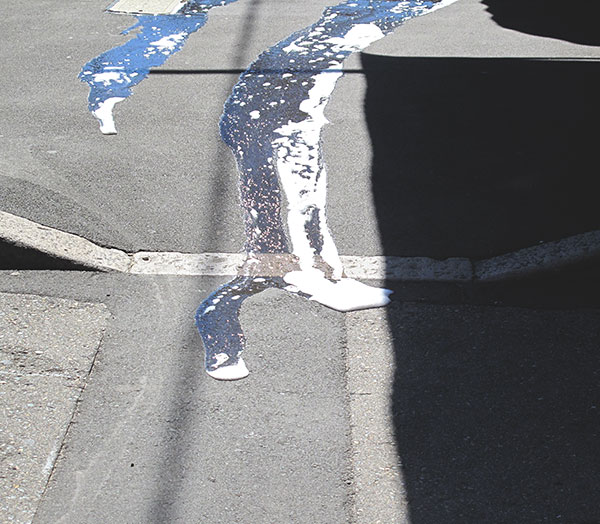
[More or less irrelevant picture of wash-up water running down a Sydney sidewalk.]

The rocking of the boat got to me over the evening, and when they set a plate of roast beef and mashed potatoes in front of me for supper, I went up to our room and filled two sickbags with puke. They told us the bags are of rice-paper, which disintegrates quickly in the water, and what we should throw them overboard after filling them. “The fish all come. For them, it’s Christmas.”

I slept badly, waking every hour on the hour like a cuckoo clock. Outside the portholes, the clouds had cleared up, and the moon was laying down a wrinkled highway of light upon the waters. The boat wallowed along, rocking us, with my stomach empty it felt okay.

I’d been anxious about diving again, it had been over two years. Sylvia was just snorkeling, and for the few dives I buddied up with a guy named Mike, about my age, and with a comparable amount of dive experience—something like sixty dives—and it worked out fine. The only difficulties were that I’m slightly stopped up, so I had to work hard at clearing my ears by pinching my nose and blowing.

There are a variety of thoughts that I usually have while diving.


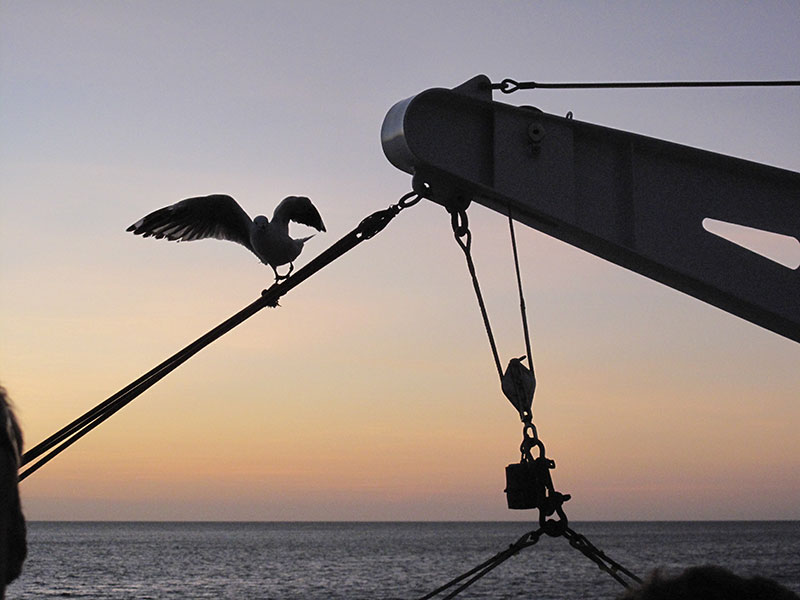
[Gull on a spar aboard the Spirit of Freedom.]

Often, at the start, I’ll be rushing, swimming fast, as if I was going to find something different around the next coral head. Really, everything is pretty much everywhere, the reefs and the undersea environment are a fractal, and if you look twice as hard at a given spot, you see three times as much.

Another common thought is, after about ten minutes, I’ll think, “Okay, I’ve seen it all, I’m done, can I get out now?” But really, you want to empty out your tank and stay in about forty minutes. So you relax and absorb more. It’s more like listening to a long symphony than like having sex. It’s not that you reach a peak and are done.

I always worry about my air supply a little bit, but over the years, I’ve gotten pretty good and stretching it out.


[Partioning the space of all possibilities.]

One of the really discombobulating things about diving is that you can’t just—stop. On land, if I really want to stare at something, I hunker down and stare for as long as I like. But in the water, I’m always drifting—propelled by currents, the motions of my limbs, and the varying buoyancy of my body as I breathe in and out. I can’t sit still. Sometimes, I do in fact make myself heavy and sit or kneel on the sandy bottom, just to have a moment of rest.

On the second morning at 7 a.m. we dived a so-called bommie, by the name of Pixie Peak. “Bommie” is from an Aboriginal word “bomara” that means underwater mountain. I’d thought I might not be up that early, but I was all too glad to leave my uneasy bed at 6:30 a.m. Pixie Peak is a ninety-foot high tower of coral, about thirty feet across, kind of a butte. We dropped down to the bottom, and wound our way up around it, our path like a barber-pole stripe.


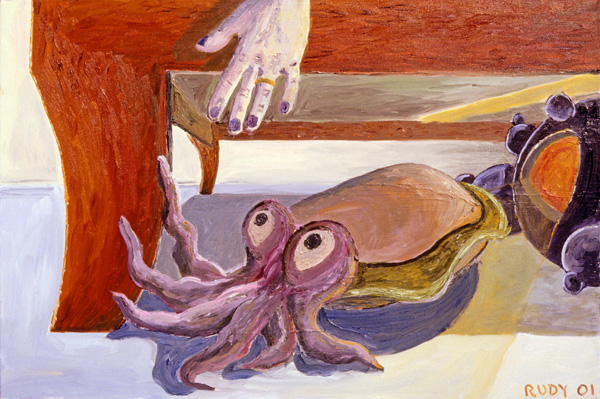
[My 2001 painting “Under My Bed” of a cuttlefish. See my paintings page for more info.]

My dive buddy and I got down to ninety feet before the others, and the first very first thing I saw was a giant cuttlefish—be still my heart. He was easily two feet long, maybe three, just like one I painted in Under the Bed as a preliminary to imagining my space-cuttlefish character Professor Bumby in Frek and the Elixir.

The cuttlefish had his facial squid-bunch of tentacles demurely gathered into a cone pointing my way. His (or her) eyes had an unfathomable expression, due to the pupils being shaped like the letter W. The hula-skirt frill-fin that circles the bulk of his body was in constant motion, easing him backwards away from me, his eldritch eyes tracking my movements. I noticed that his skin flickered very rapidly, changing its shade as rapidly as jump-cuts in a video.

Looking at some of the bright little damsel fish along the wall of the bommie, I was stuck by how really awkward they are. Their only tools for delicate maneuvers are these two little paddle fins on their sides by their gills. And at any time, random tendrils of current are canting them to one side or the other. I feel an affinity for the damsel fish—I imagine that I’m in control of my life, but really all I have are a pair of awkward paddle fins, flailing away at the sea of reality, which is so richly braided with intricate currents I can neither anticipate nor control.

I skipped the second SCUBA dive that day, at Challenger Bay (still part of the Great Barrier Reef), and took Sylvia snorkeling instead. This was in fact a really good spot for it, as the reef rose up to acres of shallows. We swam along in waters ten feet deep, feasting our eyes on the wack corals: staghorn heads filled with clans of damsel fish, shelf corals with flowery cod hiding in their shade, dozens of giant clams, thick pimply sea hares—like sea cucumbers, but bigger and creamy white with brown spots. Since Sylvia and I were doing most of our swimming with our big flipper fins, we held hands or linked arms, it was nice to be together with her, flying over this alien, jumbled paradise.

In the evening I went for a night dive—this was the first really good night dive I ever had. We came back to the same relatively shallow reef where Sylvia and I had snorkeled. Each diver had a flashlight in hand and a glowstick mounted on his or her tank. The guides had mentioned that the coral might be spawning—they usually do it a few days after the full moon in November or December, and we’d just had a full moon the other day. We did indeed find some spawning coral.


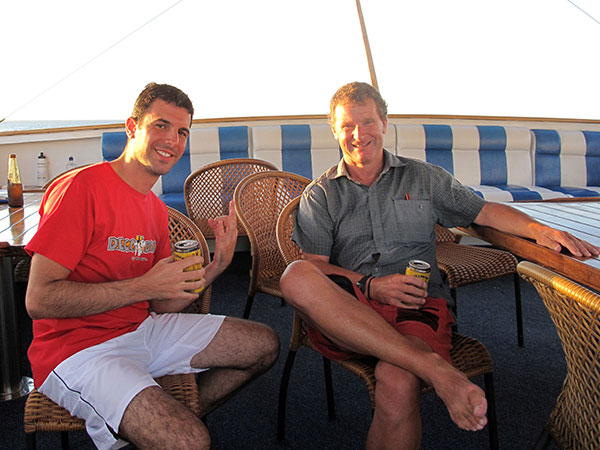
[Two of my dive buddies, Mark (left) and Mike (right).]

Keep in mind that a coral reef is a colony of individual polyps, each in its own little stony niche. When they spawn, some of the polyps send out clouds of sperm, and others push out little pink eggs the size of a BB, or a bit smaller. Worms, fairy shrimp, small fry, and sea lice crowd around the spawning reef, eating as much of the bounty as the can. Each little spot on the reef becomes a scene of great activity, reminding me of Times Square at New Years Eve, albeit on a very small scale. Some of the sea lice were nipping my scalp and my hands.

There were dozens of big trevalley fish around us, each of them two or three feet long, maybe twenty pounds—they were fascinated by our flashlight beams, and hoping to eat any smaller fish that we highlighted.

In the coral I saw bright red beads shining in the light, looking close I could see these were the eyes of tiny little red shrimp nestled in nooks. Some large purple nudibranchs (or sea slugs) were on the crawl, out to mate with each other. They were like big velvety washrags or dishtowels, with a soft pair of feelers at one end. A night of sex on the reef.


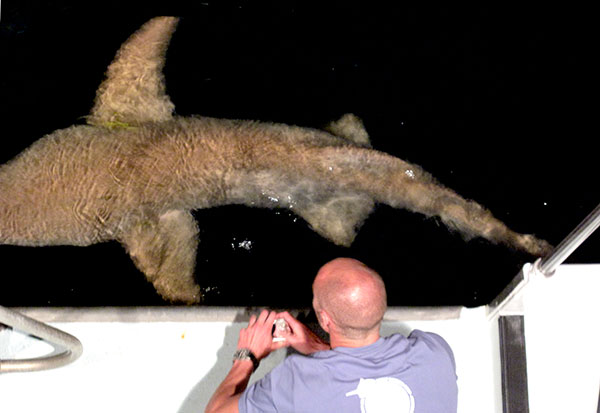
[After our dive, a nurse shark came up to the back of the boat wanting food. That's my third dive buddy, Daniel from Italy, there. He did the night dive with me.]

After the night dive we got brownies with chocolate syrup and whipped cream. There’s a sense that you can eat any amount of food if your diving. This said, I didn’t sleep very well. I got with insomnia and did yoga on the deck for awhile. It feels extraterrestrial to have all different constellations in the sky. I think I saw the Southern Cross.

We dived another cylindrical bommie-tower the next day. A great sea turtle perched on a ledge of this bommie, like an eagle in his aerie. But, unlike an eagle, he was unperturbed by seeing a dozen divers wallow by.

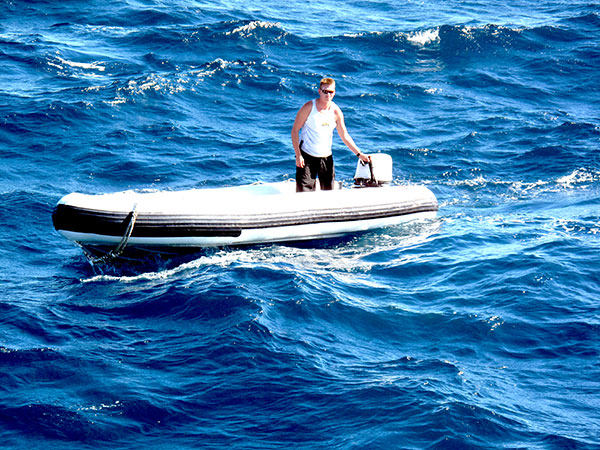
The last dive was kind of exciting, as we were trying to complete a fairly long route around three or four bommies—and we swam rather deep. I was kicking overly hard, and I ran out of air before we could finish our plan. I surfaced with my current dive buddy, a young guy called Marc, and we saw we were a couple of hundred yards from the ship. Marc still had plenty of air, so we wallowed along just under the surface. But the closer we got to the ship, the stronger the currents got. I didn’t have the strength for the last fifty yards. An inflatable lighter from the ship was buzzing around, and I got him to pick us up, which was exciting. By now the surf was so high that the lighter couldn’t really dock to the ship, we had to jump out as the waves sent the little boat hurtling by.


[Rescued from the current by a lighter.]

I did eight dives in three days, and one snorkel session. Actually I would have liked to snorkel more—I tend to see more when I’m snorkeling, and there’s less time pressure, and less of a need to stay close to your buddy.

The Great Barrier Reef is certainly better than any of the sites I’ve visited in Mexico, Hawaii, or the Turks and Caicos Islands. In general, South Pacific sites like the Great Barrier Reef have, I think, brighter fish and more interesting coral—including the so-called soft coral, which is floppy and leathery.


[A land tree with a strangler-fig growing down it.]

In terms of the South Pacific sites, I think Fiji, Tonga, Micronesia, and Palau are certainly as good or maybe even a little better than the Great Barrier Reef. I’d still have to say Palau has the best boat dives, and more awesome walls. And Fiji, Tonga, and Pohnpei have the virtue of having good snorkeling areas that you can swim to right off shore—it really takes a boat to get out to the Great Barrier Reef from the mainland of Australia.

But it was totally worth going to see the Barrier Reef, and good to be in the water again. Diving’s really pretty easy, I remembered—as I always do.

Share

Australia #8. Happy Holidays from the Queensland Jungle!

Tuesday, December 22nd, 2009
Share

Merry Christmas to all! And Season’s Greetings. And a great 2010. I’ll be taking a week or two off from posting now.

Unreal that we’ve already polished off the first decade of the 21st Century.

We flew to Cairns in Queensland on the northeast part of Australia. Keep in mind that in Australia “north” means warmer, as in “closer to the equator.” So Queensalnd’s winter is like summer in, like, Mississippi or Louisiana or even Florida in the US.

It was weird to see the (plastic) Christmas tree in Cairns, where it’s over a hundred degrees. The town’s slogan this time of year is “SumMerry Christmas!”

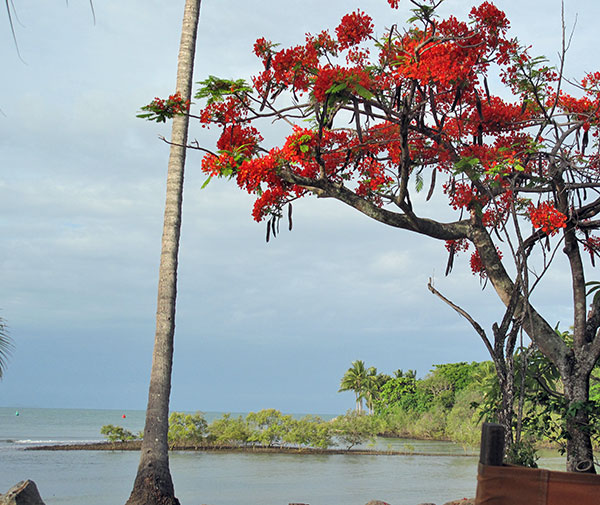
We spent two nights in a resorty spot north of town called Palm Cove. Palm Cove is a lovely spot, a little like Fiji, with palm trees, weird birds, gnarled little grape-leaf trees, islands, ibis birds yodeling in trees, and a whole different set of stars in the sky.

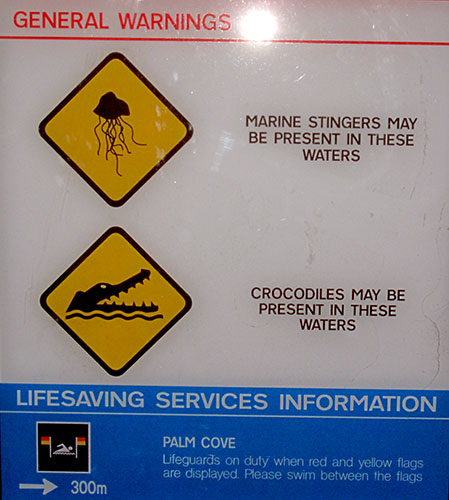
There’s these things called box jellyfish in northern Australia, the size of your head, and with twenty-foot long stinger-laden tendrils. If you get stung you might actually die. Ordinarily there aren’t many of them out in the open ocean—they spawn in the rivers and drift out from there.

Thanks to the danger of box jellies nobody swims on the beaches in Queensland between October and May—which is box jellyfish season. This is a bit awkward as it’s so hot there, totally humid, and very tropical,

We stayed in a nice clean motel-like place, right on the beach, and they do have a tiny area of the beach fenced in with underwater nets to keep out the box jellyfish—which they just call stingers for short. But the pen is very so small, and the water’s a bit muddy right at the shore, and the in any case the water’s full of tourists wearing huge floppy-brim anti-sun hats, so—eccch, naw. In any case, the motel has a nice pool. And we took a swim in the Mossman River.

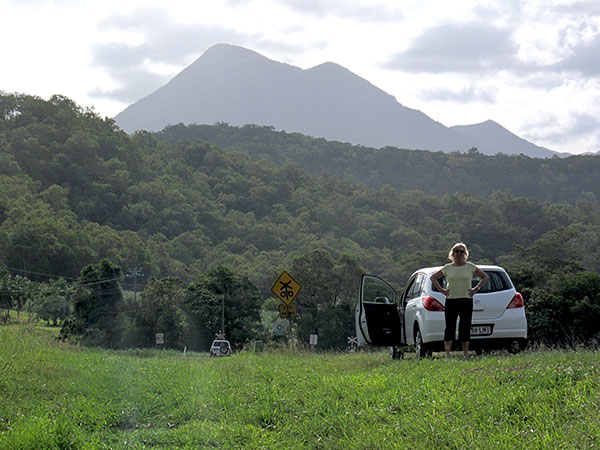
The town of Mossman is about an hour’s drive north of Palm Cove, it’s at the southern edge of the Daintree tropical rain forest. We had a rental car and we drove up there and went to the Mossman Gorge.

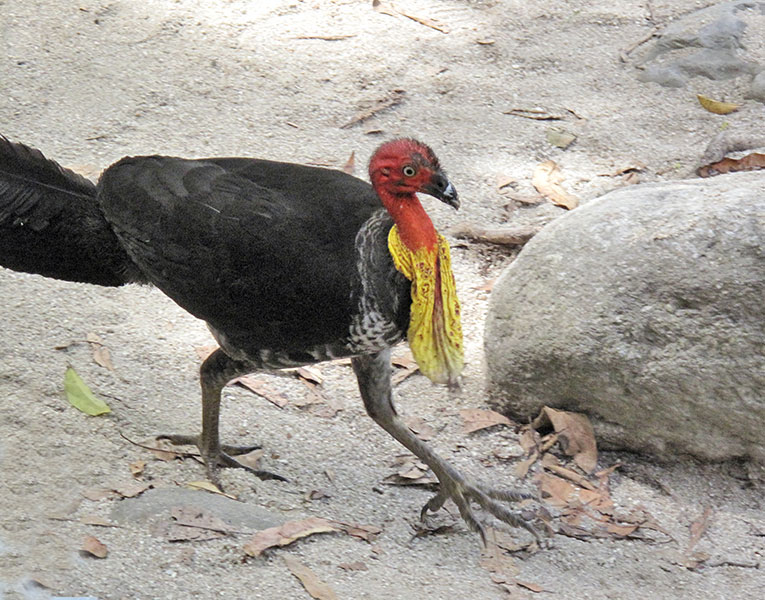
It was a little crowded with locals—it being Sunday—but we found a spot along the Mossman River that was pretty empty, with a twenty-foot deep pool, and a jumble of giant automobile-sized smooth granite boulders. And jungle on either side. And a feral “scrub chicken” wandering around.

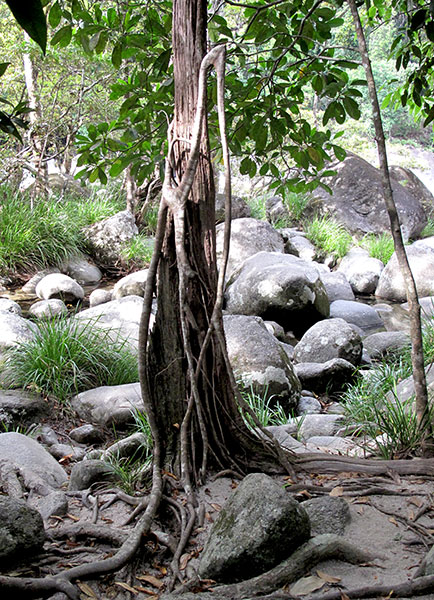
I’m talking true jungle, with vines up and down the gnarled, alien trees. Wads of fern growing in the crotches of the branches. A green parrot feather on the ground. It was great to be there and we spent a half hour in the river.

Later we stopped in at this classic outback-style Australian pub in Mossman proper, which is sugar-cane town. The pub had three people in its cavernous interior, watching a cricket game on TV. They were drunk, and excited about the cricket. The bartender, a skinny guy with a frightening stare, started telling us about the crocodiles in the Mossman River.

“Not that they’d be up where you were swimming,” said the bartender. “They don’t crawl up past the rocks, but here in town there’s some spots where the river’s very deep, with dark holes—you’d be making a mistake to swim down here. Last year a croc ate a boy and his dog.” He pressed his hands against his lean stomach, his eyes haunted.

“I ate crocodile for dinner last night,” I told him. “Getting the jump on them.”

“How was it prepared?”

“In a Malaysian curry. It was good. Firmer than I’d expected.”

“Lovely.”

After the outback bar, we went into Port Douglas, a hip-seeming town. We saw a bunch of local freaks with dreadlocks having a picnic and playing Frisbee. And we got supper in a cafe at the wharf, the tip-ass end of nowhere, the edge of the world.

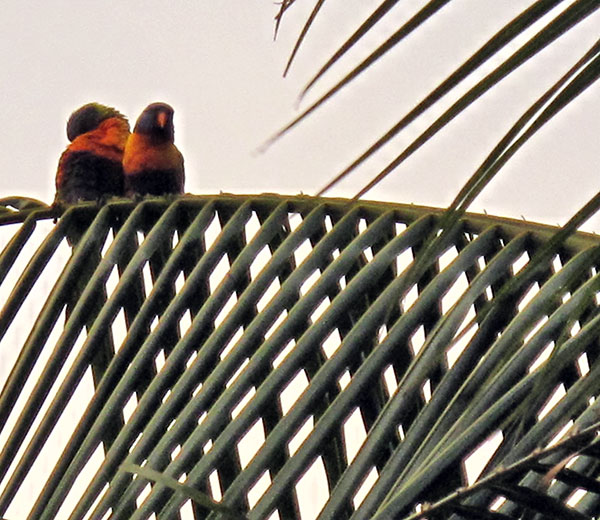
All through the meal we heard the squawking of a flock of maybe a thousand lorikeets—large birds like parrots—settling down for the evening in a grove of palms nearby.

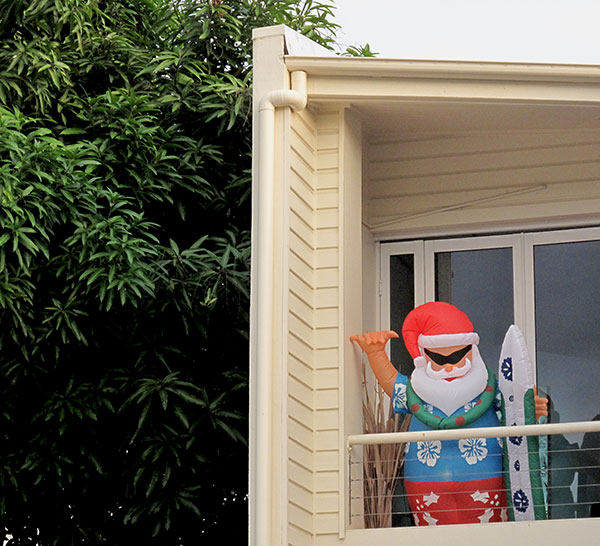
May the the inflatable surfing Santa lead you safely into the new decade!

Share

Australia #7. Sydney Swimming.

Monday, December 21st, 2009
Share

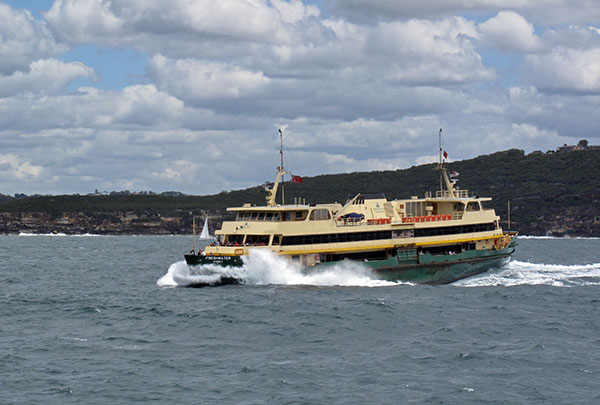
Sydney is all inside a harbor, with a mouth like the Golden Gate with steep cliffs on either side (but no bridge), and the beaches are on the outside. We took the ferry to Manly Beach to the north one day, landing on the harbor side and walking across the little isthmus to the ocean side.


[Swells rolling in from the open sea make the ferries rock and splash.]

Quite a few surfers on a beach break at Manly, and on a point break a little further out. Really big waves, coming off the Tasman Sea. Odd that the ocean has a different name here.


[Surfer at Manly Beach.]

I went swimming, and had to keep ducking under the huge breakers. We walked along the beach to a cute neighborhood called, get this, Fairy Bower. So British-sounding. Great tidepools there, and a “tide pool” of saltwater by the ocean, refilled daily by the sea, with a ladder and a little walk around it.


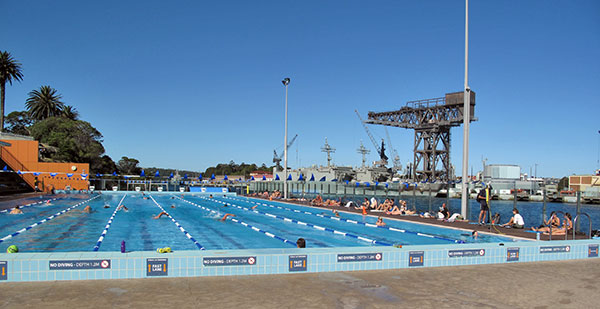
[Pool by the harbor. Note the ships nearby.]

Another day I swam in an outdoor heated saltwater pool right by the harbor in downtown Sidney, it’s beside the botanical gardens.


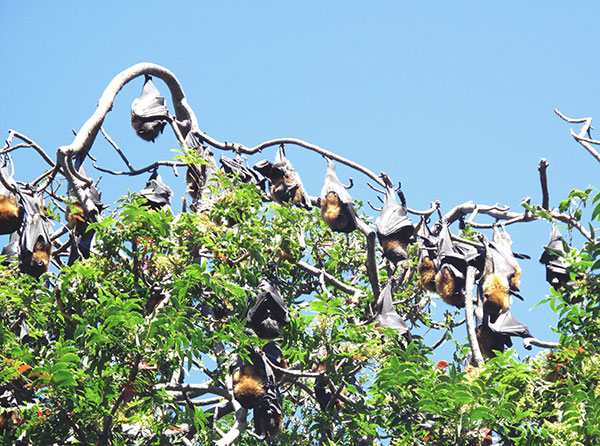
[Flying foxes dozing in the Sydney Botanical Gardens.]

After the swim, I saw giant fruit bats with five foot wingspans hanging in a lot of the botanical garden’s trees, a few of them flapping around. They’re called flying foxes. At dusk you see them circling over the harbor, on their way to go out and forage for fruit—they may fly up to twenty kilometers out from their nesting trees. The farmers don’t like the flying foxes, but they’re a protected species. They actually do a lot of good, by pollinating the trees where they feed.


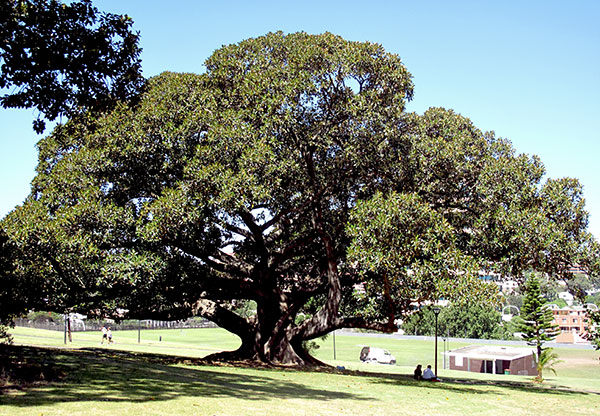
[A Moreton Bay fig tree, a wonderful, huge Australian tree you see pretty often. Moreton Bay (near Brisbane) also features a tasty crustacean called a “bug,” which is kind of like a short, wide lobster.]

On our second-to-last day in Sydney we made it to Bondi Beach, took the bus there. It has lovely sugar-fine sand, a crescent, with quite a large village bordering it, bigger than Cruz, almost like Berkeley, with quaint cottages with flowers and vines. Surfers on the waves.


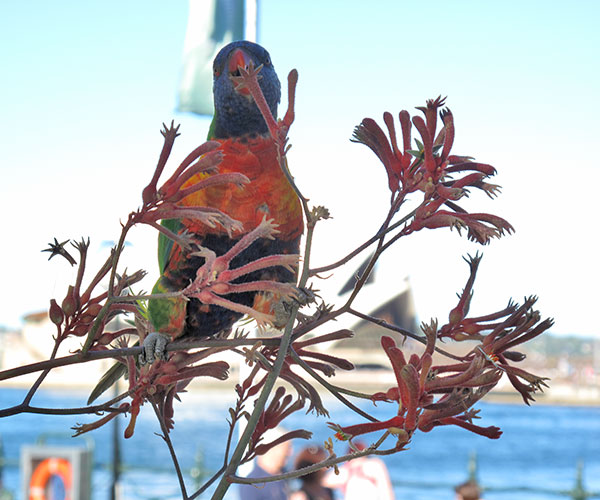
[Wild parrots and lorakeets can be found nibbling the vegetation downtown.]

The wind was very, very strong, so we didn’t stay right on the beach that long, we went over to a bluff on one side and sat by another saltwater pool, this one just a few inches higher that the ocean, built on the rocks, with waves splashing in. We saw an exceedingly tan man who was even fatter than me—I’m eating sweets every chance I get, gelato, almond croissant, profiteroles, you name it. We saw two cute young woman hop down to the beach with their boards and go in—reminding us of our daughter Isabel in her high school years.

We walked along the bluff, which was weirdly sculpted by wind and surf.


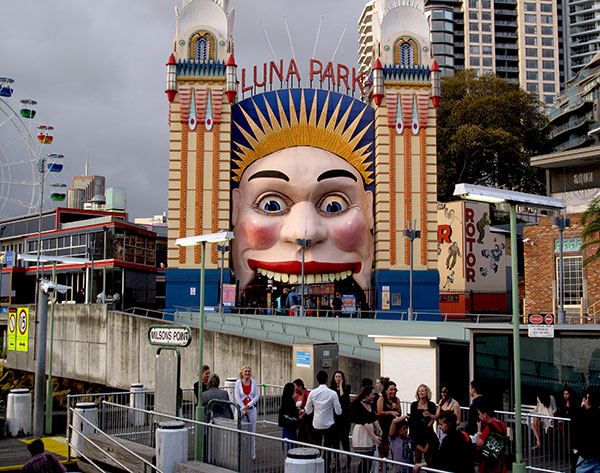
[Luna Park in Sydney.]

On our last night in Sydney, we rode the ferry around another part of the harbor, passing the funky “Luna Park” amusement park. We got some paella at a street festival, walking around very slowly on our weary legs. Right after we laid down in our room, a fireworks show started over the water. I ran back outside to see it. It’s a good life.


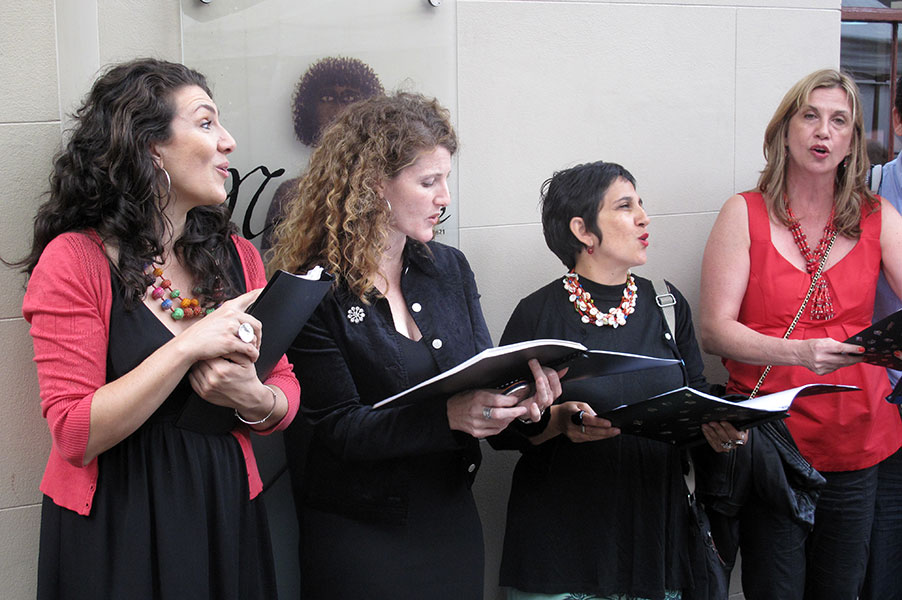
[Carollers at the Friday Night Market in the Rocks district of Sydney.]

There’s a pub downstairs called “the oldest pub in Sydney” and it’s constantly full of beefy Australians. Sometimes you even see guys wearing kilts. After we went to bed—this being Friday—they kicked out the jams, they had a guitarist and they sang, in massive beefy tearful unison, songs until midnight. Not that it kept us awake. Resting our weary trotters.

Share

Australia #6. Sydney

Saturday, December 19th, 2009
Share

The people in Melbourne kept trying to express the difference between Melbourne and Sydney. Maybe it’s like the difference between Philadelphia and New York or between San Jose and San Francisco. Not that either of these comparisions really does justice to the urban charm of Melbourne. Each city is unique.

It’s nice that Melbourne is on a slanting slope, and that it has so many old buildings—in that sense it’s a bit like Seattle, only minus the all-important factor of the ocean. In any case, I’d say that Sydney feels a little more sophisticated and happening than Melbourne—and, like San Francisco or Seattle, Sydney is on the ocean instead of on a muddy river or bay.

Speaking of my fair home city of San Jose, in a Sydney department store I saw a Chinese-made T-shirt saying, meaninglessly, “Western Conference. California. Ten Years. San Hose, Calif.” With an “H” instead of with a “J.” San Ho, yes.

We stayed in the Russell Hotel, a relatively inexpensive B&B in the Rocks district of Sydney, near a bunch of ferry slips along what’s called the Circular Quay, with the famous Sydney Opera House just a short walk along the waterfront from our room.

The Opera House is one of those rare buildings that lives up to one’s expectations. I never quite understood how it was shaped until I got to be here and walk around it. It’s roof is made of a bunch of cusps or horns or pairs of sphere-sectors. They look a little like sails or claws. Although cast from cement, the roofs are covered with white and beige tiles, so they’re pleasant to the touch—you can walk all around the outside of the building, and in many spots the roofs come down to the ground.

We had dinner—roast jewfish(!)—in a restaurant near the Opera House with a full moon rising over those Mohawk white roofs, the Sydney Bridge all lit up, tall buildings reflected in the water, and the lights of the Luna Park amusement park in the distance, it’s entrance a huge face with an open mouth. You can take a ferry to Luna Park!


[Great view of Sydney from the quay near the Opera House.]

I’d like to see a show at the Opera House—but the big halls are sold out, and the shows in the small halls aren’t so inviting, like, a one-man show of a British guy lamenting about losing his apartment of twenty years (seriously), and a show of drag queens singing Christmas carols. Not that there’s anything wrong with that…but instead we went to see Les Claypool at the Enmore Theatre, also getting to mingle with hipster Sydneysiders (they really call the natives that).


[Squirting turtle in the lovely Archibald Fountain in Hyde Park. (Thanks for the ID, Paula)]

The Enmore is an old movie theater in the Valencia-Street-like neighborhood of Newtown. A quartet: an eclectic cello, a drummer, a vibes player, and Les on various kinds of bass guitars or bass-guitar-like instruments. The musicians wore tuxedos and masks.

Les rocked, at one point the vibes player switched to drums and did a dual drum solo with the main drummer, incredible, like a conversation, and near the end, Les came back onstage, dressed up in an ape suit and playing a one-string instrument by whacking it. The lights were beautiful colored cones, filled with stage fog.


[Random scraps of ornamental stone from an old building, arranged at the edge of the botanical gardgen in Sydney.]

It was good to see the grungers at the concert and in the neighborhood. We overheard a woman on six-inch platform boots telling a friend, “I’m angry at everyone all the time.” I saw a guy in a T-shirt saying “Dag Nasty” with a picture of a sheep’s butt (remember that a “dag” is a sheep’s dingleberry).


[Lots of didgireedoo players on the Circular Quay, a great sound all day.]

In the train back from Newtown we sat near a weathered Aussie couple, drinking a half-pint of gin, the woman maundering on and on, the two of them somewhat fitter-looking than their US counterparts. Looking out the train window I saw an excavating machine at work beneath an underpass, one of those jointed arms with claws, and had the sudden feeling of being on another planet.


[The Sydney Tower.]

The next day I happened to start talking to another American in downtown Sydney, a guy called Mike, with tattoos on both arms. He said he came from New Orleans, and that he was in Australia as a musician, with some gigs, moving from town to town. “You’re playing with Les?” I said, as a long-shot.

And, yes, he turned out to be the vibes player for Les Claypool’s band. He was a little surprised that I’d seen him playing the night before, but maybe not as surprised as I was. For me, it felt like meeting a mythic shaman or a cartoon character. He seemed glad to talk to me. They’re playing the Fillmore in San Francisco on New Years Eve, as they’ve often done before.


[An artist who's currently calling himself Tatuz Nishi made a site-specific work by building little houses around two large sculptures of men on horses in front of the Gallery of New South Wales.]

I’m feeling some literary inspiration for my writing from the input here. The platypus beak, the fake-autobiographical novel True History of Ned Kelly, the Les Claypool band concert, and the Aboriginal art.


[Okay, I took a LOT of pictures of the opera. The ferries are cool, we rode them a lot.]

Share

Australia #5. Oz Slang, More Art, Oz SF

Thursday, December 17th, 2009
Share

Leon and Yolande taught us some Australian slang, and we also learned some from our old Melbourne friends Robert and Margaret Mrongovius, who had us over for dinner at their house. They lived in the neighboring apartment when we were in the University Guest House for a year in Heidelberg in 1979, thirty years ago.


[Reading room in the Melbourne main library, where we went to do our email for free.]

Here are some tidbits I gleaned from the locals.

A buff jock type guy with short hair drinking beer with his friends is “boofy” or a “boofhead.” A redneck is a “bogan” or a “westie.”

A nap is a “kip.” Food you find in the woods is “bush tucker.”


[A quaint corner of Williamsport, near Melbourne.]

A group of kangaroos is called a “mob of roos”?

A “dag” is a clot of crap on the wool near a sheep’s butt, so “daggy” means “gross or gnarly.” Yet sometimes, “dag” will be used fondly, like “nut”, as in “You are a dag.” I mentioned this to Leon, and it turns out he used to date a woman who’d say that to him, “You are a dag,” and it annoyed him. So of course I started saying to him, and even loudly declaring on the Melbourne night sidewalks, “I am a dag!”

“Shonky,” means sleazy, shoddy, sneaky.

Cockney rhyming slang is used here. “Have a butcher” means “Have a look,” as look rhymes with the hook in butcher’s hook. A “porky” is a “lie,” as lie rhymes with the pie in pork pie.

For more, see the Australian dictionary of slang.

We visited young Alice Mrongovius—the daughter of our old Heidelberg friends—we last saw her thirty years ago, when she was two or three. She’s just gotten an art degree from the Victorian College of the Arts (VCA), and is paying the bills with a job as a barista in a cafe. She’s very cute and lively, a cartoonist, with work at her site, www.banditfox.com. She and her sister Martina have done several comic books together.


[Tower of the Contemporary Art Museum in Melbourne.]

Yesterday, Sylvia and I actually looked through a group show by Alice’s graduating art class at the VCA, which happened to be near the building where I gave my talk. Alice was showing some drawings and a pair of milk cartons with slip covers.

Not many of the young people seem to be into painting—it’s mostly photos, videos, collages, or assemblages. Maybe painting is too hard, too slow, too much trouble. Another factor is that it’s easier to tell at a glance if a painting isn’t very good. If someone puts a pile of dirt on the floor, then it’s not so clear if this is worse than or better than the other piles of dirt on the floor that one has seen in museums and art galleries. With a pile of dirt, the artist is less exposed.

Speaking of dirt, there was one dashed-off work in the show that was kind of witty, it was a cheap oriental-patterned rug with a lumpy surface—the lumps are the result, the viewer slowly realizes, of a great deal of random paper trash having been hidden under the rug. The work, by Ilie Rosli is called “Swept Under.”

Another assemblage that I liked was a pair of doors connected by an accordion-like corridor—“Limbo” by Carmen Reid.

Today we hit the botanical gardens—I saw some unfamiliar Australian trees like the banyan-like Moreton Bay Fig and the Ridge Myrtle with its ridged bark. We had a bland British lunch at the public tea garden there, with mynah birds fighting over the scraps.

And on the way back, we happened upon the Malthouse Theater, a modern complex that was showing, among other things, an hour-long modern dance performance: “Structure and Sadness” by Lucy Guerin.


[The West Gate freeway bridge near Melbourne.]

“Structure and Sadness” is a great piece. Unlike most contemporary ballets, it’s about a specific historical event, to wit, the collapse, during construction, of a part of the West Gate freeway bridge over the Yarra River near Melbourne in 1970. The six dancers acted out abstract notions of stresses and force vectors, while building a very large house-of-cards bridge-span which collapses near the end of the performance. While listening to Joan Jett singing “Crimson and Clover,” a woman learns that her husband, a bridge construction worker, has died. At the very end, four of the dancers lie down under a metal plank—another lies down to one side, and the final dancer walks over the plank into the darkness. Using the bridge. This could come across as being over-literal, but it was done with great subtlety. It’s an interesting mixing of levels, and beautiful dance.


[Marker in the Yarra River near Melbourne.]

I’ve also been reading the Australian writer Peter Carey’s 2001 historical novel, True History of the Kelly Gang, written as if by the Australian outlaw—or “bushranger”—Ned Kelly (1854-1880). It’s a wonderful book, written in dialect, as if transcribed from papers that Ned left behind.

What inspired me to read this book was that we saw Ned Kelly’s armor on display at the Victoria State Library—Ned had it made from quarter-inch-thick steel for his final showdown with the cops, or “traps,” as he calls them. We go to this huge old stone library nearly every day to check our email and cruise the web—it’s always soothing, on a trip, to get back into the familiar bath of your online personality.


[A “time-ball” signal in Williamsport, near Melbourne.]

We went to an SF-related party on our last day in Melbourne, which was great fun. It was nice to meet some more SF people—the encyclopedist Peter Nicholls was there, as was the expatriate American (now Australian) SF novelist and anthologist Jack Dann. Both of them were really enjoyable people. Finally I was talking to some locals who’d heard of me!


[One more picture of the cool building in Federation Square.]

The party was at the house of Jenny and Russell Blackford, stalwart members of the Melbourne science-fiction scene—for a time they helped edit and publish a zine, Australian Science Fiction Review, which included SF essays and (often) squabbling letters in the back. They’d heard of my visit through Damien Broderick, the once-Melburnian SF writer who’s now working in Austin, Texas. I got to know Damien a few years ago when he was writing his non-fiction book, Transrealist Fiction—a study of the realistic-SF genre that I myself named.

Share

Australia #4: Lord Casey and my Talks

Wednesday, December 16th, 2009
Share

We settled into the Casey House in Melbourne. It was an elegant 1864 townhouse near Fitzroy Park, owned by an 80-year-old woman who lives in Sydney, in another of her properties. This place was originally built by an eminent Melbourne painter, and passed into the hands of Lord Richard Casey (1890-1976).


[Spooky front hall.]

He was born rich, and active in Australia politics—in the 1960s he was the Governor-General, that is the representative of the Queen of England. The present owner is Lord Casey’s daughter. She hasn’t removed the family furniture, books, art, and knickknacks.


[Lord Casey’s shaving mirror.]

The property manager is instructed to rent the rooms only to artists, on a short-term basis. Leon’s partner Yolande knew an artist who’d roomed here, and she had the idea of getting us in. The rent is only about $70 per night. It’s very cool to be living here, it’s like being in an old movie. I have a great shaving mirror.

The bedroom doors don’t lock, and in the bedroom next door is a who’s here for the same conference on media art that I’ve come for. It’s like being in a grad school dorm.


[Lord Casey’s lighter and a “Kanga Crew” pin from an airline.]

The cupboard in our room has a shelf filled with various personal possessions of Lord Casey. And ivory handled hairbrush, a case with small mustache brushes, a silver egg cup, a marvelously intricate brass cigarette lighter with green lizard hide wrapped around it. I’m half-tempted to take a souvenir, but I feel it would be too risky to taunt the spirits of the dead. The house does have a haunted feel.


[Icon-like stove in the old kitchen.]

I can see using this place in my novel-in-progress, Jim and the Flims. I want to put in a scene where Jim’s not-really-a-friend Skeeves finds the golden sarcophagus of Amenhotep I with the bodies of Weena and Charles inside it. I figure the sarcophagus could be on the locked third floor of the Casey house, in an abandoned painting studio, beneath a skylight, it’s polished surfaced reflecting the slow play of the sky.

I had three talks scheduled in Melbourne, each one different.

The first two talks were at the Burwood campus of Deakin University in Melbourne, and the third was with Leon Marvell at the “Re:Live” conference on Media Art at the Victorian College for the Arts.

Talk 1: “My Life as a Writer”. I was more than prepared for this one, having just finished my third draft of my autobiography, formerly called Nested Scrolls and currently entitled Rudy the Elder.

Talk 2: “Life is a Gnarly Computation,” was a talk I’ve given before. I connected with a fractal artist fan of mine online who lives in Melbourne, Mark Townsend, and he met me to ride out to the talk with me. He worked on a fractal flames program called Apophysis, based on another fractal program by yet another friend of mine, Scott Draves, who used to hang around San Francisco doing shows, he called himself Spot. The worldwide network of SFictional computer pioneers!

Talk 3: My conference talk with Leon, called, “Lifebox Immortality … and How We Got There.” I spoke extemporaneously and Leon read a paper aloud. We had two Q&A sessions, one after each of our talks, it was good. Leon’s talk had a passionate, mystical tone. I should also mention the Melbourne SF fan, Tony..who came to all three of my talks. Good on ya, Tony!


[Old board game in Lord Casey’s house.]

I got a couple of SF ideas while answering the questions at the Lifebox presentation. Like, what if your lifebox becomes so good at emulating you that it starts getting hired for your speaking gigs instead of you? And what if your lifebox becomes corrupted, seeming to reveal unsavory (and heretofore unknown-to-you) details about your life. And then maybe there’s a blowback effect whereby you in fact begin making those nasty aspects of your re-edited life come true.


[Pro-life demonstrators outside a Melbourne fertility clinic.]

Sylvia pointed out that a lifebox would be more engaging if it remembered the individual interlocutors. This would be feasible—the lifebox could create mini-lifebox models of the people it talks to, remembering their interests, perhaps interviewing them a bit, and never accidentally telling the same story twice—unless prompted to.


[Pro-choice demonstrators on the other side of the street, outside the same Melbourne fertility clinic.]

By the way, I don’t think it would be that hard to train a computer program to act as a reasonably good interviewer. It could start with data on the interviewee, and mine a list of topics. As the interview progressed, the agent could hark back to things that had been mentioned, or create questions pairing together things that had been mentioned. Now and then the interview agent could throw in a somewhat random or even dadaistic question. As often as I’ve been interviewed, I well know that the interviewers often don’t bring much intelligence to bear upon their questions.

Share

Rudy’s Blog is powered by WordPress