




Rudy’s Blog

Buy Rudy's books! Click covers for info.                 Blog text and images copyright (C) Rudy Rucker 2012.


Archive for July, 2009

What is a Soul?

Thursday, July 16th, 2009
Share

Recently I’ve been blogging about a trip I took to Denmark and Norway. Today I’ll still be using some pictures from that trip, but today’s subject is going to be something different. I’ve been thinking about science-fictional ways to provide for an afterlife in my novel-in-progress, Jim and the Flims. I thought about it quite a bit, and it was useful to read the “Eschatology” entry in the second edition of Clute and Nicholls, The Encyclopedia of Science Fiction .

My question today is simple. What is a soul? I’ll describe seven possible answers, with the last one, the lifeworm answer, being the one I plan to use in my novel. Feel free to comment with your own ideas!

(1) Christianity can be said to use souls as a way to punish or reward people later on. The irreligious view this as a carrot-and-stick set-up that’s used as a scam along the lines of, “Pay me now, and you’ll get your reward in heaven.” I myself wouldn’t go this far, as I have generally positive feelings about religion. But, in any case, given that I’m writing a commercial SF novel, I prefer to focus on the more science-fictional explanations for the soul.

(2) In Hinduism, reincarnation is a way that souls recycle life-energy, with the idea that beings can become more enlightened with successive passes through life. Eventually a given soul may get everything right, break free of the cycle and return to the source. I see this process as being a little like finishing a videogame—where you get to start over each time you goof and get killed.

(3) Philip Jose Farmer’s Riverworld series uses an alien-related reincarnation idea. Some aliens have developed an ability to generate free-floating souls (called “wathans”) which can be attached to certain living beings. The wathans can be caught when their host being dies, and they can be “resurrected” by attaching them to further beings.

Moving on, let’s consider four software-based scenarios. That is, we’ll suppose that our bodies, minds, and lives are somehow encoded as patterns of information, and that this software can generate copies of us after we die. How might this work?

(4) We might think of reanimators who are in effect gathering the software of specimens in our world. Come to think of it, I’ve already written a book using this approach, none other than my second novel, Software—in which the reanimators are intelligent robots that the humans built. In a variation on this theme, the reanimators are supernal aliens. But I definitely don’t want to use higher beings with magical-seeming powers. Resorting to aliens only kicks the real questions upstairs.

(5) In a religious version of reanimation, which is called soul sleep, God remembers you after you die, and then resurrects you in a material body at some future time. Adherents of this belief draw support from the following passage in the Gospel of Luke, where the so-called good thief speaks to Christ: “ ‘Jesus, remember me when you come into your kingdom.’ He replied to him, ‘Amen, I say to you, today you will be with me in Paradise.’ ”

(6) In the digital virtual reality approach, we suppose that we’re all living in a huge simulation in a giant box of a computer, in which case we’re all software patterns in the first place, and our bodies were really just some associated graphics and animation routines. This scenario has been pounded into the ground by the trilogy of Matrix movies.

I don’t like the digital virtual reality approach as it disrespects the rich analog reality of the physical world. Another downside is that the digital virtual reality scenario usually invokes an incredibly wise, boring and pompous Chief Programmer who stands outside the simulation—and, as with alien reanimators, this shifts the interesting questions up a level. I want my soul to be right here staring me in the face, just as I am. Like my skin. I don’t want my soul to be under the control of some bearded British-accented guy in a white suit—like in The Matrix Revolutions.

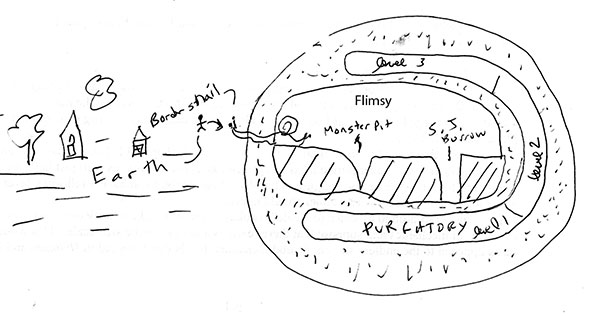
(7) In Jim and the Flims, I plan to use what I’ll call a lifeworm approach. I’ll use the word “lifeworm” to refer to the quantum computation embodied by my entire life: a complete record of information about my body, mind and actions. I’ll suppose that lifeworms are permanent and can’t really disappear. I’m thinking of there being a two-way street between objects and their lifeworms. The object generates the lifeworm, yes, but, the lifeworm can serve as a template for a copy of the object.

The soul-as-software concept feels fresher if we think in terms of quantum computation instead of in terms of chip-based digital computation. Ordinary matter is carrying out quantum computations all the time—so we don’t need to imagine that there is a different level of hardware to carry out the computations underlying our phenomenal reality. Our phenomenal reality is the computer. Note also that we can be quantum computations of matter without having to invoke any external programmers—the process is emergent, intrinsic, self-generating. My soul-software is just something that evolved. Finally, note that it’s scientifically reasonable to suppose that the quantum-computational software inherent in a lifeworm can generate a clone of the original being.

To make this funky and science-fictional, I’ll say that lifeworms aren’t mere abstractions. They’re physical objects made of kessence, which is a type of highly subtle aether, akin to dark energy. The lifeworms are a bit like shadows, or like the air currents in the wake of a flying bird, or like the turbulent eddies trailing behind a swimming fish, or like spacetime trails, or like the tube of skin that a snake sheds. More precisely, a lifeworm is like some rubbery shellac that adheres to a being’s spacetime trail. You might think of the lifeworm as the mold you’d get if you were to pour latex into the hollowed-out negative cast of a sculpture.

When a being dies, a lifeworm made of kessence appears. The lifeworm had lined the spacetime trail of this individual. And now, as the head of the trail dissolves with the individual’s death, the lifeworm can crawl out—like a snake emerging from a burrow. The burrow was the individual’s life.

A kessence lifeworm without a material body is like a loose string (in the sense of string theory), and it tends to shrink to a very small size, dropping down to the Planck scale, the smallest quantum level—and that’s where the afterworld is, in the subdimensional zone that underlies ordinary reality. “The Kingdom of Heaven is within you”…literally!

Share

Norway 3. Balestrand, Norway. Dreamscape.

Wednesday, July 15th, 2009
Share

[ The following is another installment from my travel journals, written during a recent trip to Norway.]

June 26-27. 2009.

This morning we took a boat from Flåm to Balestrand, a slightly larger resort spot. The boat left at 6 a.m., but, in a way, this didn’t feel that early, as by then the sun had been up for hours and hours.

Riding the boat up the Sognefjord, I was sitting in a plastic chair on the back deck, still sleepy, and I closed my eyes to rest. I became aware of all the air currents around me—flapping my trouser legs, waving my several tufts of hair, buffeting my cheek, the whole atmosphere alive with currents and waves, the ocean of air all around me.

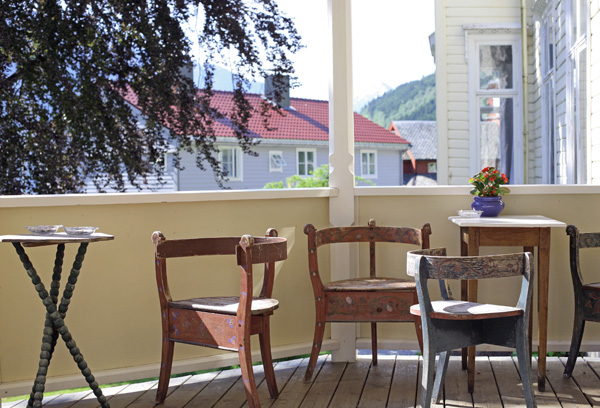
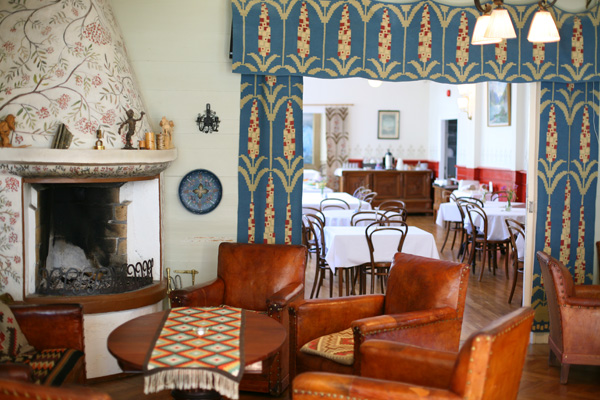
Now it’s about 9 a.m. We’re on the front porch of Kviknes Hotel, a grand old place, all wood, with endless lobbies and parlors full of vintage furniture and Norwegian impressionist paintings. Wood floors and ceilings. No cruise boats here, the nearest highway is hidden in a tunnel under the mountain behind the town, it’s utterly still.

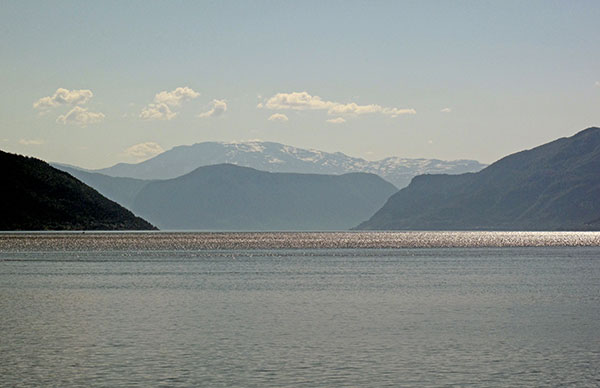
The mountains across the fjord stand in layers, like a theater’s curtains, framing the onward path.


[Click the panoramic image of the view in photos and drawing at Balestrand to see a bigger version.]

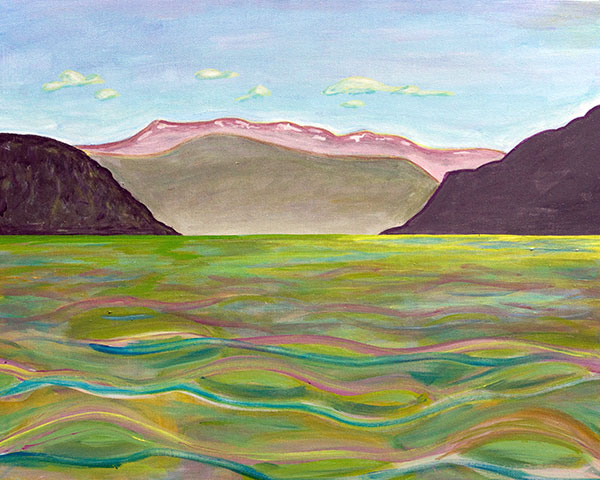
A panoramic view of this might be easier to paint than to photograph. I’d love to have my paint kit here. Well, I’ll make a sketch. David Hockney took his watercolor kit to Norway, I just remembered, and there’s some nice fjord images in his book (and website), Hockney’s Pictures .

I can hardly believe we made it here. Living the dream.

It’s the next day, 7:40 a.m., I’m sitting on our balcony at Kviknes Hotel. As I mentioned, painters came here in the late 1800s, and a lot of their pictures are in the hotel lobbies.

There’s one mountain in particular near the hotel which appears very often. A dumpling of a mountain, a pudding with a curly top. I’m looking at it right now.

I bought a cheap bathing suit at the COOP supermarket and went swimming for a fairly long time off the steps in front of the hotel, the fjord is wide here, and much warmer than at Gudvangen. My bathing garb is one of those nasty tight little suits that you see on old men in Europe. It’s always great to be in the living water. It tastes only slightly salty, due to all the streams flowing into what is, by rights, a 150 mile long estuary of the sea. Brackish.

For the last two nights we’ve had these enormous hotel buffet dinners with, like, two dozen kinds of cured fish and dried meat as appetizers, not to mention the hot roasted or friend meats and fish—and the formidable array of puddings. Everything is yummy, but it’s binge eating—you feel stunned when you’re done. I guess this is how you eat on a cruise ship. Indeed, the Kviknes dining room feels like a ship, we sit by the window with the fjord twenty feet below.

Very quiet in this town. Two or three seagulls circle nearby squawking, just as they’ve squawked for thousands of years. Nice to think I’m hearing the same sounds as the ancients. Nobody analyzes a seagull squawk, and I don’t suppose the bird premeditates it.

“Squawk.” The critic: “But what does this squawk mean?”


[This is how the Kviknes Hotel looks from the back...at midnight. It’s never really dark at all.]

It’s good being on vacation, away from my usual concerns about my writing career. My attention is either in the ongoing Now or in the What Next, that is, in the plans for our free-form itinerary—boat to Fjaerland tomorrow, then bus to Hellesylt, boat to Geiranger and boat to Ålesund.

We’re running out of days—we’ve spent ten nights in Scandinavia, with six more to come. Precious treasure, these slow days. Each vacation day dilates, filled with new sights and experiences. At home, a week can go by before I’ve noticed. “What? It’s Sunday again?” Or even a year: “I can’t believe it’s time for Christmas.”

My left hip is hurting a lot—it’s wise to walk slowly and sit down a lot and take elevators when I can. Last year a doctor said my hip joint is deteriorating and eventually I might have it replaced. Maybe next spring? I’ll try taking the debatably efficacious glucosamine supplement pills first. In any case, the hip hurts somewhat all the time, and more if I walk all day. So I don’t feel as able to go on long hikes or on scrambles up the mountains—like I used to do. We rented a canoe yesterday, and I’ve been biking.

But today we went for it and managed a three mile walk—lovely to be up in those trees and meadows with the village and the fjord below.

On the way back from our hike, Sylvia and I happened to be walking by the tiny Balestrand harbor just at the right time to see a new ship, Stril Challenger, being christened—funny that we use so liturgical a word in this context. Apparently the ship belongs to the Havyard company, an oil-drilling outfit, and is designed for emplacing anchors for the immense off-shore oil-rigs of Norway.


[Mannequin in folk garb.]

The high-school brass band played a few numbers, including the Norwegian national anthem and Happy Birthday—the musician kids all pale-skinned blondes and redheads. An official made a short speech, a woman in a Norwegian folk dress broke a bottle of champagne against the hull, and we joined a stream of locals filing up the gangplank to look around the huge Stril Challenger. And then the ship took off for a little cruise across the fjord and back, although Sylvia and I had gotten off by then—I was unsure about how long the cruise might be.

Later, after the passengers came back, we watched as the ship cavorted around the fjord, with smaller launches buzzing around it—I think of the word, “lighter,” used to mean a smaller boat that you use to unload a barge. I like that ships use smaller boats as extensions of themselves. Imagine still smaller shuttle pods emerging from the lighters. A fractal regress of ships.

This set me to thinking about a starship launch ceremony. I imagined a great mothership ship with smaller ships circling it—the lighters. And one of the lighters darts down to a boy’s house, the lighter appears in the room of our young hero, Gunnar, to take him on a trip. As the lighter carries him off, Gunnar cries out for some precious object that he forgot—and a lower-level lighter the size of a basketball goes back to his room to scoop up the pet soft plastic robot that Gunnar calls a “shoon.”


[Sunrise at 1 a.m.]

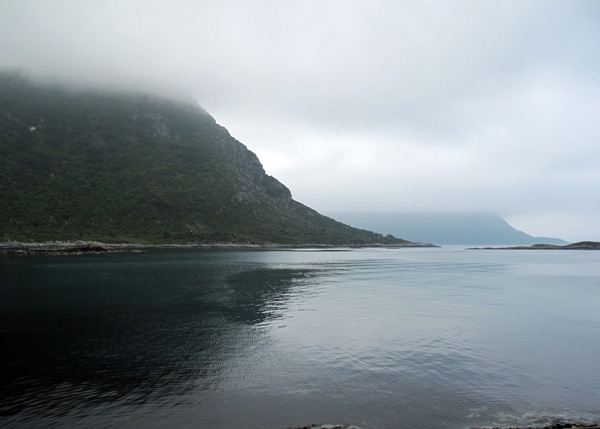
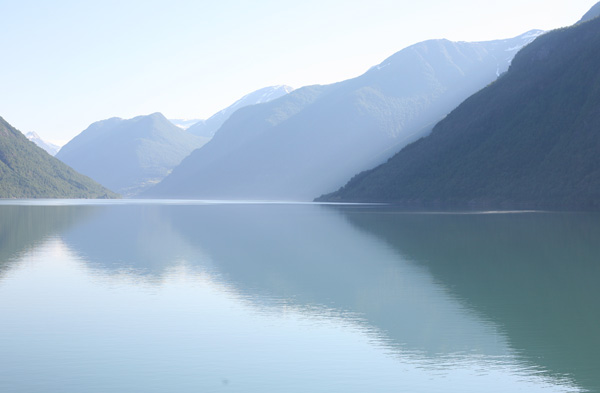
Sitting by the fjord at the edge of the grand hotel’s green lawn. I could stay here for months. It feels like the afterlife, like heaven. The air is slightly hazy, drenched in light. The flat water, the mountain ranges doubled as reflections. We’re so lucky to be here

Share

Norway 2. Flåm. Biking. The Narrow Fjord.

Tuesday, July 14th, 2009
Share

June 24-25, 2009.

Today we rode the train to Flåm—you say that funny letter like “oh”. On the ride down into the valley we passed an immense waterfall. The train stopped and a woman appeared, dancing in the distance with wavy arms, the troll-woman of the falls, I guess.

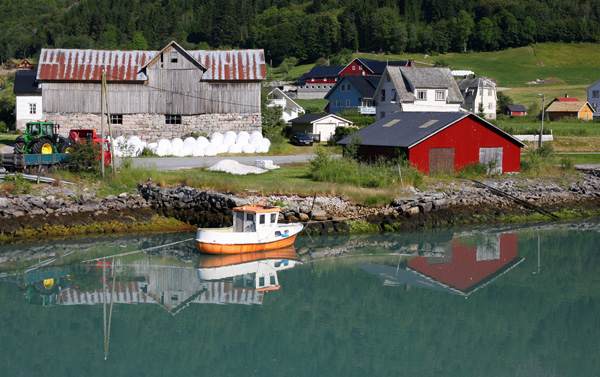
The hotels were full, but we found a stark room at the Heimly Pension, every surface covered by linoleum, a kind B&B with boarding-house food, but with an exhilarating view of the tip-ass end of the fjord. Great steep wooded cliffs plunge down into the blue-green water.

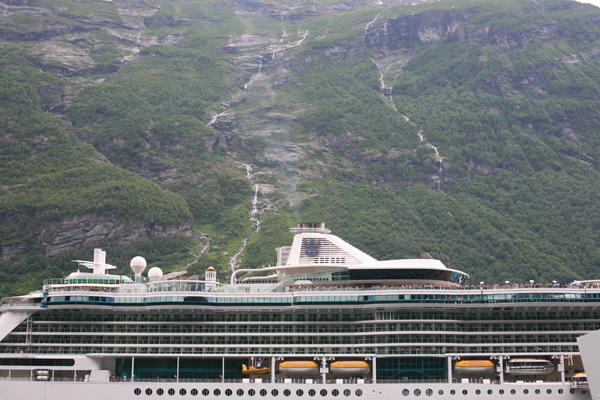
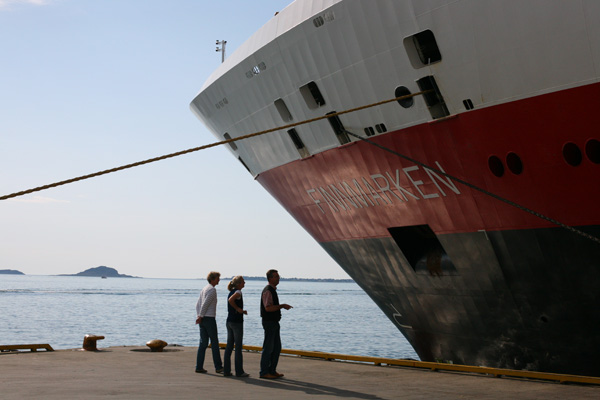
There was a cruise ship the size of a really large hotel docked here, blocking the view, roaring like an idling bus, spewing a steady plume of diesel smoke—but just now he honked for his scattered passengers and lumbered off. Sweet silence.

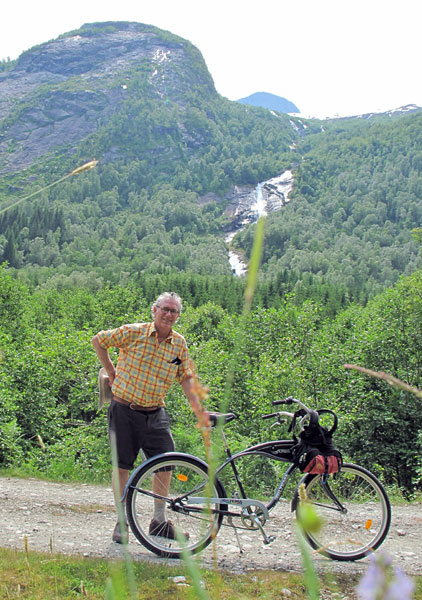
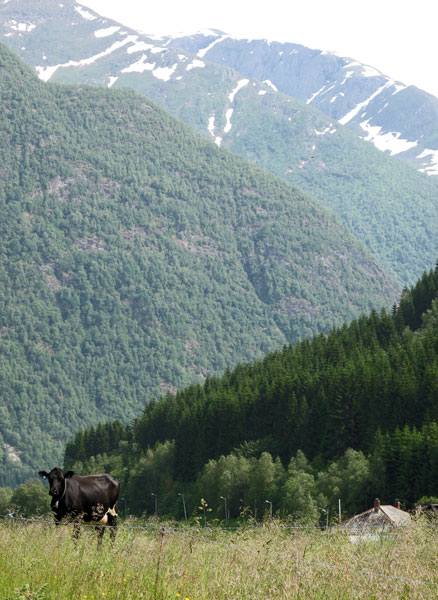
The next day I rented a bike and rode up into the valley, getting deep into the countryside—it was just what I wanted to see, tiny roads with farms and weird Nordic cattle, some sheep.

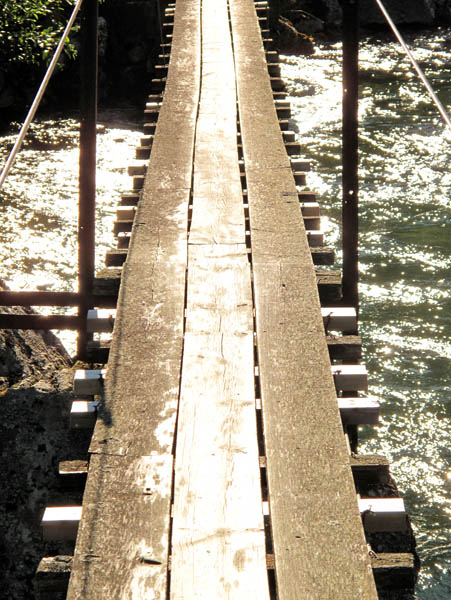
A wild river with rocks that had walking platforms.

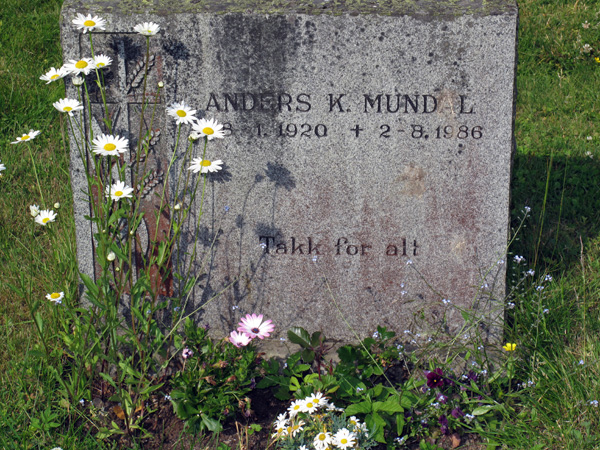
A tiny church with a fresh grave for a woman with a surname the same as the village: Flåm.

In the afternoon we took a cruise up into an even narrower branch of the fjord called Naerøyfjord—leading to a spot called Gudvangen. The narrower fjords have steeper walls—in one spot we passed a sheer mass of stone that was 1800 meters tall. It’s hard really to grasp how big something like that is, in the clear air, your eyes can’t quite assess it. Sometimes we’d see a single mad farmhouse teetering on a brink—or a lone hiker, and the scene would snap into its gargantuan scale.

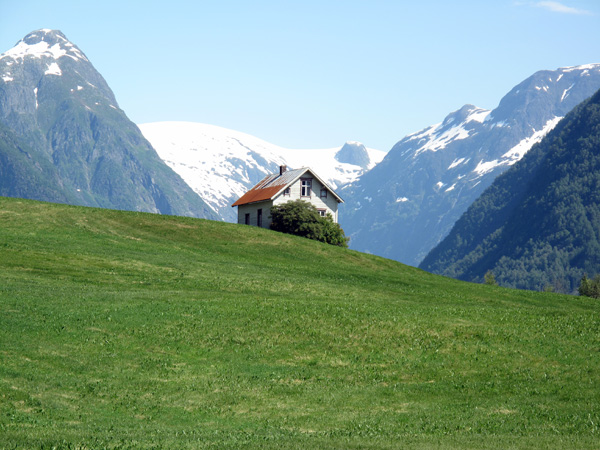
In most spots the fjord walls are at least partially wooded. Up above them is an undulating highland of gray-brown mountains, patchy with snow even now in midsummer. It’s like Norway has only two elevations: sea level and 1 km high, with a labyrinth of steep cliffs connecting the two.

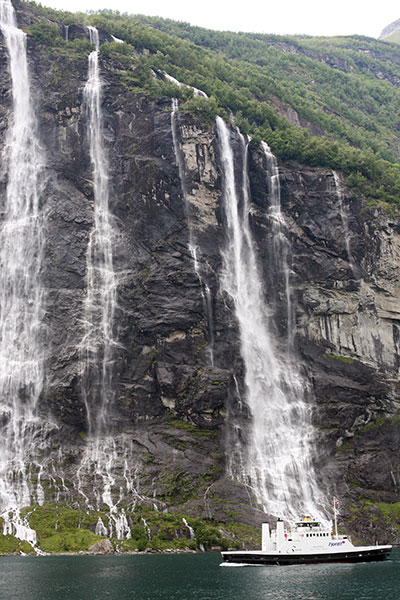
The water from the melting snow gushes down the cliffs in streams that fall in cataracts, bedizening the precipice with white skeins, some of them free-falling for a hundred meters. One waterfall was striking a slanted rock with such force that a steady geyser shot up at the base—an upwards waterfall.

We rode on a huge boat, a big steel car-ferry, with gratifyingly few passengers. We saw some smaller boats that were packed like sardines—chartered by the big cruise ships, I guess.

In Gudvangen there was a tourist restaurant with a funny sculpture of a troll—seems like the trolls always have long dick-like noses. Guys were riding a helicopter up to the tops of the fjord cliffs and hang-gliding down. People are always looking for a chance to run an internal combustion engine.

Sylvia and I went for a hike. It was an unseasonably hot day—we’re very lucky with the weather—and near the end I jumped naked into the fjord, not far from where a glacial waterfall was falling in. It was so cold that the instant I hit the water I was scrambling to get out—moving fast before my limbs seized up and I sank to the bottom of the kilometer-deep gulf.

Share

Two New Podcasts of My Readings

Monday, July 13th, 2009
Share

This weekend I taped a couple of performances. Charlie Jane Anders introduced me for a short reading at her monthly live show, Writers With Drinks, at the Make Out Room bar near Valencia Street—a visually lovely place.

Among the other writers whose readings impressed me there was the young Chelsea Martin, reading bad-attitude thoughts in a flat voice.

The crowd at Writers With Drinks isn’t at all like the usual science-fiction crowd, it’s more like a hipster literary salon.

I also read at Dark Carnival, tucked into a cave of books. We had a long Q & A session about posthumanism and the real-world prospects for computer-mediated immortality.

I made podcasts of the two events, and you can click on the icon below to access them via my Feedburner podcast station.

(Note that Feedburner only shows my most recent podcasts. For older podcasts, see my archive on Gigadial, which runs back to 2005.)

Share

Norway 1. Bergen, Midsummer.

Friday, July 10th, 2009
Share

[Reminder: I’m giving two readings this weekend, Saturday night and Sunday afternoon. The following is from my travel journals, written during a recent trip to Norway.]

June 22-23, 2009.

We’re in Bergen now, in a new country. The Norwegians are even better-looking than the Danes.

We passed through a maze of traffic and dull-seeming neighborhoods between the airport and downtown Bergen, but here, near the water, it’s very cute, a little like Gloucester, Mass, with wood frame clapboard houses on hilly narrow streets around a port.

Tomorrow night is the Midsummer festival in Scandinavia. A young woman at the hotel desk told us that the locals have a bonfire somewhere near town, and a big party, with many people coming by boat.

“It starts after dark?” I ask, still got getting it.

“It doesn’t get dark,” she says.

We’re far enough north that we have that 24-hour light.

This is a picture of me sitting in the full sunlight at 10 p.m. In the end, we didn’t have energy to seek out a bonfire party. The sun wouldn’t stop shining, and we went to bed tired, feeling like kids who have to turn in before the grown ups.


[Upper Ole Bull Place.]

We saw a statue of the famous Bergen-born violinist Ole Bull, a name which briefly obsessed me, and I started saying it a lot, as in “I wish Ole Bull was here with us now,” or “What would Ole Bull do in this situation?”

Maybe he’d go to this bakery.

It was fun in Bergen—the beautiful little streets and colorful wooden houses. Unbelievably beautiful women and handsome guys—clean-featured as models, with shocks of naturally blond hair and interesting double-bowed lips. Vow!

The main department store in Bergen. I like that font.

This morning, walking a quiet back street, I wished I lived there.

Passed a California-seeming shop called Witchy Bitchy Beauty Spot, for tattoos and punk gear like boots and skulls. Supposedly Bergen is the best rock and roll city in Norway.

Apropos of nothing much…I read “The House Left Alone” by Robert Reed in the SF Year’s Best #14 this morning, it has a great set-up. Two guys get a “starship” in the mail. It’s the size of a bowling ball. But then it turns out just be a robotic scout ship with some nanomachine seeds in it—a probe to be launched by a rail gun.


[A cool picture of a futuristic yacht appearing in a California-shaped space between some ancient houses.]

It would have been much cooler if the ball had really been a starship. Like if (1) that object the guys get in the story had generated a field in the shape of a big starship that our characters could ride inside. Or if (2) it had been a kind of teleportation amulet—you just grab onto it, swing it like a bowling ball, and whoosh, it takes you somewhere far away. Or if (3) it had been filled negatively curved space, so the boys could just get inside it and then take off.


[Germ-killing blue light in the men's rooom at the local museum, which has some good Edvard Munch.]

It’s occurred to me that walking is a form of teleportation. You think about moving, and then…you move. Being alive at all is so very strange.

Now leaving Bergen.

Share

Hylozoic Hype

Thursday, July 9th, 2009
Share

A couple of good reviews of Hylozoic came out recently:

One is by Charlie Jane Anders on io9, and

And the other is by Doug Fratz on Sci Fi Wire.

I did a couple of interviews this week. One was with Mike Perschon, about The Hollow Earth, for his blog, Steampunk Scholar.

And the other was with John Joseph Adams, about Hylozoic, for a piece to appear on Tor.com pretty soon.

I updated my cumulative PDF file of “All the Interviews,” and you can also find these interviews in there, as well as a few others that I’ve done in the last few months.

And remember that I’m giving two readings this weekend, Saturday night and Sunday afternoon.

Share

Copenhagen 2.

Wednesday, July 8th, 2009
Share

June 20-21, 2009

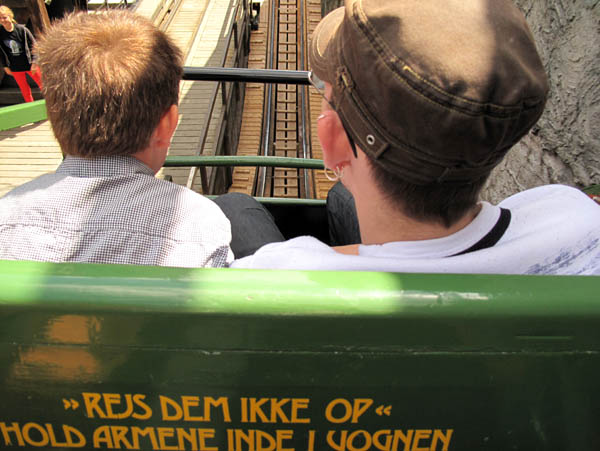
The Tivoli amusement park is sweet, cozy, European. I only went on one ride, a small roller coaster. No point giving myself a stroke with some neck-whipper. He had a late lunch of smørrebrod, that is, buttered bread with…you pick. I had fjordrejer on mine, local shrimp. The place was called Grøften, meaning Ditch. One of the guys I met the other day, Morten, told me that his grandparents used to take the train into town for a big day at Tivoli, ending with a great beer-drinking cigar-smoking dinner at Grøften.

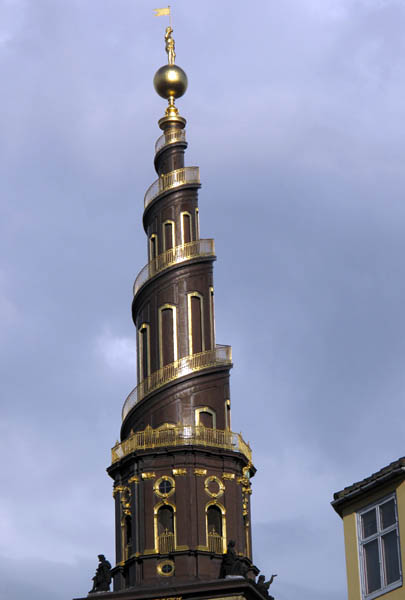
Right now I’m sitting at a street cafe under an umbrella, rain showers taking turns with the sun. the cafe gives the customers blankets to huddle in. A steeple in front of me, church name unknown, but I’m tired of looking up names on the map. Just being here is enough, adrift in unnamed Danishness. The blonde women pin their hair in Danish pastry updos.

Earlier today, Sylvia and I saw a half dozen couples in the cavernous City Hall, with parent friends, grandparents and even children, Danish toddlers, brilliantly blonde—everyone dressed up for civil wedding ceremonies. It reminded me of Sylvia and I getting married at the City Hall in Geneva, some 42 years ago.


[Near the palace, Rosenborg Slot.]

The fountain on my left has big bronze storks, wings up, perched, beaks facing out. Illustrating a Hans Christian Andersen fairy tale? Danish storks.

Score! I just a blanket to huddle in on my cafe chair—looking bumlike, I’m sure, in the striped Rastafarian watchcap I just bought on the street—sipping hot tea, this is the life. It’s quite cool here, June or not, although the Danes seem to find it summery. The younger women wear tights and T-shirts, always the leg-warmer-type tights under the skirts.

This square is tiled with polygonal stones in red and shades of gray, five shapes in all, a regular but unorthodox tessellation, deserving of an illustration in any comprehensive volume on the Tilings of the Plane. Here comes the rain again.


[It’s good to be King Christian IV of Denmark.]

The other day we toured this great palace called Rosenborg Slot. One room was paneled in wood, with an oil painting on each panel, good little Bruegelesque pictures. I can see this place as a model for the inside the castle of the King of Flimsy in my novel.

In the display cases of treasures, they had some nautilus shells that had been carved away in spots to reveal the inner surfaces, which were in turn pierced to resemble the iron lace of a knight’s helmet.


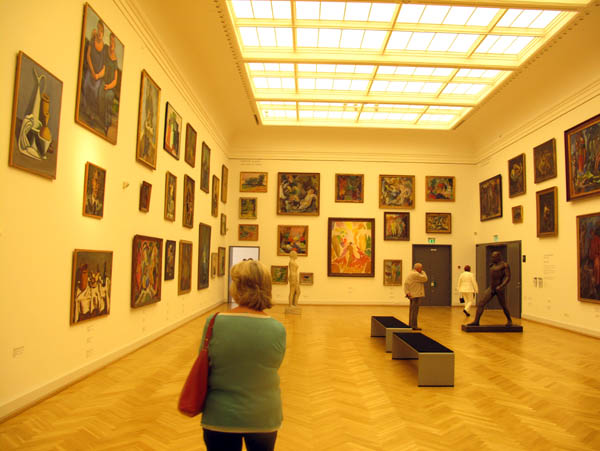
[Bruegel painting of the poor eating the rich at the Statens Museum for Kunst.]

Last night we went to a Baroque music concert in an ancient little octagonal wooden church. We went by bus and had dinner on the way, and arrived fifteen minutes late, so we had to wait in the vestibule with a lone Scandinavian usher, who looked like the frequent Bergman actor Max von Sydow. In a way, hearing the first song this way made it the most beautiful, as if we were waiting in the wings of Paradise, the musicians visible through the peepholes in the closed double doors, the walls pale green with dry flaking paint, the whole structure elderly and spindly, the music unutterably rich and sweet. Finally going inside it was even more like a Bergman film, so utterly 1910, a line of distance and idiosyncratic faces along one of the balcony railings, and I could imagine the skillful sequence of scenes that would unveil to me the inner passions behind these specific visages, the dark-haired woman with vivid eyes, the short-haired lean man with a striped tie, the youth in a windbreaker, the aging beauty with her white hair pulled back in to Danish pastry updo.


[A writing desk at the Danish Museum of Art & Design, dig how the writer controls the dragon of creativity by wielding...a red-hot poker?]

I didn’t bring my laptop—partly to avoid the weight and the hassle, partly to get away from computers. I have been checking my email every day or two on the hotel’s machine, although it’s a very expensive $12 for twenty minutes, and the rip-off lamers who run the system—www.wayport.net—(a) start the timer at 15 minutes instead of 20 minutes even though I’ve supposedly paid for 20 and (b) eat up two more minutes of my time with their login and their ads, and (c) only have Internet Explorer, instead of Firefox, and IE pops up a security warning every few seconds when you read webmail, a warning that you have to click on to continue, wasting more of your expensive time. I sound like a junky complaining about a short count…and that’s why, in fact, I’m glad to be away from computers.

We haven’t been seeing any English-language newspapers either—it’s great not seeing the ongoing media hype for the right wing and not be reading about the Middle East, health care, the recession, and the California budget crisis.

June 22-23, 2009

I feel heavy and slow today—I ate lamb for supper before the concert last night, something I normally don’t do. It felt good eating it, though. Before the dinner we walked in a gorgeous park called Frederiksberg Have, it was like an anthology of gardens, little walls and hedges closing in the short stories of flowerbeds and fountains. A wedding party was in full swing in a clearing. Passing a shadowed bench, I saw a bridesmaid (or bride?) lying on her back with her pale silk skirt hiked up , and an urgent black-suited groomsman (or groom?) lying on top of her. People go nuts at weddings.

“People f*cking!” I whispered to Sylvia, who hadn’t noticed them.

“Oh stop it,” she said, taking my remark for one of my random lies or Tourette-syndrome-like outbursts.

All day the sun and the rain squalls alternate. So far it’s never rained longer than half an hour. It’s like the rapidly changing weather you get on an island.

We unwisely got on a tour-the-town bus this afternoon, a bus stinking of diesel fumes, waddling like a crippled hippo, filled with numb or voluble tourists. It drove straight to a row of desolate souvenir shops along the cruise-liner dock, and then to…the Little Mermaid, a small and undistinguished statue, forlorn in a remote corner of the waterfront, surrounded by parking lots, and mobbed my tourists. Ugh. The Disney Version. Locals have twice sawn off the Little Mermaid’s head.


[We didn’t go to Legoland, but here’s a store with a cool display representing the infinitely regressing doctrine that objects are made of small replicas of themselves.]

Imagine if a town were to deliberately erect a lowest-common-denominator tourist attraction, well away from the city center—just to keep the more gullible tourists out of the way. When we have a cook-out at home in California, a certain kind of hornet or yellow-jacket often appears, aggressively going after the meat—and one strategy against them is to set an unprotected plate of meat scraps off to one side. The hornets will tend to gather at the scrap plate—at the tourist attraction.


[Concrete armchair at the Danish Museum of Design.]

We got off that bus for good after the Little Mermaid and walked to the Danish Museum of Design, a fascinating place with a great cafe in a big garden, hardly anyone there, a I felt like a guest a rich person’s city house.

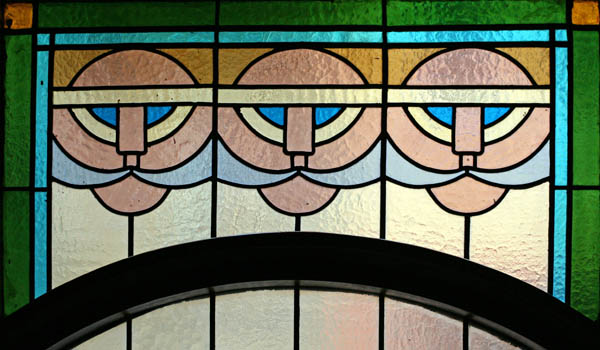
I liked the Art Nouveau rooms in the museum—those gnarly, chaotic zigzag curves in the decorative patterns. Like the late Sixties, Art Nouveau didn’t last nearly long enough.

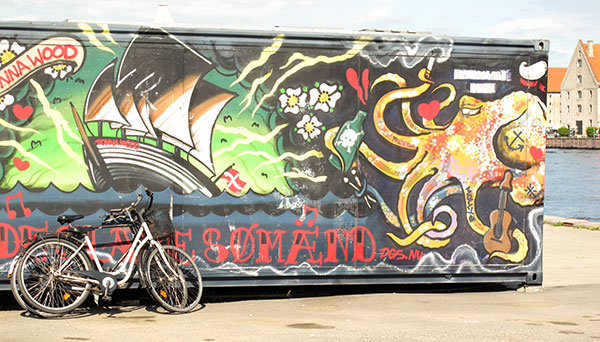
I hung out by the harbor for awhile, the waters alive with boats: water taxis, moored restaurants, kayakers, sightseeing barges and even a submarine. The first hot day we’ve had here. Did I mention that the sun goes down around 11:30 p.m., and that the sun is up by 4 a.m.? In between it’s like twilight. We’re pretty far north, nearly as far as Alaska.

On our last night in Copenhagen we ate in a cafe full of cute young people—the tables and chairs were mismatched thrift-store items, mostly pastel—I’ve seen this fashion in New Zealand but not yet in the US. Again it felt like being at someone’s house. After supper we walked along the river, with the sun still setting at 10 pm. As always, I long to paint the CAPOW-wave-rule patterns of the light reflected on undulating water. I remember admiring these sunset blogs in Maine, forty years ago. Pale whitish blue and pale beige-yellow.


[The Kong Arthur is a great hotel.]

I woke briefly at 3 am, and it was already light. The actual night is only a few hours long, and even then it’s not dark. Obversely, it must be the case that, around Christmas time, it’s only light from, say, 10 a.m. to 2 p.m. Now I finally understand why, in Bergman’s Fanny and Alexander, they go to church in the dark on Xmas morning. I’d always imagined that for some strange reason they were going to church at 5 a.m. But it was probably closer to noon.

And now on to Bergen, Norway…

Share

Rudy’s Blog is powered by WordPress