



Rudy’s Blog

Buy Rudy's books! Click covers for info.                 Blog text and images copyright (C) Rudy Rucker 2012.


Archive for July, 2009

How to Write (Clarion West, 2009)

Monday, July 27th, 2009
Share

This week (July 27 – July 31, 2009) I’ve been teaching some emerging writers here in Seattle at the Clarion West workshop in Seattle. It’s a full schedule, with all the group workshopping of stories, one-on-one conferences, and reading the stories to be workshopped the next day. Many thanks, by the way, to the organizers, Leslie Howle and Neile Graham.

It’s been interesting for me to read so many different types of stories, and to hear the students’ concerns and ideas. It reminds me of my original sense of SF as vast and dreamy. As the days go by, my head swims more and more.
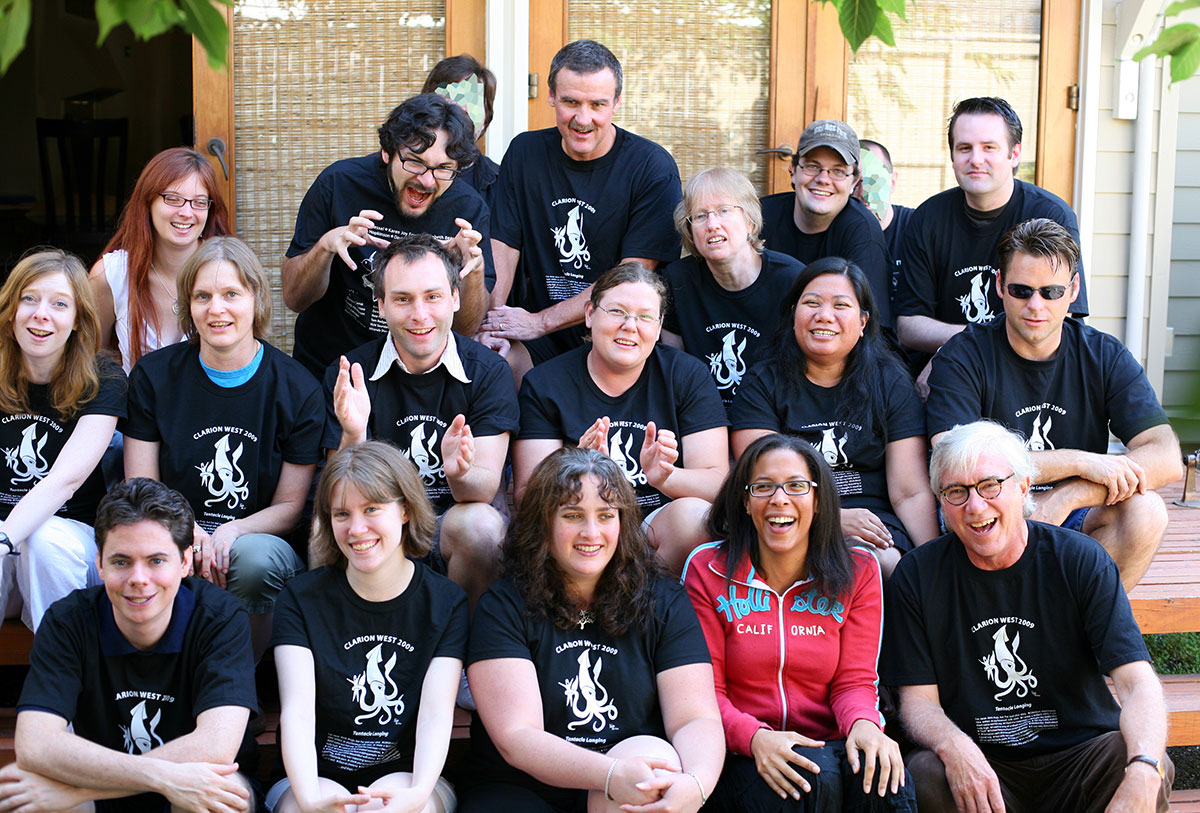

[Rudy and the 2009 Clarion West class on graduation day. Photo by Leslie Howle. Click picture for larger image. Here are the names of the people in the picture listed left to right, from first to last rows: First row: Joel Walsh, Miranda Shevertalov, Kris Millering, LaShenda Vavra, Rudy Rucker. Second row: Siobhan Carroll a.k.a. Von Carr, Julia Sidorova, Lucas Johnson, Elizabeth Wasden, Rochita Loenen-Ruiz, Steven Ellmore. Third & Fourth Rows: Emily C. Skaftun, Randy Henderson, William T. Vandemark (photo obscured), Tom Rodgers, Vicki Saunders, Nate Parkes, Derek Muir (photo obscured), Jordan Lapp.]

I’d imagined that, while I’m here, I might write a transreal story about teaching writing, but I feel a little too scattered for that. The temperature’s been in the 100s, which doesn’t help. But I do want to write something—my way of getting my head together.

So what I’ll do is to work up some Q & A here, adding to this one post as the week goes by. This is by way of amplification to the “Writer’s Toolkit” document that I use when I talk about writing, (in fact some of these notes may end up in there).

I’ll order the entry additions in blog style, that is, with the more recent ones first.
July 31, 2009

A few final points:

Write what you love. Let the market follow you instead of the other way around. Use your whole self. Don’t hold back, don’t be embarrassed to write wild. Push for publication. If you can’t sell, enjoy it anyway…and consider starting a webzine with some friends. Writing is self discovery. Believe in the Muse.

Graduation day!

Today I led my class into the basement of the sorority house on the U.W. campus where I’m lodged, into a room which serves as a little temple or meeting place for the sorors, a room complete with an oil lamp, the Aladdin-kind that you see used in graphics to symbolize WISDOM.

In the same rhythm as that golden oldie chant, “Om Mane Padme Hum,” we chanted these lines over and over—and enlightenment descended. The Eleusinian Mysteries of F & SF!

Time, saucers, sex and goo
Elves, mutants, robots too
Muse of strangeness old and new
My blank pages call to you.

We really got into the sing-song, doing it mantra style, Gregorian style, and, at the end, as a sweet chorus. It was one of those experiences that sticks in my mind, a milepost. I think it’ll stay with some of the students, too. I wanted them to understand about the Muse. In the end that’s what you have to count on. In a way, that’s the most important thing I could teach them.
July 30, 2009

I’m still having trouble finding good endings for my stories. What more can I do?

Don’t settle for a trailing off ending. In high literature, this is fairly acceptable—to have a story where, at the end, the characters are in for more of the same boring and depressing life as usual. Sometimes younger writers think this kind of ending presents a fresh insight about life. But, it’s very well known among adults that life is hard and boring, often unexciting, and filled with ultimately irresolvable problems.

People who read science fiction and fantasy stories are generally looking for a relief from life’s dreariness. They would prefer, I think, to see a happy ending or at least a tight and exciting ending. An ending where something happens, a moment when life seems to make sense, an instant when a higher order shines through the dull machinations of fate.
Thinking of a nice ending can be hard. You want to jump out of the system of your story a little bit, to reach out for a greater synthesis. How?

First of all, it helps to understand what your story is really about. Think about the transreal aspects of your story—the very fact that you picked its topics indicates that these themes and situations have some special meaning for you. What does your story stand for in terms of your personal and emotional life? How might some resolution be found to the problems here suggested?

You have to put your whole heart and soul into the story in order to really get it off the ground. That means you want to think about it all the time—or at least a lot of the time—for days and maybe even weeks on end. Look for clues to the story in the debris on the street, in the faces of the people you meet, and in the flow of media that cascades over your head.

Most of all, you’re waiting for the Muse. If you sincerely seek her, the Muse will come. Sometimes you won’t realize that she’s speaking to you. You’ll think you’re just having a crazy, impractical idea. Stay alert, and notice what you are given. Before long, the proper ending for your story will come.
July 28, 2009

I’m trying to get the students to write some transreal stories, but it’s a little hard to redirect the flowing stream of the workshop. This is the last week of six, so a lot of momentum has built up. They’re into rewriting some of the stories from earlier weeks—which is what last week’s teacher, David Hartwell, set them to doing. That’s okay, too. It’s all F & SF.

How do you write a transreal story?

A transreal story is strongly based on some real situation in the author’s own life. The idea is to build up the characters on the basis of yourself and the other people you know—possibly merging people or reassembling parts of personalities. Take some issue that concerns you and think of some classic SF or fantasy riff that in some way represents this concern. Dial it up and put in a twist at the end if possible. Imagine that your fictional character finds his or her way through the problem that’s bothering you. Note that the story needn’t look especially different from any other SF story, that is, we’re not looking for a deeply emotional True Confessions tale. In other words, don’t let the “real” overwhelm the “trans.” You’re still writing SF. But you’re using the “real” to keep the characters from being flat or plastic.
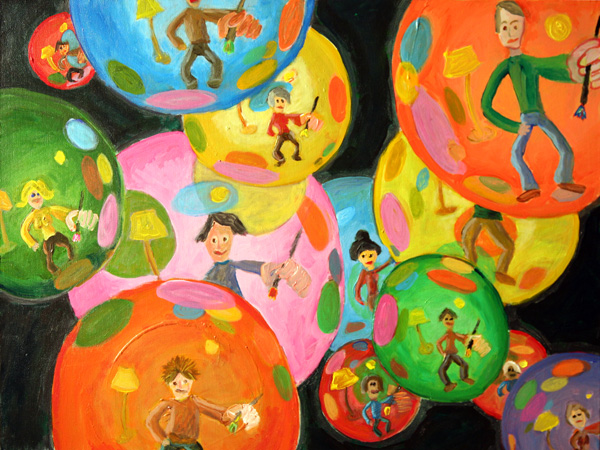
I feel like my stories are quite well-written, but that I need just another step to make them commercially publishable. What can I do?

The stories might already be good enough, be sure to try a lot of markets. Also keep in mind that, in general, you’ll get a little better with each story that you write. But here’s a few basic things you might try to kick the story up a level.

Make sure that your characters aren’t too flat and generic. You don’t want your hero or heroine to be totally good and right and courageous. They need to have some edges, some quirks. This is why I often recommend thinking of some actual people you know when designing your characters. In the same vein, try not have the dialog be too smooth and scripted. Pay attention to the way people actually talk—they blurt, they argue, they lose the thread, they go off on tangents.

Another useful principle is to give the reader some gnarly and interesting things to contemplate. In a movie, special effects add millions to the budget, but in a story it only takes a few hundred words. It’s always good to describe some specific science-fictional objects to about—little devices or creatures or knots in space. This is an instance of the old “show don’t tell” principle. Rather than having two people discussing some theory, have one of them pull out, like, an egg with a claw sticking out, and the claw blossoms into a flower…that kind of thing.

It’s also good to bring in your special fantastic or science-fiction miracles early in the tale. Don’t make the reader wade through most of the story before something exciting happens. Hit them with a wild new development quite early on, and then you can play with the consequences, maybe piling on some extra quirks as you move towards the conclusion.

July 27, 2009
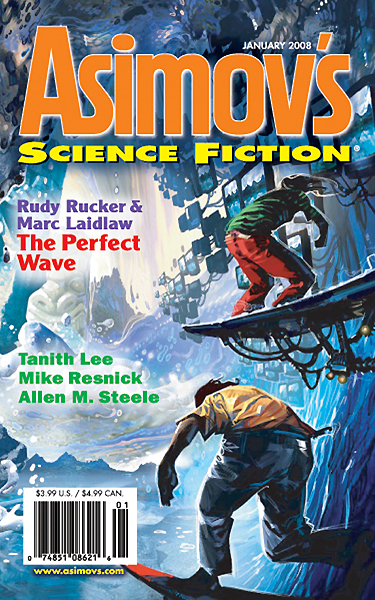
What is a story, as opposed to a novel?

I see a story as being something like a paperweight—a blown lump of glass with some kind of crack or pattern in it. You can hold it in your hands, you can see the whole thing at once, it’s transparent. But there’s this weird flaw or fault-surface line inside that makes it interesting. Flaw and fault in the geologic or materials science sense—not in the sense of there being something wrong—although, in a way, the interesting parts of a story are when something goes “wrong” for the characters.
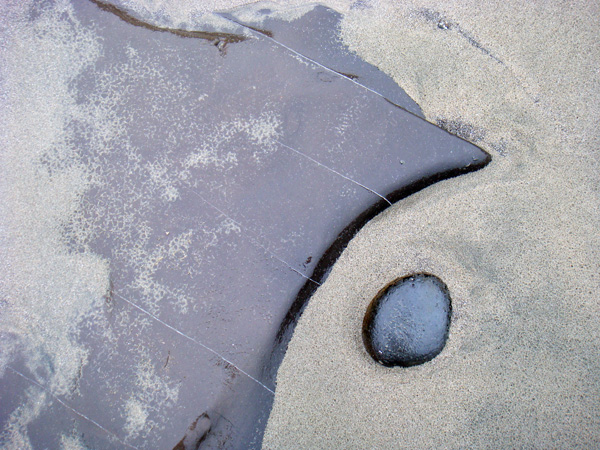
What about ending a story?

It’s best if the ending is a twist or a “reveal”—some unexpected consequence of the assumptions in the story. Let me back up on that. I like to refer to the standard fantasy and SF tropes or scenarios as being “power chords.” For a story, you generally select two power chords and work with them, jamming them up against each other, extending them, trying to think of a new way that a given power chord (like telepathy or time travel) might be actualized in a fictional world. And if you think about the situation enough, you can, with luck and inspiration, come up with a twist.

If you can’t think of a twist, you can always go for spiritual uplift. The main character achieves insight into their big problem and rises above it. Or a couple finally declares their love for each other. Or someone gets out of jail (which is, come to think of it, an objective correlative for spiritual uplift). But you do need something.
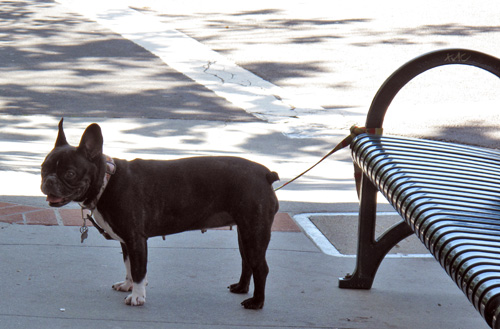
How do you know when a story is done?

It sometems takes me six or seven to finish a story—including the preliminary passes when the story isn’t written through to the end yet. After each pass, I print it out and go outside, or to a coffee shop, and read the new version, marking it up, and trying to figure out where it’s going and how I’m going to end it. At some point, I feel like the story is done—that is, I’m not seeing more things to mark up and change.

But some stories come out whole, really in one pass, with maybe a few small tweaks afterwards. These are more like pieces of calligraphic paintings, single gestures that cohere into an attractive, gnarly shape. When I’m fortunate enough to come up with a story like this, I try not to overwork it.

How do you sell a story?

When It’s done, I email or snailmail it to an editor—some magazines only take snailmail—and if it comes back, I send it back out again right away, like the very same day. I used to work my way down to lower-and-lower status publishers, but now, if I can’t sell the story to, like Asimov’s or Tor.com or maybe Interzone or some kind of original-story anthology, I just short-circuit the process and put the story in my own webzine, Flurb.

Sometimes, if the story seems non-commercial, I just earmark it for Flurb right away. It’s good to have your own webzine. With some promo and help from other authors, you might be able to get a lot of people to read it. Obviously it’s important to cajole others into your zine so it doesn’t look like a total vanity project. At this point, I publish two stories a year in Flurb, although sometimes my pieces aren’t really stories, they’re chapters of novels in progress.

Thanks to having the Flurb outlet, I’ve given up on sending stories to certain editors—who’ve turned down two or three stories by me. The SF world is small enough that usually these editors are friends. But there’s something about my fiction that doesn’t appeal to them, and there’s no point going through the same rejection over and over again. For any given writer, some markets just aren’t going to work.

This said, when I was a beginning writer, I had a much higher threshold for rejection pain, and would indeed try the same editors over and over and over again. Not that it usually worked. Three Noes tends to mean No forever. It’s nice that the Web has come along to give us another way out. Let a thousand Flurbs bloom!
Share

Clarion West. Reading in Seattle.

Thursday, July 23rd, 2009
Share

I’m heading off to be the instructor for the final week of the Clarion West science-fiction writing workshop in Seattle.

To get ready, I reworked and expanded the “Writer’s Toolkit” document that I use when I talk about writing.

I’ll be doing a reading at 7 p.m. on Tuesday, July 28, 2009, at the University of Washington Book Store in Seattle. More info here.

Share

The Afterworld as a Monad with an Infinite Center

Wednesday, July 22nd, 2009
Share

I’m about two-thirds done with an Escher-inspired painting that I’m calling “Topology of the Afterlife.” I probably won’t get around to finishing it until mid-August.

I mentioned my motivations for this painting in a post the other day. In a nutshell, the painting has to do with my ideas about the afterworld, Flimsy, that appears in my novel-in-progress, Jim and the Flims. I see Flimsy as being tiny, down at the lowest level of space scale. I think of it as being what Leibniz calls a monad.

Now, it wouldn’t make sense for tiny Flimsy only to be in one particular location, so I’ll assume that it’s an ubiquitous monad. That is, Flimsy is inside every particle of matter and space.

You might say that the copies are in synch, like mirror-balls. But it would be more accurate not to say that the Flimsy monads are different views of one and the same thing. The One that underlies everything.

Here’s the win with this approach: if Flimsy is to be found within every particle of the universe, then Flimsy can serve as a stargate.

Like, I shrink down into Flimsy, and then ooze out of it onto the surface of planet Bex in the Whirlpool Nebula!

Now another issue comes up. If Flimsy is going to be housing the souls of aliens from throughout our universe, then I need for the place to be very large, perhaps even infinitely big—even though it’s smaller than an electron.

I can do this by using a space-warp trick: the center of the Flimsy-ball is negatively curved space that spikes out, with an unattainable center that is literally at infinity. God’s Eye.

Putting it differently, you might say that you can’t reach the center of Flimsy because you keep shrinking as you get closer and closer to it.

I first used this idea in 1979 when I was writing my novel White Light. I wanted to describe a terrace outside the infinite Hilbert’s Hotel, a terrace which has alef-null tables (that is, as many tables as there are natural numbers.)

After an indefinite interval of time I woke up with a start. I was covered with sweat, confused. The light outdoors hadn’t changed. The phone was ringing and I picked it up.

It was the clerk’s smooth voice. “Professor Hilbert is having tea on the terrace with some of his colleagues. Perhaps you’d care to join them. Table number 6,270,891.”

I thanked him and hung up. The terrace was reached by passing through the lobby. From outside, the terrace had looked fairly standard, with about fifty tables around the circumference. But now that I was on it I could see that everything shrank as it approached the middle…so that there were actually alef-null rings of tables around the terrace’s center.

Already about ten rows in, the tables looked like dollhouse furniture, and the gesticulating diners like wind-up toys. To find Hilbert I’d have to go in better than a hundred thousand rows. Fortunately there was a clear path in, so I could run.


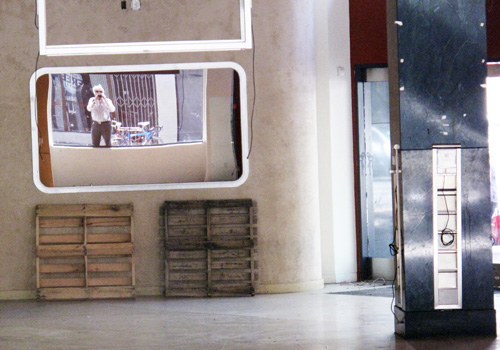
[A melancholy picture of now-deserted Virgin Record Store at Powell and Market St. in San Francisco. A mirror across the empty room reflects me looking in through a plate-glass window. As chance would have it, White Light was orginally published by Virgin Books, a short-lived offshoot of the record company.]

The space distortion affected me without my feeling it. When I got to the dollhouse tables, I was doll-sized and they looked perfectly normal to me. I sped towards the center, staring at the strange creatures I passed.

… Each table had a little card with a number on it, and when I got into the six millions I slowed down a little. There were so many creatures. The endless repetition of individual lives began to depress me…the insignificance of each of us was overwhelming. My vision began to blur and all the bodies on the terrace seemed to congeal into one hideous beast. I lost my footing and slipped, knocking a waiter off his foot.

… Before long I spotted three men sitting at a table, two in suits and one in shirtsleeves. With a sudden shock I realized I was looking at Georg Cantor, David Hilbert and Albert Einstein. There was an empty place at their table. I hurried over, introduced myself and asked if I could join them.

I’d already been thinking along these lines, being inspired by the classic Zeno Bisection paradox, which notes that the infinite sum of a half plus a quarter plus an eighth plus a sixteenth and so on…equals one. But I’m pretty sure that I originally got the 2D version from Escher, I already had a book of his images by then.

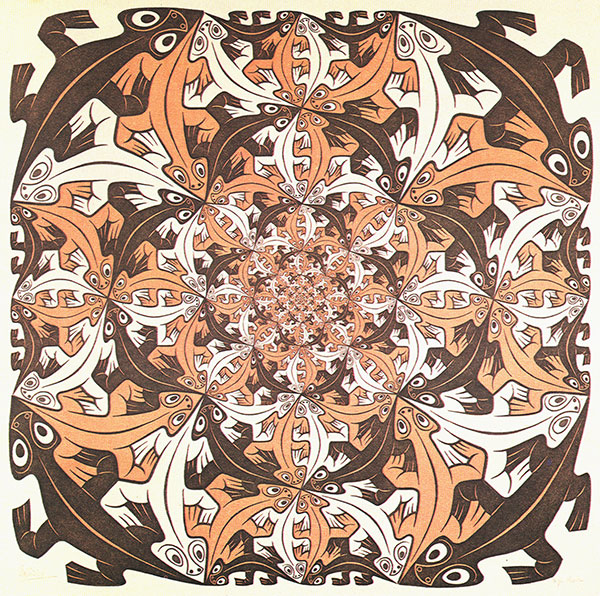
Indeed Smaller and Smaller I, a wood engraving of 1956, Escher represents this type of “infinite terrace” by a tessellated square in which the inner tiles grow smaller and smaller as they near the center.

Copyright M. C. Escher. Visit the Escher gallery and shop for more info.

Discussing this piece in the wonderful old book, The Magic Mirror of M. C. Escher, his friend and editor Bruno Ernst writes:

“Escher took things to fanatical lengths and, using a magnifying glass, cut out little figures of less than half a millimeter. For the center of the wood engraving Smaller and Smaller I he purposely used an extra block of end-grain wood so that he could work in finer detail.”

I love it when artists or authors are fanatical about their craft.

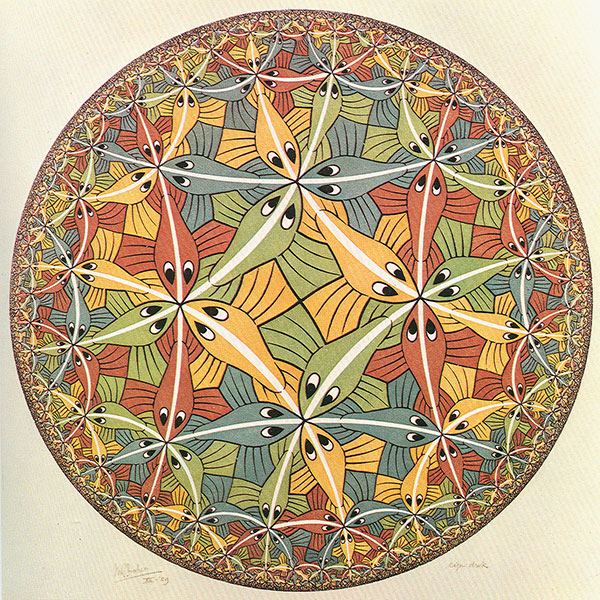
I should also mention that Escher was also interested in the “opposite” way of fitting infinity into a finite region: drawing a disk in which things shrink as they get nearer to the circumference. This appears in Circle Limit III, a woodcut from 1959.


Copyright M. C. Escher. Visit the Escher gallery and shop for more info.

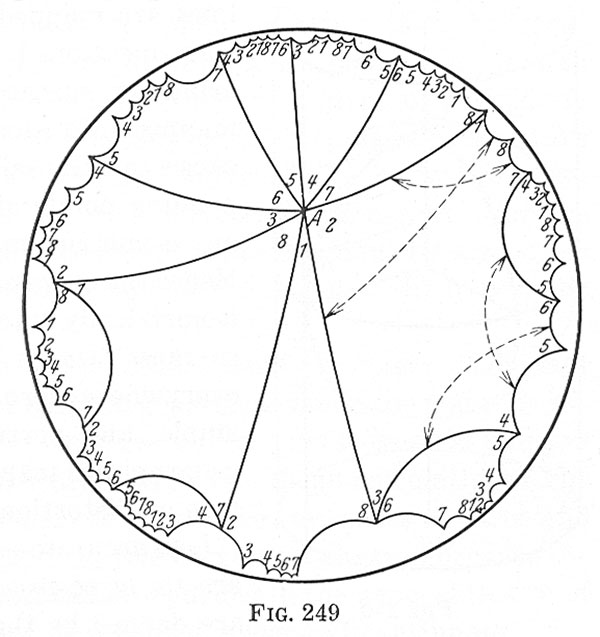
Escher’s inspiration for this pattern seems to have been a mathematical diagram of Poincaré’s model of hyperbolic geometry.


[Illustration from D. Hilbert and S. Cohn-Vossen, Geometry and the Imagination]

Although in many ways more beautiful than the shrink-towards-the-center model of the Hilbert’s Hotel terrace, this hyperbolic model isn’t suitable for Jim and the Flims—because I want my explorers to be coming into Flimsy through a bounding wall of living water. And if there’s an endless regress piled up at the edge, then it’s very hard to come in though that. If there’s in an infinite expanse towards the middle, that leaves open the possiblity of many adventures.

Share

Norway 6. Ålesund. Jugendstil.

Wednesday, July 22nd, 2009
Share

July 1, 2009.

[ The following is the final installment from my perhaps-too-lengthy notes on a recent trip to Scandinavia.]

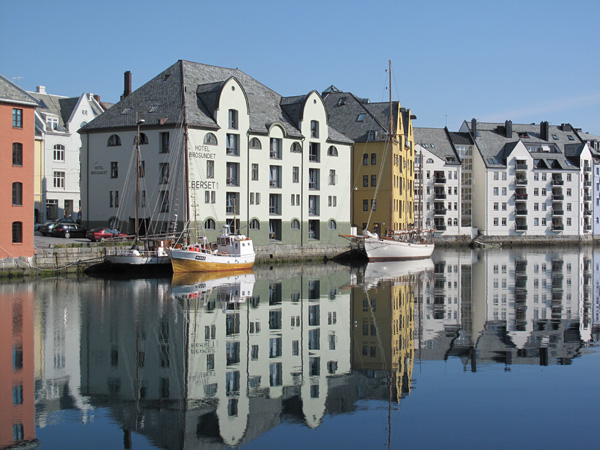
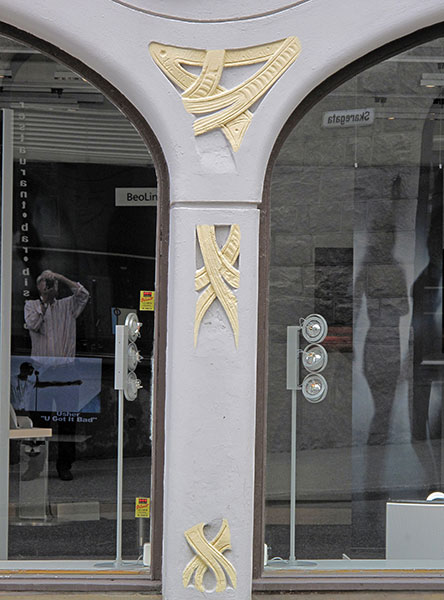
I’m sitting on a stoop in sunny Ålesund near a canal. The buildings in this neighborhood are in Scandinavian takes on the Art Nouveau style, more commonly called Jugendstil here. The style happened to be in fashion in 1904, when the town burnt to the ground and was rebuilt over just a few years.

Nothing much on the agenda for our final two days—just wander around this pretty town. My credit card has stopped working—I guess the bankers are suspicious about the run of charges emanating from Denmark and Norway. But I don’t feel like phoning up the Empire’s bureaucracy to (maybe) straighten this out. Meanwhile my bank card is still able to extract kroner from the ATMs—which they call mini-banks here.

I’m in a bakery—I just had the best piece of pastry in years, a dry mille-feuille puff croissant wrapped around almond paste. To intensify the sensation, I pushed the whole second half into my mouth at once, then fell choking to the floor, knocking over my table and my chair—just kidding about that last part.


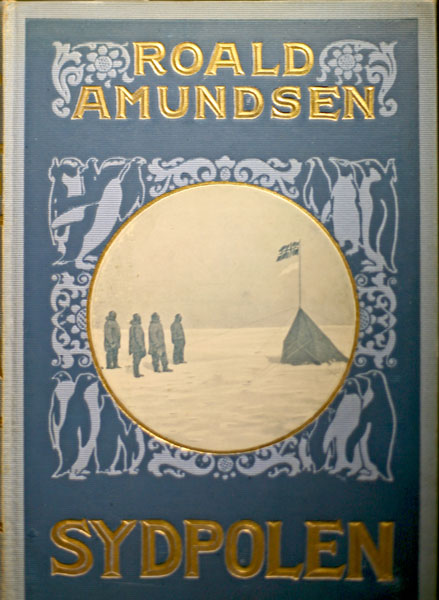
[Art Nouveau cover for a book by Norwegian polar explorer Amundsen.]

A baby in a carriage beside me is topped by the mound of a cotton-covered feather-bed comforter. All of the beds here have these fat comforters and no top-sheets or blankets. Given the unusual heat during our stay—70 or even 80 Fahrenheit—we’re hot at night, steaming in the midnight sun. Last night I saw the sunrise at 2 a.m. They have posters around town that mention the latitude—I think it’s 62 degrees.

Quite a few of the Norwegian women have platinum blonde hair, fine and nearly white—I’m not sure I’ve ever seen women with this as their natural hair color. Some of the Norwegian blondes are punks with cropped hair, pigtails and tattoos. Others, more traditional, wear their forelocks in braids that they wrap around their brows in an old-school braid-crown. The Norwegian babies are tender and so fair.

We were just in the library for some free email on their machines. It’s fun going into the public buildings of a town.

We walked around the shopping streets—with lovely Art Nouveau facades—but the insides of the buildings have been merged and hollowed out to hold an—aaack— mall that’s very nearly isomorphic to the Valley Fair mall in San Jose, only with H & M as their anchor store instead of Macy’s. But, ah, they do have that celestial bakery at the outer edge. I notice another pastry now—a cake with whipped cream reddened by cherries—they call it bloot cake, for “blood cake.”

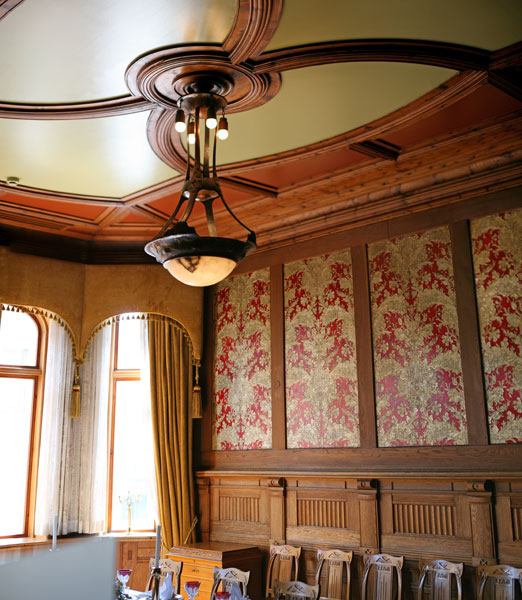
We tour the Jugendstil Sentrum (Art Nouveau Center), and see an interesting slide show about Baltic and Scandinavia versions of this international style—it was big in Finland as a means to express a romantic nationalism directed against Russian dominance. I bet something like Art Nouveau will be big again, when advanced tech and new materials make possible a return to custom craftsmanship. The museum spoke of this one Jugendstil room as a work of “total art,” in which every detail is designed to act as a voice in the ecstatic chorus of the whole.

Looming over the town is one of those fat cruise starships that we saw before, The Jewel of the Sea, filled with alien invaders of a sort, that is, my fellow countrymen. This morning they tied up at a wharf a block from our hotel.

“I’m not one of them,” said the bespectacled, well-heeled alien, his face suspiciously tan and un-Norwegian. “My wife and I came here on public transport from Alpha Centauri, just like you natives do.”

“Oorck!” cried the rabble of pale street urchins surrounding the intruder. “Oorck, Oorck!” The first stone struck the alien square upon the forehead. He tottered and fell…

I bought a souvenir Norwegian wool cap, absurdly overpriced, but one of a kind (I’d like to think). It has tassels on it.

Tomorrow we go home, we already scoped out the spot where the airport busses leave. It’s a little sad to see the vacation end. I would have liked to visit Stockholm as well—but my legs and body are cumulatively fatigued after two and a half weeks of touring, also it feels like time to halt the gushing outflow of cash.

It’s been great. Takk for alt.

Share

Norway 5. Geiranger. Cliff Hike. Kvak!

Tuesday, July 21st, 2009
Share

[ The following is the second-to-last installment from my notes on a recent trip to Scandinavia.]

June 30, 2009.

We took a regular bus from Fjaerland to Hellesylt, and then a ferry from Hellesylt to Geiranger. I was anxious about catching the bus, but it was on time to the second, and very comfortable inside. Great views as we labored over the ridges separating one fjord from the next. In many stretched the road was what we’d call one-lane, although it had traffic in both directions. The busses and cars would pull over for each other at times.

The cruise from Hellesylt to Geiranger really takes the prize. We saw dozens of really big cataracts—any one of which would be a major sight back in the continental US—and here they’re lined up on both sides of the fjord, writhing down the tree-studded cliffs that are several thousand feet high.

Abandoned farms perch on some of the nearly vertical meadows—what kind of maniac build his farm in a place like that?

Sore hip or not, I managed to hike to the top of a thousand foot bluff this morning. It felt like being back in Zermatt. I saw lots of ferns and rushing streams. The trees are mostly aspens. Some bell-collared sheep were in the thickets, peering suspiciously at me. And at the top, goats lolled with gratifying recklessness at the very edge of a towering drop. On the way back, I walked along the edge of a field, quite lovely with a barn and a cliff in the background.

The exercise made me happy, and I started singing a song that I heard on the Mickey Mouse Club show forty years ago, a song about Donald Duck’s global fame. The song, as I recall it, was presented in what may well have been a Norwegian accent. “Kvak kvak kvak, Donald Duck, watch him do his stuff. Kvak kvak kvak, Donald Duck, now he’s had enough.” I videoed myself performing this number.

Now I’m limp and tired from the hike. Waiting on the dock for a lighter for the large Hurtigruten ship, which we plan to board for a five hour ride up the length of this fjord to the city of Ålesund.


[Those tiny dots by the top railing are people!]

People are pouring off the lighters from a repellently gargantuan cruise ship called “The Jewel of the Sea,” truly the size of a starship—then flocking directly to a waiting line of tour buses. From the outside, it looks as if going on a cruise tour means doing everything in a crowd, with lots of standing in line. But it’s easier, I’m sure, than freelancing the trip, and for some people just the right thing.

I may go on a cruise myself one of these days, especially when I’m older and less mobile. Today in any case we’re riding a more reasonably-sized Hurtigruten mothership to Ålesund.

Great excitement riding the lighter to the Hurtigruten ship. A hatch in the big ship’s hull opens for us at water level, and we enter via a gang plank. It’s so spaceship-like, just like Han Solo landing in a hatch of the giant ship in Star Wars. One deck up was a desk like at a hotel, the “Resepsjon.” Now we’re in the panoramic view lounge on Deck 8, very comfortable, and this particular cruise ship isn’t looking so bad from the inside.

As we approach the mouth of the fjord, the view opens up to resemble the coastline of, say, Maine or Vancouver, with low islands and peninsulas on every side. But vaster, mistier, and calmer than anything I’ve seen before. The Happy Isles, the Blessed Lands of the far north.

Share

Norway 4. Fjaerland. Twilight Zone.

Monday, July 20th, 2009
Share

[ The following is another installment from my notes on a recent trip to Scandinavia.]

June 29, 2009.

Today we got a boat from Balestrand to Fjaerland, a sweet, quiet hamlet between the Fjaerland fjord and the Jostalbreen glacier, which is the largest in Europe.

When Sylvia and I got off the ferry to Fjaerland, it felt like an episode of the Twilight Zone. The other passengers on our boat all got into a tour bus that had ridden in the ferry. They drove off, leaving us alone, in this utterly silent and deserted Sunday morning Norwegian village, the fjord beside us and snow-capped mountains all around.

Anything I say feels superficial, overly dramatic, here in the core of this uncanny beauty. I feel like a fly on a freshly frosted cake.

Sylvia had been talking about finding a book to read so, lo and behold, there’s an unmanned shelf of books by the road, with a sign reading “Honest Books, 10 Kr. each.” We’re both wearing shades, very Californian. I light a cigarette, I’m a noisy wise-guy, the tour bus grinds by, I wave, nobody seems to see me.

True to Twilight Zone style, I imagine myself as a city clicker in a black suit, and my consort as a sexy blonde on spike heels, our voices overly loud amid the silent mountains.


[Part of the porch of the Hotel Mundal appears on the left.]

The Hotel Mundal is the size of a large house, vintage 1891, with a fresh-faced young woman at the desk, perhaps from the founder’s family.

Across the street is a wooden church. Some first names in the churchyard across the street form our little hotel: Gurid, Ingvald, Ingebrigt, Ola, Kjell, Ola, Mikkel, Anggar, Brynhild. There’s a Swanhild Aarskog.

Many of the gravestones bear the epitaph, “Takk for Alt,” meaning “Thanks for Everything,” some just say Takk. I love that.

What a great sentiment with which to leave the world. “Thanks for everything, world, it’s been great—you really went all out.” And forget about any bitter rant like, “Rage, rage against the dying of the light.” Go out happy. Why not?

Life’s rich panoply. I’m so grateful that I made it here.

The second day I rent a bike and ride up the canyon, nobody in sight for miles. At one point a single vehicle drives by: a blue tractor. I pass a bridge too rickety to walk upon.

In the evening an older woman, the manager of the hotel, tells us about its history.

She mentions that a few months ago a farm’s concrete reservoir of cow manure had burst uphill, releasing a kind of a poo-avalanche that swept past the hotel and into the fjord. No sign of that now.

In the front yard of the hotel is a vertical stone plinth, like a mini-version of that 2001 slab, covered not with writing, bit with (seemingly) lichen-like spots. Suppose that the spots are glyphs in the Unknown Tongue used by the Great Old Ones who live beneath the placid surface of the fjord.

Thinking back to our arrival in terms of a Twilight Zone episode, I imagine that the woman finds a book with curious blotches and symbols. It’s called God Bøk, which is Norwegian for Good Book.

“Is this math?” she asks, flipping through the pages. Her consort is a mathematician, she’s a linguist.

Suppose that the bursting of the cow-poo reservoir was orchestrated by the Great Old Ones? Too ludicrous maybe. Perhaps it would be more commercial to have a moonlit clearing with the proposed human sacrifice of a beautiful Norwegian girl, a sacrifice blocked by the woman heroine, with her man’s aid—they have power because they’ve deciphered the blotch-runes on the stele by using the God Bøk.

Share

Towards a Topology of the Afterworld

Saturday, July 18th, 2009
Share

I’ve been painting for the last couple of days, and speaking of painting, last night we saw a good French movie about a painter, Séraphine. Quite beautiful and inspiring, if a bit slow in spots. It made me want to paint more!

This is “Fjord at Balestrand,” acrylic on canvas, 20″ by 16″. I based it on this photograph that I took on our trip to Norway, photo that I already blogged a few days ago, but I’ll put it here for comparison.

I like the theatrical way that the mountains on either side of the fjord frame the view. As the act of painting was getting good to me, I went ahead and did another one.

This is “Magic Door,” acrylic on canvas. 14″ by 18″. In fairy tales and science fiction stories, people often encounter magic doors to other worlds. Here I started with a kind of grid that’s based on the reflection patterns in water. And then I filled in a lot of little “doors,” arranging them so that the whole pattern makes a door in itself.

As always, you can find more info at my paintings page.

I’m also thinking about Jim and the Flims. The other day I blogged about “What is a Soul?”—and many thanks to you readers for all the interesting and far-out comments. The next step I’ve been thinking about is how to fit the afterworld into the scheme of things. I decided to put the afterworld down in the subdimensions, at the smallest possible size. By the time I came up with the model, there were quite a few constraints in the story, so the representation is kind of intricate, shown above.

That’s a border snail connecting our world to the subdimensional Flimsy, which is a kind of bubble inside an electron-sized ball of Living Water. Purgatory is in there too, with three levels, if you tunnel down into that cone in the soil of Flimsy, and proceed through the three levels of Purgatory, you can sail down from Flimsy’s sky. The well-like hole is the Supreme Jiva’s burrow. I’ll say more about all this some other time, right now I’m tired out from paitning.

My latest project is to turn my little sketch image into a big painting with the working title, “Topology of the Afterworld,” Acrylic on canvas. 40″ by 30″. Here’s a photo of how the painting looks today. The blank middle part says, “Coming Soon!”

Share

Rudy’s Blog is powered by WordPress